
Quattr's own daily observation
AI visibility as an MCP data source
Request a demo Play this question →
- ~1 day behind, run daily
- OAuth 2.1 · read-only
- Claude, ChatGPT, Cursor, VS Code
- Citations · mentions · sentiment
- Surfaces you select, per tracker
Asked in your assistant
Do answer engines cite us, and did it matter?
This source, on its own
- Citation rate18.4%
- Share of voice11.2%
- Positive sentiment62%
this source stops here
- ✕Is a 4-point move real?engines vary daily
- ✕Do untracked prompts cite us?basket is a sample
- ✕Why did this answer change?no engine internals
- ✕Which page should we fix?no traffic weighting
The same question, routed wider
- ✓ AI visibility citations, mentions, sentiment
- ✓ Server logs whether the bot fetched it
- ✓ GA4 or Adobe sessions and named goals
- ✓ Statistical engine tested before it is called
What comes back
- Citation rate−4.1 pts
- GPTBot fetches−96%
- AI referral sessions−31%
Illustrative
- Setup~2 minutesNothing to connect. Quattr runs the prompts; you ask about them.
- ScopeRead-onlyThe MCP reads observations. It cannot change a tracked prompt set.
- Sources behind itEightAI visibility alone works. Seven more join when connected.
- Tools58 across 11 categoriesFour cover AI answers; the assistant routes to them.
What an AI-visibility MCP server does
An MCP server is the connection between your assistant and a system that holds data. Quattr runs your prompts against the answer engines on a schedule and records what came back: whether you were cited, whether you were mentioned without a link, which of your URLs the answer was built from, and in what tone. No first-party system records any of this, because it happens inside someone else's product.
It spans two rungs of the ladder rather than one. Being cited is Referenced. Being described accurately, or unfavourably, is Represented. A brand can be cited constantly and represented badly, and the two are reported separately because the fix for each is different.
Connect AI visibility in about two minutes
Nothing to authorise for this source. The prompt runs happen on your account already.
- 01 Add the endpoint Paste it into your client's MCP settings. One server, every source, there is no per-source endpoint to manage.
https://mcp.quattr.com/mcp - 02 Sign in with Quattr OAuth 2.1 in the browser. The session is bound to your organisation and scoped read-only; no API key is created or stored in your client.
- 03 Name an engine, or do not Answers cover every tracked surface unless you name one. Ask about a single engine and the card says so, because engines disagree and a blended figure hides which one moved.
What you can ask on day one
Plain questions, not tracker configuration. Each one runs against the observation alone, nothing else has to be connected first.
-
Are we being cited more or less on ChatGPT than three months ago? -
Which prompts do we never appear in, and who gets cited there instead? -
Which of our pages do answers actually get built from? -
How does our share of voice compare with our tracked competitors, engine by engine? -
Is anything being said about us that is inaccurate or negative?
The AI-visibility tools it exposes
-
ai_visibility_overviewCitation rate, share of voice, mentions and sentiment per engine for a period. R3 Referenced -
ai_visibility_trendHow those figures moved over days, weeks or months, per engine rather than blended. R3 Referenced -
ai_visibility_competitorsYour standing against tracked rivals on the same prompts, ranked, with sentiment. R3 Referenced -
ai_prompt_coverage_gapPrompts where you under-appear, with the domains and URLs cited in your place. R3 Referenced
You never name one of these. The assistant routes the question; the reference is public so an answer can be checked against what it was built from.
Where AI visibility reads, what it assumes beneath, and what it cannot reach. Filled rungs are measured; hatched rungs are taken on faith.
- R5 Rewarded out of reach Nothing this source records reaches up here.
- R4 Represented reads here Represented. How you were described. Sentiment, not citations, and the half the rung labels do not show.
- R3 Referenced reads here Cited. An answer named your page as a source, this is what the four tools stamp.
- R2 Retrieved assumed, not measured This source takes this rung on faith. Another one has to prove it.
- R1 Reachable assumed, not measured This source takes this rung on faith. Another one has to prove it.
A reading at any rung is only as trustworthy as the rungs beneath it. A citation rate assumes the page was reachable, fetched and retrieved. Logs can prove the fetch happened; nothing here can. The two halves of this source sit on different rungs.
Where a single-source AI MCP stops
Not at a feature the vendor forgot. At the edge of what watching an answer engine records.
- Why did the citations stop? An engine citing you less is an outcome, not a cause. Whether its crawler stopped fetching the page, when it stopped, and what it was served last is recorded only at your own origin. needs Server logs
- Did the citation send anyone? Being cited is not a visit. Whether referrals arrived, and whether they did anything your organisation counts as a result, sits on the other side of the click. needs GA4 / Adobe
- Are AI Overviews doing this too? Google's on-SERP AI Overviews are observed with the results page rather than here. Folding the two together hides which surface actually moved, so they stay apart. needs Rank tracking
- Can that page even be used? A citation target has to be reachable and indexable before any engine can build an answer from it. An orphaned or canonicalised page is a citation problem with a structural cause. needs Site crawl
Seven more sources answer what AI visibility structurally cannot
Every source is one you already own or one Quattr collects for you. Connect none of them and the AI answers still work. Connect logs and analytics and a citation figure gains both a cause and a consequence.
- Server logs yours The cause behind a citation change. Whether the engine's crawler was still fetching the page it used to cite, and what status it was served. hours to nightly
- GA4 or Adobe yours The consequence. Referral sessions from answer engines and whether they converted against your named goals, rather than a citation count on its own. loads nightly
- Rank tracking Quattr The other AI surface, plus classic standing. Whether demand you lost on the results page is the same demand answer engines are now absorbing. ~1 day behind
- Site crawl Quattr Whether citation targets are reachable and indexable at all, so a coverage gap can be traced to structure rather than to content. per crawl schedule
- Search Console yours What the same pages earn in classic search, so a page cited constantly by engines and ignored by Google is visible as the anomaly it is. 1 to 2 days behind
- Google Ads yours What you pay for questions engines now answer directly, which changes what an auction is worth before any cost-per-click moves. ~1 day behind
- Lighthouse / CWV Quattr Page experience on the templates engines cite most, for when referral traffic arrives on a page that loses people before it renders. varies by site
- The ladder that orders them R1 Reachable → R2 Retrieved → R3 Referenced → R4 Represented → R5 Rewarded. A broken lower rung invalidates every reading above it. The method →
Quattr MCP compared with a standalone AI-visibility MCP
A category comparison, not a claim about any one vendor. A standalone connector is a good piece of software doing a narrower job; the table is here so you can tell which situation you are in before installing anything.
| Dimension | A standalone connector | Quattr MCP | When it matters |
|---|---|---|---|
| Prompt coverage | The prompt set you configure in their workspace, tracked across their engine list. | Prompts you upload or type, classified into your own topics and as branded or not, on the surfaces and schedule you select per tracker. | If you want a specific hand-built list running this afternoon, the standalone tool is the one. |
| The first-party join | No access to your logs, analytics or rankings, so a citation figure stays a citation figure. | Citations read beside crawler fetches, referral sessions and conversions against your named goals. | When someone asks what a citation was actually worth. |
| Other sources | None. One server per source; your assistant holds several unrelated connectors. | Seven more behind the same endpoint, joined on the URL and on your segments. | The moment a citation change needs a cause rather than a chart. |
| Two surfaces kept apart | Answer-engine citations and Google's AI Overviews are often reported as a single AI number. | Measured separately and never folded together, with every figure naming the surface it came from. | When a rise on one surface is quietly hiding a fall on the other. |
| How a question is answered | Presence, position and sentiment rows come back; your assistant decides what they mean. | The question is routed to a governed analysis that names its engine and scope and returns a verdict. | When engines disagree and a blended average would be the wrong answer. |
| Significance | Not offered. Engines vary day to day, and every wobble reads as a trend. | Changes are tested before they are called changes, and undecidable ones are reported as undecidable. | Weekly reporting on a metric that moves on its own. |
| Time to first answer | Minutes. Sign in, paste your prompts, watch them run. | Minutes once the account is set up, because segments and prompt baskets exist before the first question. | Honestly, this row favours the standalone tool when you want an answer within the hour. |
| Cost | Metered plans, often with a small tier you can start on immediately. | Included with a Quattr subscription. No separate MCP product, no separate bill. | If you are not a Quattr customer, the standalone tool is the one you can use this afternoon. |
Rows describe a category, checked against publicly documented behaviour. Named-vendor claims live on the comparison pages, dated. If a row is wrong or out of date, it is a defect, tell us and it changes.
What AI visibility itself will not tell you
- Engines are non-deterministicThe same prompt can answer differently twice in a row. Visibility is therefore reported as a rate over repeated observation rather than as a state, and a single run is never evidence on its own.
- The basket is a sample, not a censusFigures are scoped to the prompts being tracked. A question nobody tracks is invisible here, so the basket's coverage belongs beside any number it produced.
- A citation is not a visitBeing cited means an answer used your page. Whether anyone clicked through is a separate and much smaller number, recorded in analytics rather than on the engine.
- It observes outputs, not reasonsYou can see what an engine cited and what it said. Why it chose one source over another happens inside a model nobody outside it can read, so any ranking-factor claim is inference.
Freshness, permissions and what is stored
- Freshness
- About a day behind. Prompts run daily by default, with frequency set per segment, and the run date rides on the card.
- Scope
- Read-only. The MCP reads observations and cannot add, remove or reschedule a tracked prompt.
- Sign-in
- OAuth 2.1 in the browser. No API key is minted or stored in your client config.
- Tenancy
- Sessions are bound to your organisation. A session cannot reach another tenant's trackers.
- Your prompts
- The questions you type to your assistant are sent to the server to route them, and are not used to train anything. They are separate from the tracked prompt set below.
- The prompt set
- Prompts you upload or type, run on the AI search surfaces you select per tracker, with history from the tracker's first run.
Origin event to answered card for AI visibility, with the stage each stated limit attaches to.
- lag enters
- data leaves
- modelling begins
- 01 A prompt basket runs against surfaces on a schedule
- data leaves: The basket is a sample, not a census.
- 02 Responses captured
- lag enters: ~1 day behind.
- 03 Parsed for citations, mentions and sentiment
- modelling begins: It observes outputs, not reasons. A citation is not a visit.
- 04 Rates computed over repeated runs
- modelling begins: Engines are non-deterministic, so the output is a rate over repeated runs rather than a state.
- 05 Compared to the competitor set
On-SERP AI Overviews and answer-engine citations are observed separately and reported separately. This is the page's most misunderstood claim.
Surface A
On-SERP AI Overviews
Observed on Google's results page. Whether an overview appeared for the prompt, and whether it named you.
Surface B
Answer-engine citations
Observed on the engines themselves. Whether a generated answer cited you as a source.
Never folded together. Different surfaces, different observation methods, different denominators. No combined figure is reported, because no honest one exists.
Who can connect it, and what it costs
This is a source Quattr collects rather than one you connect. There is no engine account to authorise and no key to issue: if your organisation uses Quattr, prompt baskets and surfaces are already configured per segment, and the MCP is a way to ask about the results where you are already working.
A dedicated AI-visibility tool is the honest recommendation when you simply want to know whether you appear. Several will have your own prompt list running within the hour on a small paid tier, which is the right trade when presence is the whole question and what it cost you is a question for later.
Learn to read the numbers yourself
- topic Answer engine optimisation Retrieval rank, per-engine substrates, and the evidence-graded citability table.
- topic The two AI surfaces Why citations and AI Overviews are different measurements, and how to read the noise.
- metric AI citation rate What the denominator is, why it moves on its own, and what it does not imply.
- report The AI visibility report What belongs in it, and why a citation count without its basket is not reportable.
Questions people ask before connecting
Is this the same as tracking AI Overviews?
No, though they can overlap. AI Overviews are observed automatically with the results page for every segment, and can also be configured as a surface here. Either way the two readings stay separate and each figure names its surface.
Where do the tracked prompts come from?
From you: upload a file of prompts or type them in when you set up a tracker. Quattr then classifies each one by topic and as branded or not; it does not write prompts for you.
Which engines does it cover?
The ones you select for each tracker: ChatGPT, Google AI Mode, Perplexity, Gemini and Claude. Each tracker sets its own surfaces and schedule, so a prompt worth watching daily on one engine can be watched less often, or not at all, on another.
Can it tell me why an engine cited a competitor?
No. It records what was cited and what was said. The reasoning happens inside a model nobody outside it can inspect, so anything about why is inference rather than observation.
Does a citation mean we got traffic?
No. A citation means an answer used your page; referral sessions are a separate and much smaller number. Connect analytics and both appear side by side rather than one standing in for the other.
How often do the prompts run?
Daily by default, with frequency set per segment. The card carries the run date so a figure is never read as live, and repeated runs are what make a rate meaningful.
What if I connect nothing else?
Citation rate, share of voice, sentiment and coverage gaps all work. The cause and consequence joins are the ones that want server logs and analytics connected.
Is a standalone AI-visibility MCP ever the better choice?
Yes. If you want your own prompt list watched today, on a small plan, without anyone configuring segments first, a dedicated tool does exactly that and does it well.
All eight sources, one spine
Watch this source answer real questions
All runs →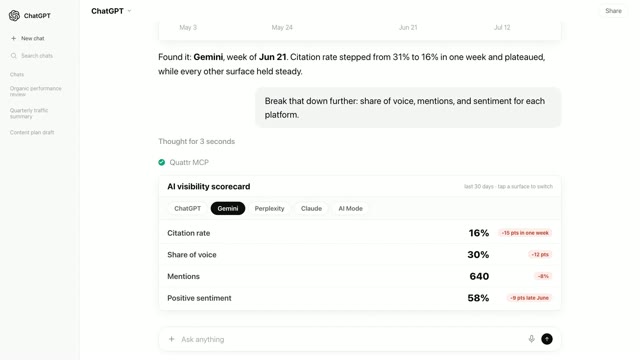 1 min 22 secYour next customer might never see a results page.AI visibility · AI visibility pulse◐Recreated from an anonymized session
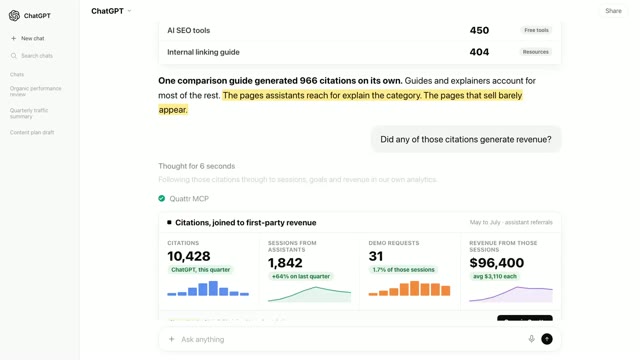 1 min 55 secChatGPT cites us. Does any of it become revenue?AI visibility + Web analytics · Search to revenue◐Recreated from an anonymized session
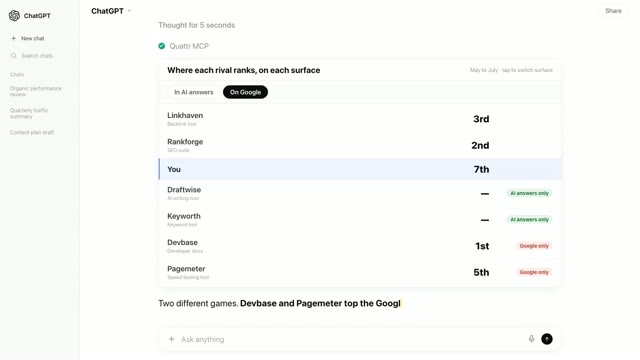 2 min 27 secYou know who beats you on Google. AI search has a different list.AI visibility + Rank tracking · AI vs traditional gap◐Recreated from an anonymized session
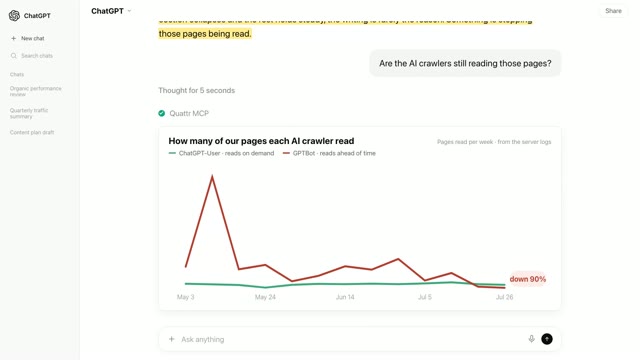 2 min 8 secYou cannot be cited by an AI that never read your page.Server logs + AI visibility · AI crawler readiness◐Recreated from an anonymized session
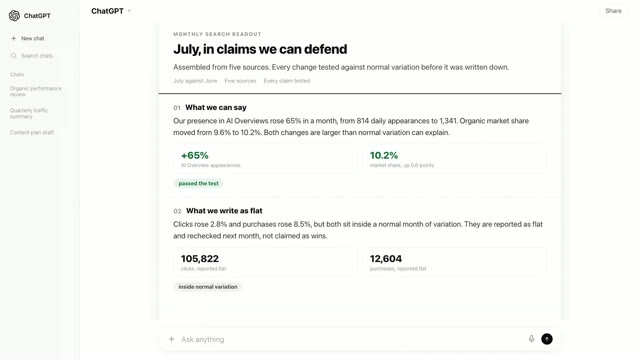 2 min 18 secThe deck is due tomorrow. The numbers live in five places.Search Console + Rank tracking + AI visibility + Web analytics + Google Ads · Monthly exec review◐Recreated from an anonymized session
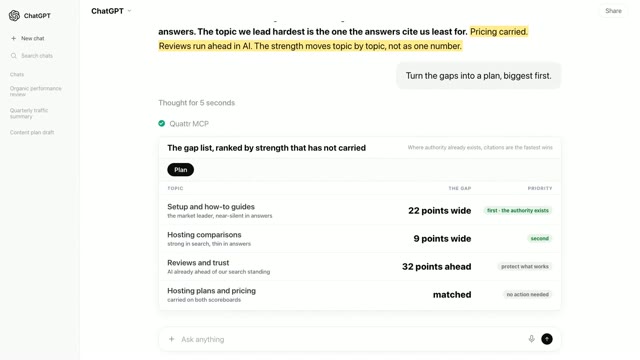 2 min 17 secYou won Google. The AI answers are being written without you.Rank tracking + AI visibility · AI prompt coverage gaps◐Recreated from an anonymized session