

Key Takeaways
- The phrase has a traceable origin. Adobe used “agentic search optimization” as a named category when it closed its Semrush acquisition on April 28, 2026, grouping SEO, GEO, and ASO in the announcement. The thing it describes was already underway; the label is a packaging decision.
- One word separates two different jobs. “Agentic SEO” usually means software that runs your optimization for you. “Agentic search optimization” means getting found and chosen by software that’s running an errand for someone else. They get sold under nearly the same name. This is about the second.
- A distinction I’d offer, not one anyone has settled: agents read and compare a lot of brands, but can only buy from a few. Comparison touches B2B and services right now. Purchase is concentrated where the checkout protocols actually run.
- A good deal of what’s marketed as an ASO method is just data hygiene with a new label. Complete structured data, content a crawler can read, an intentional robots.txt, and one canonical version of your brand. Worth doing. Mostly not new.
- The measurement story rhymes with the AI Overviews one. The hand-off to an agent happens somewhere you can’t instrument, so the usual analytics go quiet. No first-party “agent visibility” dashboard exists yet that I’d trust, and I’d be wary of anyone selling one.
On April 28, 2026, Adobe announced it had completed its acquisition of Semrush. Tucked into the announcement was a now-three-part list of what brands have to optimize for: search engines, large language models, and agents, SEO, GEO, and ASO. The first two had been in circulation for a while; the third had not been a fixture in many marketing plans before that week. So before “ASO” sets into a checklist somebody charges you for, it’s worth pinning down what it actually points at, who has to care, and which moves hold up under scrutiny.
Where does the term Agentic Search Optimization come from?
A corporate press release, not an academic preprint or a platform’s developer docs. Adobe’s Semrush announcement put the acronym in front of a very large enterprise audience at once, and a fuzzy idea picked up a fixed label almost overnight. Semrush, now an Adobe company, carries the same framing in its own description.
What the label sits on top of is older than the label. The pieces that make agent-driven buying possible were being assembled through late 2025 and into 2026. The Agentic Commerce Protocol, the open standard OpenAI and Stripe maintain for letting an agent complete a purchase, published its first dated spec on September 29, 2025, and has shipped revisions roughly every few weeks since; it’s still marked beta. Google and Microsoft pushed their own agent-payment and checkout efforts into the market over the same stretch. None of that infrastructure waited for the word “ASO.” The word showed up afterward to name work that was already happening.
That order of events is the useful part. The protocols are public, dated, and checkable. The acronym is a convenience, a real one, but a convenience. Keep the two separate when someone quotes you a number.
“Agentic” is doing two jobs
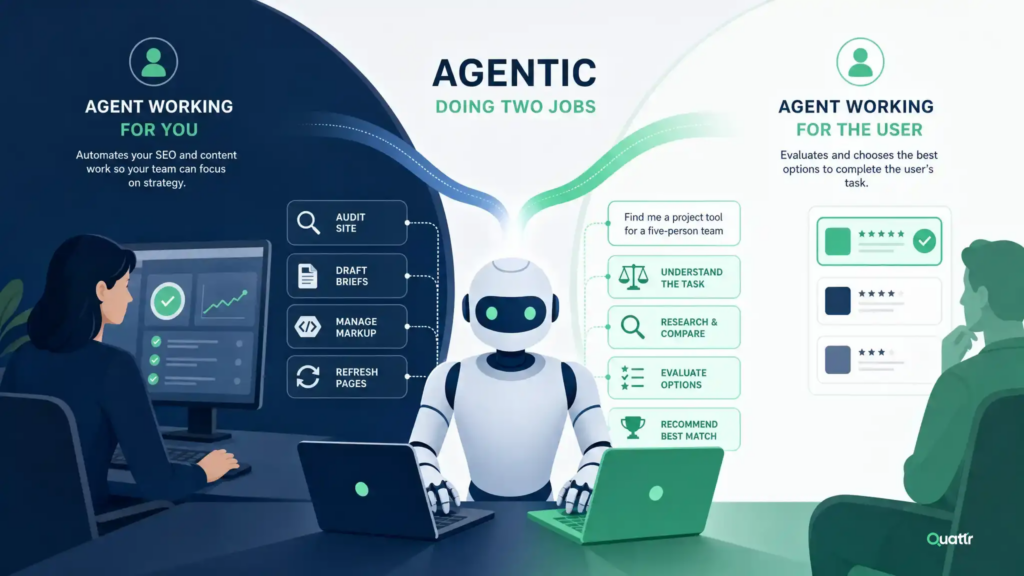
The bigger source of confusion is that “agentic” gets attached to search in two ways that point in opposite directions.
In the first, the agent works for you. These tools audit your site in a loop, draft briefs, manage markup, and refresh pages without a person having to do each step. That’s a story about your team’s workload.
In the second, the one Adobe’s framing is pointing at, the agent works for the user, and it’s evaluating you. Someone hands an assistant a task (“find me a project tool for a five-person team,” “book this,” “shortlist three vendors”), and the assistant goes off, weighs the options, and decides what to put forward. You’re not holding the tool here. The tool is sizing you up, possibly without your ever seeing a request hit your logs.
This piece is about the second. The gap between them isn’t academic: in one, you’re the operator, in the other, you’re the thing being judged.
Watch one agent actually do this
Ask ChatGPT for a project tool for a five-person team, and it doesn’t return ten blue links; it reads structured data and reviews across a set of vendors, weighs them against the constraint you gave (“five people,” “budget”), and hands back a short list with reasons. You either made that list or you didn’t. If your pricing page renders only after scripts run, or your product markup is vague about team size and seat limits, the agent has nothing firm to reason over and quietly moves to a competitor that does. No request hit your logs. You just weren’t in the shortlist.
The clearest real-world version of the inverse is Amazon. After ChatGPT’s shopping research launched, Amazon updated its robots.txt to block OpenAI’s crawlers, all three of them, making roughly 600 million product listings invisible to ChatGPT Shopping. For Amazon, that’s a deliberate walled-garden bet, protecting a $56 billion ad business.
For everyone without Amazon’s leverage, it’s the cautionary version of move three: block the wrong line in robots.txt and you remove yourself from the surface that was about to cite you.
![ChatGPT explaining OpenAI's three crawlers — GPTBot, OAI-SearchBot, and ChatGPT-User — and what each one controls. (ChatGPT, [model], [date].)](/wp-content/uploads/2026/06/image-8-1024x548.png)
Who actually has to care
Here’s a framing I’ll put forward as mine rather than dress up as a settled fact, because I haven’t seen anyone establish it cleanly: agents read and compare far more brands than they can buy from, and the two keep getting blurred together.
Comparison is the wide part, and it’s live now. Ask an assistant to weigh software options or vet a supplier, and it’s pulling sources, lining you up against rivals, and deciding whether you make the shortlist. That reaches well beyond retail into B2B, SaaS, and professional services, where nobody is “checking out” in a chat box, but selection is clearly happening. If your category involves people comparing options before they commit, you’re already inside that loop.
Purchase is the narrow part. An agent can only finish a transaction where the commerce rails actually reach, which today means the categories wired into standards like ACP and the competing checkout efforts, concentrated in retail and a handful of consumer verticals. I’m deliberately not going to quote you a market-size forecast or a per-industry adoption percentage here; the numbers in circulation come from competing analyst models that don’t agree with each other, and picking one to sound precise would be exactly the kind of false confidence this space is full of.
The practical read: if you sell physical goods or bookings, the transaction layer is your near-term question. If you sell software or expertise, the comparison layer is the quieter, earlier-arriving of the two.
Agent visibility is only partly measurable
Anyone who’s read our pieces on AI Overviews or Siri knows the recurring line: a surface you can’t see yourself on is a surface you can’t manage. ASO inherits that, and arguably makes it worse.
Classic e-commerce handed you everything: impressions, clicks, time on page, cart adds, and where people fell out. When an agent mediates, the part you can watch may not begin until late in the process, because the discovery and the comparison run inside a model you don’t instrument. The questions that matter turn unfamiliar: did you show up at all, were you the lead suggestion or a line near the bottom, how often do you appear next to a named competitor, and is your product data complete enough that an agent trusts it? Sensible questions. None of them has a mature, first-party readout yet. Treat a vendor promising a tidy “agent visibility score” the way you’d treat a Siri playbook today, a guess with an invoice attached.
Four moves that hold up
Strip away the framing, and most “ASO strategy” is data hygiene. I don’t mean that dismissively. The hygiene matters more now precisely because there’s no human on the other end to look past a thin product page. An agent won’t look past it. It reads the structured data and keeps moving.
Four moves are defensible this week, and none of them needs a new platform:
Get your structured data complete and correct.
Product, Offer, Organization, and Author markup is how an agent works out what you sell and who stands behind it. The thing that quietly costs you is incompleteness, stock that says available when it isn’t, attributes too vague to answer a basic “will this work for me” question. Completeness beats cleverness here.
Serve content the crawler can actually read.
If your page only assembles itself after scripts run in a browser, a fair number of agents won’t see what’s there. Rendering that content server-side or pre-building it isn’t an optimization anymore; it’s the floor.
Go through your robots.txt on purpose.
Make sure you haven’t reflexively shut out the crawlers that feed agent answers. A lot of sites blocked every AI bot in a wave of caution and, in doing so, removed themselves from the surfaces that might have cited them. Decide each line deliberately rather than by default.
Give agents one canonical version of you.
When two products or two companies share a name, an agent needs a single authoritative source to tell them apart and trust the result. Keeping your identity consistent across your own site and the major reference points is unglamorous, and it’s often what decides whether an agent is sure enough to put you forward.
That’s most of the real list. The newer levers people are excited about deserve attention but not your budget yet, they’re early, their effect on whether you actually get cited is unproven, and anyone calling one of them the single biggest win in ASO right now is ahead of the evidence. File them under ‘watch closely,’ not ‘act now.’
SEO, GEO, and ASO: Difference
The three aren’t rival strategies you choose between; each rests on the one before it.
| Layer | Optimizes for | Who’s judging you | Live now? |
|---|---|---|---|
| SEO | Search engines rank links | A ranking algorithm | Yes, mature |
| GEO | Generated answers citing you | A model writing a response | Yes, emerging |
| ASO | Agents acting for a user | An agent comparing or buying | Comparison yes; purchase narrow |
SEO still earns the authority to be read by an agent. GEO still shapes how you turn up in a generated answer. ASO extends both into the moment an agent acts on someone’s behalf. None of them retires the others, which is why “ASO replaces SEO” is the wrong read.
Two open questions worth keeping open
It’s tempting to cast ASO as the thing that replaces SEO and GEO. I wouldn’t. The more credible read, and the one Adobe’s own three-tier picture implies, is that each layer rests on the one before it. SEO still earns the authority to be read by an agent. GEO still shapes how you turn up in a generated answer. ASO extends both into the moment an agent acts on someone’s behalf. None of them retires the others.
Two genuinely open questions are better left open than papered over. The competing commerce standards haven’t resolved into a winner, so betting your whole stack on one is a wager, not a best practice. And early agent-referred activity is easy to over-read: big percentage swings off a small starting base look more decisive than they are.
The teams that come out ahead won’t be the ones holding the longest list of ASO tactics. They’ll be the ones who can tell the difference between comparison and purchase, know which one their business actually faces first, and do the unglamorous data work that feeds both, while keeping the honestly open questions open instead of filling them with confident guesses.
What to do next
Three things, none of them heavy.
First, determine whether your near-term exposure is to comparison or purchase, and put your effort there. A SaaS company and a household-goods brand do not have the same ASO problem.
Second, run the four-point hygiene pass, complete markup, ensure readable rendering, implement a deliberate robots.txt, and establish one canonical identity. Most of what gets sold as strategy collapses back into these.
Third, tell your stakeholders plainly that agent visibility is only partly measurable for now, so nobody anchors a forecast to a dashboard that doesn’t exist yet.
See where you stand on the surfaces you can measure. Quattr’s AI Search Visibility platform tracks citation share, mention coverage, and brand gaps across AI Overviews, ChatGPT, and Perplexity, so the measurable surfaces stay measured while the agentic ones settle.
FAQs on Agentic Search Optimization
Agentic search optimization is the practice of getting your brand found and chosen by AI agents that are completing tasks on someone’s behalf, comparing vendors, using shortlisting tools, or making a purchase. Unlike SEO (optimizing for search engines) and GEO (optimizing for generated answers), ASO targets the moment an agent acts for a user. The term entered wide circulation through Adobe’s April 2026 Semrush acquisition announcement, which grouped SEO, GEO, and ASO as the three layers brands must optimize for.
They sound nearly identical but describe opposite jobs. “Agentic SEO” usually means software that runs your optimization for you, auditing your site, drafting briefs, and managing markup automatically. “Agentic search optimization” means getting found and chosen by software running an errand for someone else, where the agent is evaluating you rather than working for you. In the first, you’re the operator; in the second, you’re the thing being judged.
Yes, most likely the comparison layer rather than the purchase layer. Agents read and compare far more brands than they can buy from. Comparison is live now across B2B, SaaS, and professional services, where an assistant lines you up against rivals and decides whether you make the shortlist, even though no checkout happens in the chat. Purchase is narrower, concentrated in retail and consumer categories wired into protocols like ACP. If people compare options before committing to you, you’re already in the loop.
Four moves hold up without buying a new platform: complete and correct structured data (Product, Offer, Organization, Author markup), so agents can tell what you sell and trust it; server-side rendered or pre-built content a crawler can read without running scripts; a deliberately reviewed robots.txt that doesn’t accidentally block the AI crawlers feeding agent answers; and one canonical version of your brand identity across your site and major reference points. Most of what’s sold as “ASO strategy” reduces to this data hygiene.
Only partly, for now. The discovery and comparison run inside a model you can’t instrument, so the hand-off happens where your usual analytics go quiet, much like AI Overviews. No mature first-party “agent visibility” dashboard exists yet, and a vendor selling a tidy “agent visibility score” is offering a guess with an invoice attached. The honest move is to tell stakeholders not to anchor a forecast to a dashboard that doesn’t exist.

Quattr is an AI-native Search Visibility Platform founded in Palo Alto, California, built for mid-market and enterprise brands competing in the age of generative search. Recently recognized across G2's Spring 2026 reports with #1 rankings in AEO Results, Usability, and Relationship, Quattr helps brands win visibility across traditional search and AI-generated answer surfaces.
Quattr's AI agent, GIGA, evaluates content the way AI systems do, identifying gaps across structure, authority, internal linking, and discoverability to surface the highest-impact fixes. With capabilities like autonomous internal linking, E-E-A-T intelligence, and the new GIGA Landing Page Generator for keyword-matched, AI-search-ready pages, Quattr helps teams move from diagnosis to deployed changes without manual bottlenecks.