









Quattr leads AEO, SEO, and content rankings on G2 Spring 2026. View our G2 badges →
Request demo
Request demo

Platform use cases

Use cases for growth in AI answers and search

For AI search growth, grouped by what you need: know where you stand, act on the site, prove what it returned, and the foundations under all three. Each use case names the problem and what Quattr does.

4.9/5on G2 · 67 verified reviewsG2 Users Most Likely To RecommendG2 Best Usability
  • Bluehost
  • Simpplr
  • Coursera
  • Gaylord Hotels
  • Housing.com
  • Men's Wearhouse
  • Eightfold.ai
  • HostGator

Know · 9 use cases

Where you stand in AI answers and search

Before anyone changes a page: where you appear in AI answers and in search, who wins instead, why the numbers moved, and which work is worth the most.

  1. Where you appear in AI answers
  2. Who is cited instead of you
  3. AI Overviews on your keywords
  4. Why traffic changed
  5. Your market share against rivals
  6. Where the opportunity is
  7. Technical issues costing clicks
  8. Demand you are missing
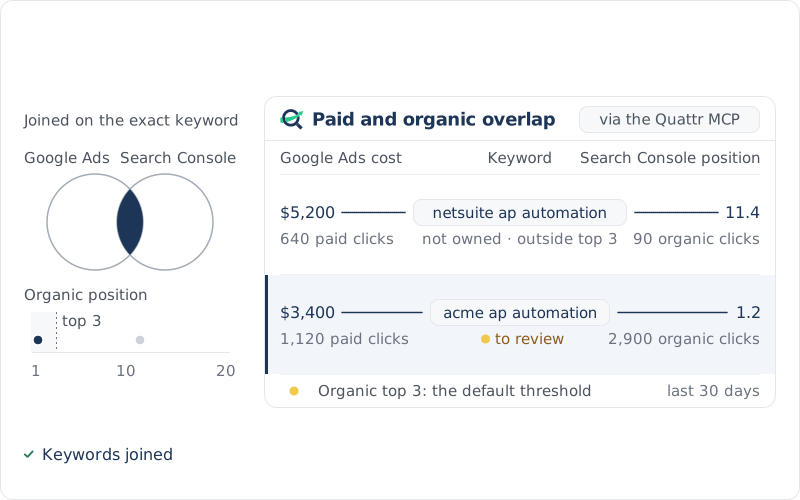
  9. Paid terms you already rank for

Where it stops

Tracker prompts come from you, and AI visibility history starts with a tracker's first run.

Know · 1 of 9

See where AI answers mention and cite you

“Buyers ask AI assistants about our category, and we can't see whether we're in the answer.”

What Quattr does

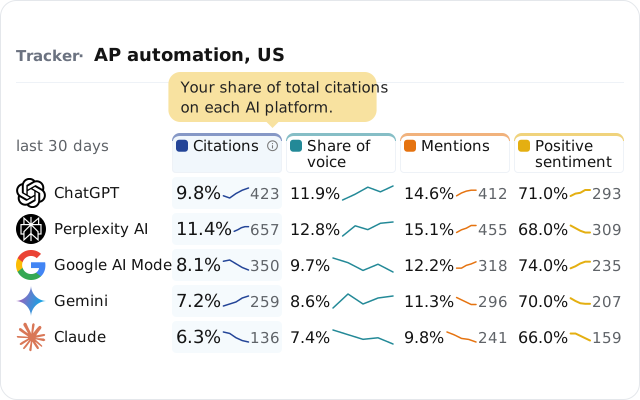
AI Visibility trackers run the prompts you upload or type on the AI surfaces you select, by country and device, on the schedule you set. Each run reports Citations, Share of Voice, Mentions and Positive Sentiment for you and your competitors, by topic, intent and country.

AI Visibility: Citations by platform for one tracker, last 30 days

Know · 2 of 9

See who AI answers cite instead of you

“A competitor keeps showing up in AI answers for our category, and we don't know why.”

What Quattr does

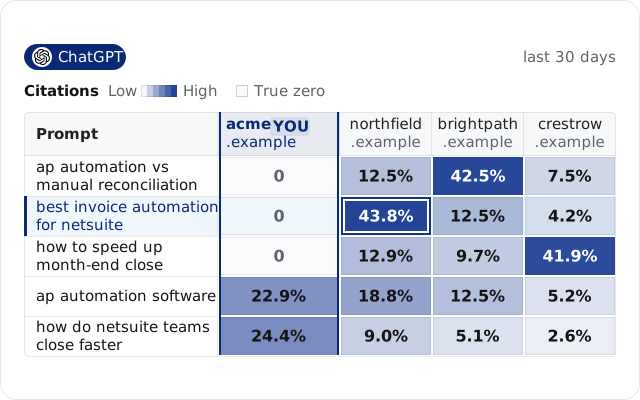
The prompts view lays your prompts against the domains cited in their answers, the cited-URL view names the competitor pages that earn each citation, and each run's full answer can be read with its sources and exported. In your own AI tools, the Quattr MCP turns each prompt where you are missing into the content angle to write for it.

AI Visibility: ChatGPT prompts by domain, heat map

Know · 3 of 9

Track AI Overviews on keywords you rank for

“AI Overviews now sit above our best rankings, and we can't see how often.”

What Quattr does

Competitive Trends reports AI Overviews inclusion on the keywords your rank trackers run, with a daily page count and your visibility against competitors. In your own AI tools, the Quattr MCP reads AI Overviews search market share by segment.

Know · 4 of 9

Find out why traffic changed

“Organic clicks fell last week, and leadership wants to know why by Friday.”

What Quattr does

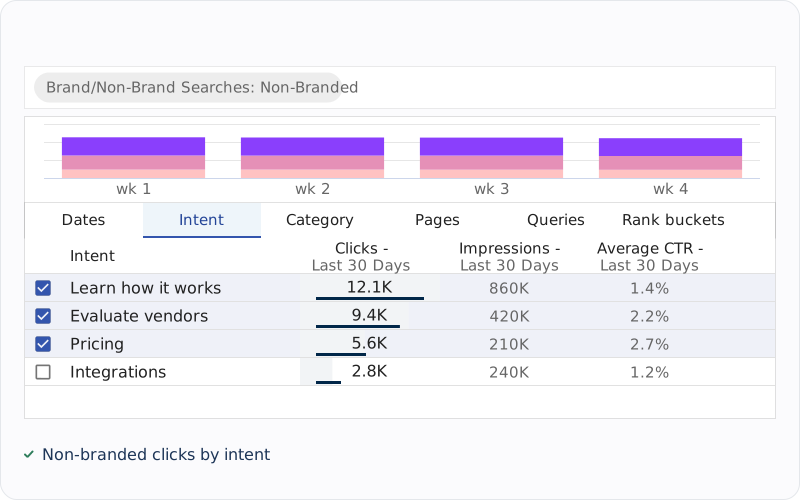
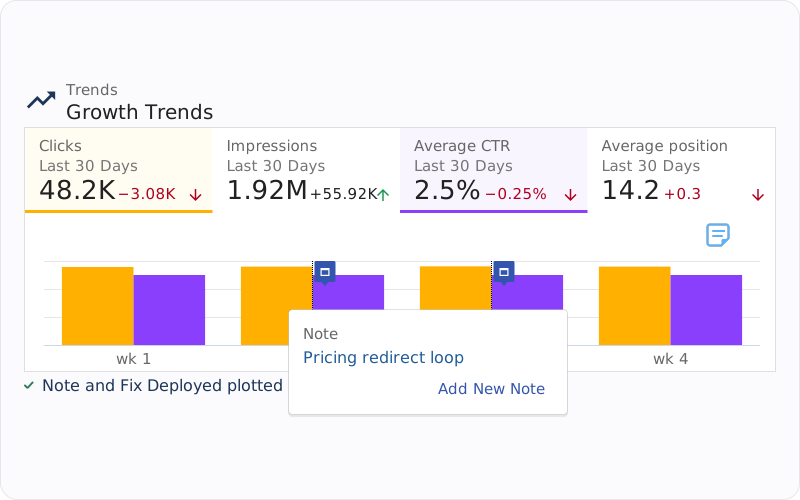
Growth Trends compares the period with the one before or last year and drills the change by your intents, categories, rank, country or device. Notes and Fix Deployed events sit on the same trend, so your team can name the cause.

Growth Trends: non-branded clicks drilled by intent, three intents stacked

Know · 5 of 9

Track search market share against named rivals

“We know our rankings. We don't know whether we're gaining on the three competitors that matter.”

What Quattr does

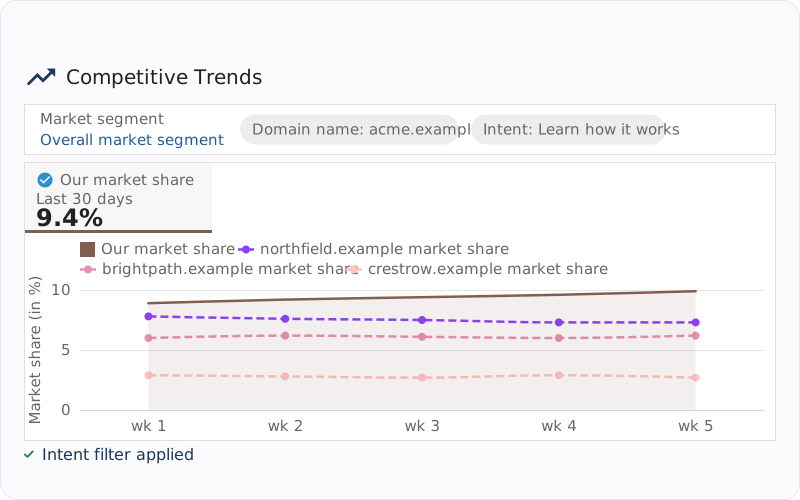
Rank trackers run your keywords by country and device on the schedule you set, daily by default, against up to 10 competitors you name. Competitive Trends models search market share from those positions, by intent, category, country or device; it is modeled from rank, never measured traffic.

Competitive Trends: acme.example leads its tracked rivals in one intent

Know · 6 of 9

Rank pages and keywords by clicks at stake

“We have thousands of pages and keywords, and no order for which to work on first.”

What Quattr does

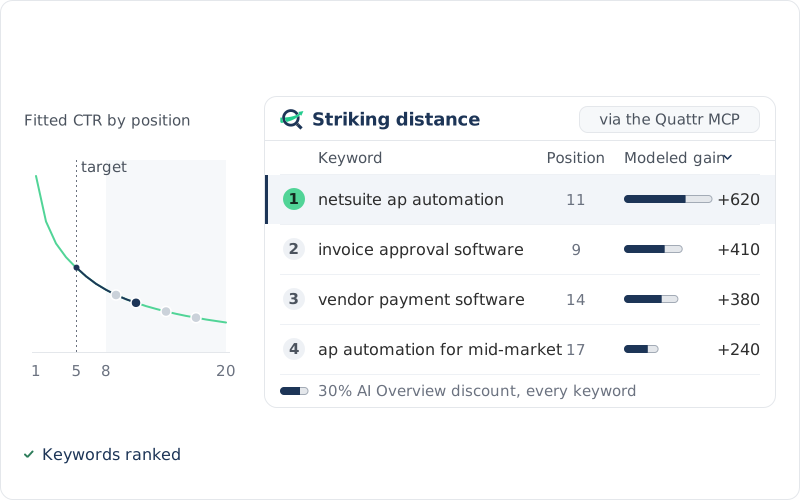
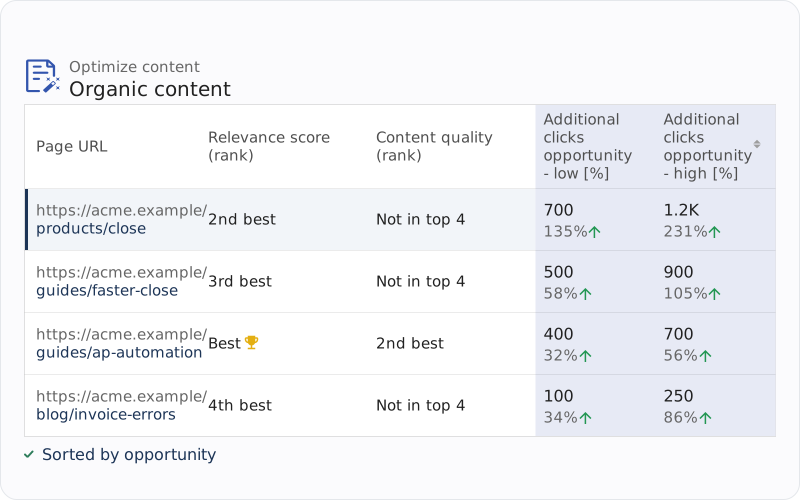
Optimize Content ranks pages by Additional Clicks Opportunity, shown as a low-to-high range, never a point estimate. Through the Quattr MCP, striking-distance keywords are sized on your own site's click-through curve, with a 30% AI Overview discount by default.

Quattr MCP answer: four striking-distance keywords ranked by modeled gain

Know · 7 of 9

Find the technical fixes that cost clicks

“Our site audit lists thousands of issues, and engineering will fix a handful this quarter.”

What Quattr does

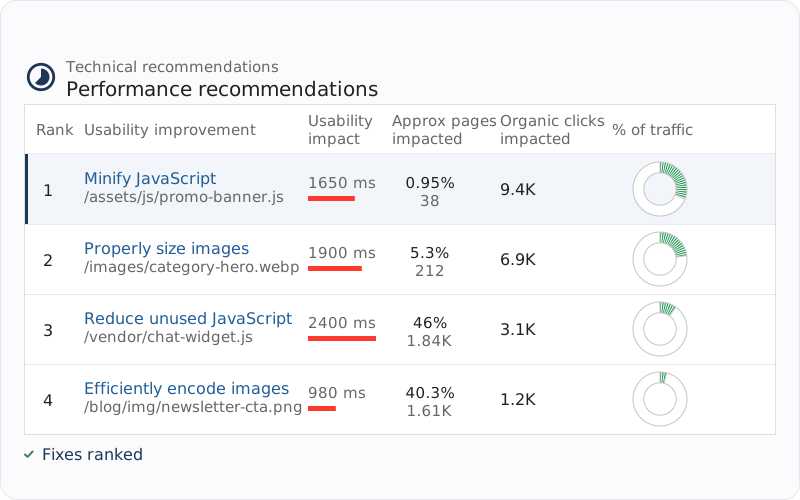
Technical Recommendations ranks Lighthouse findings by usability impact and the organic clicks each fix touches, and filters them by category. Site speed trends by category and device, and crawl outcomes URL by URL, show where to look.

Technical recommendations: four Lighthouse fixes in traffic-weighted rank order

Know · 8 of 9

Find the topics competitors lead

“Competitors rank for whole topics where we have no page at all.”

What Quattr does

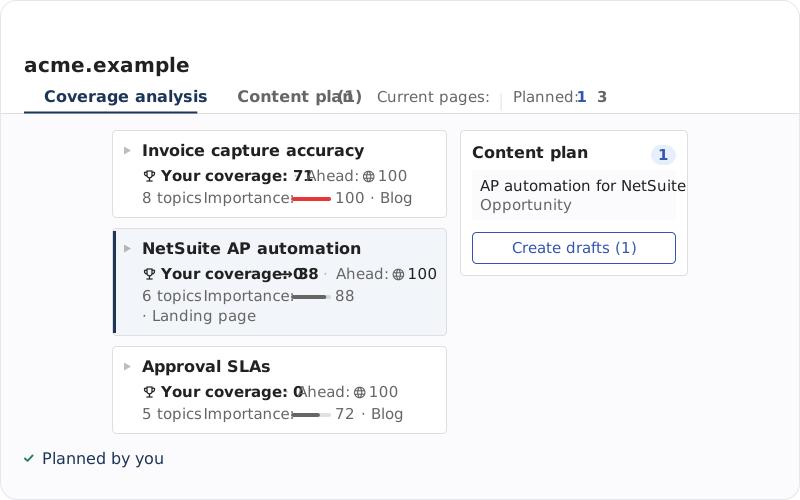
Content Ideas groups a keyword set into themes and shows your coverage and who is ahead. Page Workflow lists the keyword clusters rival pages rank for that your page does not target.

Content ideas: a landing page planned for the theme a competitor leads

Act · 7 use cases

Make the change on your site, with approval

Improve and create pages, link the whole site, get fixes shipped and reorganize your categories. Quattr prepares the work; your team approves what goes live.

  1. Improve the pages you have
  2. Create the pages you are missing
  3. Write what AI answers draw on
  4. Link the site, with control
  5. Review and publish with approval
  6. Ship the fixes that matter
  7. Reorganize your categories

Where it stops

Analysis in your own AI tools is read-only; changes are made in the platform, with approval.

Quattr ranks technical fixes and tracks them; your team ships them.

Act · 1 of 7

Improve the pages you already have

“We keep publishing new pages while the ones that already rank slowly lose ground.”

What Quattr does

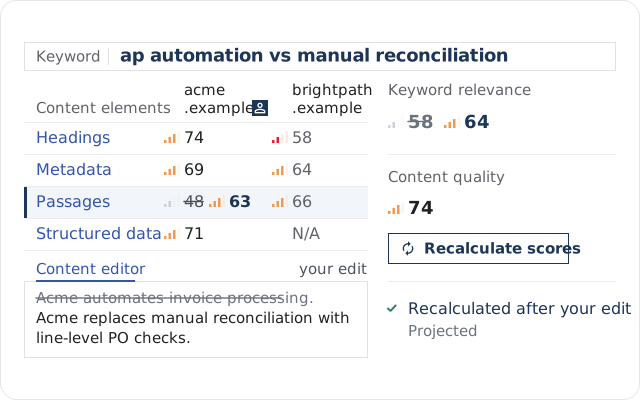
Optimize Content picks the page by the clicks at stake, and the Guided Editor scores each element against competing pages and drafts rewrites your team accepts. Start with what you already have, because refresh outruns net-new.

Organic content: pages sorted by additional clicks opportunity, high end

Act · 2 of 7

Create pages in your brand and design system

“We know which pages we need, and our team can't build them fast enough.”

What Quattr does

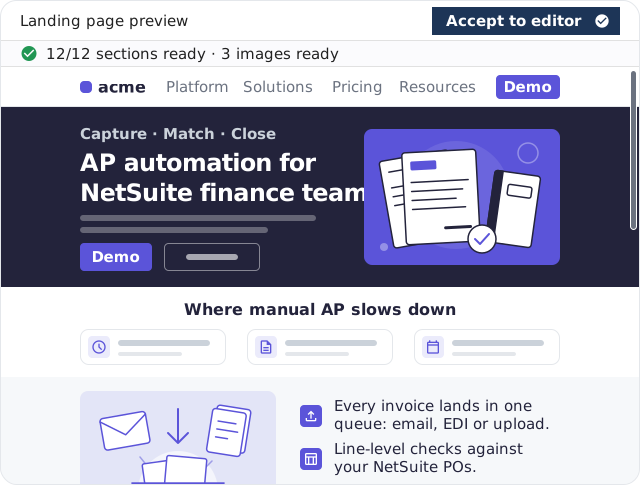
GIGA drafts pages from your plan in Content AI, and the Landing Page Generator (early access) builds a landing page from a sourced research brief, a section library and your saved design system. Your team accepts every page into the editor; nothing publishes on its own.

Products and capabilities

Men's Wearhouse: 10x stronger day-30 clicks on GIGA-launched pages. Read the Men's Wearhouse customer story

GIGA-touched pages earned 70% more traffic than held-out pages (internal holdout test, 2025).

Landing page preview: acme's finished page, 12 sections and 3 images ready

Act · 3 of 7

Shape the passage AI answers draw on

“We know which prompts we're missing from, but not what to change on the page.”

What Quattr does

The Guided Editor re-scores a passage against the competing page an AI answer cites, and what AI cites becomes a list of what to change or create next. In your own AI tools, a citability read explains, factor by factor and without a score, what holds one page back.

Guided editor: one passage edit, re-scored against a competing page

Act · 5 of 7

Check every page before it ships

“Legal, brand and SEO each need to sign off, and drafts stall in email threads.”

What Quattr does

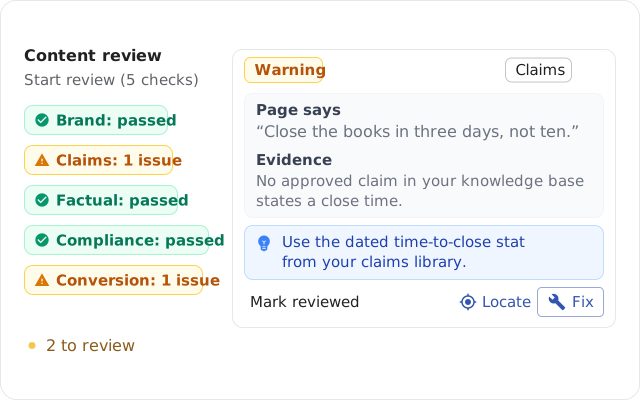
Content Review checks brand consistency, claims, factual accuracy, compliance, conversion and E-E-A-T with the evidence behind each finding, and your team's claims rules apply as the page is written. Accept and publish are restricted to approvers; a CMS publish offers a Preview, and a rollback restores an earlier version and republishes it.

Content review: a claims finding quoted with its evidence, 2 to review

Act · 6 of 7

Get the fixes that matter shipped and marked

“Engineering ships SEO fixes, and three weeks later nobody can say which ones landed.”

What Quattr does

Each recommendation carries a status (New, In Progress, Fix Deployed, Not Feasible, Not an Issue), and Quattr detects a fix when the issue has been absent from scans for 10 days. Fix Deployed marks your Growth Trends chart, so the trend shows when each fix landed.

Growth Trends: a note at wk 2 and a Fix Deployed event at wk 3 on one trend

Act · 7 of 7

Redesign your categories while reports keep running

“Our categories were set up years ago, and a migration broke half of them.”

What Quattr does

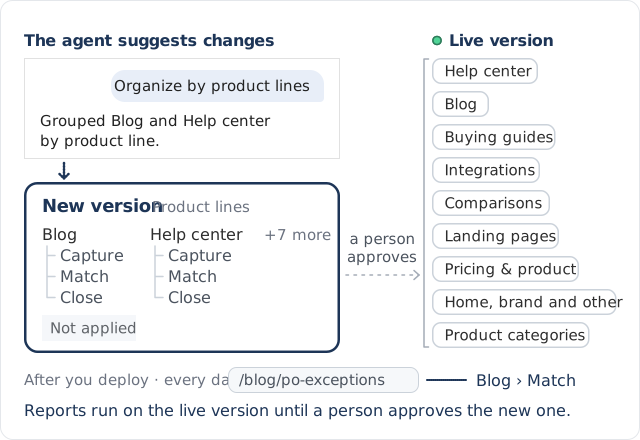
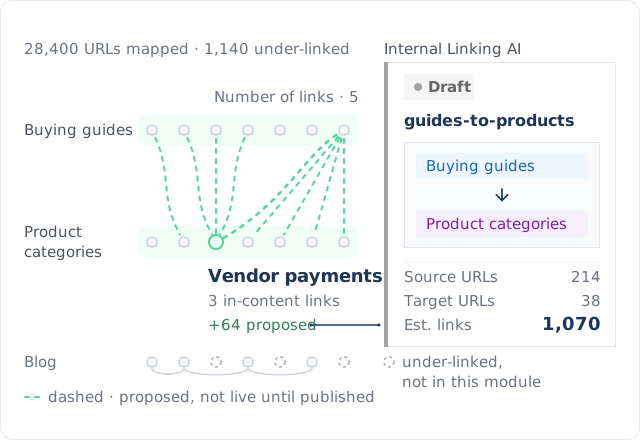
In a chat, Taxonomy Designer's AI agent drafts a new version of your categories while the current ones keep serving every report. The new version waits for a person: applying shows the busiest pages that would move, asks before changing pages set by hand and can be undone until Deploy Changes runs; then new pages are placed every day.

Products and capabilities
Taxonomy Designer is turned on per account. Your admins with Taxonomy Designer access apply and deploy designs themselves.

The agent's new taxonomy version beside the live one

Prove · 6 use cases

Show what the work returned

After the work ships: whether it moved anything, whether the change is real, how it tracks against plan, and what search and AI answers returned.

  1. What the work moved
  2. Real change or noise
  3. Plan against actual
  4. Search and AI to revenue
  5. One monthly readout
  6. How each number is measured

Where it stops

A saved comparison shows the difference. It does not claim the lift.

Significance tests run in your own AI tools.

Prove · 1 of 6

See whether the work moved anything

“We shipped rewrites, links and fixes, and can't tell which ones moved anything.”

What Quattr does

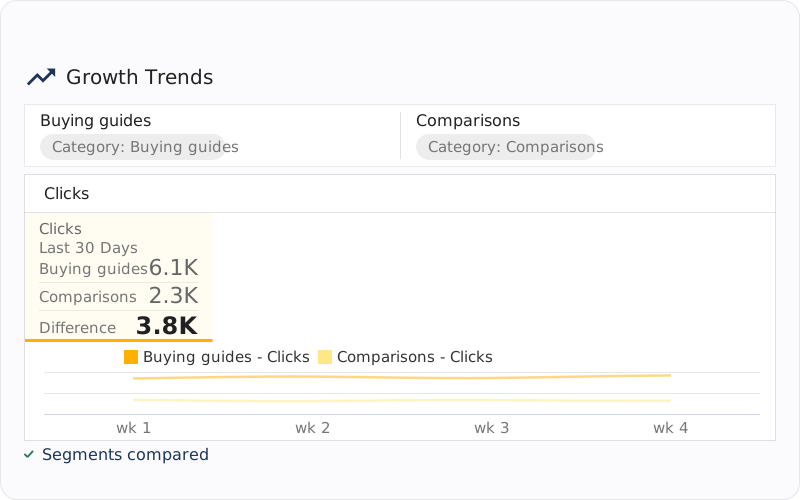
Published Changes and Fix Deployed events mark the trend on the day a recommendation's status changes, and your notes sit beside them. A saved comparison charts the pages you changed against the rest with a Difference tile; it shows the difference and does not claim the lift.

Growth Trends: two saved segments side by side, with the Difference in clicks

Prove · 2 of 6

Test whether a change is real

“Every dip starts a fire drill, and half of them turn out to be nothing.”

What Quattr does

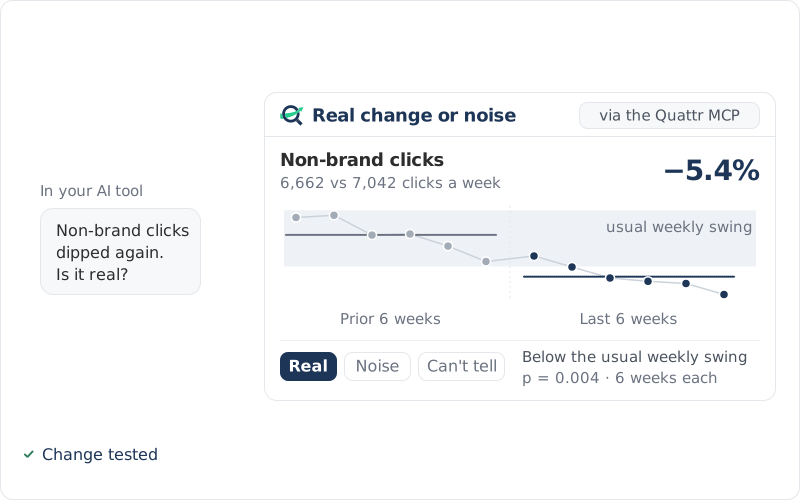
In your own AI tools, the Quattr MCP tests a change for significance before calling it one, on search, analytics, search market share, paid, page experience and AI-citation reads. Each verdict reads real, noise or can't tell, with the test's power taken into account.

Quattr MCP answer: a dip in non-brand clicks tested and read as real

Prove · 3 of 6

Plan the opportunity, then track actual clicks

“We promised leadership a number in January and need to show where we stand.”

What Quattr does

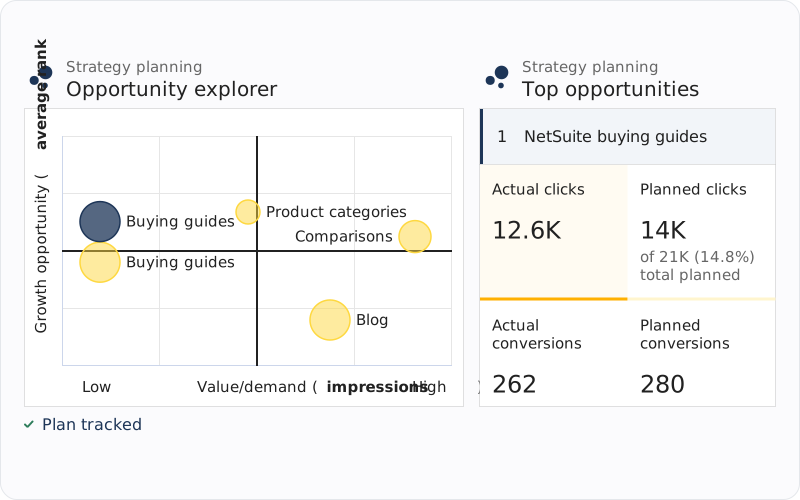
Opportunity Explorer maps opportunities by category: you set a rank target, and Quattr derives projected clicks and conversions you can edit. Top Opportunities tracks Planned Clicks against Actual Clicks, with no dollar figure.

Opportunity Explorer and Top Opportunities: a rank target set, then tracked

Prove · 4 of 6

Read search and AI visits through to revenue

“Finance asks what search returned this quarter, and AI answers are part of that question now.”

What Quattr does

Growth Trends reports conversions for up to 10 named goals from your analytics, and Google Ads conversions stay separate from them. In your own AI tools, the Quattr MCP reads citations beside AI-referral sessions and conversions, and search impressions through to goals and revenue.

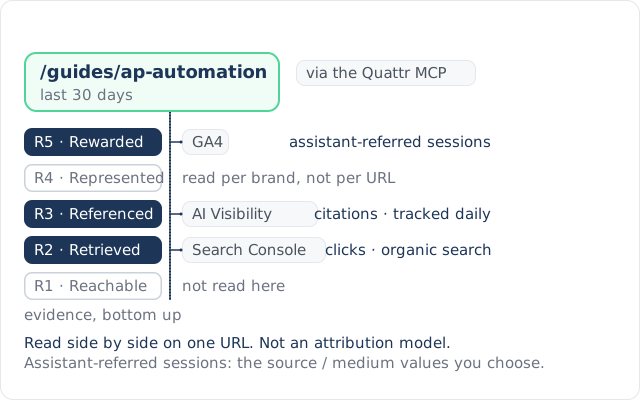
Quattr MCP: one acme.example URL read on three rungs of evidence

Prove · 5 of 6

Give leadership one readout that holds up

“The board wants to know what search returned this quarter, in numbers it trusts.”

What Quattr does

In your own AI tools, a monthly executive review reads market position, demand captured, AI answer standing and outcomes, and reports a change only once it passes a significance test. Looker dashboards put the same numbers in front of every team, on accounts with Ad-Hoc Analysis turned on.

Prove · 6 of 6

Know how each number is measured

“Two dashboards show two different numbers, and nobody can say which one is right.”

What Quattr does

Each metric has a published measurement reference, and each read carries its source and its freshness; when a source is missing, the read is refused with the reason. The method page sets out the five rungs and eight levers Quattr reads against.

The evidence ladder All four tools read R2

Where Search Console reads, what it assumes beneath, and what it cannot reach. Filled rungs are measured; hatched rungs are taken on faith.

  1. R5 Rewarded out of reach Nothing this source records reaches up here.
  2. R4 Represented out of reach Nothing this source records reaches up here.
  3. R3 Referenced out of reach Nothing this source records reaches up here.
  4. R2 Retrieved reads here Google retrieved the page into a results set. Impressions are Google's count of that, not yours.
  5. R1 Reachable assumed, not measured This source takes this rung on faith. Another one has to prove it.

A reading at any rung is only as trustworthy as the rungs beneath it. Every Search Console reading assumes the page was reachable. If a crawl or log answer says it was not, the impression data above is describing a different page than you think.

Foundations · 7 use cases

Your data, definitions and controls underneath

The data every read starts from, the categories and intents every report slices by, the knowledge every draft is written from, and who approves what ships.

  1. Your own data, freshness stated
  2. An AI agent for your taxonomy
  3. Your intents and brand split
  4. Your knowledge, brand and design
  5. Your AI tools, skills and agents
  6. Fits your stack
  7. Approvals and data handling

Foundations · 1 of 7

Work from your own data, dated

“Every tool shows a different number, because each one samples its own data.”

What Quattr does

Quattr reads your Search Console, analytics, Google Ads and server logs beside its own rank tracking, site crawl, AI visibility and Lighthouse observations, and each source has its own page. Every read carries its source and how fresh it is.

Products and capabilities
Search Console is self-serve; your analytics source is set up by Quattr.

From collection to answer

Origin event to answered card for Search Console, with the stage each stated limit attaches to.

  • lag enters
  • data leaves
  • modelling begins
  1. 01 A query runs on Google
  2. 02 Google's own aggregation and privacy thresholds
    • data leaves: Query rows are sampled and suppressed below a privacy threshold. The parts do not sum to the total.
  3. 03 Reporting lag
    • lag enters: 1 to 2 days behind, always stamped rather than assumed.
  4. 04 API or BigQuery read
  5. 05 Joined to your segments
    • modelling begins: Average position is a weighted average over impressions, not a rank you held.

Foundations · 2 of 7

An AI agent builds and runs your taxonomy

“Our site grows every week, and keeping its categories current is a project we never finish.”

What Quattr does

Taxonomy Designer is an AI agent built on Claude: describe your site in a chat and it builds a version-controlled classification model, then places new pages every day once your team approves it. The same categories slice Growth Trends, search market share and Opportunity Explorer, and feed GIGA, Autonomous Internal Linking AI and your own agents.

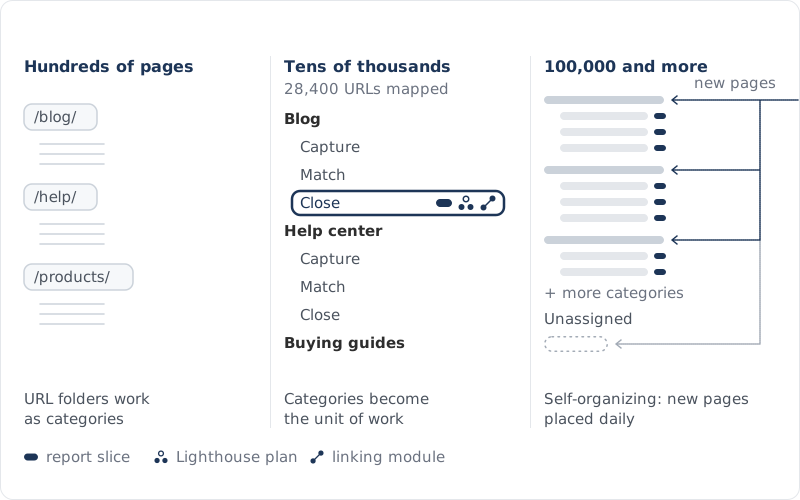
As the site grows

  1. Hundreds of pages URL folders work as categories, and a person can read every page.
  2. Thousands Folders stop saying what a page is about: /blog/ and /help/ hold every product line, so a report sliced by folder mixes them.
  3. Tens of thousands Categories become the unit of work. Lighthouse tests a few pages per category, and linking modules are defined by category, not page lists.
  4. 100,000 and more New pages arrive every day, and a deployed design classifies them automatically. Pages it can't place with confidence stay Unassigned: the unassigned share is the number to watch.

Large sites are designed from a sample spread across the site's sections, and the tree says so.

A page the design can't place with confidence, by what it is about or by a URL rule, stays Unassigned, so coverage won't be 100%.

Categories as a site grows from hundreds of pages to six figures

Foundations · 3 of 7

Group queries into your own intents

“Brand searches flatter our numbers, and our real topics don't match any tool's buckets.”

What Quattr does

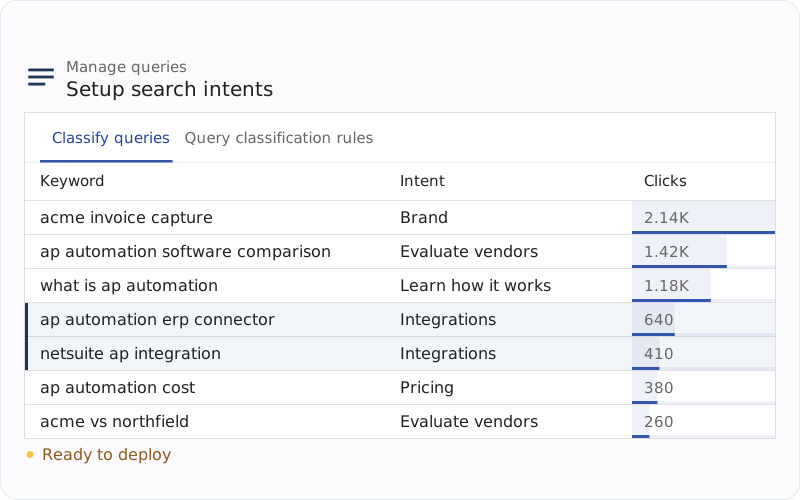
Search intents are your own keyword groups, built from labels and rules, and the Brand/Non-Brand filter splits every Growth Trends view. AI Visibility prompt topics map to the same keyword groups, so one intent reads across search and AI answers.

Manage Queries: two sample queries labeled Integrations, ready to deploy
Manage Queries: two sample queries labeled Integrations, ready to deploy The phone crop of acme.example's Manage Queries sample set: four sample queries with their intents. A person labels ap automation erp connector and netsuite ap integration with the existing Integrations intent, beside ap automation cost in Pricing and acme vs northfield in Evaluate vendors. The labels wait for Deploy, which retrains the model and reclassifies every existing and future keyword. Illustrative data for a fictional site, acme.example. Keyword Intent ap automation erp connector netsuite ap integration ap automation cost acme vs northfield Pricing Evaluate vendors - Integrations - Integrations Labeling samples Ready to deploy

Foundations · 4 of 7

Give every draft your knowledge and brand

“Generic AI drafts sound like everyone else and get our product details wrong.”

What Quattr does

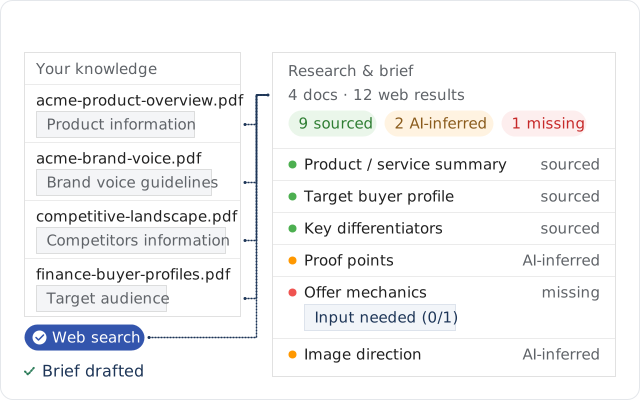
Context holds the knowledge bases, brand kits and page design systems you add, tagged by purpose, and every brief, draft and landing page is written from them. Your documents inform your work only, never training data.

Research & brief: a twelve-part brief drafted from your documents and the web

Foundations · 5 of 7

Run Quattr's analyses in your own AI tools

“Our analysts live in their AI assistant, and each one runs the Monday report differently.”

What Quattr does

The Quattr MCP and plugin bring Quattr's analyses into your own AI tools, read-only, with OAuth 2.1, permissions from your account, organization isolation and server-side audit logging. Skills run an analysis the same way every time, you schedule runs in the platform, and custom agents compose skills, governed MCP verbs and your Context.

Foundations · 6 of 7

Send the work where your teams already work

“Our reporting lives in Looker and our tickets live in Jira, and search work reaches neither.”

What Quattr does

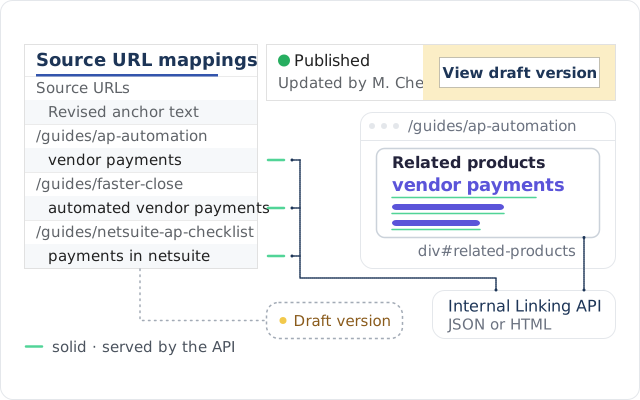
Internal links reach your site through the Internal Linking API as JSON or HTML, pages publish to your CMS, and Looker dashboards run on the same data through Ad-Hoc Analysis. Findings share to Slack and file to Jira, once each is set up for your account.

Internal Linking AI: published links served by the API while a draft waits

Foundations · 7 of 7

Choose who approves, and how data is handled

“Security will ask who can publish, what gets written where, and whether our data trains a model.”

What Quattr does

In Content AI, accept and publish are restricted to approvers, review gates can hold a page until its claims are resolved, and revision history keeps every version to restore. Analysis is read-only, nothing is written back to your analytics or ads accounts, and your data is not used to train models.

Operating controls

  • Roles & approvalsAccept and publish actions are restricted to approvers.
  • Review gatesClaims review can require resolution before Accept.
  • Claims & compliance rulesTeam rules apply at write time, not just at review.
  • Controlled contextYour documents inform this work only, never training data.
  • Revision history & restoreEvery accepted change is a version you can restore.
  • Design-system readinessBrand and Composition Kits refresh from your live site.

Use cases

4.9/5 on G2

Based on 67 reviews

  • G2 badge: High Performer, Enterprise
  • G2 badge: Best Usability
  • G2 badge: Best Support, Enterprise
  • G2 badge: Users Most Likely To Recommend
View our G2 badges

Bring one opportunity. See the whole system work it.

A real question, a page, a category, a market you want. Quattr brings together the context, the analysis, the prepared work, your review, and the measurement that follows.

Request a demo

No canned deck. No credit card. Your data stays yours.

or explore the interactive demo