Quattr Leads AEO, SEO, and Content Rankings on G2 Spring 2026.
Quattr Leads AEO, SEO, and Content Rankings on G2 Spring 2026.

Housing.com is one of India's leading online real estate platforms, part of REA India, the Indian arm of REA Group, a global digital property company. Operating as a two-sided marketplace, Housing.com connects property buyers, renters, and sellers nationwide. The platform serves millions of users with listings spanning residential purchases, rentals, and new housing projects, making organic search a critical acquisition channel for both buyers and sellers.
For a platform operating at programmatic scale, organic visibility is not just a marketing metric. It is the connective tissue between supply and demand. Every ranking gained or lost directly impacts listing exposure, lead generation, and marketplace liquidity.
Housing.com's SEO team partnered with Quattr to bridge the gap between search performance and executive communication. The team was already running a sophisticated programmatic SEO operation with dashboards, rankings data, and traffic reports. But leadership was not asking about rankings. They were asking whether Housing.com was winning.
That question required a fundamentally different measurement framework, one that could separate competitive performance from market-level forces.
THE CHALLENGE
When leadership asks, "How's SEO performing?" they are really asking: "Are we winning?"
Housing.com's SEO function was not underperforming. The team had built a mature programmatic engine, diligently tracked rankings, and reported traffic trends on schedule. Yet none of these metrics could answer the questions leadership actually cared about.
For a two-sided marketplace at programmatic scale, the real questions are harder.
1. Is growth happening because the market is expanding, or because Housing.com is taking share from competitors?
2. Is performance consistent through Google algorithm updates, or is volatility being masked by seasonal demand?
3. Are multiple URLs ranking on Page 1 and consolidating authority, or cannibalizing each other?
4. When traffic dips in a quarter, is it a competitive loss or a market-wide contraction affecting every player?
Without decomposing market demand from competitive share, leadership cannot distinguish between macroeconomic headwinds and competitive threats. A 10% decline in traffic might mean the team is losing ground, or it might mean the entire real estate search market contracted by 15% and that Housing.com actually outperformed. These are fundamentally different stories with fundamentally different strategic implications.
The challenge was compounded by the nature of the real estate search. A user searching for "2 bedroom apartments in Mumbai" has fundamentally different intent than someone searching for "new luxury housing projects in Mumbai." But they represent different market segments, funnel stages, and competitive dynamics.
Housing.com needed a framework to define the micro-segments that represent its actual competitive battlefield and to track those segments consistently over time, with continuous measurement that could detect shifts as they happened. The SEO team needed the right data tracked consistently.
THE SOLUTION
Housing.com deployed Quattr's Market Share Intelligence to transform how the team measured and communicated organic performance. Instead of reporting just rankings, the system gave the team a way to explain traffic trends in clear terms: is the market growing or shrinking, and is Housing.com gaining or losing its share of that market?
Quattr's Search Intent modeling engine starts with Google Search Console Bulk Export. It's layered on two things: a way to categorize every URL on the site by purpose, and a set of rules to generate training data for a classifier to group keywords by buyer intent.
This turned raw search data into strategically meaningful segments. Instead of looking at a single giant pool of pages or keywords row by row, Housing.com could now break performance down into these important segments.
The category describes the section of the programmatic website: Buy, Rent, or Commercial. Intent grouped the search queries that Google surfaces in Search Console based on what the searcher was actually looking for, such as "Flats for Sale with Pricing" versus "House for Sale in City." Beyond these, geographic dimensions added another layer of clarity. Keyword City captures the location the searcher typed into Google, such as "apartments in Pune." Page City captured the location embedded in the URL, such as a listing page targeting Mumbai.
With this taxonomy in place, the team could isolate performance across business lines. Each segment had its own competitive dynamics, demand patterns, and strategic priority.
Quattr's approach created a continuous signal that updated daily. With over 18 months of baseline data accumulated, the system became predictive. When extended with forecasting models like Google TimesFM, the team could understand trends proactively.
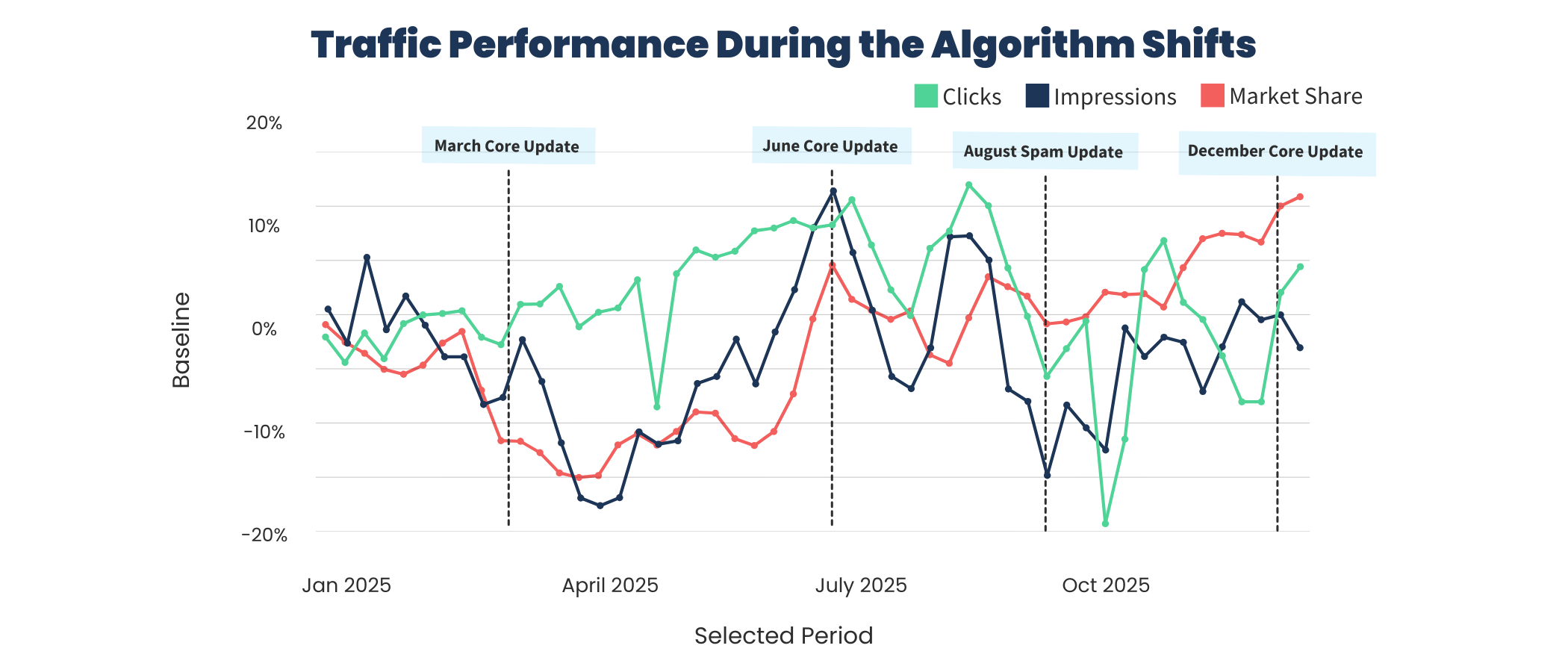
Quattr's Market Share Intelligence helps explain traffic trends by layering competitive visibility on top of their GSC clicks and impressions. The same set of keywords is tracked over time and weighted by demand to measure the market share. Algorithm update annotations on the timeline also help validate experiments and assess how competitor tactics perform through each update cycle.
One pattern that emerged from these annotations was that deploying net-new pages at scale without controls could pose a cannibalization risk, as those pages may not be rewarded in subsequent algorithm updates.
THE RESULT
The value of Quattr's Market Share Intelligence is in connecting real demand signals with competitive visibility.
When clickstream data from platforms like GA4 indicated softening sessions, Quattr separated demand contraction from competitive capture. Across the tracked non-brand keywords, Housing.com's relative share of visibility grew by 12.8%, while two key competitors lost 0.3 and 0.6 percentage points, respectively.
This was targeted competitive growth: demand down, clicks compressed, but Housing.com was taking a larger slice of what remained and identifying net-new segments to track going forward.
Quattr's daily tracking enabled the Housing.com team to read algorithm changes quickly. When Google rolled out updates, most teams waited weeks for data to stabilize before concluding. Housing.com's team could see patterns forming within days. One critical insight emerged: having multiple URLs ranking on Page 1 for the same set of searches was showing diminishing returns. More pages were not producing more clicks.
Based on this signal, Housing.com pivoted. Instead of continuing to publish as many new URLs as possible, the team doubled down on improving the structure and quality of existing pages, strengthening the site's organization, internal linking, and the content structure of each programmatic landing page.
When algorithm updates happen, the SEO team can now show leadership within a day that a decline is impacting every player in the category, not just Housing.com. The conversation shifts from alarm to focus: which tactics are winning and losing in internal testing, and what are competitors doing differently?
The SEO function at Housing.com evolved into an intelligence function that could explain exactly what was happening in the market, why, and what to do about it. Competitor movements, whether expanding their page count or consolidating their authority into fewer URLs, became clear signals explained by Quattr's Market Share and Intent Modeling.
Year-over-year, Housing.com's monthly Market Share grew by 12.8%, while a priority competitor's monthly Market Share dropped by 10.1%. These shifts were small in absolute terms but significant in what they revealed about competitive momentum, as Housing.com's pages gained visibility in segments previously dominated by that competitor.
The SEO function evolved from reporting what happened to explaining why it happened and what to do about it. Quattr creates a strategic narrative where we can explain to leadership that our Market Share grew 12.8% while two key competitors lost ground after Google’s quarterly algorithm updates.
.jpg)
Quattr is an AI-native Search Visibility Platform founded in Palo Alto, California, built for mid-market and enterprise brands competing in the age of generative search. Recently recognized across G2’s Spring 2026 reports with #1 rankings in AEO Results, Usability, and Relationship, Quattr helps brands win visibility across traditional search and AI-generated answer surfaces.
Quattr’s AI agent, GIGA, evaluates content the way AI systems do, identifying gaps across structure, authority, internal linking, and discoverability to surface the highest-impact fixes. With capabilities like autonomous internal linking, E-E-A-T intelligence, and the new GIGA Landing Page Generator for keyword-matched, AI-search-ready pages, Quattr helps teams move from diagnosis to deployed changes without manual bottlenecks.
And we’re happy to share the wisdom. Here are some resources curated just for you:


.png)


