


Table of Contents
8.
9.
10.


Case Studies
Why Enterprise SEO Requires a Deterministic Truth Layer
When Probabilistic Data Becomes an Enterprise Liability
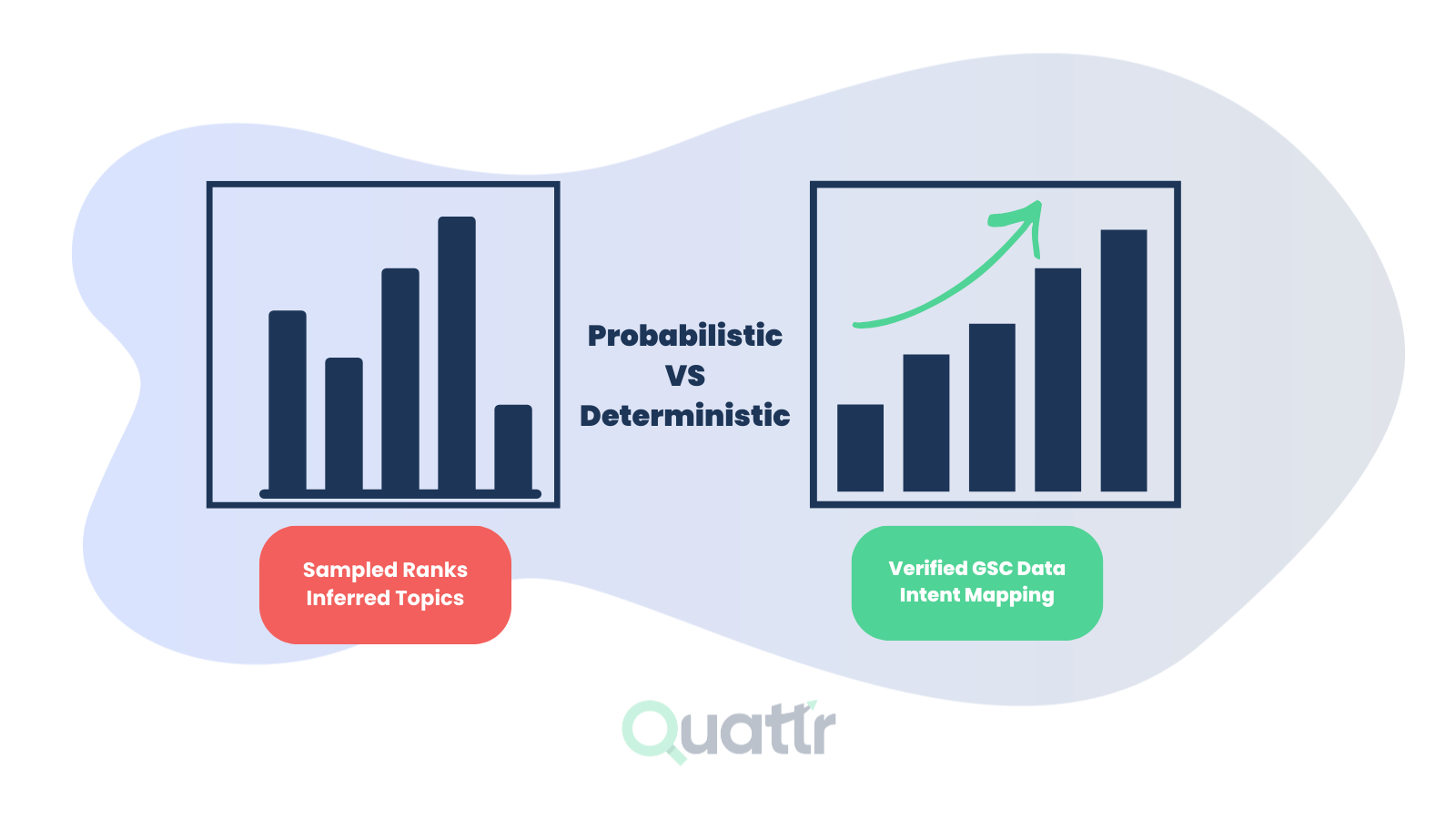
Enterprise SEO usually doesn’t fail because of poor strategy. It fails when forecasted metrics and modeled opportunities stop holding up during real execution and executive scrutiny. Most SEO data today is probabilistic, useful for direction, but much weaker when major business decisions and budgets depend on proving real-world impact.
What You Need to Know
Most SEO metrics today are partially modeled, not fully observed.
Probabilistic data is useful for direction, but weaker for execution decisions.
Enterprise SEO breaks down when forecasts cannot survive stakeholder scrutiny.
Sampled SERPs and inferred keyword coverage can create misleading confidence.
Reliable execution requires metrics tied closely to actual site performance.
The closer SEO gets to budget and revenue decisions, the more data accuracy matters.
Table of Contents
8.
9.
10.
SEO Runs on Data That Isn’t Truly Measured
Ask any senior SEO how many of their "core metrics" represent direct measurement versus modeled estimates. Most will admit the industry’s open secret:
1. Rank distributions are sampled.
2. Visibility scores are heuristics.
3. Topic clusters are predicted embeddings.
4. AI-Answer Engine presence is inferred from partial captures.
5. Share of voice is an extrapolation built on incomplete SERP observation.
It’s not that probabilistic data is “bad.” it tells you what might be the real case, but once you want to gauge more, it breaks.
Where Probabilistic Systems Quietly Fail Experts
Probabilistic data is built on inference, not observation. In a sandbox, this is acceptable. At scale, it introduces a "data drift" that paralyzes governance. When your measurement:
The Enterprise Disadvantage: You Can’t Scale Ambiguity
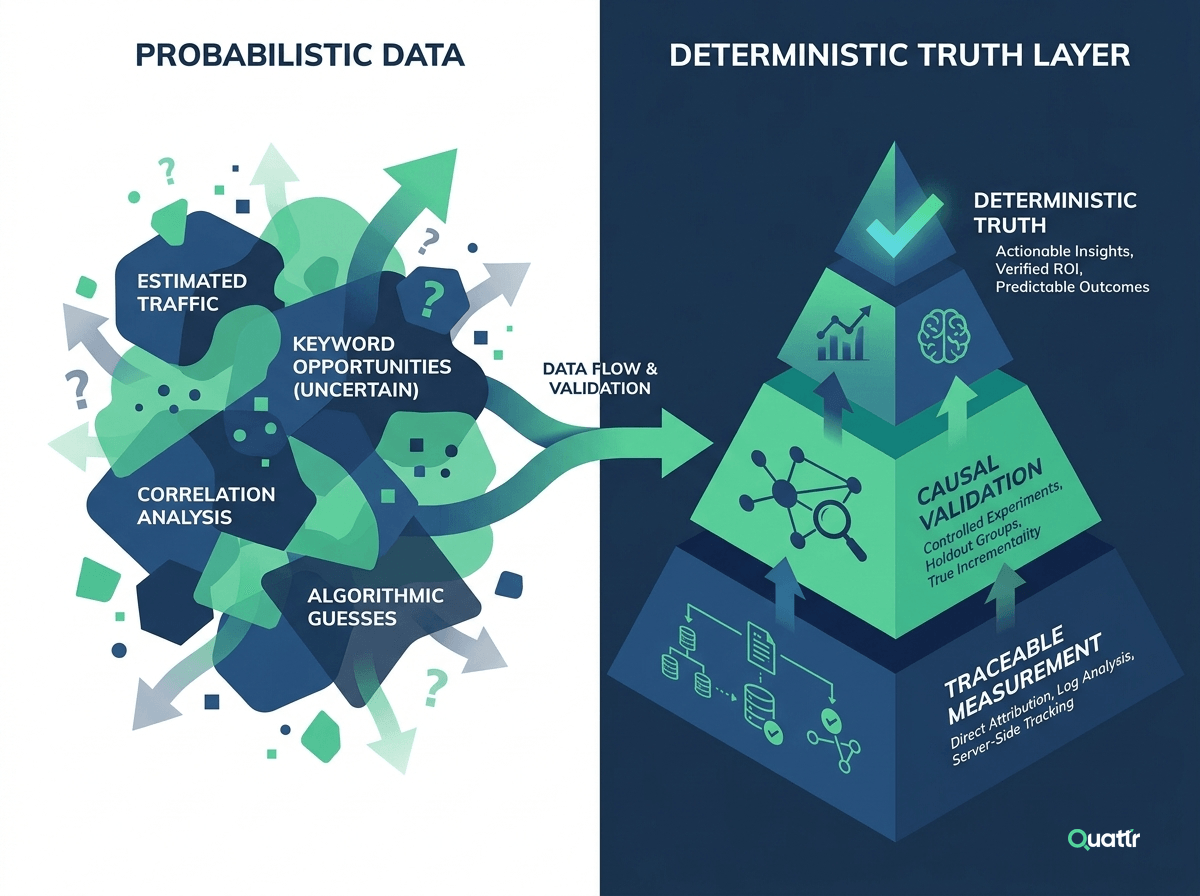
At scale, ambiguity isn’t just a nuisance, it’s a tax on execution velocity. Probabilistic SEO data creates three structural failures that stall even the most talented teams:
1. The Execution Gap: Velocity dies when platforms "move the goalposts." When signals shift unpredictably due to sampling errors, SEO roadmaps are rewritten quarterly to chase ghosts, rather than driving long-term equity.
2. The Death of Causality: To scale, you must prove that Action A caused Revenue. Because probabilistic measurement layers are inherently unstable, you cannot isolate your impact from the tool's noise. Without causality, SEO forecasting is treated as "guesswork".
3. Market Fragmentation: Cross-market SEO requires a single source of truth. Probabilistic systems fracture under the weight of different SERP shapes and device patterns across GEOs. This forces teams into a reactive posture, constantly explaining why the data looks different, rather than executing on what makes it grow.
The Need for a Deterministic Truth Layer
What enterprise SEO truly needs is not another dashboard; it’s a deterministic truth layer:
1. Consistent measurement across GEOs, SERP modes, and AI surfaces.
2. Traceable, auditable evidence behind every visibility claim.
3. Causal proof that action A led to result B.
This is where Quattr diverges from the SEO category. Rather than relying on scrape-and-guess methodologies, the platform aligns external visibility signals with raw website data to establish what actually changed, and why.
This foundation unlocks something most SEO teams still lack: true SEO experimentation. With a deterministic truth layer, Quattr enables controlled A/B testing across pages, templates, and content systems, measuring lift, regression, and neutral impact with causal confidence.
Instead of debating whether a rollout “worked,” teams can isolate variables, account for seasonality and noise, and prove outcomes before scaling execution. Deterministic truth doesn’t just improve reporting, it makes SEO testable, governable, and repeatable at enterprise scale.
Let’s look more closely at what sets Quattr apart.
How Quattr Delivers Deterministic Truth with GIGA
The industry’s mistake isn’t using probabilistic models, it’s using them in isolation. Visibility is inferred, trendlines are projected, and outcomes are explained after the fact. What’s missing is a grounding layer that defines what is actually happening before modeling what might happen next.
Quattr changes the equation by treating Google Search Console Bulk Export and Server Logs as the engine room of its truth layer. These sources form the deterministic backbone of GIGA, Growth Intelligence, Guidance, and Automation.
GIGA establishes a semantic system of record by aligning external search and AI visibility signals with first-party telemetry from your own site. It does not replace probabilistic insight; it anchors it.
In practice, this means predictive signals are always interpreted alongside real outcomes. AI visibility is joined with actual AI-referred visits in a single trended view. Search market share is viewed in context with GA4 traffic, not abstracted away from it. Deterministic data tells you what happened; probabilistic modeling reveals what deterministic signals may be masking.
For example, deterministic performance alone can’t answer whether seasonality is suppressing demand, or whether underlying visibility has quietly eroded. Probabilistic modeling can surface that a seemingly stable trend is hiding a 7% loss in true search presence. Together, they provide a complete operational picture.
By anchoring predictive insight to causal, first-party truth, Quattr eliminates hallucination in SEO reporting. This foundation allows teams to move from estimated reach to executable causality, without losing the foresight needed to act early.
Quattr’s Deterministic Advantage in Practice
Once the truth layer exists, execution becomes straightforward and, critically, causal.
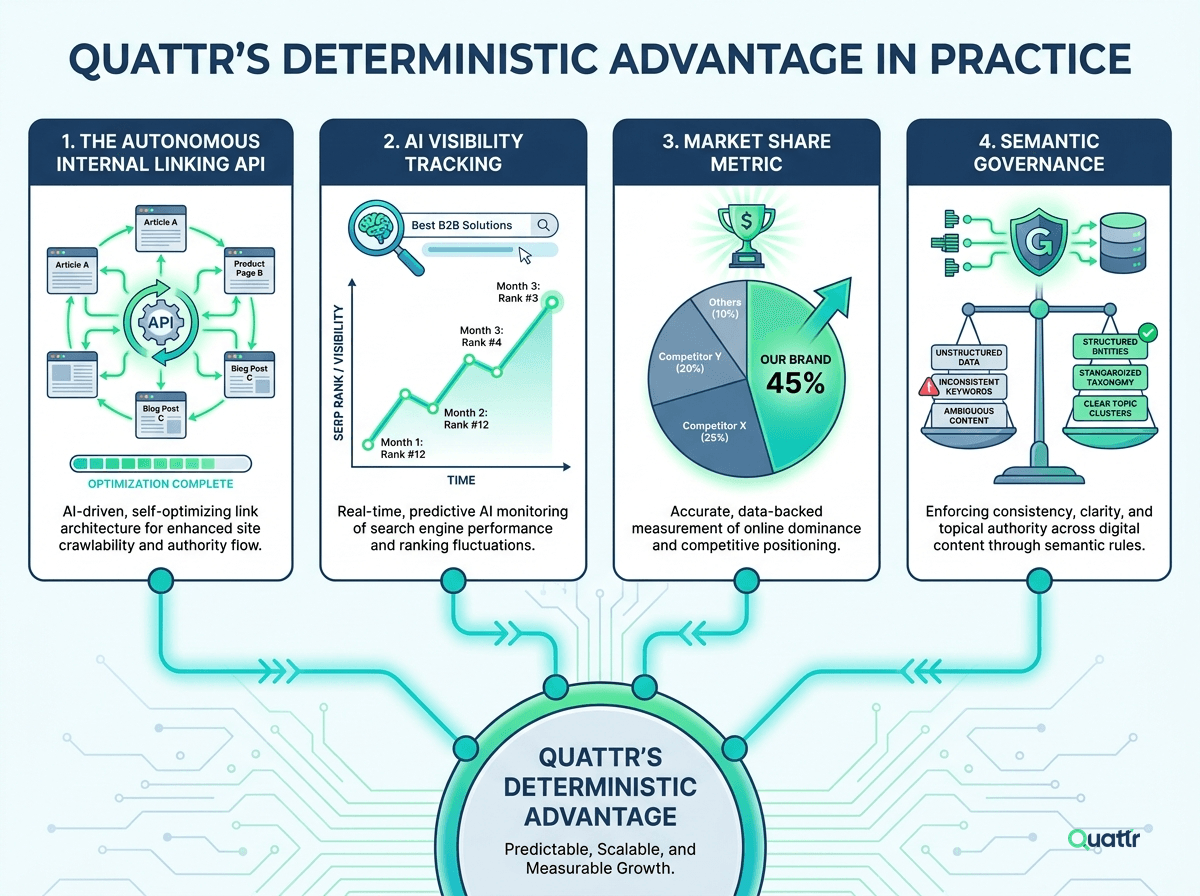
1. The Autonomous Internal Linking API
This is the purest example of deterministic execution. The Autonomous Linking API ingests the raw, deterministic search query data from GSC to find demand clusters and "missing paths," then generates highly contextual, entity-aligned link pairs with diversified, query-driven anchor text.
The Result: You aren't guessing if the links work. You are using the graph to choose the shortest, most authoritative path between an entity, an intent, and a page.
2. AI Visibility Tracking
Quattr’s platform is built to track and optimize for the Generative AI ecosystem (Answer Engine Optimization, or Generative Engine Optimization).
1. Deterministic Capture: Quattr capture verifiable citations across GenAI surfaces and match them to your GSC high-intent queries.
2. GIGA Agent: Uses deterministic data to find precise content gaps, ensuring your content is engineered to objectively exceed the benchmarks of current winners.
3. Market Share Metric
Quattr's Market Share Metric isn’t a score; it’s a unified visibility distribution mapped across all competitive surfaces.
1. It is linked and analyzed against its actual performance parameters, such as clicks, sessions, and impressions extracted from the GSC data.
2. It normalizes data across global markets, devices, and intent segments, allowing teams to act on a shared truth and eliminate regional volatility.
4. Semantic Governance
Probabilistic clustering reshuffles taxonomies every quarter. GIGA ends that loop.
Because it operates as a semantic operating system, it maintains a canonical map linking every intent, entity, and page to its defined purpose. That canonical mapping stabilizes your clusters, internal links, and content backlog even as algorithms or models shift.
The result: no more moving goalposts. Roadmaps hold, strategies persist, and every page’s role in the experience graph is known, measurable, and provable.
Deterministic SEO: The Foundation for Enterprise Growth
The industry will continue to debate AI search, zero-click behavior, and algorithmic opacity. But none of these challenges matter if the measurement layer beneath them isn’t deterministic.
Probabilistic tools tell you what might be happening. Quattr shows what is happening and then lets you act on it at scale.
Enterprises don’t win by predicting the future. They win by eliminating uncertainty in the present.
Quattr, through GIGA, semantic truth mapping, execution-led workflows, and enterprise governance, delivers what probabilistic SEO systems cannot: operational clarity at scale.
Move past probabilistic guesses with Quattr
Request a DemoFAQs
What’s the difference between inferred visibility and deterministic visibility?
Inferred visibility estimates what might be happening based on sampling and models. Deterministic visibility is based on traceable, auditable signals, where every claim can be tied back to a verifiable source such as query-level data or captured AI citations.
How does AI search make probabilistic SEO even riskier?
AI answer engines surface content through opaque retrieval paths. If visibility is inferred rather than captured, teams can’t prove where, why, or how a brand appeared, or didn’t. This turns AI visibility into narrative reporting instead of auditable evidence.
What role does Google Search Console play in deterministic SEO?
At scale, Google Search Console, especially Bulk Export, provides one of the few sources of deterministic, query-level demand data. Long-tail queries increasingly reflect AI-mediated retrieval, making GSC a foundational signal layer rather than a diagnostic tool.
About the Author

About Quattr
Quattr is an AI-native Search Visibility Platform founded in Palo Alto, California, built for mid-market and enterprise brands competing in the age of generative search. Recently recognized across G2’s Spring 2026 reports with #1 rankings in AEO Results, Usability, and Relationship, Quattr helps brands win visibility across traditional search and AI-generated answer surfaces.
Quattr’s AI agent, GIGA, evaluates content the way AI systems do, identifying gaps across structure, authority, internal linking, and discoverability to surface the highest-impact fixes. With capabilities like autonomous internal linking, E-E-A-T intelligence, and the new GIGA Landing Page Generator for keyword-matched, AI-search-ready pages, Quattr helps teams move from diagnosis to deployed changes without manual bottlenecks.

Read More


Ready to see how Quattr
can help your brand?
Try our growth engine for free with a test drive.
Our AI SEO platform will analyze your website and provide you with insights on the top opportunities for your site across content, experience, and discoverability metrics that are actionable and personalized to your brand.