Quattr Leads AEO, SEO, and Content Rankings on G2 Spring 2026.
Quattr Leads AEO, SEO, and Content Rankings on G2 Spring 2026.

As search continues to evolve, AI Overviews have become increasingly relevant in today’s search landscape, with Google delivering AI-generated summaries directly in the results page, often above traditional organic listings.
While this helps users get faster, more contextual answers, it also reshapes how websites earn visibility, clicks, and organic traffic. In this guide, we’ll explore what AI Overviews are, how they work, and how you can optimize your content to appear in them.
In this blog, we will explain what AI Overviews are, why they matter, and how SEOs and marketers can benefit from understanding their potential impact.
5.
6.
7.
8.
9.
10.
An AI Overview is a Google feature that uses AI to give quick, summarized answers at the top of search results. It pulls information from multiple websites, combines it into a short explanation, and shows source links so users can learn more.
It looks at your question, understands what you really want to know, gathers information from multiple trusted websites, and turns it into a short, easy-to-read summary at the top of the page. You still see links to the original sources, so you can dig deeper if you want.
The goal is simple: help users understand a topic faster, while guiding them to useful content when they’re ready to explore more.

For SEO professionals, this development signifies a shift: content must be authoritative and directly answer user queries to be featured in AI Overviews, potentially reducing users' need to click through to individual websites.
AI Overviews now appear across a wide variety of search queries and are accessible to users in 200+ countries and territories in more than 40 languages. As the feature continues expanding globally, millions of users encounter these AI-generated summaries directly on the search results page.
However, AI Overviews don't appear for every query. Google displays them selectively when its systems determine that an AI-generated explanation can provide a clearer or faster answer than traditional results. Quattr has a dedicated guide on how to structure content for Google AI Overviews if you want to improve your odds of being featured.
Google's AI Overviews are significant because they are changing how information is presented in search results and how websites gain visibility. Instead of users clicking through multiple pages, Google now provides AI-generated summaries directly at the top of the results, often answering the query instantly. This shift is part of the broader move toward Generative Engine Optimization (GEO), where visibility inside the answer matters as much as ranking for the click.
This shift can reduce visibility for many websites and increase the number of zero-click searches, where users find the information they need without visiting another page. As a result, some websites may experience lower organic traffic compared to traditional search results.
Appearing in an AI Overview can be valuable. Even without a direct link, being referenced in the AI-generated summary can increase brand exposure and credibility, placing your brand at the very top of the search results where users are most likely to see it. Tracking this kind of exposure is exactly what tools like Quattr's AI visibility tracking are built for, since traditional click-based metrics don't capture it.
AI Overviews are fundamentally altering SEO strategies and evolving it into GEO. While traditional SEO focuses on driving traffic to websites, GEO tools emphasis now shifts to establishing authority and trustworthiness to be recognized by AI systems. Let's explore how AI Overviews are redefining the SEO landscape.
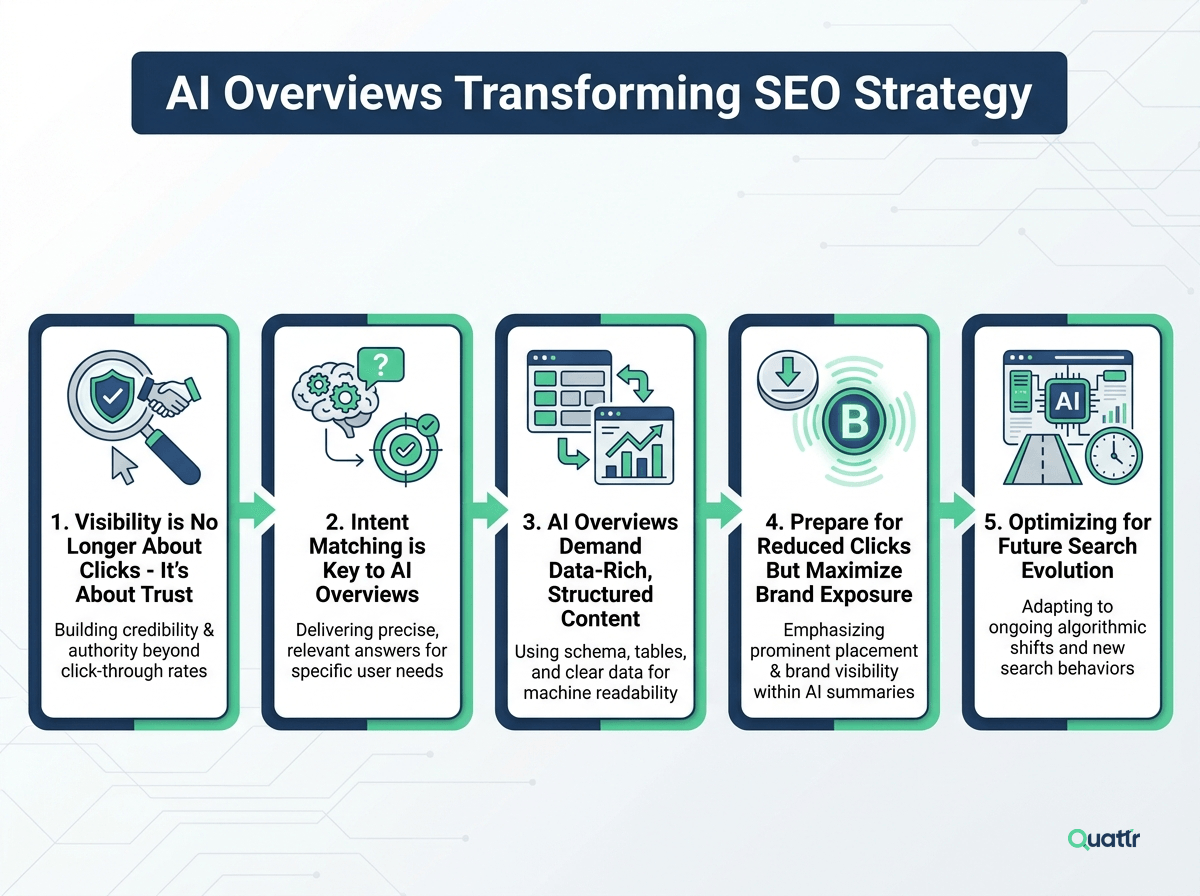
With AI Overviews, the primary goal is no longer solely click-throughs. It's about becoming a trusted information source that Google's AI relies on. It requires a fundamental shift from simply attracting visitors to cultivating genuine authority and showcasing expertise.
In the 2022 update, Google added another E for experience in its EEAT framework, meaning content now needs to show real-world, firsthand experience from experts on the topic.
For instance, including firsthand experiences, such as, personal accounts from product use or expert contributions from subject matter experts (SMEs) can strengthen the perceived credibility of your content, aligning with Google’s heightened emphasis on real-world experience and expertise.
You need to produce every piece of content that demonstrates Experience, Expertise, Authoritativeness, and Trustworthiness (E-E-A-T). This means citing reliable sources, presenting facts, and maintaining a tone of authority throughout your site.
Tip: Conduct a content audit to identify and address gaps in trust signals, such as missing citations, weak author bios, or outdated information.
Google still values backlinks, but quality trumps quantity in the age of AI Overviews.
Focus on earning backlinks from authoritative websites within your industry. Prioritize publications, academic sites, or trusted sources from which Google’s AI will likely pull. Engage with industry experts, contribute guest posts, and collaborate on research projects to enhance your site's authority.
Google's focus on matching user intent is amplified with AI Overviews. Many Google AI overview studies showcase that they appear for informational queries more as compared to any other queries like transactional or navigational.
However, Google's focus on matching user intent is not new. Traditionally, SERP results have always been designed to align with the intent behind user queries, whether informational, transactional, or navigational.
How this intent-driven information is presented has changed with Google AI Overviews. Instead of offering a list of links that users need to sift through, AI Overviews deliver concise, intent-matched summaries pulled directly from trusted sources.
This shift emphasizes the need for SEO strategies that don’t just aim for high rankings but also prioritize understanding why users are searching, allowing you to create content that directly serves their intent in a more consumable format.
Let's take an example: a query such as "What is SEO?" is more likely to generate an AI Overview than an "SEO Meaning" query.


Keywords are still important, but context and intent are the key. Ensure your content addresses the full scope of the user’s intent, not just specific keywords. For example, if someone searches for "What is SEO,” your content should provide more than a list—it should include what are the types, where to start, what they need, etc.
Long-tail keywords often capture specific user intent and are favored in AI Overviews. These keywords tend to be more descriptive and reflect the precise questions users ask.
Tools like Google’s Search Console and Answer the Public can help you discover long-tail keywords relevant to your niche. By focusing on these detailed queries, you can create content that not only answers the user’s question but also anticipates follow-up questions, improving your chances of being featured in AI Overviews.
Content featured in AI Overviews is typically data-driven and well-structured, facilitating easy extraction by AI systems. AI isn’t just looking for the best article; it’s looking for information that is easy to extract and presents clear, factual answers.
Present your data in ways that Google’s AI can easily pull from, such as bullet points, tables, and lists. This helps the algorithm digest the information quickly, increasing your chances of being featured.
Data and facts can become outdated really quickly, and Google’s AI favors accurate and well-maintained information. If your blog is three years old and hasn't been updated, your chances of being featured in an AI Overview drop drastically. While fresh updates can improve relevance, AI Overviews primarily prioritize authoritative, well-structured content—even if it’s not the newest.
Actionable Tip: Regularly audit your high-performing content to ensure it’s still relevant and update it with fresh data and insights.
One of the most significant impacts of AI Overviews is that users may no longer need to click on your link to get the necessary information. This affects CTR in two ways: the links under AIO will likely get more clicks, while the other links below AIO can see a major decline in CTR.
But it doesn’t mean your efforts are in vain. Getting featured in an AI Overview by writing intent-specific and useful information enhances your brand visibility and increases brand recognition and trust, leading to indirect traffic and engagement over time.
If your content is featured in an AI Overview, ensure your brand name is prominently included in the answer. Whether within a statistic, a quote, or a short description, your brand should be clearly associated with the high-quality information Google presents.
As users may not click through to your site, consider incorporating micro-conversions directly in the overview content. For example, encourage users to take action—such as signing up for a newsletter, downloading a guide, or checking out a case study—within the text that is likely to generate AI Overview.
AI Overviews are still evolving, and so is the role of AI in search. As Google’s algorithm learns and refines how it generates overviews, so should your strategy. Being nimble and proactive will allow you to take advantage of future AI-driven opportunities.
For example, in 2024, Google has started testing ads in AIO. This means a big step towards monetizing AI search results.
Start testing with different formats, such as video, interactive elements, and infographics, which may soon play a larger role in AI Overviews. Stay ahead of the curve by keeping an eye on how Google’s AI evolves and incorporating structured data to make your content even more accessible to algorithms.
Use tools to track when and where AI Overviews appear for your target keywords. Keep an eye on competitors who are being cited in AI Overviews. Analyze what makes their content stand out, and apply those findings to your content strategy.
Google AI overview is transforming the core principles of SEO strategy and content planning. As Google integrates AI to provide direct answers to queries, SEOs must evolve to cater to this new environment where concise, highly relevant, and authoritative information is prioritized. The changes driven by AI Overviews demand a shift in how we think about content creation, user intent, and long-term SEO goals.
Consider the following strategies to adjust your long term content planning goals:
AI overviews present direct answers at the top of the search results; SEO success is no longer solely about generating clicks but about being seen as an authoritative source. So now your content needs to go beyond click-driven strategies and should be focused on being the trusted source that Google selects for these high-value summaries.
One way to achieve this is to start focusing on building topical authority rather than chasing every possible keyword. For example, if your niche is about digital marketing, build a series of interconnected articles that explore different facets of SEO, AI in search, content marketing, etc. This increases your authority on the subject as a whole, making it more likely that Google will pull content from your site for AI Overviews.
AIO delivers concise summaries; SEO professionals must find the right balance between brevity and depth in their content to meet this need. Start by structuring your content with quick, skimmable answers to primary questions while allowing for deeper exploration.
Use clear headings, bullet points, and data tables to make it easier for Google’s AI to extract relevant information. However, ensure there’s additional depth that backs up the overview with detailed insights.
With AI Overviews, users may become accustomed to receiving instant answers, and their expectations for speed, accuracy, and relevance are shifting. Focus on creating user-first content that answers key questions upfront while maintaining relevance and clarity.
Anticipate follow-up questions and address them within the content. This will better serve user intent and increase your chances of being selected for AI Overviews, as Google's AI values content that provides complete, trustworthy answers.
Tools like Answer The Public can help to identify related queries and common follow-ups.
Google algorithm keeps on updating and so will AI overviews, such as the rolling out of ads in Google AIO. It's essential for SEOs to continuously monitor how AI Overviews appear for their target keywords and adjust their content strategies accordingly.
Track keywords that trigger AI Overviews and analyze what content is featured. Pay attention to competitor analysis—observe how your competitors optimize their content for AI Overviews and apply those insights to your strategy.
Quattr helps you adapt to Google's AI Overviews by analyzing your keywords, meta tags, and content structure to provide actionable SEO insights. Its AI visibility tracking monitors your AI Overviews presence through metrics like daily page count, visibility percentage, and SERP coverage, capturing this data from real, consumer-facing AI responses rather than simulated prompts.
You get citations, brand mentions, share of voice, and sentiment tracked across Google AI Overviews, ChatGPT, Claude, and Perplexity, benchmarked against competitors so you know exactly where your visibility gaps are. Quattr also ties these AI insights back to your GA4 and Search Console data, connecting AI visibility to real clicks and conversions, so you can adapt your content strategy with real-time tracking and data-backed decisions.
Yes, even if your content is not ranked first, it can still be pulled into an AI Overview if it is deemed authoritative, trustworthy, and highly relevant to the user’s query.
Yes, AI Overviews can impact CTR by reducing clicks on traditional search results, as users may get their answers directly from the overview. However, being featured in an overview can significantly increase brand visibility.
To optimize for AI Overviews, focus on producing concise, well-structured content that answers specific user questions. Implement schema markup, use long-tail keywords, and ensure your content demonstrates E-E-A-T (Experience, Expertise, Authoritativeness, and Trustworthiness).

Quattr is an AI-native Search Visibility Platform founded in Palo Alto, California, built for mid-market and enterprise brands competing in the age of generative search. Recently recognized across G2’s Spring 2026 reports with #1 rankings in AEO Results, Usability, and Relationship, Quattr helps brands win visibility across traditional search and AI-generated answer surfaces.
Quattr’s AI agent, GIGA, evaluates content the way AI systems do, identifying gaps across structure, authority, internal linking, and discoverability to surface the highest-impact fixes. With capabilities like autonomous internal linking, E-E-A-T intelligence, and the new GIGA Landing Page Generator for keyword-matched, AI-search-ready pages, Quattr helps teams move from diagnosis to deployed changes without manual bottlenecks.


Try our growth engine for free with a test drive.
Our AI SEO platform will analyze your website and provide you with insights on the top opportunities for your site across content, experience, and discoverability metrics that are actionable and personalized to your brand.


.svg)
.svg)


