


Table of Contents


Case Studies
Related Content
SEO Content Marketing: A Complete Guide to Growth & Visibility
Content Marketing Plan for B2B, B2C, and eCommerce
Content marketing helps you get discovered by potential customers early in their decision-making journey through blogs, videos, social posts, and more. People usually research before buying, and the content they find often shapes their trust and perception of your brand.
But not all content works you need to understand what your audience is searching for, what drives action, and how to create content that actually gets seen and converts.
Table of Contents
6.
7.
8.
9.
10.
What is a Content Marketing Plan?
Content marketing is a planned strategy that involves creating and sharing useful, relevant, and consistent content like blogs, videos, and social media posts, to attract and engage a specific audience. Instead of pushing direct sales, it focuses on building trust, credibility, and long-term relationships that eventually lead to business growth.
Key Aspects of Content Marketing:
Value-driven: Content should inform, solve problems, or provide meaningful insights rather than just promote products.
Audience-focused: It targets a clearly defined group with specific needs and interests.
Long-term approach: The goal is to build authority and trust over time, not instant results.
Multi-channel presence: Content is shared across platforms like websites, social media, email, and webinars to reach users wherever they are.
What is the Importance of Content Marketing?
Content marketing is essential for building a strong digital presence and creating meaningful connections with your audience. By consistently delivering valuable and relevant information, businesses can improve visibility, earn trust, and guide users toward making informed decisions without relying on hard selling.
1. Builds Trust and Credibility: High-quality, informative content positions your brand as a reliable source of knowledge, helping potential customers feel confident in choosing your products or services.
2. Improves SEO and Online Visibility: Publishing relevant and search-focused content regularly helps your website rank higher on search engines, making it easier for users to discover your brand organically.
3. Generates Cost-Effective Leads: Unlike paid ads, content continues to attract and engage users over time, making it a sustainable and budget-friendly way to generate leads.
4. Supports the Buyer’s Journey: Content educates users at every stage, from awareness to decision-making, helping them move forward with clarity and confidence.
5. Boosts Engagement and Retention: Engaging and useful content keeps your audience interested, encouraging them to return and interact with your brand repeatedly.
6. Strengthens Brand Identity: Consistent messaging and tone across content help define your brand’s voice, making it more recognizable and relatable to your target audience.
Using a Content Marketing Funnel to Map User Journey
When creating a content strategy for your business, it is important to map out the consumer journey and provide appropriate content at every. Think of your content offerings in the form of a funnel- the most popular content up top and the most important, conversion-driven content at the bottom. The three funnel stages of any content strategy cycle can look like this:
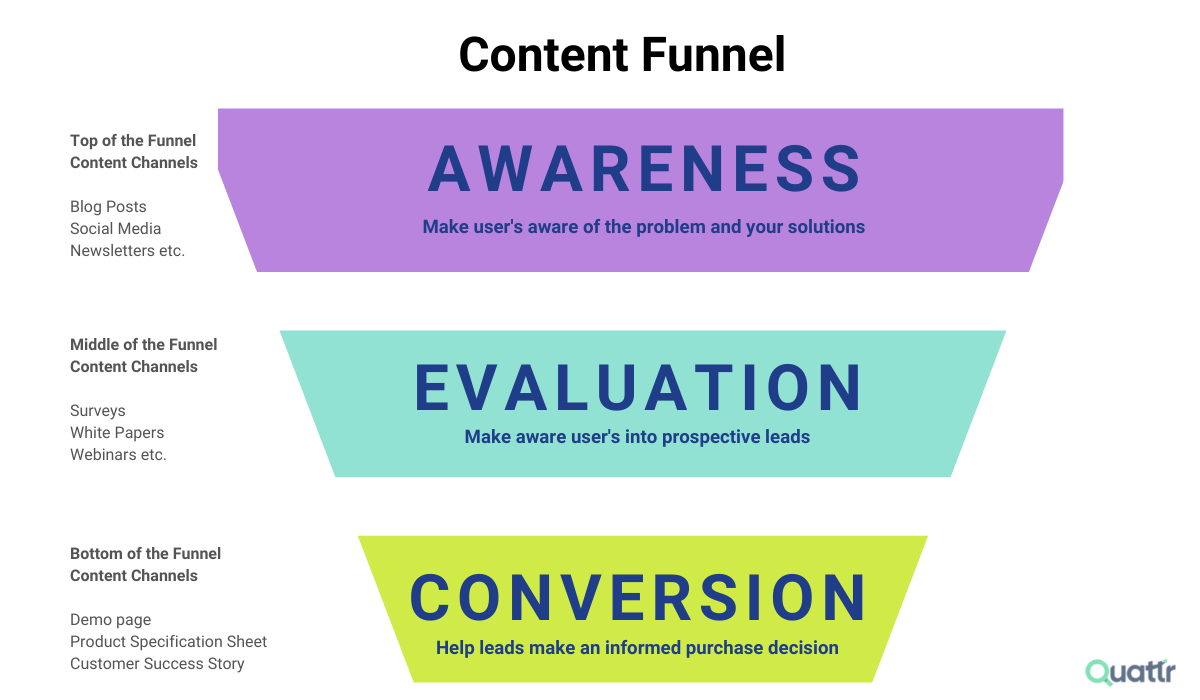
1. Top of the Funnel Content
This stage focuses on building awareness by helping your audience understand their problem and possible solutions. The goal is to educate and attract a broad audience through formats like blog posts, social media content, infographics, newsletters, and eBooks.
2. Middle of the Funnel Content
At this stage, users are evaluating their options. They already understand the problem and are comparing solutions, so your content should highlight why your offering stands out. Formats like case studies, whitepapers, webinars, and detailed guides help build trust and move them closer to a decision.
3. Bottom of the Funnel Content
Here, the user is ready to take action. Content should focus on conversion by clearly showing value and reducing friction. Demo pages, customer success stories, product details, and strong calls to action like “Start Free Trial” or “Book a Demo” are key at this stage.
To succeed, it’s important to keep users engaged across all stages, guiding them from awareness to decision while capturing and nurturing leads effectively. A strong content strategy should always balance three things: engaging the user, improving search visibility, and driving meaningful conversions.
Read more on how to optimize your content in our content optimization guide here.
Content Formats and Types
Content marketing uses different formats to attract, engage, and retain audiences by delivering useful and relevant information. Common formats include blog articles, videos, social media posts, infographics, eBooks, case studies, and email newsletters, all of which help increase brand awareness, improve search visibility, and guide users through the buying journey.
Here are the main types of content marketing and their purpose:
1. Blog Posts
These are essential for driving organic traffic, improving SEO, and positioning your brand as an authority in your industry.
2. Video Content
Videos are highly engaging and effective for product demos, tutorials, and storytelling, especially across social platforms.
3. Social Media Content
Used to connect with audiences in real time, build brand awareness, and create a community on platforms like Instagram and LinkedIn.
4. Case Studies
They showcase real success stories, helping build trust by demonstrating how your product or service works in real scenarios.
5. Infographics
Visual content that simplifies complex information, making it easy to understand and highly shareable.
6. Email Marketing
Helps nurture leads and maintain relationships through personalized communication and regular updates.
7. E-books and Whitepapers
In-depth content pieces designed to provide valuable insights and generate leads through detailed knowledge.
8. User-Generated Content (UGC)
Content created by customers, such as reviews or social posts, which adds authenticity and builds trust.
9. Podcasts
Audio content that allows brands to connect with audiences in a more personal and convenient format.
10. Interactive Content
Includes quizzes, tools, or calculators that increase engagement by offering personalized experiences.
11. Webinars
Live or recorded sessions that educate audiences while allowing deeper interaction and engagement.
12. Memes
Light, entertaining content that spreads quickly on social media and helps boost engagement and relatability.
A Simple Process to Build a Content Marketing Strategy
Many content marketing efforts don’t deliver results because they lack a clear strategy to attract the right audience and guide them through the buying journey.
If you start publishing content randomly across platforms without a clear plan for which channels to focus on, how to position your brand, and how each piece of content moves users forward, the return on investment will likely be disappointing.
To avoid this, here’s a structured, step-by-step approach to building an effective content marketing strategy.
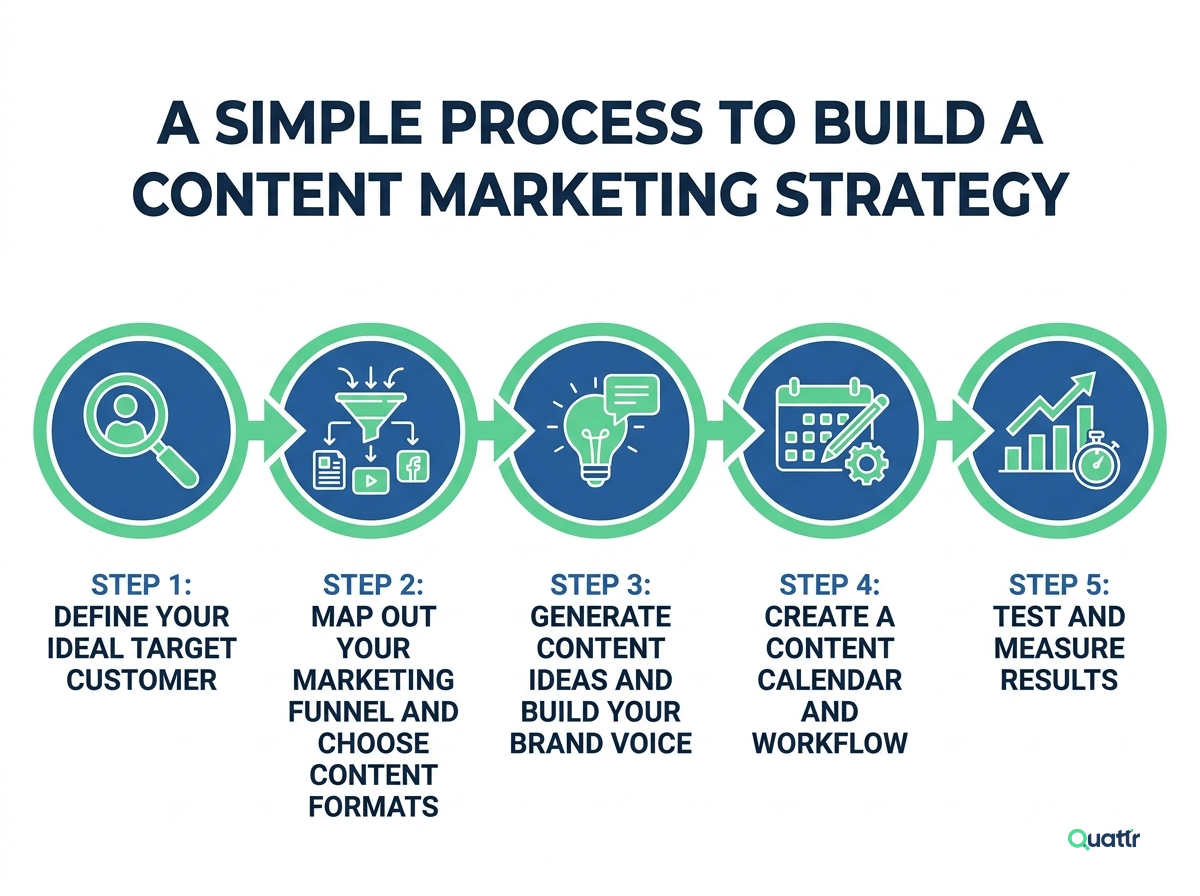
Step 1: Define Your Ideal Target Customer
Content marketing is only effective when it reaches the right audience.
If you attract the wrong people, conversion rates will be low, or you may end up with customers who aren’t the right fit, leading to higher churn and support challenges.
To clearly define your ideal customer, consider the following:
What is the job title or role of the person who buys your product or service?
What type of company do they work for in terms of size, industry, or structure?
What specific problems or challenges are they trying to solve?
How much knowledge do they already have about this topic?
Answering these questions helps you build a clear buyer persona, making it easier to shape the rest of your content strategy.
Step 2: Map Out Your Marketing Funnel and Choose Content Formats
Most people won’t make a purchase the first time they visit your website, and that’s completely normal.
The goal of content marketing is to build a relationship over time that eventually leads to a purchase decision.
The content marketing funnel includes multiple stages, starting from awareness, where users are just discovering a problem, to the decision stage, where they are ready to choose a solution.
For example, if your product simplifies accounting processes, a typical journey might look like this:
Reading a blog post about business finance basics
Watching a video explaining specific topics like accounts payable or receivable
Attending a webinar showing how your software automates these processes
Creating content for each stage ensures you can guide users smoothly through their journey.
If you promote your product too early, you risk losing trust. If you never introduce it, users may never convert.
You’ll also notice that different stages require different types of content. Choosing the right format depends on two key factors:
First, understand what type of content your audience prefers. Some audiences lean toward specific platforms. For example, TikTok may not be ideal for hiring a lawyer or agency, but it works well for consumer products. Studying competitors can help identify what works.
Second, consider what you can produce consistently. Even if video works well in your industry, it won’t help if you can’t maintain quality and frequency. Consistency is critical, so choose formats you can sustain long term.
Once you’ve decided on formats, map them to each funnel stage. You don’t always need different formats for each stage. For example, blog content alone can cover awareness, consideration, and decision.
The key reason for mapping your funnel is to ensure each step has a clear call to action that moves users forward.
Step 3: Generate Content Ideas and Build Your Brand Voice
A strong content strategy is not just about formats, but also about having something meaningful and unique to say.
You need a system to consistently come up with content ideas that resonate with your audience.
A simple framework to generate ideas includes:
Identify the key problem your audience faces that your product solves
Understand the common advice available and why it may not fully work for your audience
Offer a better solution supported by your experience, data, or insights
With the rise of AI-generated content, generic ideas are everywhere. Content that offers a fresh perspective or challenges common thinking stands out more.
Before publishing, ask yourself
Does this idea already exist everywhere?
Is this truly the best way to solve the problem?
If the answer is no, refine your content. Consistently sharing original insights builds trust and positions you as a leader in your space.
Step 4: Create a Content Calendar and Workflow
Your strategy will only work if you publish content regularly.
The foundation of a successful content marketing approach is simple: consistency, quality, and relevance.
Many marketers struggle because they either stop too soon or fail to maintain a steady publishing schedule. As a result, audiences lose interest, and engagement drops.
To avoid this, create a structured content calendar and workflow.
Use a project management tool to break down campaigns into tasks, assign responsibilities, and set deadlines. This ensures that every piece of content moves smoothly from planning to publishing.
Once a clear process is in place, maintaining consistency becomes much easier.
Step 5: Test and Measure Results
The final step is tracking performance.
Content marketing takes time, so immediate results are not always visible. However, there are early indicators that show whether your strategy is moving in the right direction:
Your sales team receives better quality leads that convert faster
Brand awareness improves through mentions, backlinks, and search demand
Website traffic steadily increases
Existing customers remain engaged and satisfied
Along with these broader metrics, track the performance of individual campaigns to identify what works best.
Most marketers rely on analytics tools to monitor performance, along with SEO platforms to track visibility and growth.
By continuously analyzing results, you can refine your approach and focus on content that delivers the highest impact.
As content discovery evolves, it’s important to understand how visibility is no longer limited to search engines, this shift is explained in SEO vs AI Visibility: Market Share Is Now Split Into Two Signals.
Proven Content Marketing Tactics
The content strategy outlined above helps you build a strong foundation. Once your systems and workflows are in place, you can take things further with a few advanced tactics that improve engagement, conversions, and overall performance.
1: Interact directly with your audience
Research is important, but real insights come from conversations. Instead of only analyzing data, engage with your audience in communities like Slack groups, Facebook groups, or niche forums. This helps you understand real problems, gather content ideas, and build authentic relationships. Focus on helping, not selling, by answering questions and observing recurring challenges.
2: Introduce your product naturally
Content should educate first, but it also needs to convert. The key is to introduce your product in a helpful, non-pushy way. Start by explaining different solutions to a problem, including alternatives, and then position your product as one of the options. This approach builds trust while still guiding users toward your offering.
3: Repurpose content across platforms
Creating new content for every platform can be resource-intensive, but repurposing solves this. A single piece of content can be adapted into multiple formats. For example, a long video can become short social clips, blog posts, or even email content. This allows you to maximize reach without constantly creating from scratch, as long as each format is optimized for its platform.
4: Convert visitors into leads
Driving traffic is only part of the equation. You also need a system to capture and nurture that audience. Offer valuable resources like templates, guides, or checklists in exchange for email addresses. Once you have that connection, you can build relationships through email and guide users toward conversion over time.
5: Study competitor ad strategies
Looking at competitors’ content is useful, but analyzing their paid ads can reveal even stronger insights. Focus on ads that have been running for a long time, as they are likely delivering results. These campaigns can inspire high-performing content topics and messaging for your organic strategy. Tools like ad libraries and SEO platforms can help you uncover these patterns.
Content Marketing Automation With Quattr
Content marketing is a crucial aspect that any and every business needs to engage and plan for. Building a content marketing plan can be a daunting task, and the template above should help kick start the process.
Although when it comes to creating a content marketing plan for an enterprise, aligning internal teams to the same goal can be difficult. The Quattr platform helps you align enterprise-level teams to come together and build your search presence.
Review top SEO factors, PPC campaigns, review content, audit, and create new content for top search intents with Quattr and grow across your entire website. Quattr can also help automate technical efforts taking away the manual effort from your engineering front.
Interested in Automating your SEO and Content Marketing Efforts?
Request a DemoFAQs
What is SEO Content Marketing?
Content marketing in SEO is a strategic method of creating and sharing useful, relevant, and consistent content such as blogs, videos, and social media posts to attract and engage a specific audience. Instead of directly promoting products, it focuses on delivering value, building trust, and guiding users toward meaningful actions over time.
How does Content Marketing Attract Potential Customers?
Content marketing helps attract potential customers by creating relevant and engaging content. It also allows businesses to establish trust and credibility with their target audience, leading to increased engagement and conversions. Content marketing also allows businesses to reach their target audience efficiently and cost-effectively, as the content can be shared across multiple platforms and channels.
How to Create an SEO Content Marketing Plan?
Creating an SEO content marketing strategy involves researching target keywords, creating content optimized for keyword clusters, publishing optimized content, and leveraging external sources to improve visibility. It also involves creating content that is helpful to the reader, optimizing it for different devices, and marketing the content on multiple channels. Additionally, it involves tracking and measuring the performance of the content.
About The Author

About Quattr
Quattr is an AI-native Search Visibility Platform founded in Palo Alto, California, built for mid-market and enterprise brands competing in the age of generative search. Recently recognized across G2’s Spring 2026 reports with #1 rankings in AEO Results, Usability, and Relationship, Quattr helps brands win visibility across traditional search and AI-generated answer surfaces.
Quattr’s AI agent, GIGA, evaluates content the way AI systems do, identifying gaps across structure, authority, internal linking, and discoverability to surface the highest-impact fixes. With capabilities like autonomous internal linking, E-E-A-T intelligence, and the new GIGA Landing Page Generator for keyword-matched, AI-search-ready pages, Quattr helps teams move from diagnosis to deployed changes without manual bottlenecks.

Read More


Ready to see how Quattr
can help your brand?
Try our growth engine for free with a test drive.
Our AI SEO platform will analyze your website and provide you with insights on the top opportunities for your site across content, experience, and discoverability metrics that are actionable and personalized to your brand.