


Table of Contents


Case Studies
Related Content
Topical Authority in SEO: Build Trust and Rank Higher
How to Build Topical Relevance for SEO?

What if your website could rank for almost every important keyword within your niche? That’s the idea behind topical authority. While some claim you can achieve this just by creating a lot of content, the reality is more balanced SEO still requires links, strategy, and consistency.
Topical authority isn’t a magic fix, but when done right, it can significantly improve your visibility and trust. In this guide, we’ll break down what topical authority really means and how you can build it effectively.
Table of Contents
8.
9.
10.
What is Topical Authority?
Topical authority means your website is recognized as a trusted source for a specific subject. Instead of covering many unrelated topics, you focus on one niche and create helpful, in-depth content that answers different questions users may have. This helps search engines understand that your site has real knowledge and expertise in that area.
To build topical authority, you need to go beyond targeting just one keyword. You should cover the topic in detail by creating a main page for the broad subject and then supporting it with multiple related articles that explore subtopics. All these pages should be connected through internal links so both users and search engines can easily navigate and understand the structure.
This approach also supports Google’s focus on trust and expertise, as your content shows consistency and depth. Unlike domain authority, which depends more on backlinks, topical authority is built by creating relevant, well-connected content that fully covers a subject.
Topical Authority and Related SEO Concepts
Topical Authority and Google E-E-A-T
One closely related SEO concept with topical authority is E-E-A-T (experience, expertise, authority, and trustworthiness). Search engines like Google use the E-E-A-T principle when evaluating the content of a web page for rankings.
Building topical authority is like planting a seed - the more you nurture and care for it with good-quality soil, sunlight, and water, the healthier and stronger it will grow.
Similarly, the more you invest in creating in-depth, accurate, and reliable content, the more you build your reputation as a trusted authority in that specific topic or field. And this isn't just about the present value of your content but how it prepares and positions you for future growth and credibility.
Topical Authority vs Topical Relevance
Topical authority and topical relevance may sound similar, but they mean different things.
Topical authority is about trust over time. When a website keeps publishing helpful and detailed content on one subject again and again, search engines start seeing it as an expert in that area. For example, if a site regularly writes about heart health, it builds authority in that topic.
Topical relevance, on the other hand, is about how well a single page matches what a user is searching for. If someone searches for “best heart-healthy diets,” a page that directly answers that question clearly and in detail is considered relevant.
Both are important for SEO. Authority helps your site gain long-term trust, while relevance ensures your content matches user intent and gets clicks and engagement
Topical Authority vs Domain Authority
Topical Authority & SEO - Why Does it Matter?
Google doesn’t just look at keywords, it tries to understand the meaning and connection between topics. For your website to rank well, Google needs to clearly link your content to a specific subject and see it as relevant for related searches.
When you create multiple pieces of content around the same topic, it becomes easier to connect them through internal links. This helps both users and search engines navigate your site better and can even increase your chances of earning backlinks naturally.
The key idea is simple: when your content is focused on one subject and well-connected, Google starts seeing your site as knowledgeable and trustworthy in that area. Now, let’s address the bigger question before moving ahead.
How Does Topical Authority Work?
In its quest to deliver the most valuable search results to users, Google values topical authority as a key ranking factor. Its underlying principle is simple:
The more authoritative & relevant your content is to a specific topic, the better your chances of ranking well in search results.
Google uses a variety of factors to rank websites. It employs an algorithm called Latent Semantic Indexing (LSI), which finds patterns in how words and ideas link in a website’s content. It helps Google understand a website's specific area of expertise.
In the next section, let us look at the algorithms that Google deploys to understand the topical authority of a website.
Google Algorithms & Topical Authority
Google's algorithms are the heart of its search engine. These algorithms use hundreds of ranking factors to provide users with the most relevant & high-quality search results. These algorithms include:
1. Google Panda (2011): It was introduced to lower the ranking of "low-quality sites," particularly those with thin and duplicated content. The panda algorithm boosts the relevance of search results by favoring pages with comprehensive and original information.
2. Google Penguin (2012): This algorithm targets spammy or overly-optimized sites. It ensures websites don't manipulate search rankings using black-hat SEO techniques like keyword stuffing and link schemes. Therefore, sites with genuine content and ethical SEO practices exhibit more topical authority.
3. Google Hummingbird (2013): This algorithm signifies a leap forward in understanding the context and semantics of search queries. Rather than matching keywords, Hummingbird tries to comprehend the intent behind a search. This algorithm significantly boosts websites with in-depth and valuable content that comprehensively addresses users' queries.
4. E-A-T (Expertise, Authoritativeness, and Trustworthiness): E-A-T is not an algorithm but a significant part of Google's Search Quality Guidelines. It ensures that search results are relevant, high-quality, and trustworthy. This algorithm was updated in 2022 to include Experience & is since known as Double E-A-T or E-E-A-T.
5. BERT (Bidirectional Encoder Representations from Transformers): Introduced in 2019, this algorithm uses Natural Language Processing (NLP) better to understand the context of words in search queries. It emphasizes the importance of user-focused content written in natural language instead of keyword-stuffed content.
How to Build Topical Authority in Simple Steps?
Building topical authority is essential for long-term SEO success and requires a clear, structured approach.
Below are practical steps to help you build strong authority in your niche:
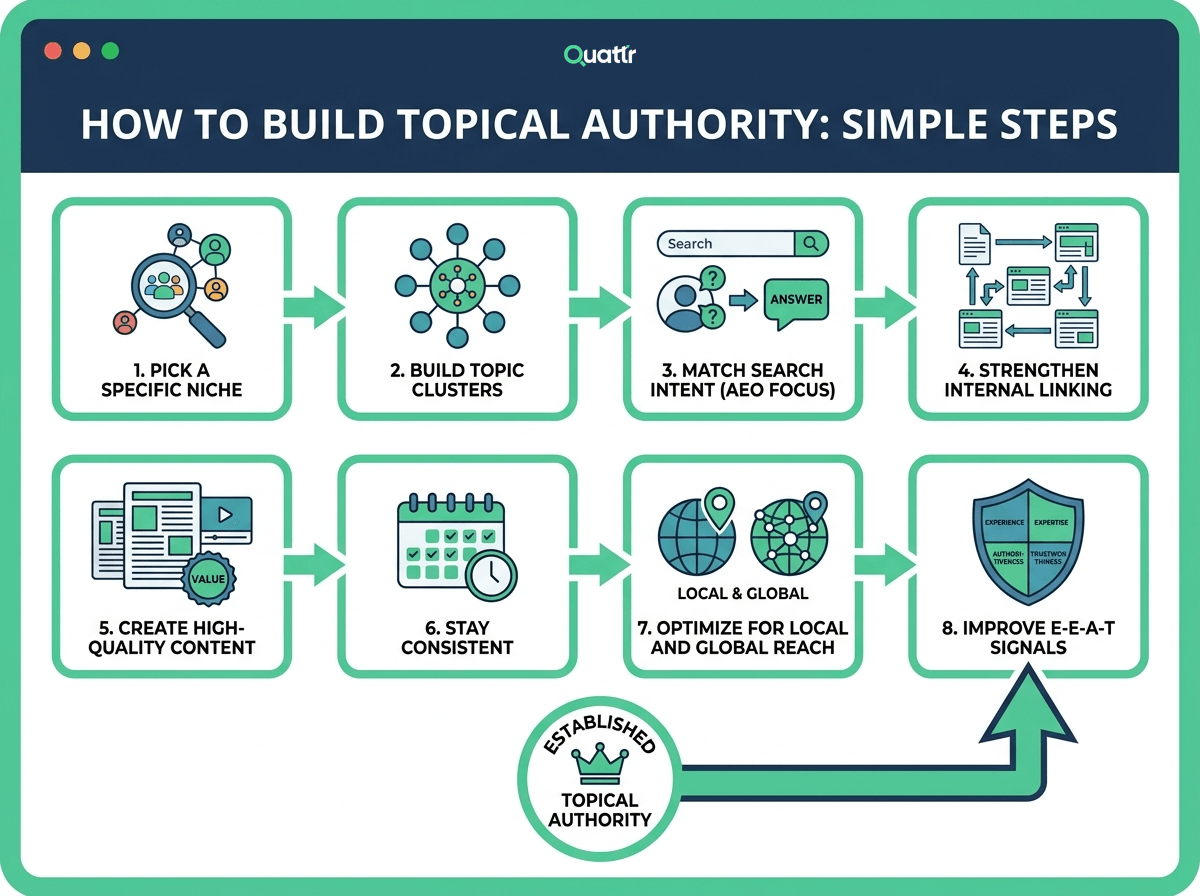
1. Pick a Specific Niche
Start with a well-defined topic that matches your business. Avoid covering too many unrelated areas.
Example:
Instead of “marketing,” go with “local SEO for small businesses.”
This makes it easier for search engines to understand your focus.
2. Build Topic Clusters
Topic clusters form the base of strong topical authority.
A cluster includes:
Pillar Page: A detailed guide on the main topic
Supporting Articles: Content that covers smaller subtopics
Example:
Pillar: SEO Guide
Cluster:
Keyword research
On-page SEO
Technical SEO
Link building
All supporting pages should link back to the main pillar page.
3. Match Search Intent (AEO Focus)
Modern SEO is about clearly answering user questions.
To align with AEO:
Use clear headings
Add FAQ sections
Give direct, simple answers
This helps your content appear in:
Featured snippets
Voice search results
4. Strengthen Internal Linking
Internal links connect your content and improve authority.
Best practices:
Link related pages naturally
Use clear and relevant anchor text
Avoid adding too many links unnecessarily
This improves navigation for both users and search engines.
5. Create High-Quality Content
Content quality plays a major role in building authority.
Focus on:
Unique insights
Real examples
Updated information
Clear structure
Avoid:
Thin or shallow content
Keyword stuffing
Repeating the same topics
6. Stay Consistent
Regular publishing builds trust over time.
Create a plan:
Post weekly or bi-weekly
Stick to your main topic
Update old content regularly
Consistency signals reliability to search engines.
7. Optimize for Local and Global Reach
If targeting different regions:
Add location-based keywords
Include global examples
Keep language simple and clear
This helps you reach both local and international audiences.
8. Improve E-E-A-T Signals
Show that your content is trustworthy and credible.
Focus on:
Experience: Share real examples
Expertise: Show deep knowledge
Authority: Gain backlinks and mentions
Trust: Provide accurate information
Ways to improve:
Add author bios
Include case studies
Use reliable sources
By consistently strengthening these signals, you build long-term trust with both users and search engines, helping your content rank higher and perform better.
Establish Yourself as an Authority with Recommendations From Quattr
Building topical authority helps your website become a trusted source, improving rankings and credibility in your niche. However, it takes time, consistency, and a clear strategy focused on creating relevant, high-quality content.
Quattr can make this process easier by helping you find the right topics and create optimized content faster. It also provides prioritized recommendations so you can focus on areas that drive the most organic growth.
Want to Boost the Topical Authority of Your Website?
Request a DemoFAQs
Is topical authority related to keywords?
Yes, topical authority is related to keywords. Topical authority refers to a website or content's credibility or expertise on a specific subject or topic. Keywords are used to help establish this authority in search engine algorithms. By consistently using relevant keywords naturally in your content, you can improve your topical authority and achieve higher search engine rankings.
How often should I update my content to maintain topical relevance?
To maintain topical relevance and authority in SEO, it is advisable to refresh your content every 6 to 12 months. Remember, the updates should add value & provide up-to-date information and trends. Regular updates help ensure that your content remains accurate and relevant.
How long does it typically take to establish topical authority?
Establishing topical authority in SEO isn't instantaneous; it's a gradual process that can take several months to years. Factors like content quality, content refresh frequency, and audience engagement play a role. Moreover, solid link-building and keyword optimization strategies are crucial to expedite topical relevance and authority scores.
About The Author

About Quattr
Quattr is an AI-native Search Visibility Platform founded in Palo Alto, California, built for mid-market and enterprise brands competing in the age of generative search. Recently recognized across G2’s Spring 2026 reports with #1 rankings in AEO Results, Usability, and Relationship, Quattr helps brands win visibility across traditional search and AI-generated answer surfaces.
Quattr’s AI agent, GIGA, evaluates content the way AI systems do, identifying gaps across structure, authority, internal linking, and discoverability to surface the highest-impact fixes. With capabilities like autonomous internal linking, E-E-A-T intelligence, and the new GIGA Landing Page Generator for keyword-matched, AI-search-ready pages, Quattr helps teams move from diagnosis to deployed changes without manual bottlenecks.

Read More


Ready to see how Quattr
can help your brand?
Try our growth engine for free with a test drive.
Our AI SEO platform will analyze your website and provide you with insights on the top opportunities for your site across content, experience, and discoverability metrics that are actionable and personalized to your brand.