Quattr Leads AEO, SEO, and Content Rankings on G2 Spring 2026.
Quattr Leads AEO, SEO, and Content Rankings on G2 Spring 2026.

In the AI era, creating content is easier than ever, but building trust is harder. With so much AI-generated information online, search engines must work harder to decide what is accurate and reliable. This is where Google E-E-A-T becomes even more important.
E-E-A-T, which stands for Experience, Expertise, Authoritativeness, and Trustworthiness, helps Google identify content created with real knowledge and genuine experience.
Today, it not only influences traditional search rankings but also affects how AI systems choose which sources to cite and summarize. In a world shaped by AI-driven answers, strong E-E-A-T is essential for staying visible, credible, and competitive. In this article we will learn about what E-E-A-T is, its importance and ways to build E-E-A-T.
Google first introduced the concept of E-A-T in 2014 within its Search Quality Rater Guidelines. The framework originally stood for Expertise, Authoritativeness, and Trustworthiness and was created to help quality raters evaluate the credibility of content in search results.
In December 2022, Google updated the framework by adding another “E” for Experience, officially making it E-E-A-T. This update emphasized the importance of first-hand, real-world experience in content creation.
In the Search Quality Rater Guidelines, Google explains:
Experience, Expertise, Authoritativeness, and Trust (E-E-A-T) are all important considerations in Page Quality rating. Trust is the most important member of the E-E-A-T family.
Google also highlights that content should clearly demonstrate real experience or strong subject knowledge, especially for important topics like health, finance, and safety.
In simple terms, Google introduced E-E-A-T to make sure users see content that is accurate, reliable, and created by people who truly understand the topic.
Google E-E-A-T stands for Experience, Expertise, Authoritativeness, and Trustworthiness. Google uses this framework to make sure search results show accurate, useful, and people-first information. Among all four elements, Trustworthiness is the most important, because if content is not trustworthy, nothing else matters.
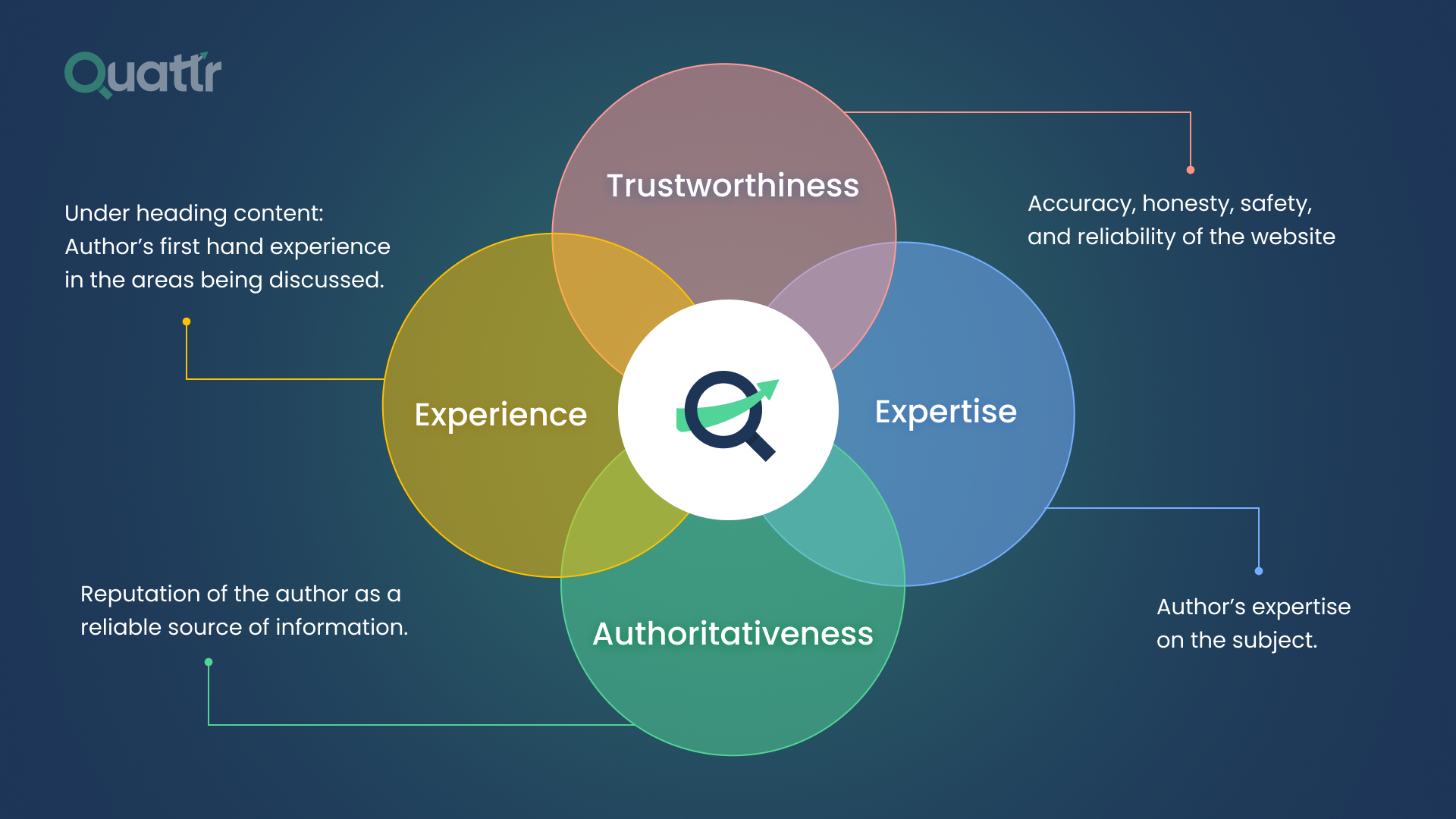
Experience means the content creator has real, first-hand involvement with the topic. It goes beyond basic research. It shows that the writer has actually used, tested, or personally dealt with what they are talking about. Google values lived experience because it makes content more authentic and helpful.
In the AI era, this is even more important. AI tools can generate information quickly, but they cannot replace genuine human experience. Content that includes personal insights, real examples, screenshots, case studies, or lessons learned stands out from generic AI-written text.
Example
An author writing about Google E-E-A-T shares real examples of how their website improved rankings after updating author bios, adding expert quotes, and improving content accuracy. They include data, before-and-after results, and practical insights from their own experiments.
Expertise means the writer has strong knowledge, skills, or qualifications in the topic they are covering. This could come from formal education, professional experience, or years of working in the field.
In today’s AI-driven search landscape, expertise helps separate surface-level content from in-depth, reliable information. AI systems and search engines prefer content that demonstrates deep understanding rather than generic summaries.
Example
An SEO professional explaining Google E-E-A-T shares technical insights, references official guidelines, and explains how algorithm updates affect rankings. The content reflects real industry knowledge, not just copied definitions.
Authoritativeness refers to reputation. It shows whether the website or author is recognized as a trusted voice in their industry. This is built over time through consistent, high-quality content, mentions, backlinks, and positive brand recognition.
In the AI world, authority plays a major role because AI platforms often rely on well-known and reputable sources when generating answers. If your brand is seen as credible, it is more likely to be cited or referenced.
Example
A digital marketing website that regularly publishes research-backed SEO studies and is frequently quoted by other industry blogs becomes known as a reliable source. Over time, both Google and AI platforms treat it as authoritative.
Trustworthiness is the foundation of E-E-A-T. It focuses on accuracy, transparency, safety, and honesty. Even if content shows experience and expertise, it must still be reliable and factually correct.
In the age of AI-generated content, misinformation spreads quickly. That is why trust is critical. Search engines and AI systems prioritize content that provides clear sources, updated information, secure browsing, and transparent authorship.
Example
An article about Google E-E-A-T includes references to official guidelines, clearly states who wrote it, shows the last updated date, avoids misleading claims, and ensures the website is secure. This builds confidence for both users and search systems.
In the AI era, strong Experience, Expertise, Authoritativeness, and Trustworthiness are not optional. They help your content stand out from automated content, improve search rankings, and increase your chances of being cited in AI-generated answers.
There are many misunderstandings about Google E-E-A-T. It is important to know that E-E-A-T is not a technical setting you can switch on. It is a quality guideline that helps Google identify helpful and trustworthy content. Here are some common myths explained in simple terms:
E-E-A-T is not a single ranking signal like page speed or mobile friendliness. It is a concept that helps Google’s systems understand content quality. Strong E-E-A-T often leads to better rankings, but it is not a standalone metric.
Google does not assign a public score or number for E-E-A-T. There is no dashboard where you can see your “E-E-A-T rating.” It is evaluated through many signals related to content quality and trust.
You cannot improve E-E-A-T just by adding an author bio or a few credentials. Real experience, expertise, and authority are built over time through consistent, high-quality content and a good reputation.
E-E-A-T is especially important for YMYL topics like health and finance, but it applies to all types of websites. Every site needs to show trust and credibility, even if the level of scrutiny differs.
Adding “Reviewed by” or listing qualifications helps, but it is not enough on its own. Google looks for real expertise, accurate information, and a trustworthy online presence.
E-E-A-T is not a new algorithm. It has been part of Google’s quality guidelines for years and continues to guide how content quality is assessed.
In simple terms, E-E-A-T is not a checklist or shortcut for instant rankings. It is a set of principles that reflect content quality, credibility, and user trust. When you focus on genuinely helping users, strong E-E-A-T naturally follows.
Google E-E-A-T is important because it helps search engines and AI systems decide which content is trustworthy, helpful, and worth showing to users. Here are some key reasons why Google E-E-A-T matters:
When your content shows real experience and knowledge, Google is more likely to trust it. Trusted content has a better chance of appearing higher in search results.
If you write about health, finance, safety, or legal advice, Google checks your content very carefully. This is to protect users from harmful or incorrect information.
With so much AI-generated content online, Google wants to show information created with real knowledge and true experience. E-E-A-T helps filter out weak or unreliable content.
When people see clear, accurate, and honest information, they trust your website more. This increases engagement and improves your brand reputation.
AI tools and search systems choose sources they trust. Strong E-E-A-T increases your chances of being mentioned or cited in AI-generated answers.
In simple words, Google E-E-A-T is about proving that your content is helpful, accurate, and created by someone who truly understands the topic.
Building E-E-A-T in the AI era is not about tricks. It is about proving that your content is real, helpful, and trustworthy. Here are practical and easy-to-understand ways to do that.

Make sure your content is written or reviewed by someone who actually knows the topic. This could be a professional, a specialist, or someone with real-life experience.
Do not publish content under names like “Admin.” Show the real person behind the article. Add their name, photo, background, and why they are qualified.
In the AI era, search engines and AI tools look for clear signals about who created the content. When they see real experts, your credibility increases.
Ask customers to leave honest reviews on platforms like Google, G2, Trustpilot, Reddit, or industry forums.
AI systems often read these public discussions. When real users talk about their experience with your brand, it builds strong trust signals.
Also respond to reviews, both positive and negative. This shows transparency and responsibility.
Do not just repeat what every other website is saying. Add original insights, real examples, case studies, research, or personal experiences.
For example, instead of writing general tips, share results from your own test or experiment.
Search engines and AI platforms prefer content that adds new value, not copied ideas.
Use related keywords and explain topics clearly so search engines understand what your content is about.
For example, if you write about SEO, also naturally include terms like search engine optimization, rankings, organic traffic, and keyword research.
Also connect related articles through internal links. This helps Google understand your expertise in a topic area.
A strong reputation improves both search rankings and AI visibility.
Encourage reviews, testimonials, and feedback. Display them clearly on your website.
If someone leaves a negative review, respond professionally. How you handle criticism also builds trust.
When other respected websites mention or link to you, it improves your authority.
You can do this through guest articles, interviews, digital PR, podcasts, webinars, or expert quotes.
When trusted sites talk about you, search engines and AI systems see you as more reliable.
You want people to remember your brand when they need a solution.
Create consistent messaging, visuals, and positioning. Publish helpful content that solves real problems.
If people search for your brand name directly, it sends strong authority signals to Google.
Each author should have a profile page with:
A photo
Their experience and qualifications
Links to their other articles
Social media or professional profiles
This makes it easy for users and AI systems to verify expertise.
Your About page should clearly explain:
Who you are
What you do
Your experience
Your team
Contact details
Google’s quality guidelines recommend checking this page to understand a website’s credibility.
Make sure your website includes:
Privacy policy
Terms and conditions
Contact page
Clear refund or return policy if applicable
Without these, users may not trust your site. These are basic but important signals.
A secure and fast website builds trust.
Important technical factors include:
Fast loading speed
Mobile-friendly design
Easy navigation
If your website is slow or insecure, it reduces trust for both users and search engines.
In the AI era, E-E-A-T is not optional. Search engines rank your content based on trust signals. AI platforms decide whether to mention or cite you based on credibility.
If you consistently show real experience, strong expertise, authority, and trustworthiness, your content will stand out across both traditional search and AI-generated answers.
Building Google E-E-A-T is not just about adding an author bio or writing long content. It requires a smart content strategy, strong internal linking, and clear topic authority. This is where Quattr’s AI-powered SEO platform can support your efforts.
Quattr helps you identify high-intent topics, content gaps, and keyword clusters so you can build deep expertise around a subject instead of publishing scattered articles. By creating structured content around core themes, your website demonstrates stronger topical authority, an important signal for Authoritativeness.
Its AI-driven internal linking recommendations also help connect related pages naturally. Strong internal linking improves content discoverability, distributes authority across pages, and reinforces your expertise in a specific niche, all of which support E-E-A-T.
Quattr also helps optimize content based on search intent, ensuring your articles are helpful, relevant, and people-first. When your content truly answers user questions, it improves engagement, builds trust, and strengthens long-term credibility.
In short, Quattr helps you create structured, intent-driven, and well-connected content, making it easier to demonstrate Experience, Expertise, Authoritativeness, and Trustworthiness in the AI era.
Google’s E-E-A-T stands for Experience, Expertise, Authoritativeness, and Trustworthiness, criteria used in its Search Quality Rater Guidelines to evaluate content quality for organic search rankings. It mainly impacts SEO performance and does not directly apply to paid advertising like Google Ads or remarketing campaigns.
A practical example of E-E-A-T in action is website security. A site that uses HTTPS encryption protects user data, which builds credibility and reliability in Google’s eyes. Since HTTPS is also a ranking factor, it reinforces the trust aspect of E-E-A-T within search algorithms.
E-E-A-T itself isn’t a single measurable ranking factor like page speed or HTTPS. Instead, it’s a framework Google uses to assess content quality, and its principles are reflected in various ranking signals within the algorithm.
You can strengthen E-E-A-T by showcasing author credentials, adding real-world experience, earning authoritative backlinks, citing trustworthy sources, maintaining accurate content, and ensuring your site is secure and transparent (e.g., clear contact and privacy information).
Yes, but it’s especially important for “Your Money or Your Life” (YMYL) topics like health, finance, and legal advice. For these areas, Google applies stricter quality standards because inaccurate information could significantly impact users’ well-being or financial stability.

Quattr is an AI-native Search Visibility Platform founded in Palo Alto, California, built for mid-market and enterprise brands competing in the age of generative search. Recently recognized across G2’s Spring 2026 reports with #1 rankings in AEO Results, Usability, and Relationship, Quattr helps brands win visibility across traditional search and AI-generated answer surfaces.
Quattr’s AI agent, GIGA, evaluates content the way AI systems do, identifying gaps across structure, authority, internal linking, and discoverability to surface the highest-impact fixes. With capabilities like autonomous internal linking, E-E-A-T intelligence, and the new GIGA Landing Page Generator for keyword-matched, AI-search-ready pages, Quattr helps teams move from diagnosis to deployed changes without manual bottlenecks.


Try our growth engine for free with a test drive.
Our AI SEO platform will analyze your website and provide you with insights on the top opportunities for your site across content, experience, and discoverability metrics that are actionable and personalized to your brand.


.svg)
.svg)


