Quattr Leads AEO, SEO, and Content Rankings on G2 Spring 2026.
Quattr Leads AEO, SEO, and Content Rankings on G2 Spring 2026.


Struggling to improve your SEO even though your content is good? The problem might not be your content at all. It could be how your pages are connected to each other.
Internal links are how search engines and AI tools understand your website. When they are broken, missing, or messy, even your best pages can go unnoticed.
In this guide we will walk through how to audit your internal links, find what is holding your site back, and fix it in a way that helps both rankings and AI visibility.
8.
9.
10.
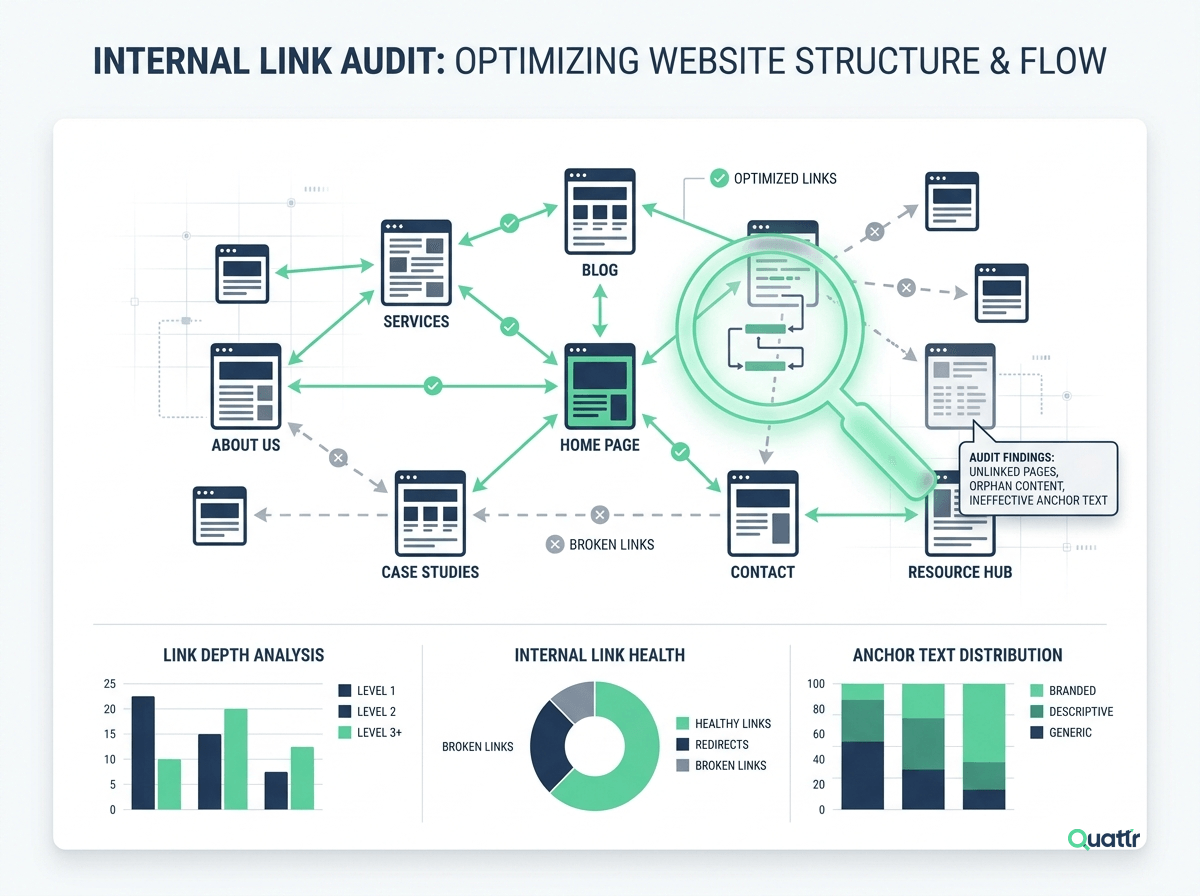
An internal link audit is a thorough review of all the links connecting different pages on your website. The goal is to improve how your site is organized, make it easier for visitors to navigate, and strengthen your search rankings and AI citations. This process finds issues like broken links, pages with no links pointing to them, and helps spread ranking power to your most important content.
Here's the thing - most website owners are missing out big time. A recent study showed that more than 80% of link opportunities get completely overlooked. Internal linking isn't just some SEO checkbox; it's how Google understands what matters, and decides which pages deserve to rank.
That's why an internal linking audit plays a critical role in SEO because it reveals how well your website’s pages are connected and whether search engines can easily crawl and understand your content.
By reviewing internal links, you can identify orphan pages, broken links, and pages that receive little or no link authority. A proper audit ensures important pages are linked from relevant sections of the site, helping distribute authority more effectively, improve crawl efficiency, and guide users to key content. Over time, this leads to better indexing, stronger rankings, and a smoother user experience.
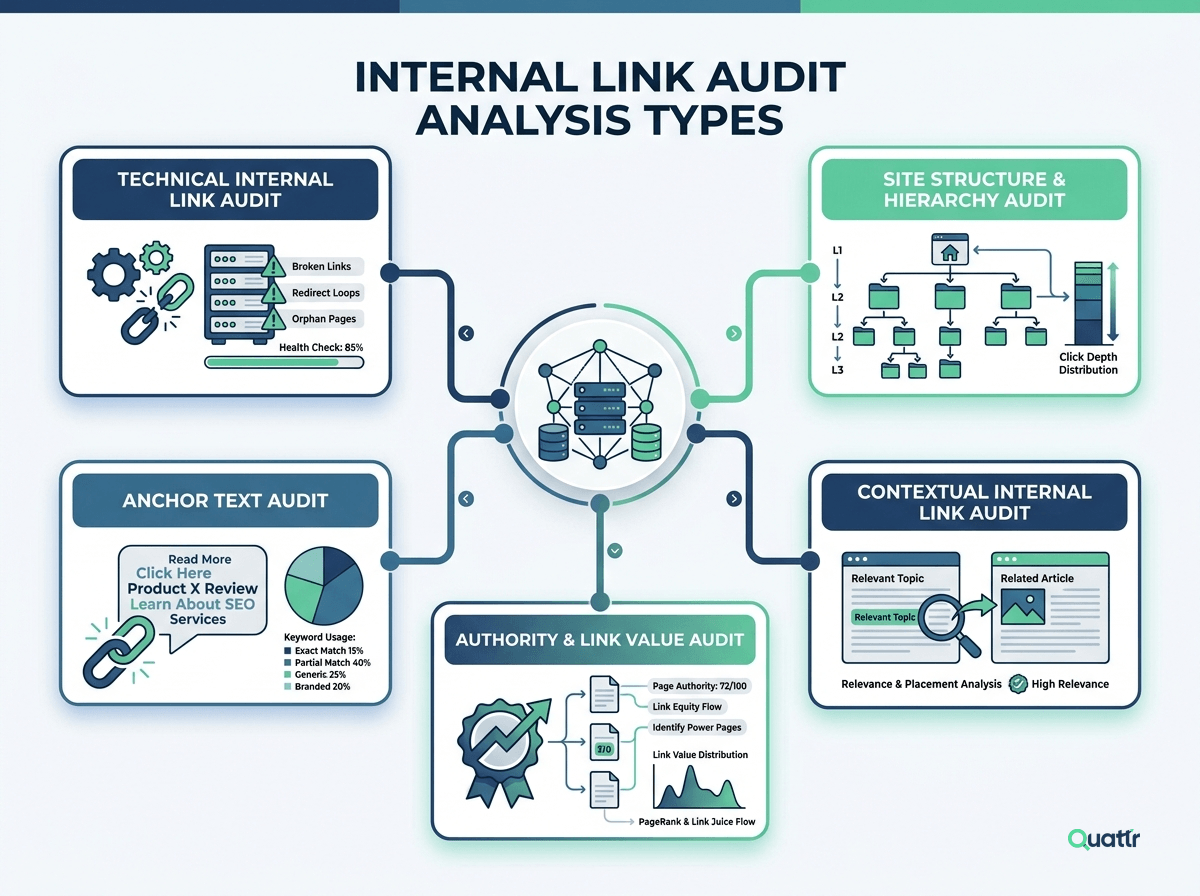
This audit focuses on identifying technical issues that block link equity flow, such as broken internal links (404 errors), redirect chains or loops (301/302), incorrect canonical tags, and unnecessary nofollow attributes. Fixing these ensures search engines can properly crawl and pass PageRank across your site.
A structural audit evaluates your internal linking architecture by analyzing crawl depth, click distance, and page accessibility. It helps uncover orphan pages (pages with no internal links) and highlights areas where important pages are buried too deep in the site structure.
This analysis reviews internal link anchor text to eliminate generic phrases like “click here” and detect over-optimized anchors. The goal is to use descriptive, relevant anchor text that improves topical relevance and helps search engines understand page context.
A contextual audit examines links placed within the main content of a page rather than menus or footers. These links carry more SEO value because they are surrounded by relevant text and reinforce topical relationships between pages.
This audit assesses how internal link equity is distributed across your website. It ensures high-value pages, such as service pages, product pages, and cornerstone content, receive sufficient internal links, rather than wasting authority on low-priority pages.
A comprehensive internal link audit relies on a suite of powerful tools
1. Screaming Frog: Essential for website crawling, identifying broken links, redirect chains, and analyzing crawl depth and anchor text
2. Google Search Console: Offers invaluable insights directly from Google, revealing indexability issues and how Google perceives your internal links
3. Ahrefs and Semrush: Leading SEO suites that provide extensive site audits, detailed internal link reports, and competitive analysis to uncover linking opportunities
The first step to running a successful internal link audit is to pull data to understand the current linking status of your website. You need to start with crawling your website. Web crawling tools such as Screaming Frog and Deep Crawl let you crawl your website and pull out the entire link source data.
The report generated gives you an insight on total number of internal links, outbound links to internal pages and status of indexibility of these pages on your website.
Remember, an internal link audit also aims to determine how many pages on your website are indexable. Therefore, it is highly important to map out the non-indexable pages at this stage.
Comprehensive crawling will lay the groundwork for identifying broken links, optimizing link depth, and ensuring a strategic distribution of link equity across your site.
The report generated via the crawl will furnish you with critical insights into the total number of internal links, the existing outbound links leading to internal pages, and the indexability status of these pages.
Scrutinize the crawl data to identify any broken internal links. These can severely impact user experience and crawl efficiency. Ensure that all broken links are either corrected or redirected appropriately.
Evaluate the crawl depth of your internal links. Pages should ideally be accessible within three clicks from the homepage to ensure optimal crawlability and user navigation. Adjust your linking structure if necessary to adhere to this principle.
Identify orphan pages – those that are not linked to from any other page on your site. These pages are isolated in terms of internal linking and can be challenging for search engines to discover. Ensure these pages are integrated into your internal linking structure.
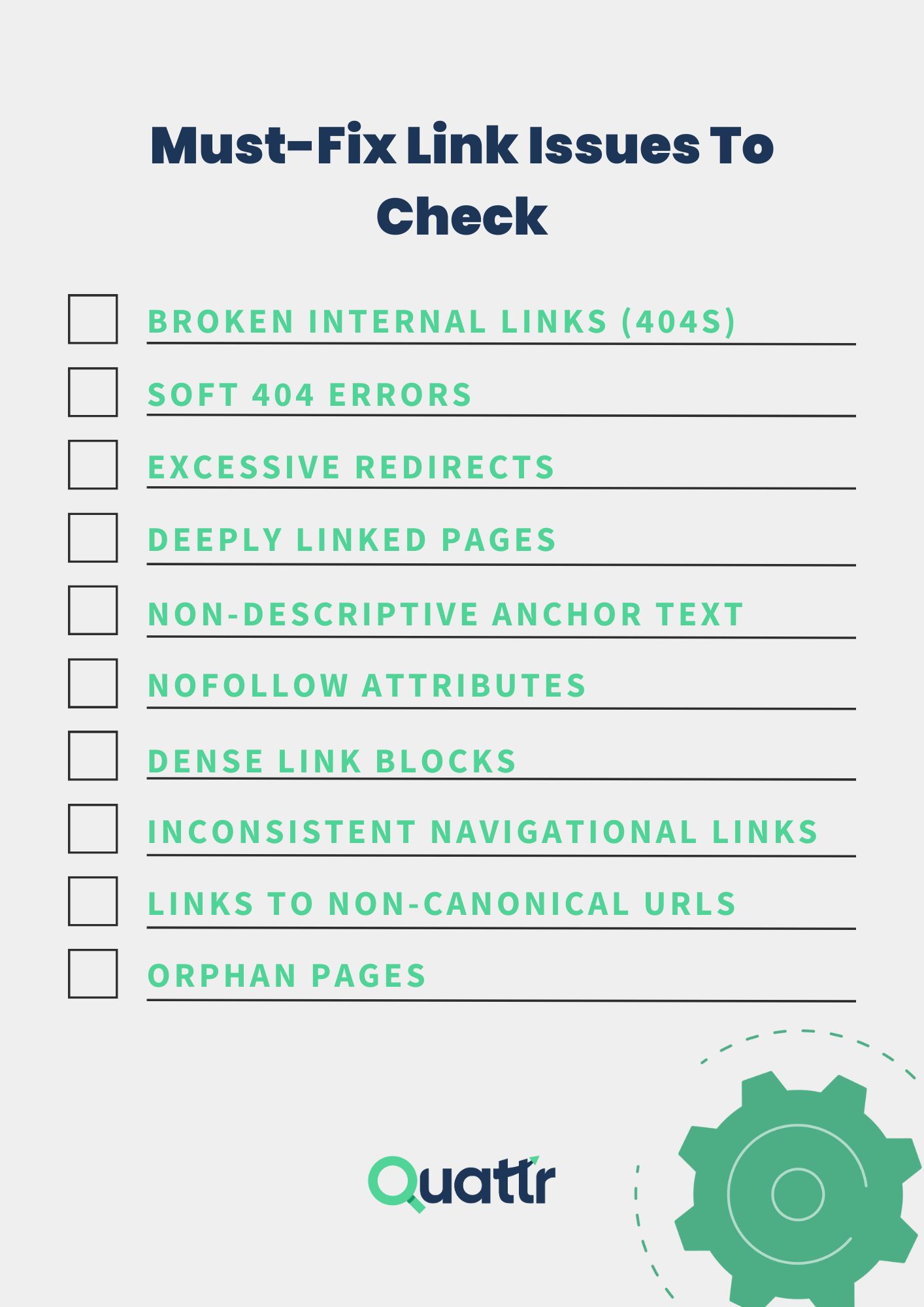
Check for any excessive internal redirects which can create unnecessary complexity and hinder crawl efficiency. Where possible, replace redirected links with direct links to streamline the user journey.
Regular maintenance of your internal link structure is paramount to sustaining a seamless user journey and optimal crawl efficiency.
Internal redirects, especially chains and loops, can hinder effective link equity distribution and degrade crawl efficiency. Replace such links with direct links wherever possible to streamline equity flow and enhance crawl performance.
Your site’s link depth, the number of clicks it takes to reach specific pages from the homepage is a critical factor in both user navigation and search engine crawling. Best practices recommend that important pages should be no more than three clicks away from the homepage.
Utilize the crawl report to evaluate the current link depth of your site. Identify pages that are buried too deeply and reassess their necessity or consider integrating them more strategically into your internal linking framework.
During your internal link audit, identifying pages with few or no internal links pointing to them (low 'inlink' counts) is crucial. These pages, often called 'orphan' or 'poorly linked' pages, struggle to be discovered by search engines and receive minimal link equity, hindering their ranking potential.
To boost their visibility
i. Map these pages to relevant topic clusters or content pillars on your site.
ii. Strategically add relevant, contextual internal links from higher-authority pages (like pillar pages or relevant blog posts) pointing to these underlinked pages. Ensure the anchor text used is descriptive and relevant.
iii. If they are truly valuable, consider adding them to navigation menus or footer links where appropriate, though contextual links are often preferred.
Track the inlink counts and performance (traffic, rankings) of these pages after implementing changes to measure the impact of your improved internal linking strategy.
Achieving an optimal internal linking structure extends beyond eliminating broken links and ensuring a shallow link depth. It involves strategically enhancing content accessibility and relevance through meticulously planned internal links. Here’s how to advance this step:
Identify Key Content Pillars: Determine which pages serve as cornerstone content for your website. These are generally high-value pages that provide significant information. Ensure these pages are internally linked from various relevant parts of your site to enhance their visibility and authority.
Optimize Internal Link Context: Analyze the context in which internal links are placed. The surrounding content should be relevant and provide a seamless transition for the user, thereby improving the overall user experience. Employ keyword-rich anchor text that is descriptive and contextually appropriate to reinforce the topic and improve search engine understanding.
Leverage Topic Clusters: Group related content together through internal links to form topic clusters. This not only aids users in navigating related information but also signals to search engines the thematic relevance of linked pages, thereby enhancing topical authority.
The final step in your internal link audit involves a detailed examination of how link equity, also known as "link juice," is distributed across your website. Effective link equity distribution can significantly impact the ranking potential of various pages. Here’s how to approach this:
Audit High-Authority Pages: Identify pages with substantial external backlinks and high PageRank. Ensure these pages are effectively distributing their link equity to other important but lower-authority pages within your site. This can elevate the overall authority and ranking potential of these lower-authority pages.
Balance Internal Links: Avoid overloading individual pages with excessive internal links, which can dilute their link equity and diminish their SEO impact. Aim for a balanced approach where link equity is judiciously distributed across relevant internal pages.
Compile a comprehensive internal link audit report capturing your findings and proposing informed modifications. Implement these changes methodically, prioritizing actions based on their potential impact on SEO performance.
1. Organize your site architecture around robust content pillars and supporting topic clusters to enhance user navigation and signal thematic relevance to search engines.
2. Employ relevant and varied anchor text that accurately describes the linked content, optimizing for discoverability while avoiding keyword stuffing.
3. Maintain shallow crawl depth for critical pages, ideally within three clicks of the homepage to boost crawlability and user experience.
4. Integrate links naturally within your content, connecting new and old pages to distribute link equity effectively throughout your site.
5. Regularly conduct an internal link audit to identify and capitalize on optimization opportunities, maintaining a healthy internal link structure for continuous SEO gains.
After completing an internal link audit, evaluate its impact by tracking key performance indicators influenced by your linking strategy. Monitor organic traffic growth and keyword ranking shifts for pages that received new or optimized internal links.
A successful audit should improve visibility for underperforming pages, signaling better content discoverability and enhanced link equity distribution. This confirms positive SEO outcomes across your site.
Use Google Search Console to analyze technical metrics like crawl stats and index coverage, indicating search engines are finding more important content. These insights reveal how efficiently your site is being processed.
Monitor user engagement metrics such as reduced bounce rate and increased time on page for previously difficult-to-navigate pages. Set up reporting dashboards to visualize trends and identify ongoing opportunities for refining internal links.
In today's AI driven world, internal linking matters more than ever. AI crawlers rely on internal links to discover and understand your pages without extra effort on your end. A well linked site gets crawled more efficiently, understood more clearly, and recommended more confidently by AI tools.
But doing this manually is slow and easy to get wrong. That is where Quattr's Internal Linking AI comes in.
It analyzes your site structure, finds the most valuable linking opportunities you are missing, and automates the process with precision. No hours spent manually adding links.
The result is a site that distributes link equity efficiently, builds page authority naturally, and becomes significantly easier for both search engines and AI tools to crawl and understand. More visibility, more traffic, and content that finally gets the attention it deserves.
Yes, you can audit your internal links manually by reviewing each page on your website and checking the links within the content to ensure they are relevant and functional. This process, while thorough, can be time-consuming and prone to human error. Leveraging a tool like Quattr Internal Linking can automate this task by efficiently adding internal links using semantically relevant anchor texts & deploying them using an API - saving you time and enhancing your site's SEO.
A link audit is the process of reviewing all the links pointing to your website to understand how they affect your SEO. It looks at where each link comes from, the quality of the site, and the anchor text used, to see whether the link is helping your rankings or causing harm. This helps you identify strong links to keep and weak or risky links that may need fixing or removal.
To find new internal linking opportunities, use tools like Google Search Console to identify pages with high authority and relevance. Analyze your existing content for related topics and keywords, then incorporate contextual links that naturally fit within the content to guide users to additional useful information.
An Internal Link Opportunities Report identifies pages on your site that can benefit from additional internal links, helping to improve user navigation and search engine indexing.
The ideal frequency for an internal link audit varies significantly by website. Small sites with infrequent content updates may only require a bi-annual or quarterly audit. For medium to large websites, especially those with frequent content additions or undergoing site migrations, a monthly or quarterly internal link audit is crucial to prevent crawlability mistakes and ensure optimal internal links. Additionally, any major website redesign or structural change necessitates an immediate, comprehensive internal link audit for SEO.

Quattr is an AI-native Search Visibility Platform founded in Palo Alto, California, built for mid-market and enterprise brands competing in the age of generative search. Recently recognized across G2’s Spring 2026 reports with #1 rankings in AEO Results, Usability, and Relationship, Quattr helps brands win visibility across traditional search and AI-generated answer surfaces.
Quattr’s AI agent, GIGA, evaluates content the way AI systems do, identifying gaps across structure, authority, internal linking, and discoverability to surface the highest-impact fixes. With capabilities like autonomous internal linking, E-E-A-T intelligence, and the new GIGA Landing Page Generator for keyword-matched, AI-search-ready pages, Quattr helps teams move from diagnosis to deployed changes without manual bottlenecks.


Try our growth engine for free with a test drive.
Our AI SEO platform will analyze your website and provide you with insights on the top opportunities for your site across content, experience, and discoverability metrics that are actionable and personalized to your brand.


.svg)
.svg)


