

Key Takeaways
- Preferred Sources isn’t new, but on May 27, 2026 it landed somewhere that matters: AI Overviews and AI Mode. Until then it only touched Top Stories. That’s the part worth paying attention to.
- It’s a user-controlled signal, which is rare. A reader picks the sites they trust, and your links get a visible “Preferred” badge inside AI answers. Google says people are about twice as likely to click a preferred source.
- Eligibility is wide open. Google says any site that publishes fresh content qualifies, not just news publishers. The one catch: it works at the domain or subdomain level, never a subdirectory.
- You can’t make someone pick you. But you can remove the friction with a deeplink and a button. Google itself suggests both, and neither is required to be eligible.
I’ve been watching the AI search visibility conversation closely for a long time now: it’s opaque, it’s indirect, and a model ultimately decides whether to cite you. Preferred Sources is one of the few things in this space that works the other way around. A reader pulls the lever on purpose in your favor. And as of May 27, 2026, that lever reaches the AI answers at the top of the results page, not just Top Stories.
Most of the coverage I saw folded that into the older Top Stories story and undersold what changed. So I want to be precise about what actually shipped, what it does, and what’s worth doing about it.
First, what’s actually new here
Preferred Sources has been around a while. Based on reporting about the launch, it began as a Search Labs experiment in mid-2025 and rolled out globally across Top Stories over the following months. That part isn’t the news.
The news is the surface. On May 27, 2026, Google announced that Preferred Sources now extends into AI Overviews and AI Mode. Before that, picking a site as a preferred source only affected your Top Stories carousel. Now, according to Google, it can shape the AI-generated answer itself. Given how much of the results page those answers occupy, that’s not a small move.
Here’s the mechanic as Google describes it. A reader goes into their Search personalization settings, opens the source preferences tool, and adds the sites they want more of. From then on, when one of those sites appears in an AI Overview, AI Mode response, or Top Stories, its link carries a “Preferred” badge that stands out in the answer.
That’s it on the reader’s side. And notably, there’s nothing to implement on your end. No markup, no schema, nothing on the page. The signal lives in the reader’s account.
Why a user-controlled signal is a big deal
Two numbers from Google frame the opportunity. Google says people are roughly twice as likely to click through to a preferred source, and that users have already selected more than 345,000 unique sources. So this isn’t a dormant setting nobody touches; people are actively curating who they want to hear from, and the sites they pick get an engagement bump.
The timing is notable because Google is simultaneously expanding other trust and attribution signals inside AI-generated results. Just days after extending Preferred Sources into AI Overviews and AI Mode, Google also expanded the Highly Cited badge beyond Google News into broader Search experiences.
What strikes me about that is how different it is from everything else in AI search. Citations, rankings, and fan-out coverage are all part of the model deciding about you. Preferred Sources is a person deciding about you and telling Google to remember it. That selection then follows the reader across surfaces rather than getting recalculated on every query.
The honest part, because this is where the hype tends to live
You’re going to see this framed as a switch that guarantees you show up. From what Google has actually said, it isn’t, and I’d rather flag that now.
Per the launch coverage, the “Preferred” badge currently appears when your selected sites happen to surface in a response, and Google’s documentation notes that preferred-source selections don’t override relevance. Being selected doesn’t force you into an answer you wouldn’t otherwise fit.
What Google has said is that it’s working toward using Preferred Sources as a ranking signal across its AI features in the future, so selected sites would appear more often. That’s stated as a direction, not as something live today. So the way I’d read it for now: it’s a thumb on the scale that rewards sites a reader already trusts, not a backdoor into answers you haven’t earned.
Which, honestly, lines up with how the rest of AI search behaves. These systems reward sources people find genuinely useful. Preferred Sources just makes that preference explicit and lets the reader cast the vote directly.
Are you eligible? (Probably)
The bar is lower than a lot of people assume. Google says any website that publishes fresh content is eligible to be selected across Search, AI Mode, and AI Overviews. From the reporting, this is not limited to news publishers; the coverage specifically calls out that blogs and other regularly publishing sites qualify, as long as they appear in the source preferences tool.
There’s one structural rule worth knowing. Per Google’s documentation, eligibility works at the domain and subdomain level only. So example.com and blog.example.com are eligible, but a subdirectory like example.com/blog is not. If your content lives entirely in a subdirectory, that’s worth factoring in before you build anything.
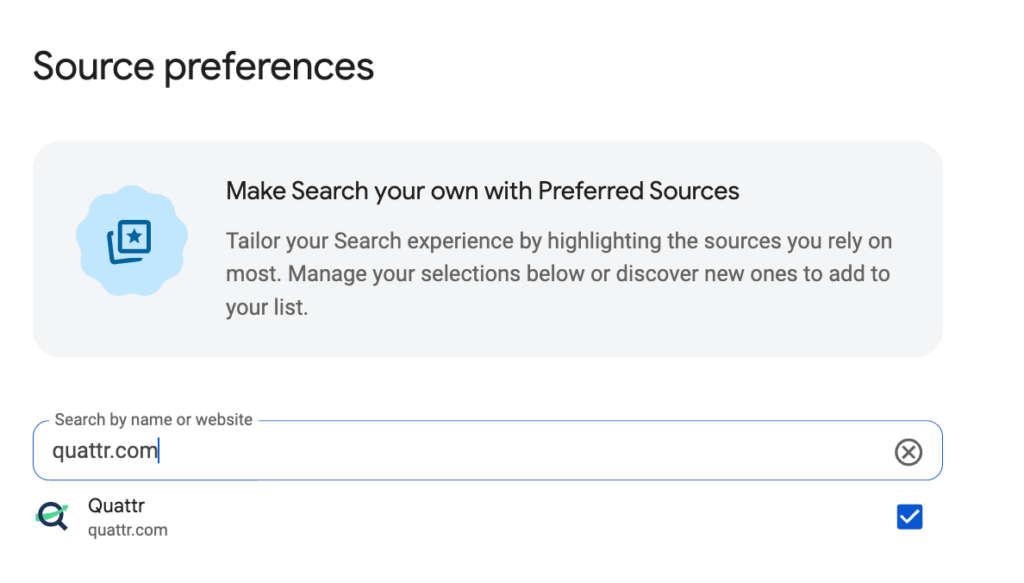
Google’s own suggestion for checking: enter your site in the source preferences tool’s search box. If it appears, you’re eligible. I’d do this before any design work, because if you don’t surface yet, a button would point readers nowhere useful.
Check this below:
What’s actually worth doing
You can’t select your own site on someone else’s behalf, and Google is explicit that none of the following is required to be eligible. They’re just the methods Google itself lists for guiding readers who already like your work toward formalizing that preference. There are two.
1. Add the deeplink wherever you already have a CTA
Google provides a URL format that takes a reader straight to your site inside the source preferences tool:
https://google.com/preferences/source?q=Your_Websites_URLSo if your site is example.com, Google’s example format becomes:
https://google.com/preferences/source?q=example.comPut it in newsletter footers, social bios, post CTAs, anywhere you already ask people to follow or subscribe. The value is purely in removing friction. Most readers won’t dig through Search settings on their own; hand them the link, and some portion will use it.
2. Add a “preferred source” button to your site
Google suggests placing a button alongside your other social CTAs. You can design your own or download Google’s official button assets, which it provides for a range of languages, including English, French, German, Spanish, Portuguese (Brazil), Japanese, Korean, Hindi, Hebrew, Russian, Ukrainian, Turkish, and several Nordic and Baltic ones. Google also notes the feature itself is available in all languages Google Search supports, not only those with downloadable assets, so a custom button works fine if yours isn’t listed.
If I were building it, I’d give the button a clear label rather than reusing a round social-icon style. A LinkedIn or X icon explains itself; “set us as a preferred source” doesn’t yet, so a labeled button is easier for a reader to act on.
Where this fits in the bigger picture
I wouldn’t treat Preferred Sources as a growth hack. It rewards an audience relationship you already have; it can’t manufacture one. The sites that benefit are the ones publishing content people actively want more of, which is the same foundation that drives citations and rankings anyway. The button banks goodwill the work already earned; it doesn’t replace the work.
The thread I’d pull, though, is the direction. As AI surfaces take over more of the results page, Google is building user-controlled levers into them, and Preferred Sources is the first major one to reach AI Overviews. Google has signaled it intends to weight these selections more heavily over time. Getting familiar now with how an audience-driven signal behaves, before it becomes a stronger ranking input rather than just a badge, seems like time well spent.
So: confirm your eligibility, add the deeplink to the places you already promote, add the button, and keep doing the slower work that earns the selection in the first place.
Want to see how your site is performing across AI search surfaces, from citation share to preferred-source eligibility? Quattr’s AI Search Visibility platform tracks how your authority is read across AI layers and where the structural gaps are. Book a demo to baseline where you stand.
FAQs on Google Preferred Sources
Based on Google’s documentation and the launch coverage, no. The “Preferred” badge currently appears when a selected site happens to surface in a response, and selections don’t override relevance. Google has said it’s working toward making Preferred Sources a ranking signal in its AI features in the future, but as described, it currently affects badging and prominence rather than guaranteeing inclusion.
No. Google says any website that publishes fresh content is eligible. The feature has a history with news and Top Stories, but the coverage notes eligibility extends to blogs and other regularly updated sites that appear in the source preferences tool.
No. Per Google’s documentation, only domain-level and subdomain-level sites are eligible in the source preferences tool. So example.com or blog.example.com work, but example.com/blog doesn’t.
The mechanic is the same; a reader-selected site gets a “Preferred” badge, but the surface expanded. Preferred Sources had been live in Top Stories; the May 27 announcement brought it into AI Overviews and AI Mode, so the badge now appears inside AI-generated answers.
No. The signal lives in the reader’s Google account, not on your site. The only optional on-site element is a button or link pointing readers to the source preferences tool.

Quattr is an AI-native Search Visibility Platform founded in Palo Alto, California, built for mid-market and enterprise brands competing in the age of generative search. Recently recognized across G2's Spring 2026 reports with #1 rankings in AEO Results, Usability, and Relationship, Quattr helps brands win visibility across traditional search and AI-generated answer surfaces.
Quattr's AI agent, GIGA, evaluates content the way AI systems do, identifying gaps across structure, authority, internal linking, and discoverability to surface the highest-impact fixes. With capabilities like autonomous internal linking, E-E-A-T intelligence, and the new GIGA Landing Page Generator for keyword-matched, AI-search-ready pages, Quattr helps teams move from diagnosis to deployed changes without manual bottlenecks.