
Commercial pages can still rank, but their visibility inside AI Overview citations appears less durable than their visibility in the classic top-10 SERP.
For years, SEO teams have treated page-one rankings as the most durable signal of search visibility. If a URL held a top-10 position, it had earned a stable place on the shelf.
AI Overviews are changing that model.
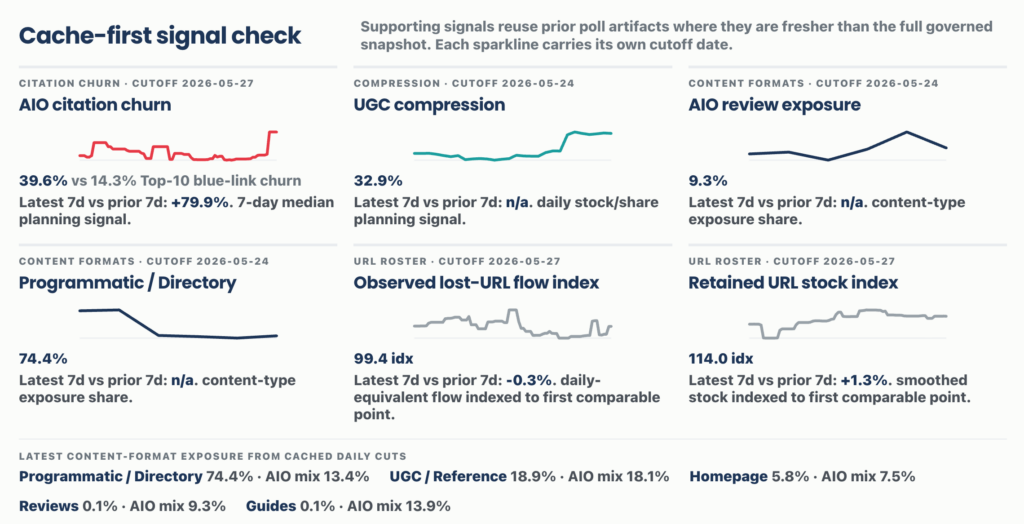
In Quattr’s May SERP telemetry, commercial article, list, review, and comparison templates rotated out of AI Overview citations faster than they rotated out of the classic top-10 blue-link frame. The latest planning signal shows 15.3% AIO citation dropout versus 12.1% top-10 blue-link dropout. The latest observed daily-equivalent rate was similar: 15.2% vs. 12.1%, or roughly 1.3x higher churn in the AIO citation layer.
The new SEO question is not only “Do we rank?” It is “Do we keep getting cited?”
The latest movement points in opposite directions
The most recent seven complete days moved differently across the two surfaces. AIO dropout was up 1.7% versus the previous seven days, while blue-link dropout was down 28.0%. Against the May 14–20 pre-marker baseline, AIO dropout was up 15.6%, while blue-link dropout was down 23.6%.
That does not mean a core update caused the shift. In this analysis, the May core marker is a date annotation only. The safer read is narrower: in observed page-one SERP telemetry, AIO citation sets were turning over faster than blue-link sets for the commercial-template cohort.
Review pages showed the widest gap
The pattern was visible across several commercial formats, but review pages showed the largest gap in the latest observed cuts.
| Commercial format | AIO dropout | Blue-link dropout | Read |
|---|---|---|---|
| Reviews | 20.5% | 12.9% | Widest AIO-vs-blue-link gap in the latest observed cuts. |
| Best / Top | 16.2% | 13.7% | AIO dropout remained higher, though the gap was smaller. |
| Comparisons | 12.1% | 8.4% | Lower absolute churn, but still higher in AIO citations. |
What this means for SEO teams
The operating model for organic visibility is splitting. Classic rank tracking still matters, but it no longer captures the full shelf-life of a URL in AI-shaped results.
Teams now need to measure citation retention alongside ranking retention. A URL that wins an AIO citation once has not necessarily earned a durable position in the answer layer. The more useful question is whether the same URL keeps being selected across repeated observations.
1. Track citation persistence, not just citation presence
A binary “cited or not cited” metric is useful for acquisition, but it misses retention. Track how many previously cited URLs remain in the citation set across comparable observations, and compare that against top-10 URL retention.
2. Separate AIO volatility from blue-link volatility
Do not assume a ranking change and an AIO citation change mean the same thing. The data here suggests the two layers can move differently, even for the same commercial page types.
3. Review commercial templates by evidence density
For review, comparison, and “best” pages, evaluate whether the page provides fresh, specific, citable support: original observations, product-level distinctions, clear update history, and concise answer blocks that can be used as support in an AI-generated summary.
4. Watch the pages that rank but stop getting cited
The most useful diagnostic segment may be URLs that remain in the top-10 frame but disappear from AIO citations. Those pages are still visible to Google Search, but they may be losing selection inside the answer layer.
The Bottom Line
AI Overview visibility has a shorter shelf life.
Commercial pages are not just competing to rank anymore. They are competing for repeated selection inside an answer layer that appears to rotate cited sources faster than the classic SERP rotates ranked URLs.
For SEO teams, that turns AIO visibility into a retention problem. Winning the citation is only the first step. Holding it is the new signal to watch.
Wondering if your commercial pages are holding their spots or quietly dropping out of the answer layer? Quattr’s AI Search Visibility platform tracks your citation persistence, quantifies template-level churn, and identifies exactly where your authority gaps live. Book a demo to baseline your true citation retention.

Quattr is an AI-native Search Visibility Platform founded in Palo Alto, California, built for mid-market and enterprise brands competing in the age of generative search. Recently recognized across G2's Spring 2026 reports with #1 rankings in AEO Results, Usability, and Relationship, Quattr helps brands win visibility across traditional search and AI-generated answer surfaces.
Quattr's AI agent, GIGA, evaluates content the way AI systems do, identifying gaps across structure, authority, internal linking, and discoverability to surface the highest-impact fixes. With capabilities like autonomous internal linking, E-E-A-T intelligence, and the new GIGA Landing Page Generator for keyword-matched, AI-search-ready pages, Quattr helps teams move from diagnosis to deployed changes without manual bottlenecks.