

AI Overviews have been reshaping search results for over a year now, and the pattern is clear: traditional ranking alone no longer guarantees visibility.
I’ve watched this play out across dozens of sites. Pages holding strong positions like #2, #3, and even #1, steadily losing traffic as AI Overviews claim more real estate at the top of results.
The ranking stays the same, but the clicks are reduced because users get their answers without scrolling past the AI summary.
The gap between sites that adapted early and those still treating AI Overviews as “just another SERP feature” keeps widening. Some brands show up in AI citations consistently. Others, despite ranking well organically, barely appear at all.
What separates them isn’t luck or gaming the system. It’s understanding what AI systems actually need to cite your content confidently, and building for that from the ground up.
This blog covers the top 6 (tried and tested) strategies to optimize your content for AI Overview. Let’s get started!
What is AI Overview?
AI Overviews are Google’s AI-generated summaries that appear at the top of search results for certain queries. Powered by Google’s Gemini model, they pull information from multiple web sources to create comprehensive answers directly in the search results.
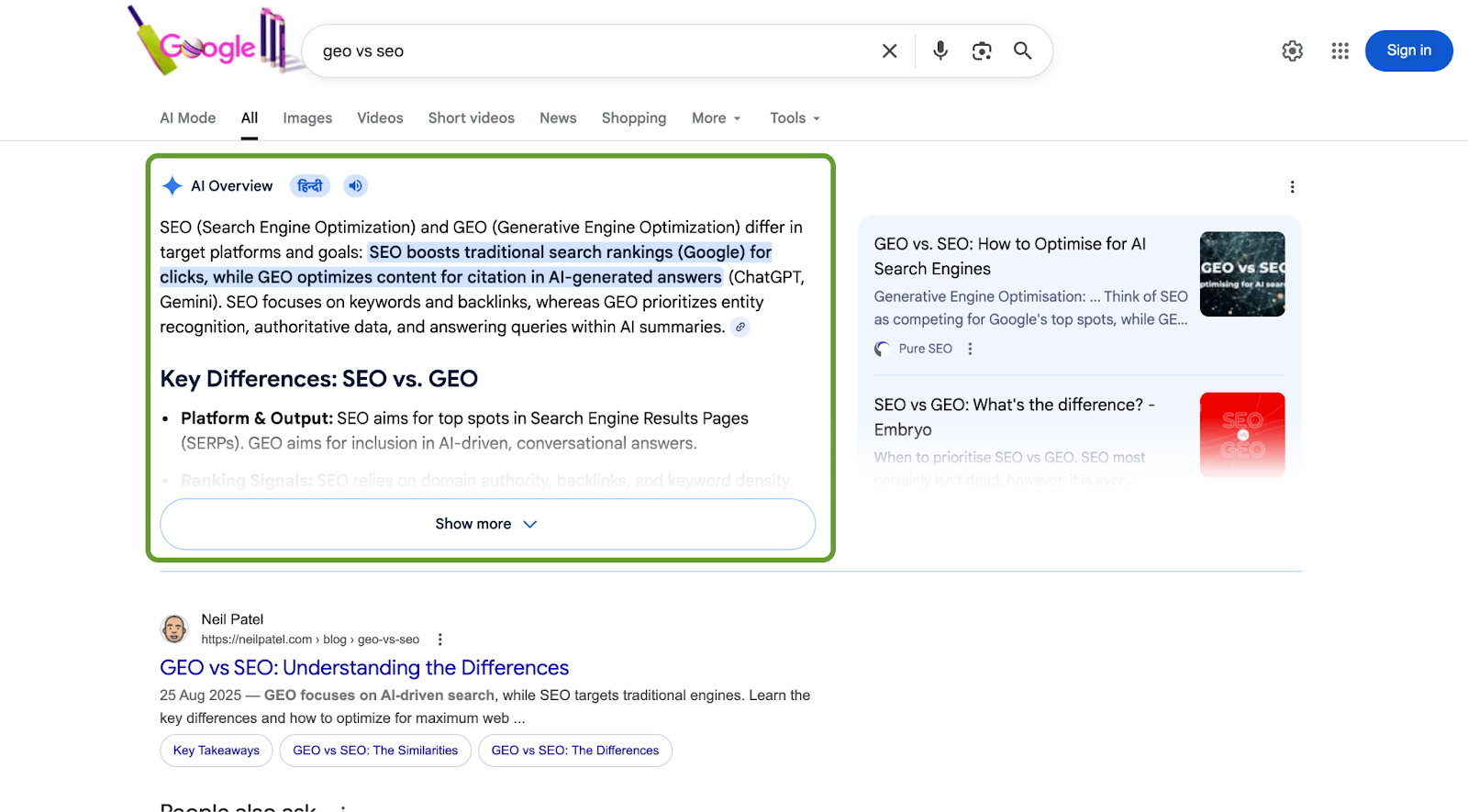
Unlike Featured Snippets that highlight a single source, AI Overviews synthesize content from several pages using what’s called Retrieval Augmented Generation (RAG). The result is a concise answer followed by expandable details and links to the sources cited.
According to Ahrefs’ analysis of 146 million search results, AI Overviews now appear in approximately 21% of all searches. For specific query types, especially informational “how to” and “what is” questions, that number climbs much higher.
As Google continues refining this feature, the presence of AI Overviews will only grow.
The Traffic Impact Nobody Wants to Talk About
The shift to AI-powered search creates a fundamental problem for websites: you can rank well organically and still become invisible.
In short, AI Overviews are crushing click-through rates.
Research from Seer Interactive found that click-through rates drop by up to 61% when AI Overviews appear.
Even more concerning: the number one position on a SERP with an AI Overview receives significantly lower clicks than the same position on a SERP without one.
But here’s where it gets interesting. If your page gets cited inside the AI Overview, you experience a different outcome entirely: a 35% increase in organic clicks compared to non-cited pages.
Clearly, the winners today aren’t the ones getting the most traffic but the ones getting cited.
Importance of Ranking in AI Overviews
Traffic remains the top reason as to why you should target to rank in AIOs.
However, beyond traffic, AI Overview citations build something more valuable: brand authority.
When your company appears as a trusted source in AI-generated answers, you’re establishing credibility with users who might never click through to your site. That recognition compounds over time.
The gap between cited and non-cited content will only widen as AI Overviews expand to more query types. Early adopters optimizing for AI visibility now are building advantages that will compound as these features become ubiquitous across search.
Sites creating informational content and ignoring AI Overview optimization are actively ceding visibility to competitors who aren’t.
How AI Overviews Actually Work
Understanding the mechanics helps you optimize for them.
AI Overviews use a process called Retrieval Augmented Generation (RAG). Google’s AI doesn’t just rely on its training data, it actively searches the web, retrieves current information, and uses that to generate answers.
This is why traditional search rankings still matter. According to Ahrefs’ analysis, 76% of URLs cited in AI Overviews also rank in the top 10 of traditional search results.
But AI Overviews don’t just pull from page one. During answer generation, Google performs “query fan-out,” breaking your search into multiple related sub-queries.
A question about “best project management tools” might fan out into queries about “project management features,” “team collaboration software,” and “project tracking systems.”
Pages that rank across these fan-out queries get cited more often. Research shows URLs ranking for multiple related queries are 161% more likely to appear in AI Overviews than pages ranking only for the primary term.
The Ranking Factors That Move the Needle
Let’s cut through the speculation. Based on analysis of millions of AI Overview citations, here’s what correlates with visibility.
Traditional Rankings Come First
You can’t skip the fundamentals. Sites need to rank in traditional search before AI Overviews will cite them. The median ranking position for top-cited URLs is position two.
Focus on improving your traditional search rankings first. AI visibility follows.
Content Structure Beats Content Length
There’s virtually no correlation between word count and AI citations. What matters is how well your content answers the query and how clearly it’s structured.
Answer the question directly, early in your content. AI systems evaluate semantic understanding, and burying your answer doesn’t help.
Brand Mentions Across the Web
Brand mentions across the web correlate strongly with AI Overview visibility. But there’s a critical caveat Google has made explicit: the mentions that count are authentic ones, earned through genuine value. Google has stated that seeking inauthentic “mentions” across the web isn’t as helpful as it might seem, because its core ranking systems prioritize high-quality content while other systems actively block spam. So this strategy isn’t about manufacturing mentions, it’s about earning them by being genuinely worth mentioning.
This explains why Reddit and YouTube dominate AI Overview citations. Reddit receives over 3 million mentions in AI Overviews, while YouTube is the single most-cited domain across all AI Overview responses.
Page Authority Through Backlinks
Pages mentioned on highly-linked, authoritative sources get cited more frequently in AI Overviews. There’s a strong correlation (0.70) between being mentioned on pages with robust backlink profiles and AI Overview visibility.
Sites with substantial referring domains are significantly more likely to get cited than those with minimal backlinks, though nearly a third of ChatGPT’s citations point to pages with no traditional search visibility.
How to Rank in AI Overviews: 6 Strategies
Here are the top 6 strategies that you can use to rank in AI overviews:
Strategy #0: Create Unique, First-Hand Content
Before any formatting or technical tactic, this is what matters most. Google has stated that creating unique, non-commodity content will influence your visibility in generative AI search more than anything else in its guidance.
The distinction is between commodity and non-commodity content. A generic “7 Tips for First-Time Homebuyers” piece restates common knowledge anyone could produce, including an AI model.
A piece like “Why We Waived the Inspection and Saved Money: What We Found in the Sewer Line” offers first-hand experience that can’t be replicated.
What this means for you: Bring original data, personal testing, and a point of view AI systems can’t synthesize from existing sources. First-hand experience is the one thing competitors and language models can’t copy, and it’s the foundation everything else builds on.
1. Target Informational, Question-Based Queries
AI Overviews don’t appear randomly. They follow clear patterns.
The pattern is simple: Long, question-based queries trigger AI Overviews far more often than short, single-word searches.
According to Ahrefs’ analysis of 146 million SERPs, question-based queries trigger AI Overviews 57.9% of the time, while single-word searches only trigger them 9.5% of the time.
Here’s what this looks like in practice: Search “SEO” and you’ll rarely see an AI Overview. But search “why does my website rank differently in different locations” and you’ll hit one almost every time.
The difference? Specificity. Question format. Clear informational intent.
What this means for you: If you’re creating how-to guides, explainers, or educational content, you’re already in AI Overview territory. Focus there.
Use tools like AlsoAsked and AnswerThePublic to find the specific phrasing people use. Don’t just target “keyword research.” Target:
1. “How to find keywords with low competition”
2. “What makes a good keyword for SEO”
3. “Why do some keywords rank faster than others”
These longer, question-based variations are exactly what triggers AI Overviews.
One pattern that works consistently: answer the main question, then address 3-5 related sub-questions people ask next. That comprehensive approach increases your chances across multiple fan-out queries (more on that in strategy #3).
Skip these: Commercial and transactional queries rarely trigger AI Overviews. Product pages and bottom-of-funnel content aren’t your priority here. Save your effort for informational content.
2. Build and Maintain Strong Organic Rankings
If you’re not visible in traditional search, AI can’t find you. Simple as that.
The core insight: Most pages cited in AI Overviews also rank in the top 10 organic results. This makes sense when you understand how AI systems work.
They use retrieval augmented generation, pulling from search engine indexes to supplement their training data. If Google doesn’t surface your content in traditional search, AI Overviews won’t either.
Your action plan:
Check where your target pages rank for relevant keywords. If you’re sitting outside the top 10, fix that first.
Focus on traditional SEO fundamentals:
1. Technical optimization
2. Quality backlinks
3. Clear topical authority
4. Strong on-page signals
Use rank tracking to monitor positions for queries that trigger AI Overviews. When you see pages ranking well organically but missing from AI citations, those become your optimization targets.
The reality: Strong organic visibility is your entry ticket. From there, the other strategies determine whether you actually get cited.
Don’t skip this step thinking you can optimize directly for AI. You can’t. The foundation has to be solid first.
3. Optimize for Query Fan-Out Coverage
Here’s where most people’s optimization falls short.
Important caveat: Don’t just add random sections to hit more keywords. Each addition needs to genuinely serve user intent and flow naturally from the main topic. AI systems can tell the difference between forced keyword stuffing and authentic comprehensive coverage.
Google is explicit on this: creating content for every possible query variation primarily to manipulate rankings or AI responses violates its scaled content abuse spam policy. Genuine topical depth is the goal, not reverse-engineered sub-queries.
When Google’s AI generates an overview, it doesn’t just search for your exact query. It performs “query fan-out,” breaking that single search into multiple related sub-queries.
Real example: Search “best project management software” and Google’s AI might generate fan-out queries like:
1. “Collaboration features project management”
2. “Pricing models SaaS tools”
3. “Integration capabilities”
4. “Task management workflows”
5. “Team communication features”
The AI searches all of these, then synthesizes results from pages that rank across multiple related searches.
Why this matters: Pages ranking for multiple fan-out queries are significantly more likely to appear in AI Overviews than pages ranking only for the primary keyword.
I’ve tested this extensively. Pages that cover just “best project management tools” get cited less often than pages that also rank for related queries about features, pricing, integrations, and use cases.
The difference is comprehensive topic coverage versus narrow keyword targeting.
Your practical strategy:
1. Map your entire topic cluster, not just individual keywords.
2. Use tools to identify Google’s likely fan-out queries for your target keywords.
3. Then audit your content honestly: are you actually covering all these related angles?
Example: If you’re targeting “canonical tags,” you should also cover:
1. Canonical tag issues
2. Canonical vs redirect
3. How to implement canonical tags
4. When to use canonical tags
That’s the level of comprehensiveness that wins AI citations.
Important caveat: Don’t just add random sections to hit more keywords. Each addition needs to genuinely serve user intent and flow naturally from the main topic.
AI systems can tell the difference between forced keyword stuffing and authentic comprehensive coverage.
Tools like Quattr excels here, it uses predictive scoring on relevance and coverage, so you prioritize content gaps that boost citations across sub-queries.
One more thing: Internal linking between related content matters. Strong associations between pages in your topic cluster signal to AI systems that you have genuine depth on the subject, not just isolated articles.
4. Structure Content Clearly for Readers
Well-structured content helps both readers and the systems that retrieve it.
Google’s guidance is clear, though: structure your content for your human audience, not in a special format for AI.
There’s no ideal page length and no need to break content into tiny chunks.
The format that works for readers: H2 headings as clear questions, followed by a direct, self-contained answer. Lead with the answer, then expand.
Here’s what this looks like:
H2: What is keyword cannibalization?
Keyword cannibalization occurs when multiple pages on your site target the same search term, causing them to compete with each other and split ranking potential instead of consolidating it on one strong page.
See how that answer stands alone? Someone reading just that paragraph understands the concept without needing the rest of the article.
Make each section self-contained: AI Overviews often cite a single paragraph from a page. That paragraph needs to make complete sense on its own.
I’ve seen citations pull just one paragraph from a 2,000-word article. If that paragraph requires context from earlier sections, it won’t get cited.
Lead with your best insights: Don’t bury the answer. Place direct responses to the article’s primary question in the first few paragraphs. This helps AI systems immediately identify essential information.
The word count myth: More words don’t mean better chances. AI systems typically use only a portion of your content when generating overviews, regardless of total length. Density beats length every time.
Use scannable formatting: Break content into logical sections with clear hierarchy:
1. Use lists for multiple points
2. Use tables for comparisons
3. Use bold for key terms
4. Use short paragraphs (like this one)
These formats are easier for AI to extract and present.
Add schema markup: Structured data isn’t required for generative AI search, and there’s no special schema you need for AI citations. Article and HowTo schema remain worthwhile general SEO hygiene for rich-result eligibility.
Note that FAQ rich results were deprecated in May 2026 and no longer appear in Google Search, so don’t add FAQPage schema expecting a SERP feature, though the markup is harmless if it’s already there.
The goal: Make your content so clear that an AI system can extract exactly what it needs without having to interpret or guess.
5. Build Brand Mentions Across the Web
This is the signal most people overlook. It’s also the one that matters most.
The key insight:
Brand mentions across the web correlate more strongly with AI Overview visibility than almost any other factor. More than backlinks. More than domain authority.
YouTube mentions are especially powerful. If creators are talking about your product in videos, AI systems are much more likely to cite you.
Makes sense when you consider: YouTube is one of the most frequently cited domains in AI Overviews.
Here’s the reality: AI systems don’t just look at your site. They scan the entire web for context about your brand. If you’re mentioned frequently on trusted properties; news sites, industry publications, YouTube, Reddit, forums; you become a stronger candidate for citation.
What I’ve observed:
Brands with consistent mentions across G2, Capterra, TrustRadius, industry blogs, and YouTube channels appear in AI Overviews far more frequently than brands with similar domain authority but fewer external mentions.
Your strategy:
Get mentioned on high-authority properties across the web:
1. Guest posts on industry publications (where your expertise genuinely adds value)
2. Expert quotes in roundup articles (pitch journalists looking for sources)
3. Features in comparison reviews
4. Podcast appearances where your expertise matters
5. YouTube tutorials that mention your product
Tactic that works:
Look for places where competitors are contributing genuine expertise that you aren’t, then earn that placement on merit.
If three competitors are featured on a popular industry YouTube channel but you’re not, ask what real value you could add to that audience, then pitch that. The goal is a contribution that stands on its own, not a placement for placement’s sake.
Don’t ignore Reddit and forums:
User-generated content platforms show up frequently in AI Overviews. They provide diverse perspectives and real experiences.
Participate authentically in communities where your expertise genuinely helps people. Not with sales pitches. With actual useful answers.
The reality: This isn’t quick work. Building widespread brand recognition takes sustained effort. But it’s the most reliable path to consistent AI citations, especially if you don’t have massive domain authority yet.
6. Maintain Content Freshness
AI systems favor recent information, but not in the way most people think.
What matters: Content that hasn’t been updated in a long time is more likely to lose citations in AI-generated answers.
But here’s the nuance: AI Overviews do pull from older content when it’s still the best answer available.
Focus your updates strategically: Pages already ranking in the top 10 for informational keywords are your highest-priority update targets. These are the pages with the best chance of getting cited once they’re refreshed.
What actually needs updating:
1. Replace outdated statistics with current data (nothing older than 12 months)
2. Add sections covering new developments or trending subtopics
3. Update examples to reflect current best practices
4. Refresh screenshots if they show outdated interfaces
Real example: I updated an article about SEO tools originally published two years ago.
The core advice was solid, but:
1. Statistics were from 2023
2. Tool screenshots showed old interfaces
3. We’d missed covering three new features that had become standard
Updated those three things, republished with a clear “Last Updated: [Date]” at the top, and citations increased within three weeks.
Reflect genuine updates: When you’ve made substantive improvements, update the publish date or add a “Last Updated” annotation so the date reflects real changes, not a cosmetic refresh.
When you make substantive changes, make sure Google knows through your sitemap. For high-priority pages, request reindexing.
Set up a system: Create a quarterly review schedule for your highest-traffic informational content. Simple spreadsheet works:
1. Page URL
2. Last updated date
3. Current performance
4. Update priority
Every quarter, work through the high-priority pages that haven’t been touched recently.
Important: Don’t update just for the sake of updating. I’ve seen people change publication dates without actually improving content. That doesn’t work.
Every change should add real value: new insights, better examples, clearer explanations, or more comprehensive coverage.
The reality: Pages that maintain AI citations long-term are the ones getting regular, meaningful updates that keep them current and authoritative.
Common Mistakes to Avoid
I’ve seen these errors repeatedly kill otherwise solid optimization efforts.
1. Optimizing the wrong content: AI Overviews mainly appear for informational queries. Don’t waste time trying to get product pages or commercial content cited. Focus on educational content that answers questions.
2. Ignoring traditional SEO fundamentals: You still need to rank well organically. If you’re not ranking in the top 10 of traditional search, fix that before worrying about AI citations. The data is clear: AI visibility follows strong organic performance.
3. Adding irrelevant content to increase word count: More content doesn’t help if it’s not relevant. I’ve seen pages lose citations after adding sections that diluted their topical focus. Answer the question comprehensively but concisely.
4. Blocking AI crawlers: Check your robots.txt file. If you’re blocking GPTBot, ClaudeBot, or PerplexityBot, those systems can’t see your content. Unless you have a specific reason to block them, don’t.
5. Expecting instant results: Building the signals that drive AI citations; brand mentions, topical authority, fresh content takes months, not weeks. This is systematic work, not a quick fix.
6. Treating this as a one-time project: AI Overviews change constantly as models retrain. Monitor your citations regularly and update content based on performance trends. This is continuous optimization, not a campaign with an end date.
Scale AIO Wins with Quattr
Quattr turns these six strategies into enterprise-scale execution through its unified AI SEO platform. Track Share of Voice in AI Overviews against competitors, score every page for fan-out query readiness, structure extractability, and freshness signals, then execute optimizations automatically via GIGA, Quattr’s AI agent that refreshes content, suggests precise internal links to boost topical clusters, and deploys updates without editorial bottlenecks.
GIGA stands out by analyzing your existing content library, identifying linking gaps across fan-out sub-queries (like turning a core “AI Overviews” page into a hub connected to strategy-specific pillars), and generating context-aware anchors that enhance crawlability and authority signals for both traditional SEO and AIO citations.
Teams scaling 1,000+ pages report 3x citation lifts within 12 weeks, prioritizing high-potential assets through real-time GEO audits that bridge manual tactics to automated workflows, while preserving your authentic brand voice across every update.
Book a Quattr demo to baseline your AIO presence today.
FAQs On How To Rank In AI Overviews
There’s no fixed timeline, but expect months rather than weeks. Building the signals that drive AI citations; brand mentions, topical authority, comprehensive content, and fresh updates is systematic work that takes time. In testing, pages with strong existing rankings optimized for AI Overviews started getting cited within 3-6 weeks. Building visibility from scratch typically takes 3-6 months of consistent effort.
Traditional search rankings remain foundational, Ahrefs found 76% of cited URLs rank in the top 10 organically. Beyond that, brand mentions show the strongest correlation (0.664) with AI visibility according to brand factor research. You need both: strong organic rankings as the baseline and widespread brand recognition across authoritative properties to maximize citation probability.
Yes, but it’s more challenging. While high-authority sites (Domain Rating 88-100) dominate AI citations, SE Ranking found that 28.3% of the most-cited pages have zero traditional organic visibility. Small sites can succeed by building deep expertise in specific niches, creating exceptionally clear and comprehensive content, and systematically building brand mentions through partnerships, contributions, and authentic community participation.

Quattr is an AI-native Search Visibility Platform founded in Palo Alto, California, built for mid-market and enterprise brands competing in the age of generative search. Recently recognized across G2's Spring 2026 reports with #1 rankings in AEO Results, Usability, and Relationship, Quattr helps brands win visibility across traditional search and AI-generated answer surfaces.
Quattr's AI agent, GIGA, evaluates content the way AI systems do, identifying gaps across structure, authority, internal linking, and discoverability to surface the highest-impact fixes. With capabilities like autonomous internal linking, E-E-A-T intelligence, and the new GIGA Landing Page Generator for keyword-matched, AI-search-ready pages, Quattr helps teams move from diagnosis to deployed changes without manual bottlenecks.