

Key Takeaways
- LLMs cite entities they can verify, not pages they can merely find. Building a consistent, cross-platform brand identity is the prerequisite for AI citations.
- Fact-density determines citation priority. Original data, first-party research, and verifiable claims give AI systems something to reference rather than paraphrase.
- Entity SEO is structurally distinct from keyword SEO. Schema properties such as
sameAs,about, andmentionsdefine who your brand is across the web, not just what your page is about. - AI authority is distributed, not centralized. Mentions in industry lists, comparisons, editorial coverage, and review communities contribute to citation probability more than your owned domain alone.
- Long-tail GSC queries are proxies for AI prompts. Low-volume, high-specificity search queries reveal the exact natural language users feed into LLMs.
- Multimodal content expands citation surface area. When the same core insight appears across a blog, video transcript, and structured data, AI confidence in citing that source increases.
- Sentiment is persistent in AI memory. Unaddressed negative signals on review platforms and forums become part of how AI systems describe your brand unless actively overwritten with fresh, citable evidence.
- Citation share, not click-through rate, is the primary GEO success metric. Track how often and in what context your brand appears across AI-generated answers, not just organic traffic.
- Every sentence in GEO content should be independently extractable. If a claim requires surrounding context to make sense, it will not be cited accurately.
Currently, traditional SEO is facing an existential crisis. For years, we’ve been addicted to the high of the “Blue Link”, obsessing over whether we were position #1 or #3.
But look at the way you search for anything. When you ask an AI engine for a solution, it doesn’t give you a list of links to click; it gives you a summary. If your brand isn’t part of that summary, you’re invisible.
Generative Engine Optimization (GEO) is the practice of structuring content, brand identity, and cross-platform presence so that AI-powered answer engines, including ChatGPT, Google AI Overviews, and Perplexity, select your brand as a cited source when responding to user queries.
Legacy SEO teams still treat GEO like a black box, waiting for an “official” dashboard, while others try to game it with keywords.
Let me tell you, both are losing. The brands winning right now aren’t just ranking; they are building a Deterministic Truth Layer that LLMs can’t ignore.
We have seen this shift firsthand. It’s no longer about keywords; it’s about Deterministic GEO. Shared below is the “Why and How” of the building blocks I use to ensure our brand is the entity the AI chooses to cite.
9 GEO Strategies to Get Cited By LLMs
1. Fact-Density & Authentic Inputs
Most content on the web right now is fluff. It’s written by AI, for AI, to sound like AI. But the problem is, LLMs don’t want to summarize another summary. They are looking for Primary Source Signals, raw, verifiable data points that they can cross-reference across the web.
The Strategy To Implement: Knit the Human Web
If you want an LLM to cite you as a source of truth, you have to feed it more than just your own marketing copy. You have to anchor your content in the real world.
Instead of saying your tool is “efficient,” weave in raw sentiment from G2, review sites, and industry niche sites, or Reddit, for that matter.
According toresearch, First-party data and original research lift AI citations 30-40% by providing verifiable, unique facts LLMs prioritize.
When an LLM crawls a Reddit thread where a user calls your product a “XYZ alternative” and then finds that same data point, the same specific “Truth”, on your blog, its confidence in your brand isn’t just high; it’s deterministic. You’ve verified the signal.
Probabilistic invisibility refers to the state in which a brand appears in AI training data but lacks the distinctive, verifiable signal strength required for an AI system to confidently select it as a cited source. The brand exists in the model’s knowledge, but not in its answers.
The cost of sticking to generic content is “probabilistic invisibility.” You might rank for a keyword, but the AI won’t cite you because it doesn’t trust your data.
By refusing to bridge the “Fact-Density” gap, you’re essentially handing your citations over to competitors who aren’t afraid to show their work.
2. Your Brand Isn’t Structures (And AI Notices)
Legacy SEO teams treat schema like a “check-the-box” activity. They add FAQ markup, see the dropdown in Google, and think they’ve won.
They haven’t. In the world of GEO, FAQ schema tells “here is a question,” but it doesn’t describe who you are.
To get cited by an LLM, you have to move from “Webpage SEO” to “Entity SEO.” If the AI can’t confidently connect your brand across different sources, it will either ignore you or, worse, hallucinate a competitor as the source of your ideas.
The Strategy To Implement: Anchor Your Identity
LLMs don’t just cite pages; they cite entities they recognize. You need to anchor your brand as the definitive authority on a topic by using the tags that actually establish your identity: sameAs, about, and mentions.
The sameAs Power: This is the most underutilized tool in our kit. It links your brand to its other high-authority profiles, LinkedIn, Crunchbase, or your official Wiki node.
It tells the AI: “The brand mentioned on this blog is the exact same company that exists on these trusted platforms.”
Most SEOs keep their data in silos. Use about and mentions to define the relationship between your brand and the topic. You aren’t just using “Keywords”; you are telling the AI: “We are the authority on AI SEO.”
You’re actually leaving your citation share up to chance while your competitors are busy anchoring themselves as the “Source of Truth.”
3. Be Cited Everywhere That Matters
LLMs don’t decide authority based on your website alone. They infer it from repetition across the web. If your brand only exists in your own content, you’re asking the model to trust a single signal. That rarely works.
AI systems are trained on industry lists, comparison pages, editorial coverage, reviews, and community discussions. When your brand appears consistently across those environments, the model’s confidence in recommending you increases.
This isn’t traditional link building. It’s citation saturation.
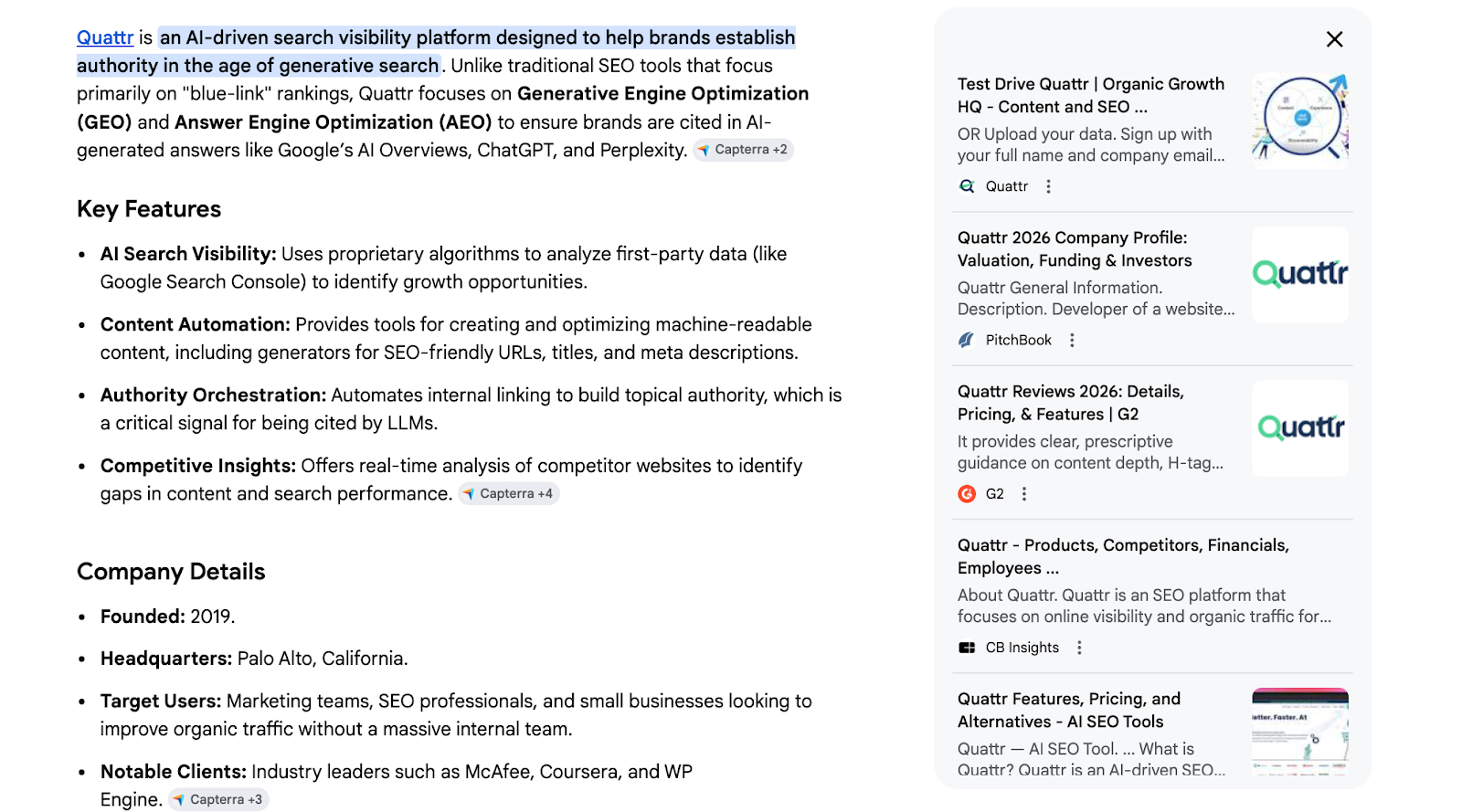
As a concrete illustration: when querying Google AI Mode for “Quattr,” 8 of the 10 sources cited in the generated response are third-party domains — review platforms, editorial coverage, comparison pages, and community threads, not quattr.com itself. This is consistent with the broader pattern in AI-generated answers: your owned domain is one input, not the primary one.
The Strategy to Implement: Distributed Authority
You need deliberate, third-party validation across credible surfaces.
Industry roundups and “best of” lists shape AI answers to commercial prompts. If you are missing from those lists, you are missing from the model’s comparison layer.
Editorial coverage and expert commentary create independent authority signals. The more often your brand is referenced in neutral contexts, the stronger your entity becomes.
Reviews and public case studies matter even more. Customers describe your product in the exact language future users will use in AI prompts. That overlap increases your citation probability.
When your brand repeatedly appears across trusted sources, the model has fewer reasons to ignore you.
And in GEO, absence is a decision, just not one you control.
4. GSC Reveals the Conversation You’re Missing
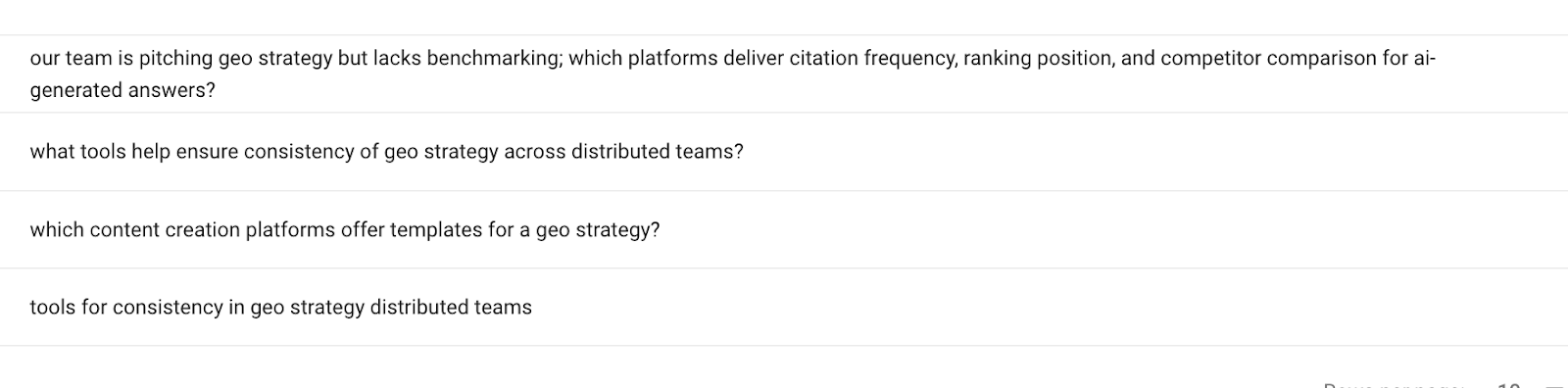
We’ve all seen those weird, zero-volume queries in Google Search Console that look like junk. Most SEOs filter them out. That’s a mistake. Those “junk” queries are often the raw, messy prompts people are actually feeding into answer engines for AI answers.
See below as a raw example
The Strategy to Implement: Listening to the Conversational Signal
When you see a long-tail query like “how do LLMs use schema for entity recognition,” that isn’t just a search; it’s a window into how users are talking to AI. While the volume might look low, the intent density is massive.
Use these long-tail queries as your H2s or blog titles. By mirroring the exact way people prompt AI, you are positioning your content as the perfect “plug-and-play” answer for the engine to extract. It’s about being the easiest answer for the bot to find.
5. Multimedia Is No Longer Optional
LLMs don’t just “read” blogs; they scrape transcripts, analyze images, and process structured data. To win the citation, you need to increase your brand’s Surface Area. If the AI finds your “Atomic” truth in a blog, sees it summarized in a video, and hears it discussed in a podcast transcript, its confidence in citing you hits 100%.
The Strategy to Implement: The Multimodal Multiplier
You don’t need a massive creative team; you just need to be strategic about how you package your core insights.
Audio & Video Transcripts: AI models (like Gemini and GPT-4) use YouTube and podcast transcripts as high-authority training data. Even a simple, AI-generated video summary of your blog provides a second “layer” of proof for the bot to crawl.
Visual Data (Infographics/Charts): Create original charts that visualize your data. AI “vision” models can now “read” these images, giving you a chance to be the source for visual search and AI-generated charts.
Structured Lists & Tools: Embed a calculator, a checklist, or a “mini-tool” on the page. AI engines love citing interactive elements because they provide immediate utility to the user.
6. Close the Execution Gap
Traditional SEO is slow. You find a gap, you put it in a spreadsheet, you wait for a writer, you wait for an editor, you wait for IT to push it live. By then, the AI has already updated its model and cited your competitor.
In GEO, speed is a strategy.
The Strategy to Implement: Causal Execution
The most successful teams don’t just “report” on gaps; they close them instantly. This is what we call Causal Execution.
Imagine identifying a content gap and pushing an update live to your CMS in seconds. That isn’t just efficiency; it’s a competitive advantage that ensures the AI is always training on your most current data.
Real example: We saw this work in the real world. A prospect mentioned a client on a Reddit thread as an “XYZ alternative.” Because our client had a comparison page ready and case studies, they were able to “surround” that prospect the moment they moved from Reddit to Google. They didn’t just find our client; they found the Source of Truth.
CloudEagle optimized 33 of its pages, which led to a 33% increase in AI citations.
7. Storytelling Shapes Sentiment (And AI Understands Both)
What an LLM actually does is summarize the entire internet’s “opinion” of you to decide if you are a credible recommendation.
If your brand has old, unaddressed negative sentiment on Reddit or G2, that becomes a permanent part of the AI’s “verdict” on your product.
The Strategy to Implement: Sentiment Shielding
You have to actively manage the narrative the AI is building about you. This isn’t about “reputation management” in the old PR sense; it’s about Sentiment Shielding.
If an AI summary says your product is “powerful but hard to use,” it’s likely pulling from a three-year-old review. You need to seed the web with updated, highly-citable documentation and community-led case studies that prove the “hard to use” signal is dead.
Don’t hide your mission statement on a “Corporate” page. Weave your brand’s “Why” into your most technical guides. Tell the AI (and the user) exactly what problem you were born to solve. This creates a causal link in the AI’s training data between a specific pain point and your specific brand.
8. Measure Success Without the “Blue Link” Click
This is the hardest part for legacy teams to swallow. In the world of GEO, the “Click” is a secondary metric. If an AI gives a user the perfect answer using your data, and that user never visits your site but remembers your brand, you still won.
The Strategy to Implement: Quantifying “Citation Share”
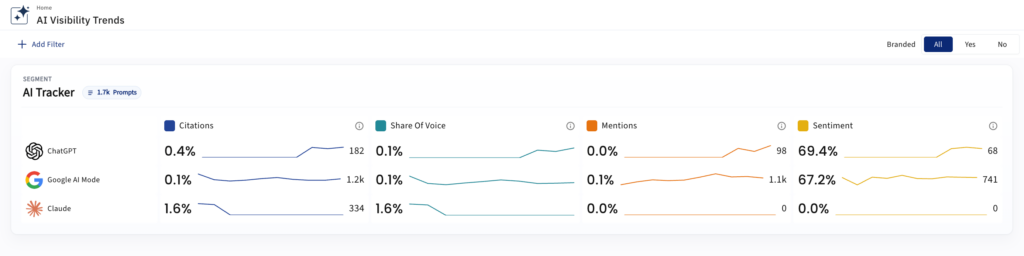
Here is the actual framework for tracking visibility in a world without rankings:
- The Prompt Audit Matrix: Don’t just “ask” ChatGPT. Create a spreadsheet of the top 20 high-intent prompts in your niche. Run them weekly across Gemini, Perplexity, and ChatGPT.
If you appear in 15 out of 20 responses, your Citation Share is 75%. If you’re mentioned but not linked, that’s a “Brand Impression.” If you’re the primary link, that’s an “Entity Win.”
- The GSC “Intent” Filter: Create a filtered view in Google Search Console for “Who,” “How,” and “Compare” queries.
An increase in impressions for long-tail, natural language queries is the earliest signal that AI engines are testing your content for their answer layers.
- Referral Source Breakdown: Watch your referral traffic for chatgpt.com, perplexity.ai, and google.com (SGE/AI Overviews).
| Metric | What It Measures | How to Track |
|---|---|---|
| Citation Share | % of high-intent prompts where your brand is mentioned | Weekly prompt audit across ChatGPT, Perplexity, Gemini |
| Brand Impression | Named without a link or direct citation | Manual audit; Quattr’s citation tracking dashboard |
| Entity Win | Cited as the primary source with a link | Referral traffic from chatgpt.com, perplexity.ai, Google AI Mode |
| Sentiment Polarity | Whether citations are positive, neutral, or negative | Review platform monitoring; AI response sentiment audit |
| Share of Voice | Your citation rate vs. competitors on the same prompts | Competitive prompt tracking |
| GSC Intent Signals | Increase in long-tail, conversational impressions | Google Search Console filtered for “who/how/compare” queries |
9. Writing “Atomic” Enough to be Extracted
LLMs don’t have time for your fluff. They aren’t looking for “engaging storytelling” in the traditional sense; they are looking for extractable truths. If a bot has to read 500 words to find one fact, it will simply find that fact on a competitor’s page, where it’s easier to grab.
The Strategy to Implement: Atomic Writing
Every sentence in your GEO-focused content should be able to stand alone. If a sentence can’t be used as a standalone quote by an AI to answer a prompt, it’s filler.
Remove the Subjectivity: Stop using words like “best,” “fastest,” or “leading.” They mean nothing to an AI.
Use Quotable Facts: Replace “Our tool helps you do SEO better” with “Quattr’s GIGA agent automates 80% of internal linking tasks.”
The Result: When the AI looks for an answer, it finds your Atomic sentence and extracts it as a direct citation. You’re making the bot’s job easy.
If you keep writing long, winding paragraphs, you are burying your value. The AI will “hallucinate” a summary of your content rather than quoting you directly. By refusing to write atomically, you lose control over how your brand is described in an AI response.
The 60-Minute GEO Reset
If you do nothing else after this blog, do this.
Step 1: Run the Verdict Test (10 Minutes)
Open:
- ChatGPT
- Google Gemini
- Perplexity AI
Ask 5 high-intent questions in your niche.
Are you:
- Not mentioned?
- Mentioned vaguely?
- Cited as a source?
If you’re not cited, you don’t own the truth layer.
Step 2: Fix One Page (30 Minutes)
Pick your most important commercial page and:
- Replace 3 vague claims with quantified facts
- Add one comparison table
- Add one standalone, quotable sentence
- Remove subjective words like “best” or “leading”
Make it extractable.
Step 3: Anchor One Entity Signal (20 Minutes)
Add or verify:
- sameAs linking to LinkedIn + G2
- A clear “About” section stating exactly what problem you solve
- One consistent brand definition across all profiles
You’re not optimizing for keywords. You’re reducing ambiguity.
If AI Isn’t Citing You, It’s Citing Someone Else.
This shift has nothing to do with traffic curves or rank tracking.
It’s about whether your brand is selected as the Source of Truth when an AI answers.
That’s the problem Quattr was built to solve.
Not by guessing how LLMs behave, but by observing where they already cite, identifying why they choose certain entities, and systematically removing ambiguity around yours.
Quattr helps teams:
- See where their brand is cited (and where it’s missing) across ChatGPT, Gemini, and Perplexity
- Understand which competitors own specific prompts, and why
- Strengthen entity clarity, fact-density, and extractability, so AI engines can confidently choose them
This isn’t probabilistic SEO. It’s deterministic GEO.
You’re not optimizing pages for rankings anymore. You’re engineering clarity, so AI systems have no reason to pick anyone else.
If you’re not being cited, you don’t own the truth layer. And Quattr exists to help you take it back.
FAQs on GEO Strategies
SEO optimizes content to rank in search results, measured by rankings and clicks. GEO optimizes content to be cited inside AI-generated answers, measured by citation frequency and brand mention share. The goal shifts from earning a link position to earning inclusion in a synthesized answer.
Run a prompt audit: search high-intent queries like “best [your category] tools” across ChatGPT, Perplexity, and Google AI Mode, and note whether your brand appears and how it is described. Track referral traffic from chatgpt.com and perplexity.ai as a secondary signal. AI visibility platforms can automate this, tracking citation share and sentiment across engines simultaneously.
No, GEO builds on SEO foundations like technical accessibility, backlinks, and E-E-A-T signals rather than replacing them. The difference is the objective: SEO targets rankings and clicks, GEO targets citations inside AI-generated answers. A strong SEO foundation is a prerequisite for effective GEO, not an alternative to it.

Quattr is an AI-native Search Visibility Platform founded in Palo Alto, California, built for mid-market and enterprise brands competing in the age of generative search. Recently recognized across G2's Spring 2026 reports with #1 rankings in AEO Results, Usability, and Relationship, Quattr helps brands win visibility across traditional search and AI-generated answer surfaces.
Quattr's AI agent, GIGA, evaluates content the way AI systems do, identifying gaps across structure, authority, internal linking, and discoverability to surface the highest-impact fixes. With capabilities like autonomous internal linking, E-E-A-T intelligence, and the new GIGA Landing Page Generator for keyword-matched, AI-search-ready pages, Quattr helps teams move from diagnosis to deployed changes without manual bottlenecks.