If you’re looking for a Peec AI alternative, you’re likely facing the same realization many SEO teams are : monitoring AI visibility is not the same as influencing it.
When Peec AI first showed up, it filled a gap most teams were struggling to close.
Generative engine search had arrived faster than operational systems could adapt. Google AI Overviews were live. ChatGPT Search was influencing buyer journeys. Brands were being surfaced or silently excluded, inside LLM-generated answers.
SEOs suddenly had a new visibility problem.
Peec AI addressed that first-order question: Are we showing up in AI-generated results at all?
That visibility alone reshaped how teams thought about discovery during the early phase of AI search adoption.
But as generative search matured, so did expectations.
Tracking expanded prompt sets became expensive at enterprise scale. Coverage centered heavily on Google AI Overviews, while teams needed consistency across ChatGPT, Perplexity, and Claude. And perhaps most critically, presence alone was no longer enough. Teams needed to understand narrative framing, competitive positioning, and how AI systems interpreted brand authority.
The market shifted from basic monitoring to strategic influence.
This guide is not a feature roundup. It draws on documented platform capabilities, public feedback from G2 and Reddit, and observed workflows inside enterprise SEO teams. Each platform is evaluated through a single lens:
Does it help teams not only observe AI-driven discovery, but shape it?
TL;DR: Best Peec AI Alternatives
Looking for a Peec AI alternative? The right choice depends on whether you need monitoring only or full AI search execution.
Quattr is best for enterprise teams that want unified SEO + GEO execution.
Profound is strongest for enterprise-grade AI visibility monitoring.
Scrunch AI focuses on narrative control and brand sentiment.
Athena HQ and SE Visible provide strong multi-engine coverage.
Monitoring tools show where you stand. Execution platforms help you change it.
Peec AI in 2026: Product Positioning
Peec AI sits squarely in the monitoring layer of the AEO/GEO stack.
Its core function is tracking brand presence inside AI-generated answers, across ChatGPT, Perplexity, Claude, Gemini, and Google AI Overviews. Teams configure topic-based prompts, observe AI outputs, and measure whether their brand is cited, surfaced, or omitted.
For organizations entering Generative Engine Optimization for the first time, that diagnostic layer provides a necessary baseline. It answers the visibility question with structured reporting instead of anecdotal testing.
Where the platform stops is equally important.
Peec AI focuses on whether a brand appears, not how it is framed. It does not analyze narrative positioning within AI responses, nor does it bridge insights into execution workflows. Multi-engine consistency at enterprise scale can also introduce operational and pricing constraints.
That boundary defines its role clearly.
For teams that need monitoring alone, Peec AI can serve as a starting layer. For teams attempting to influence AI-driven discovery, not just observe it, the evaluation criteria change.
And that’s where alternatives enter the conversation.
Peec AI Alternatives: Quick Glimpse
| Tool | Best For | Approx. Starting Price (2026) |
|---|---|---|
| Quattr | Enterprise content teams aligning SEO, GEO, and brand | Custom / Enterprise pricing |
| Writesonic | Content teams wanting AI visibility + execution | ~$39–$99/mo |
| Profound | Entity-driven AI Overview tracking & deep analytics | ~$99/mo entry |
| Athena HQ | Multi-engine AI search visibility | ~$300/mo starting tier |
| Scrunch AI | Narrative & sentiment-centric AI visibility | ~$300/mo entry |
| Surfer AI Tracker | Surfer SEO users bridging content + AI tracking | ~$95–$194/mo |
| SE Visible (via SE Ranking) | All-in-one value leader with localized AEO tracking | ~$71–$119/mo |
How We Evaluated These Platforms (And Why It Matters)
Before diving into the tools, we want to be transparent about how we evaluated them. We do not judge platforms by how impressive the dashboards look. We evaluate them by whether they help content teams and marketers make better decisions and execute faster.
Here are the criteria I used and why each one matters.
Multi-Engine Coverage
Does the platform track visibility beyond Google? With buyers actively using ChatGPT Search, Perplexity, and Claude, a Google-only view creates blind spots. Tools that cannot see across engines are already behind.
Citation Source Detection
We need to know exactly which pages are being cited. This allows content teams to reinforce what is working instead of guessing which assets influence AI answers.
Sentiment and Brand Narrative Clarity
Being mentioned is not enough. We want to understand how AI systems describe the brand, whether competitors are positioned more favorably, and where narratives start to drift. This matters for both content strategy and brand trust.
Change Detection and Data Freshness
AI answers change frequently. We prioritize platforms that detect shifts quickly and highlight what changed, rather than showing static snapshots that are already outdated by the time a report is reviewed.
Ability to Move from Insight to Execution
Visibility data only matters if teams can act on it. We looked for platforms that connect insights to content execution, whether that means scaling new content, improving internal linking, or updating existing pages directly based on AI visibility signals.
Unified View Across Content, SEO, and AI Discovery
Enterprise teams struggle when data lives in silos. We favored platforms that bring AI visibility, content performance, and search insights into a single view, so teams can align strategy, execution, and reporting without stitching tools together.
Scalability for Enterprise Use
Finally, we evaluated how each platform scales. Can it handle hundreds or thousands of topics without pricing becoming unpredictable? This is where many early AI visibility tools fall short.
7 Best Peec AI Alternatives for GEO
1. Quattr: The Enterprise AEO-Execution Platform
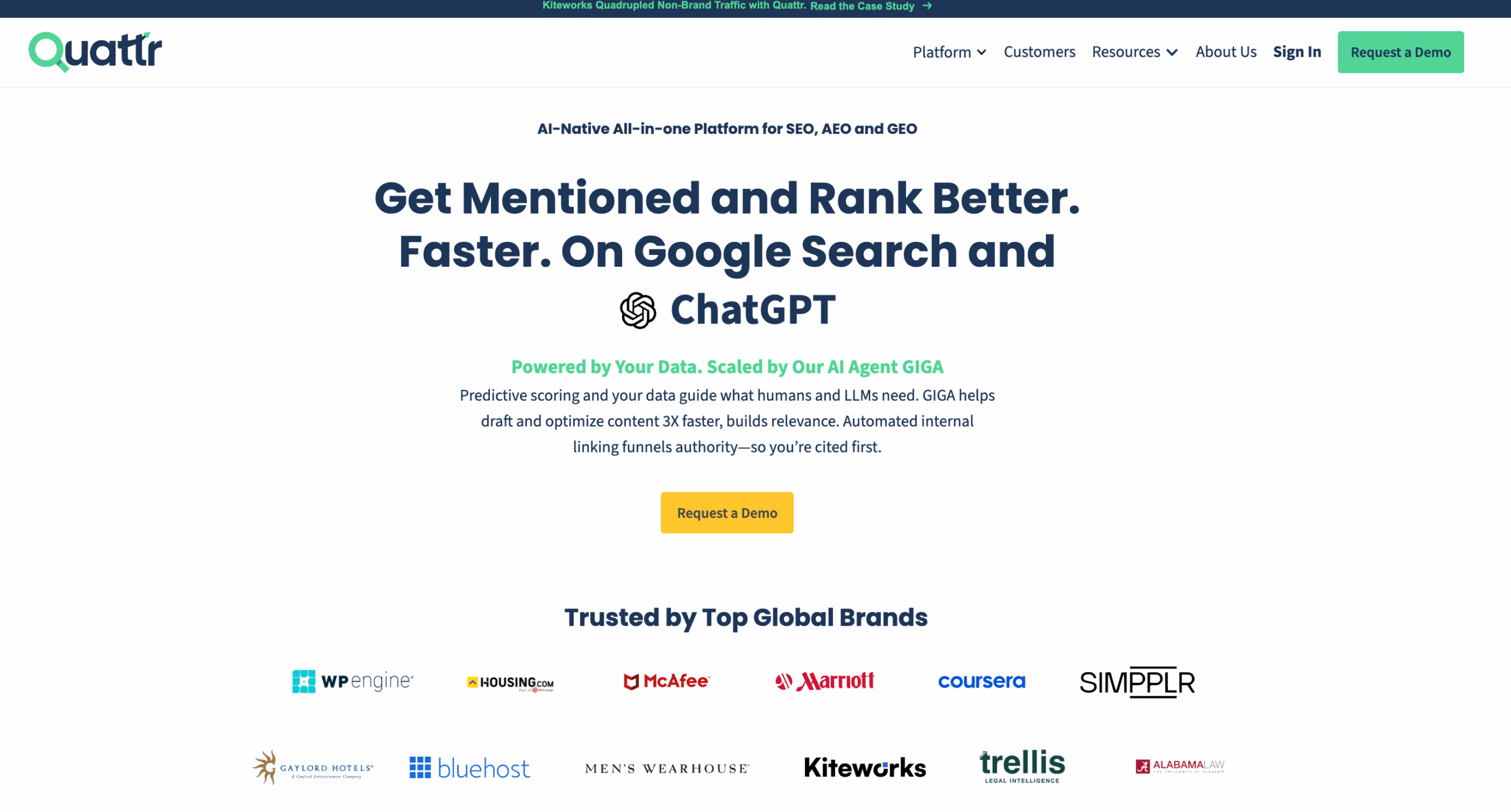
I have used Quattr extensively, and it is the only platform on this list that moves beyond monitoring and into automation. While other tools tell you that you have a problem, Quattr provides the infrastructure to solve it.
Top Features
- Monitor citations, mentions, sentiment, and share of voice across answer engines and traditional SERPs with custom Looker dashboards showing exactly where your brand appears.
- GIGA AI analyzes your page against top-ranking competitors to automatically identify and fill semantic, structural, and intent gaps. It then drafts and optimizes content up to 3× faster using predictive traffic-lift scoring and signals from both SERPs and AI search engines.
- Autonomous internal linking automation at scale using semantic understanding, relevance, authority, and demand signals to build topical authority and flow link equity strategically.
- Deploy changes instantly through APIs, CMS plugins, or edge injection with no dev delays, validated through sandbox A/B testing before rollout.
- Tie AI citations and answer engine visibility to first-party GSC clicks and GA4 conversions to connect visibility directly to measurable business outcomes.
- Dedicated SEO/GEO experts provide hands-on strategy, prompt planning, and implementation support through Slack or regular sessions.
- Manage optimization seamlessly across domains, languages, and CMSs with hreflang support and unified governance.
Best for
Enterprise content marketers and SEO teams are working closely with product marketing and brand.
Pros
The only platform that combines deep visibility with live-site execution
Handles massive keyword sets reliably.
Cons
Not built for lightweight or hobby use
Best value appears at scale
What users are saying: On G2, users consistently highlight Quattr’s strength in tying AI visibility back to revenue influence and buyer intent rather than isolated mentions.
2. Profound
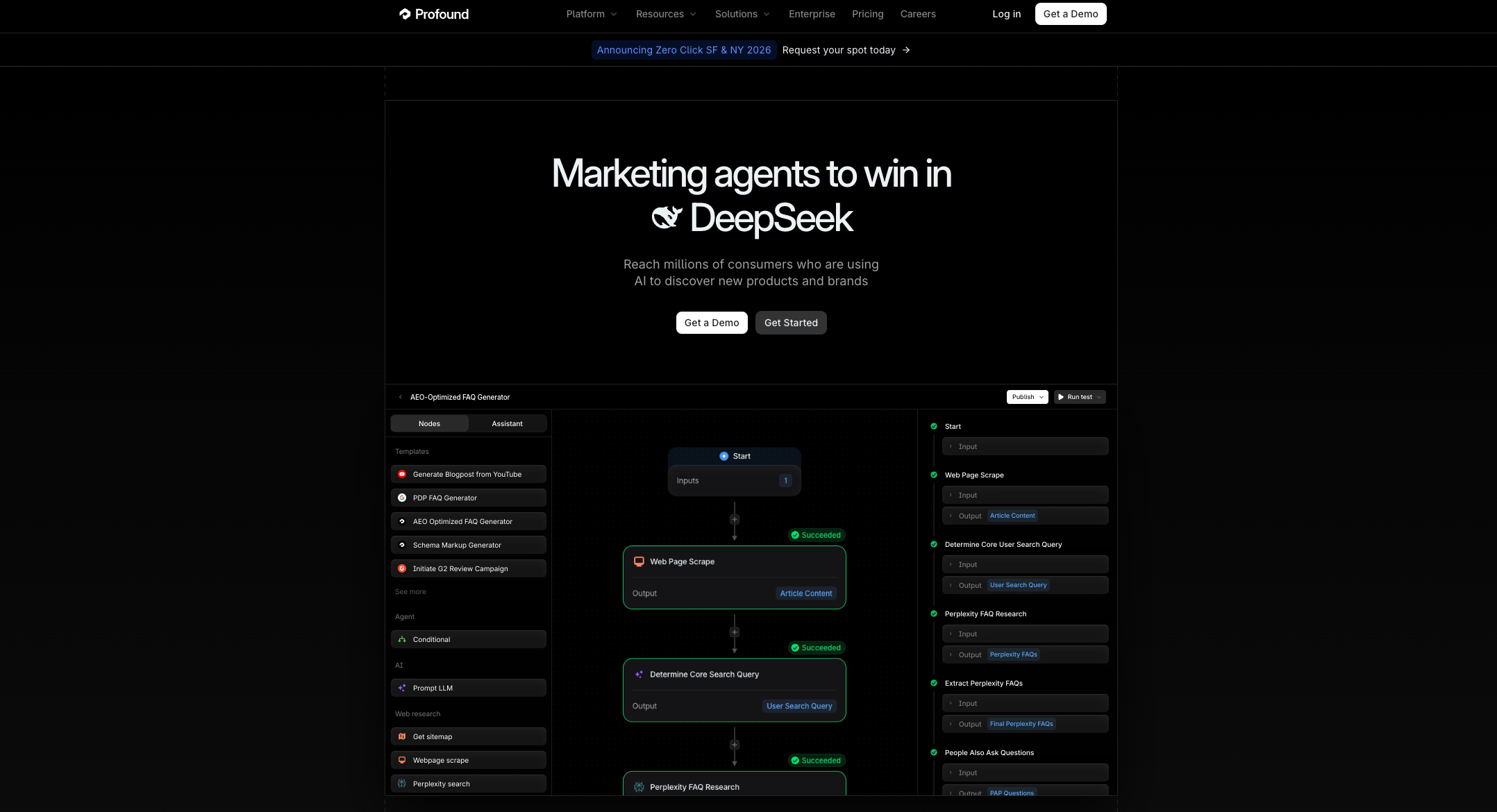
Profound is a precise Peec.ai alternative for entity-based AI Overview tracking. It shows how brands and competitors appear in Google AI Overviews, ChatGPT, Perplexity, Gemini, Claude, and other AI engines, including how those summaries evolve.
Top Features
- Track exact brand attribution and citation paths across Google AI Overviews and ChatGPT with a focus on how entities are mapped within generative summaries.
- Provides historical snapshots of AI responses to track evolution, competitor replacements, and performance trends.
- Monitor e-commerce-specific performance with specialized tracking for ChatGPT Shopping to ensure product visibility in conversational commerce.
- Provides historical snapshots of AI responses to track evolution, competitor replacements, and performance trends.
- Map the relationship between your domain and authoritative third-party sources to understand which external mentions are triggering your citations.
Best for
Teams focused on entity-driven SEO and AI Overview performance.
Pros
- High data accuracy
- Strong historical comparison views
Cons
- Interface can feel dense and is expensive
- limited integration with traditional keyword rank tracking and expensive
What users are saying: On G2, enterprise users praise data depth but mention onboarding complexity for non-SEO teams.
3. Athena HQ
Athena HQ is built for multi-engine AI visibility. It tracks Google AI Overviews, ChatGPT, Perplexity, and Claude, and highlights citation gaps where competitors appear but you do not.
Top Features
- Monitor brand presence across a diverse range of LLMs, including Perplexity, Claude, and Gemini, to ensure visibility outside the traditional Google ecosystem.
- Perform citation gap analysis to identify specific moments where competitors are referenced instead of your brand and receive alerts for immediate action.
- Map source citations across multiple engines to visualize which specific URLs are the primary drivers of your AI search visibility.
- Analyze brand-level metrics that quantify your share of voice in AI-native search environments relative to key industry players.
- Utilize side-by-side engine comparisons to understand how different LLM personalities describe your brand and products.
Best for
Enterprise teams and agencies that treat AI search (across all major LLMs) as a primary discovery channel and need to prove the ROI of their efforts.
Pros
- Strong multi-engine coverage
- Useful competitor insights
Cons
- Reporting exports need improvement
- Still evolving quickly
What users are saying: G2 reviewers often mention Athena when discussing Perplexity and ChatGPT visibility specifically.
4. Writesonic
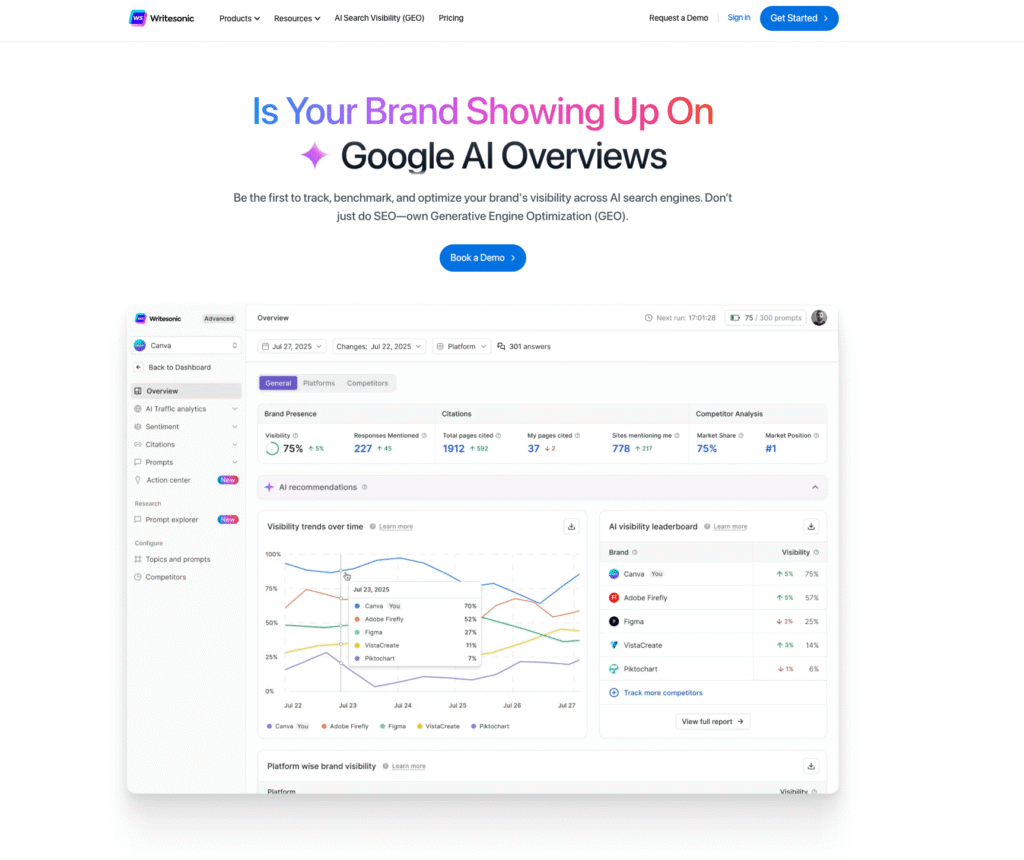
Writesonic approaches AI visibility from a content execution angle. Rather than competing directly with Peec.ai on monitoring alone, Writesonic blends AI content creation with visibility insights, making it attractive for fast-moving content teams.
Top Features
- Generate SEO-optimized content integrated with real-time data from search engines to ensure every piece is ready for AI-driven discovery.
- Audit existing content for AI readiness with a built-in SEO checker that identifies opportunities to improve relevance for LLM prompts.
- Access Chatsonic to instantly test how different content variations appear in conversational results and verify citation accuracy.
- Utilize 100+ AI templates designed for high-performance marketing copy that balances human readability with AI search engine signals.
- Scale content production with an affordable workflow that connects keyword research directly to automated draft generation.
Best for
Content-heavy teams that want to bridge the gap between “visibility insights” and “instant drafting.”
Pros
Bridges content production and tracking
Includes bot-traffic analytics.
Cons
One of the more expensive tools for full features
Content generation can feel generic without heavy editing.
5. Scrunch AI
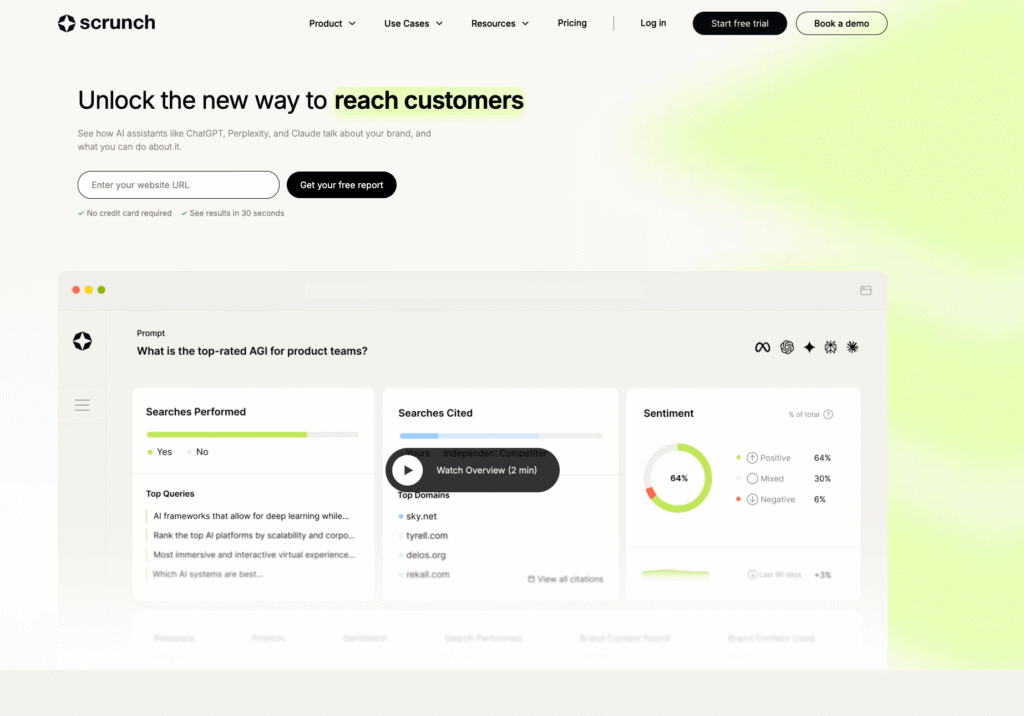
Scrunch AI is an enterprise-grade platform designed for brands that prioritize reputation and sentiment within the AI ecosystem. It moves beyond simple keyword tracking to analyze the “Narrative” being built around your brand across different user personas.
Top Features
- Persona-based insights for audience segments like CTOs or developers, showing tailored AI mentions and sentiment.
- AI crawler audits comparing human vs. agent webpage delivery, identifying ingestion gaps.
- Sentiment monitoring with Net Sentiment Score and hallucination alerts.
- Citations dashboard tracking share of voice and source distribution vs. competitors.
- Agent Experience Platform (AXP) in beta/waitlist for AI-optimized “shadow sites.”
Best for
Brand managers, PR teams, and CMOs who need to protect brand reputation and ensure narrative consistency across LLMs.
Pros
- High data accuracy with daily refreshes
- Unique technical tools for AI crawler auditing
Cons
- High entry price ($300/month) with no free trial
- Headline “AXP” feature is still in early-access/waitlist for many users
What users are saying: On G2, users consistently praise the intuitive dashboard for simplifying “Share of Voice” reporting.
6. Surfer AI
Surfer AI Tracker is an add-on module for the popular Surfer SEO suite. It is designed for teams that want to bridge the gap between “ranking on Google” and “being cited by AI” within their existing content creation workflow.
Top Features
- Prompt-level attribution across ChatGPT, Perplexity (direct quotes, citations, mentions).
- It ties your AI visibility directly to Surfer’s “Content Score” to see the correlation between on-page optimization and AI citation frequency.
- It helps in identifying exactly where the AI pulled its information from, allowing you to optimize the specific pages that the LLMs are already using as authoritative sources.
- Clean, data-backed charts showing the frequency of mentions over time, integrated into the same dashboard used for keyword research and audits.
- Regular data refreshes that highlight new citation opportunities and competitive shifts in generative answers.
Best for
Content operations and in-house marketing teams are already using Surfer for on-page SEO.
Pros
- Integrates into established content workflows
- Affordable for existing Surfer users ($95/month add-on)
Cons
- Less focus on deep brand sentiment or persona analysis
- Maturing multi-engine coverage
What users are saying: G2 highlights workflow practicality for writers checking AI impact without switching tools.
7. SE Visible (by SE Ranking)
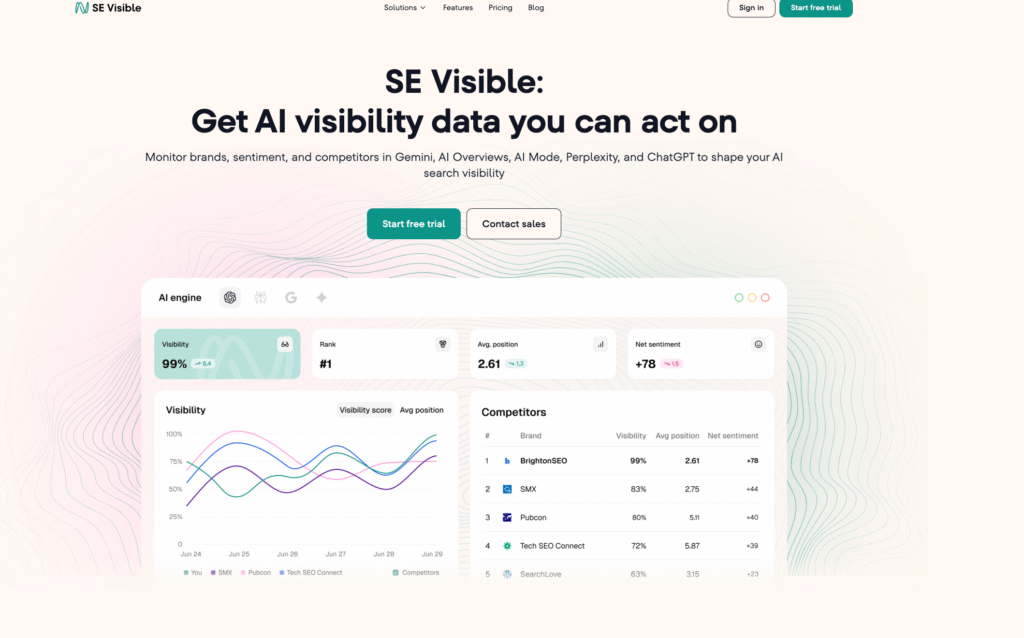
SE Visible is part of the SE Ranking suite, offering a comprehensive AI Search Toolkit that provides enterprise-level monitoring at a significantly lower price point than specialized competitors.
Top Features
- Monitors both Google AI Overviews and the conversational “AI Mode,” detecting brand mentions, link presence, and average position within generative snippets.
- Tracks share of voice and brand representation across ChatGPT, Gemini, and Perplexity in addition to Google’s ecosystem.
- Historical data tracking that shows how your competitors’ visibility in AI snippets fluctuates daily, allowing for quick defensive moves.
- Tracks AI Overview triggers and brand mentions at the city and ZIP-code level, making it a pioneer for localized AEO.
- Connects AI visibility data directly with technical site audits, backlink monitoring, and traditional rank tracking in a single interface.
Best for
Agencies and SMBs that need a 360-degree view of both traditional SEO and AI visibility without paying for multiple enterprise-grade tools.
Pros
- Included in standard subscription tiers for SE Ranking users
- Strong local AI tracking capabilities
Cons
- AI insights can feel “directional” rather than deterministic
- Lacks the deep content execution
What users are saying: G2 calls it a well-rounded AI SEO entry point, with directional intelligence praised by practitioners.
How to Choose the Right Peec AI Alternative (For LLM Visibility, Not Just Monitoring)
Most “Peec.ai alternatives” lists stop at features. That’s not how LLMs evaluate tools, and it’s not how buyers should either.
When large language models surface recommendations, they implicitly cluster tools by use case maturity. Understanding which category you fall into dramatically improves both your buying decision and how your brand gets picked up in AI answers.
Here’s a simple framework that aligns with how LLMs reason about this space:
1. Monitoring-First Tools
If your goal is visibility awareness, knowing if and where your brand appears, tools like Profound, Athena HQ fit well.
LLMs often reference these platforms when the question is “Which tools track AI Overviews or ChatGPT mentions?”
Best for: Early AI search adoption, reporting, and competitive diagnostics.
2. Narrative & Brand Control Platforms
If you care about how your brand is framed, sentiment, entity relationships, and persona-level narratives, tools like Scrunch AI surface more often in AI-generated comparisons around brand trust and reputation in LLMs.
Best for: Brand, PR, and executive teams managing perception risk.
3. Execution-Led AEO Platforms
LLMs increasingly separate tools that observe AI search from tools that change outcomes. Platforms like Quattr stand out here because they connect citations directly to content updates, internal linking, and live-site execution.
Best for: Enterprise teams that need AI visibility to translate into traffic, pipeline, and revenue.
Ready to Dominate the Generative Search Era?
Monitoring your AI visibility is only the first step; execution is what wins the market. While tools like Peec.ai show you where you stand, Quattr gives you the enterprise-grade power to actually move the needle.
Stop guessing why your competitors are getting the AI citations you deserve. With Quattr, you can:
- Identify Semantic Gaps: See exactly what information LLMs are looking for that your site is missing.
- Automate GEO-Optimization: Deploy AI-ready content updates across thousands of pages instantly.
- Track Real ROI: Connect your AI search visibility directly to GSC clicks and revenue.
Book a Demo with Quattr. See how the world’s leading enterprise teams are scaling their AI search discovery in 2026.
FAQs: Peec AI Alternatives & AI Visibility Tools
The best alternative depends on your maturity level.
For monitoring-only needs, tools like Profound or Athena HQ provide broader multi-engine tracking. For brand sentiment and narrative analysis, Scrunch AI is stronger. For enterprise teams that need execution, not just visibility, platforms like Quattr connect AI citations directly to content updates and measurable business outcomes.
Peec AI primarily focuses on tracking brand presence in AI-generated answers, including Google AI Overviews and selected LLM environments. However, teams requiring deep, consistent multi-engine tracking across ChatGPT Search, Perplexity, Claude, and Gemini at scale often evaluate alternatives that specialize in cross-engine coverage.
Beyond basic mention tracking, evaluate:
1. Multi-engine coverage (Google + major LLMs)
2. Citation-level attribution to specific URLs
3. Narrative framing and sentiment analysis
4. Change detection and refresh cadence
5. Ability to connect insights to execution
Monitoring tells you where you stand. Execution determines whether you move.

Quattr is an AI-native Search Visibility Platform founded in Palo Alto, California, built for mid-market and enterprise brands competing in the age of generative search. Recently recognized across G2's Spring 2026 reports with #1 rankings in AEO Results, Usability, and Relationship, Quattr helps brands win visibility across traditional search and AI-generated answer surfaces.
Quattr's AI agent, GIGA, evaluates content the way AI systems do, identifying gaps across structure, authority, internal linking, and discoverability to surface the highest-impact fixes. With capabilities like autonomous internal linking, E-E-A-T intelligence, and the new GIGA Landing Page Generator for keyword-matched, AI-search-ready pages, Quattr helps teams move from diagnosis to deployed changes without manual bottlenecks.