Key Takeaways
- AI visibility is now a separate metric from SEO rankings. You can rank #1 on Google and still be completely invisible in ChatGPT, Perplexity, or Google AI Overviews.
- There’s a real difference between monitoring-only tools and execution-led platforms. Know which one you actually need before you buy.
- For teams that want SEO and GEO unified in one workflow with real attribution, Quattr is the most complete option. For pure enterprise-scale monitoring, Profound sets the standard.
- Budget-conscious teams get strong value from Peec AI (€89/month) and Otterly AI ($29/month), solid entry points without enterprise price tags.
- If you’re already inside Ahrefs or Semrush, their AI add-ons are worth activating. Adding a standalone tool when you don’t need to just fragment your data.
Your brand showed up in a ChatGPT answer yesterday. Or maybe it didn’t, and your competitor did. You have no idea which one happened. That’s the problem.
And the problem is: traditional metrics won’t catch any of it. SEO tools don’t track what ChatGPT said about your brand at 11pm to a prospect in the middle of a buying decision. That’s the AI visibility gap, and closing it starts with using the right tools.
I’ve spent a lot of time working with B2B brands on their GEO strategy, and one thing is clear: the teams winning in AI search aren’t the ones with the biggest content budgets, or aren’t necessarily the biggest or oldest. They’re the ones who figured out what to measure first.
In this blog post, I’m breaking down the 7 best AI visibility tools right now, what makes each of them worth your attention, and who they’re actually built for. No fluff, just what you need to know.
Let’s get started.
What Is AI Visibility and Why Does It Matter?
Before we get into tools, let’s get aligned on what we’re measuring.
AI visibility is how often and how favorably your brand gets mentioned, cited, or recommended in AI-generated answers across platforms like ChatGPT, Google AI Mode, Perplexity, Gemini, and Claude.
This is different from traditional SEO in one critical way: you’re not trying to rank on a SERP. You’re trying to become the source that an AI engine trusts when generating its answer. That means citations, brand mentions, share of voice, and sentiment inside those AI responses are the new KPIs that matter.
And it matters more than most teams realize yet. AI-powered search is already shaping purchase decisions at scale, and the brands that earn consistent AI citations today are building the kind of trust and authority that compounds over time.
AI Visibility Metrics That Matter (And What They’re Actually Telling You)
Traditional SEO gave you rankings, clicks, and impressions. AI visibility gives you a different set of signals, and if you’re reporting on the wrong ones, you’ll miss what’s actually changing.
Citation Rate: The percentage of times your brand or content is cited in AI-generated answers for a defined set of prompts. It’s the closest equivalent to a ranking in AI search. Track this per prompt, not just as an average; averages hide where you’re actually losing.
Share of Voice (SOV): Citation rate tells you how often you appear. SOV tells you how often you appear relative to competitors for the same prompts. If you’re cited 30% of the time but your main competitor is at 65%, your citation rate alone isn’t telling you enough.
Brand Mention vs. Source Citation: Not the same metric, and most teams only track one. A brand mention is when an AI names you explicitly (Quattr counts it as AI mention count). A source citation is when an AI visibly attributes your page as a source. The two are measured separately and can coexist in one answer: an answer can name you without citing you, cite you without naming you, or do both. A positive recommendation, the AI endorsing you for the job asked, is a third outcome worth tracking on its own.
Sentiment Score: Being cited isn’t always a win. Sentiment tracking tells you whether AI platforms are framing your brand positively, neutrally, or negatively, and points you toward which content or positioning issues to fix first.
Prompt Coverage: The number of relevant prompts where your brand appears at least once. Narrow coverage means you’re visible in one context but absent from the broader category conversation. Expanding it is often the fastest way to grow total citation volume.
Source Attribution: Which specific pages are AI engines actually pulling from? This breaks citation data to the URL level so you know where your content authority lives, and where the gaps are.
AI Visibility Trend: A snapshot is useful. A trend is strategic. In AI search, visibility can shift faster than traditional rankings, sometimes within weeks of a content update or a competitor publishing something authoritative.
7 Best AI Visibility Tools in 2026
| Tool | Best For | Pricing |
| Quattr | Unified SEO + GEO execution | Custom (demo required) |
| Profound | Enterprise-scale AI visibility monitoring | From $99/month |
| Peec AI | Affordable daily tracking for marketing teams | From €89/month |
| Scrunch AI | Enterprise brand safety + multi-engine monitoring | From $250/month |
| Otterly AI | Best GEO audit + affordable entry point | From $29/month |
| Ahrefs Brand Radar | AI visibility inside the Ahrefs ecosystem | From $129/month + add-ons |
| Semrush AI Visibility Toolkit | AI visibility for existing Semrush users | From $199/month (add-on) |
1. Quattr – Best All-in-One Platform for SEO, AEO, and GEO Execution
Best for: B2B SaaS, enterprise, and mid-market teams that want SEO and AI visibility in one workflow
About the tool
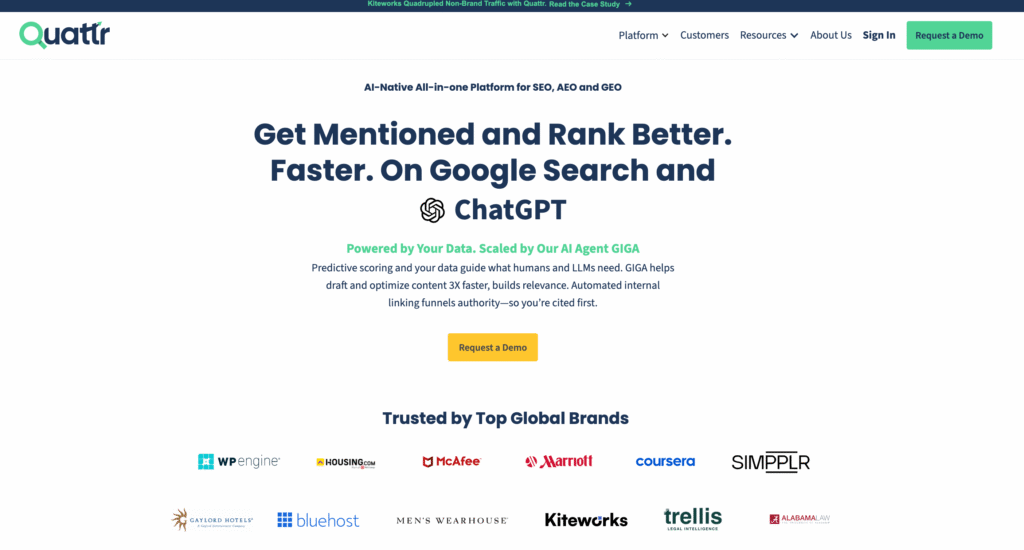
Most tools on this list track your AI visibility. Quattr is built to change it.
Quattr's AI Visibility platform unifies SEO, AEO and GEO into a single end-to-end workflow, measurement joined to execution, not AI tracking bolted onto a rank tracker. It was built from the ground up to help brands get cited by AI, not just rank on Google.
What makes Quattr genuinely different from the rest of this list is its execution layer. Most AI visibility tools tell you where you stand. Quattr tells you that and helps you fix it without leaving the platform. It captures results from real consumer-facing AI responses for the prompts, surfaces and countries you track, on every scheduled run, so you see what those answers showed, including the dynamic, RAG-retrieved content that API-only collection can miss when it runs without web search.
The platform integrates natively with Google Search Console and GA4, so you can connect AI visibility data directly to real traffic and business outcomes.
And when it’s time to act on what the data reveals, Quattr’s AI agent GIGA helps teams draft and optimize content, build topical authority, and automatically deploy internal linking, so every insight leads somewhere rather than sitting in a dashboard.
Key Features
- Tracks AI visibility across Google AI Overviews, ChatGPT, Claude, Perplexity, Gemini, and Google AI Mode
- Monitors citation share and brand mentions with competitive context
- Unifies SEO + GEO into one workflow, no platform switching
- E-E-A-T Intelligence that evaluates your page against competitors and suggest fixes
- Automates internal linking to build the topical authority LLMs rely on for citations
- GIGA agent drafts and optimizes AI-ready content grounded in your own performance data
- Integrates directly with Google Search Console and GA4 for first-party attribution
- Tracks competitive share of voice and brand sentiment at the page and topic level
Pros and Cons
| Pros | Cons |
| Unifies SEO + GEO into one workflow, no platform switching | No public pricing |
| Goes beyond monitoring to actually help you fix visibility gaps | May feel like more than needed if you only want basic tracking |
| First-party data integration means attribution you can trust | |
| Internal linking automation directly builds AI citation authority | |
| Covers the full GEO workflow: discover → optimize → publish → measure |
Pricing: Custom pricing. Request a demo to get started.
Why not explore Quattr and see the difference?
2. Profound
Best for: Enterprises that need deep, secure, multi-engine AI visibility data.
About the tool
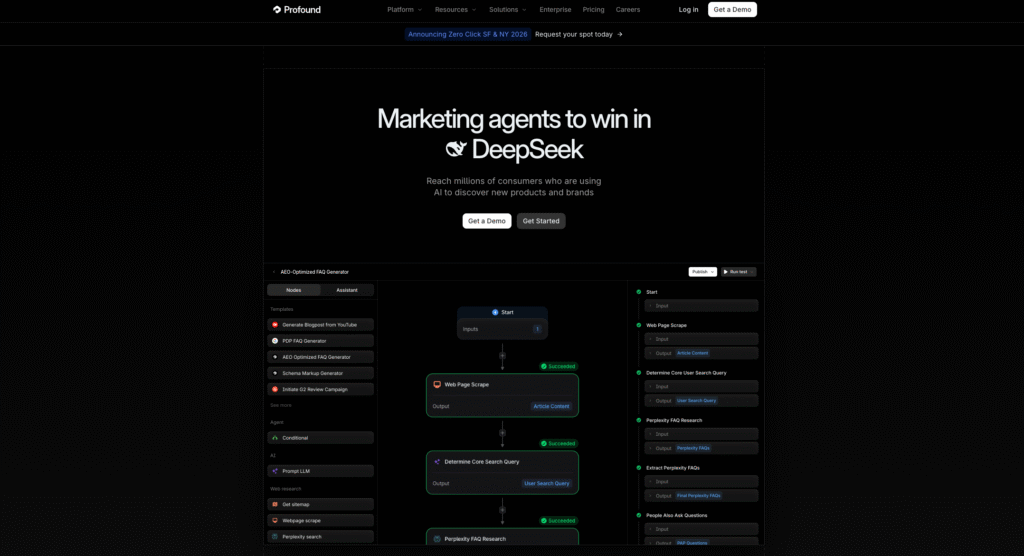
Profound is the most serious tool available if your job is understanding, at real depth, how your brand appears inside AI-generated answers at scale.
It processes 5M+ citations daily using direct consumer-interface monitoring, meaning you see what your buyers actually see, not API estimates.
The Conversation Explorer is genuinely unique: it surfaces real-time data on how often topics are discussed inside AI platforms, a demand signal that doesn’t exist anywhere else. That’s meaningful for content planning and brand strategy.
The trade-off is clear, though: Profound is a monitoring and analytics platform first. It tells you where you stand with exceptional precision, but stops there. At $499/month, you’ll still need separate tools for content creation, technical fixes, and SEO execution, which adds up fast for teams without dedicated internal resources.
Key Features
- Monitors brand visibility across ChatGPT, Perplexity, Gemini, Google AI Overviews, AI Mode, Copilot, Grok, Meta AI, and DeepSeek
- Conversation Explorer surfaces real-time AI search demand, shows how often topics are discussed inside AI platforms
- Direct consumer-interface monitoring captures actual AI responses, not API-based sampling
- Citation and source attribution show which pages AI engines pull from in your category
- Profound Workflows automates content operations for the AI search era
- Sentiment analysis tracks whether AI portrays your brand positively, neutrally, or negatively
- SOC 2 Type II and HIPAA compliant for enterprise security and data governance
Pros and Cons
| Pros | Cons |
| 5M+ citations processed daily, unmatched data depth | No free trial |
| Conversation Explorer gives AI demand data before it appears elsewhere | Full model coverage locked behind Enterprise pricing |
| SOC 2 + HIPAA compliance for strict security requirements | Monitoring-only; needs separate tools for content and SEO execution |
Pricing: Plan starts at $99/month. Enterprise plans are custom.
3. Peec AI
Best for: Growing B2B teams and agencies that want accurate daily AI visibility data without enterprise pricing
About the tool
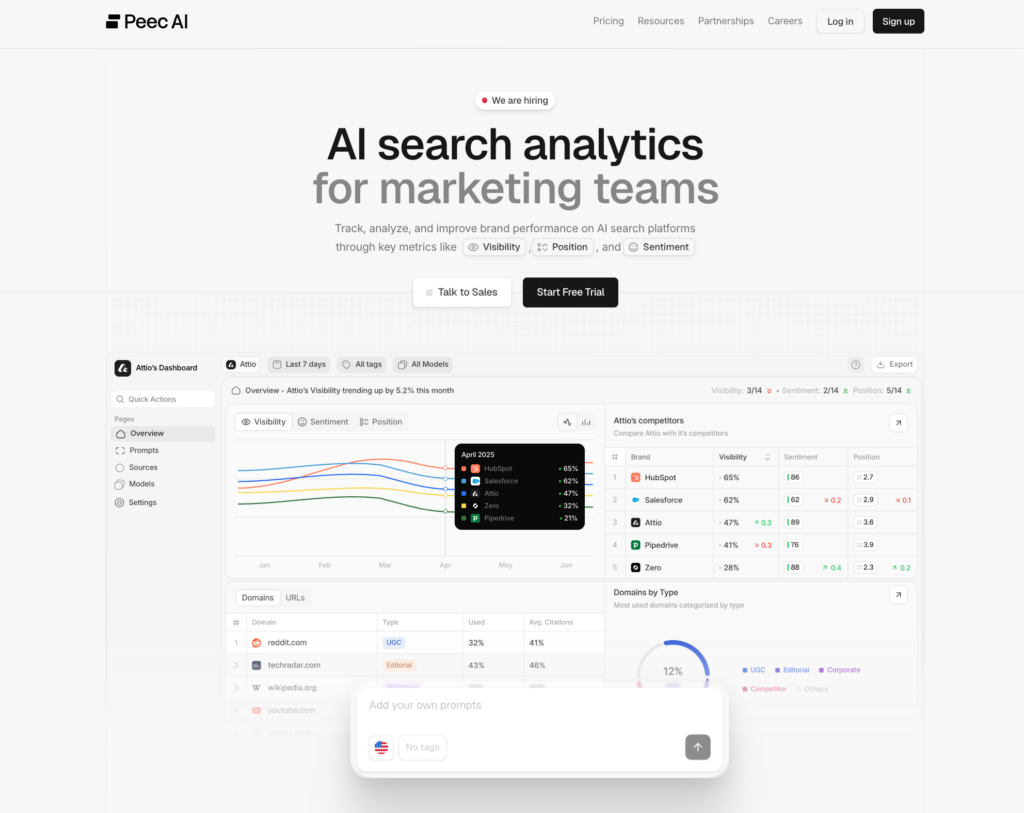
Peec AI is an AI search analytics platform built for marketing teams that want real data without the enterprise price tag.
The platform tracks how your brand appears across ChatGPT, Perplexity, and Google AI Overviews on a daily basis, and makes a meaningful distinction most tools miss: it tracks both brand mentions (when you’re named) and source citations (when your content is used but your brand isn’t explicitly called out).
That dual tracking gives you a fuller picture of your actual AI footprint. Unlimited team seats across all plans and a clean, low-learning-curve interface make it easy for teams to actually use, not just subscribe to.
Key Features
- Runs daily prompts across ChatGPT, Perplexity, and Google AI Overviews on all plans
- Tracks both explicit brand mentions and silent source citations as separate metrics
- Competitive share of voice benchmarking broken down by topic and prompt
- Looker Studio connector for streaming live visibility data into existing BI dashboards
- Unlimited team seats on every plan, no per-user fees
- Pitch workspaces for agencies to build client-facing AI visibility reports
- Multi-region tracking covering 115+ languages from the entry tier
Pros and Cons
| Pros | Cons |
| Transparent pricing — no per-seat fees | Base plan covers 3 platforms; others cost extra |
| Clean UI with low learning curve | No content creation or optimization workflows |
| Daily refresh keeps data current for active campaigns | Limited value for brand-new sites without search presence |
Pricing: Starter plan from €89/month (25 prompts).
4. Scrunch AI
Best for: Enterprise brands and agencies dealing with brand safety, misinformation, or multi-brand monitoring at scale.
About the tool
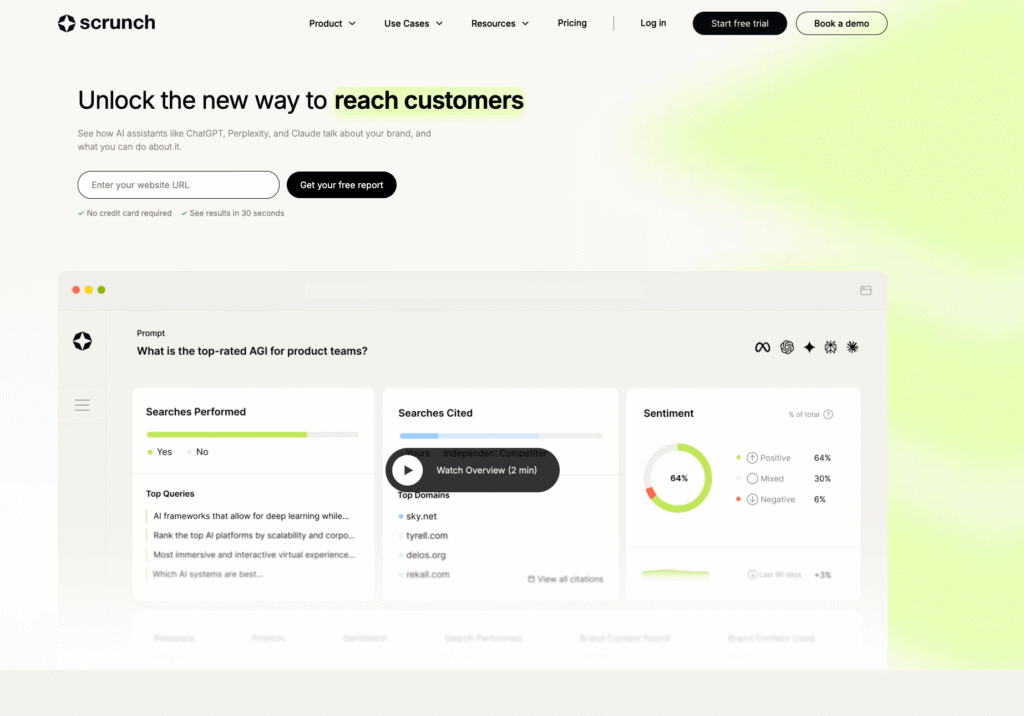
Scrunch AI was built on a premise worth taking seriously: your website was designed for humans, but AI agents don’t browse the way humans do. They compress, summarize, and respond, and if your content isn’t structured for how they work, it won’t show up.
Scrunch tracks your brand across 7+ AI engines with prompt-level daily tracking and persona-based filtering, making it particularly strong for teams dealing with misinformation or brand narrative discrepancies.
Its Agent Experience Platform (AXP) helps create a machine-readable content layer alongside your site.
Key Features
- Tracks brand visibility across ChatGPT, Gemini, Perplexity, Claude, Google AI Overviews, AI Mode, and Meta AI
- Prompt-level daily tracking filterable by persona, topic, and funnel stage
- AI bot crawler analytics show when and how AI bots crawl your site in real time
- GA4 integration connects AI citations to actual referral traffic behavior
- SOC 2 Type II compliant with RBAC access controls for enterprise security
- Agent Experience Platform (AXP) creates machine-readable content layer for AI agents
- Multi-brand architecture built for agencies managing multiple client accounts
Pros and Cons
| Pros | Cons |
| Broadest AI engine coverage tested (7+ platforms) | Starts at $250/month, one of the steeper entry prices |
| AXP is forward-thinking infrastructure, not just a monitoring layer | Prompt credit system can be confusing to manage |
| Strong for brand safety and misinformation detection |
Pricing: The plan starts at $250/month.
5. Otterly AI
Best for: Solo marketers, small teams, and anyone starting to take AI visibility seriously for the first time.
About the tool
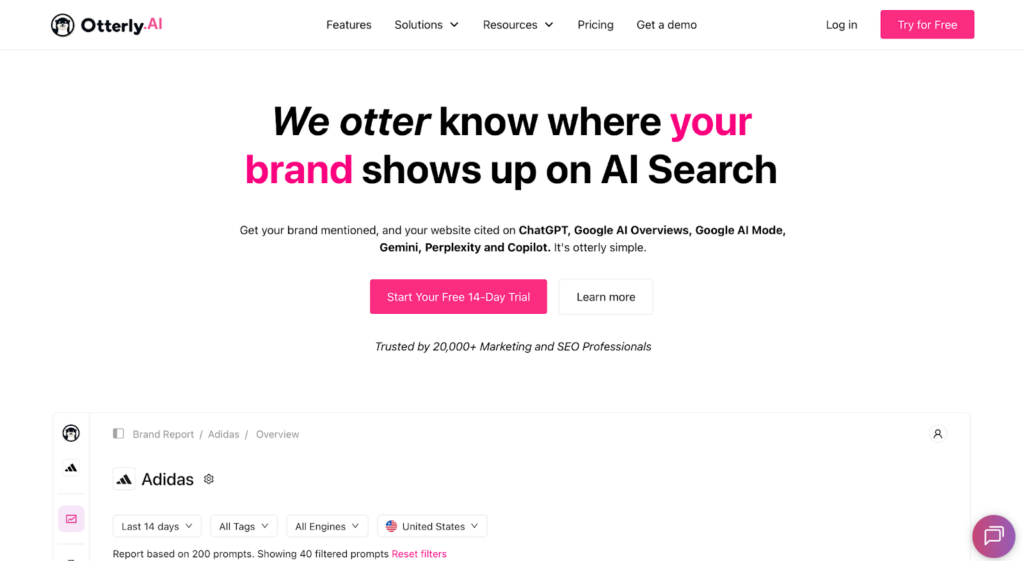
Otterly AI is one of the most accessible entry points into AI visibility monitoring, with a Lite plan at $29/month and a full-featured free trial that lets you evaluate the platform before committing to anything.
It tracks brand mentions and citations across six AI platforms with a daily refresh. The standout feature is the GEO audit, reviewers consistently call it the most detailed analysis available at this price range. It diagnoses specific structural and content factors preventing your pages from earning citations, not just a generic checklist.
The AI Keyword Research Tool converts your existing keywords and brand info into the actual conversational prompts your buyers use in AI search, a genuinely useful starting point for teams that don’t know which prompts to track.
For teams just getting serious about AI visibility, the value-to-cost ratio here is hard to beat.
Key Features
- Tracks brand mentions and citations across ChatGPT, Perplexity, Google AI Overviews, Gemini, AI Mode, and Copilot
- Brand Visibility Index tracks your AI presence trend over time as a single trackable KPI
- GEO Audit with SWOT analysis, diagnosing structural barriers to earning more AI citations
- AI Keyword Research Tool converts your brand/keywords into real prompts your audience uses in AI search
- Domain and URL-level citation analysis shows which pages AI platforms reference most
- Competitive benchmarking with side-by-side brand comparison across engines
- CSV export for stakeholder reporting and sharing data outside the platform
Pros and Cons
| Pros | Cons |
| Most affordable entry point, $29/month with a real free trial | Prompt-based pricing scales steeply at higher tiers |
| Covers 6 AI platforms from the entry tier | No built-in content creation or optimization workflows |
| AI-assisted onboarding makes setup fast |
Pricing: The paid plan starts at $29/month (15 prompts).
6. Ahrefs Brand Radar
Best for: SEO professionals and enterprise teams who want AI visibility connected to their existing Ahrefs workflow.
About the tool
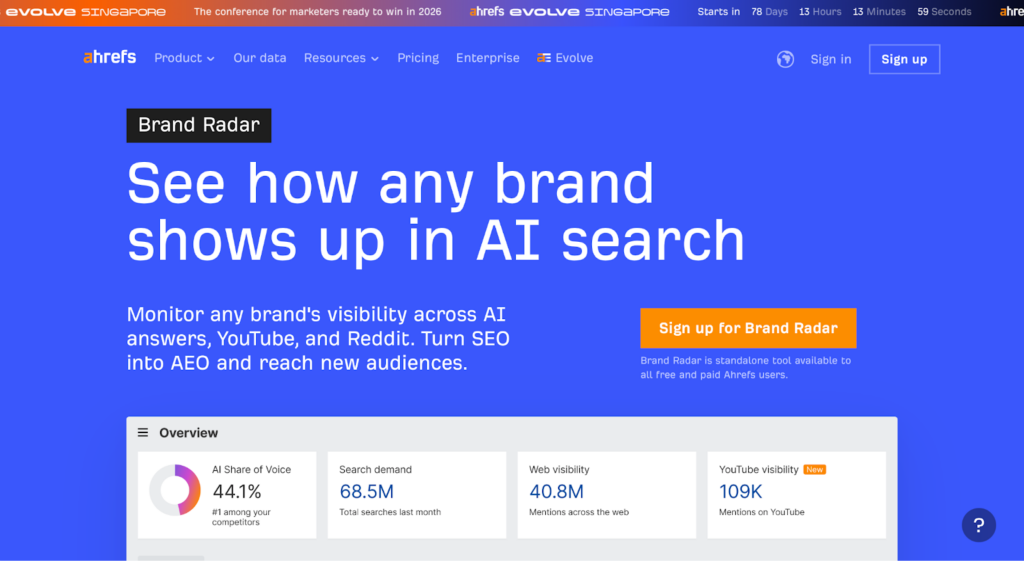
If you already live inside Ahrefs for keyword research, backlink analysis, and content auditing, Brand Radar is the most natural way to layer AI visibility onto your stack.
The core proposition is scale, a database of 252M+ monthly prompts across six AI platforms, meaning you’re not just tracking prompts you already know about. You’re discovering where your brand appears across a constant sweep of AI-generated responses you’d never surface manually.
The ecosystem integration is the real differentiator: when you find a citation gap, you can immediately pivot to Ahrefs’ keyword and backlink data to understand what’s driving it.
Custom AI prompt tracking launched in January 2026, adding granular prompt-level performance tracking. YouTube, TikTok, and Reddit mention tracking (currently beta) adds upstream discovery signals from where AI citations often originate.
Key Features
- 252M+ monthly prompts across ChatGPT, Perplexity, Gemini, Copilot, Google AI Overviews, and AI Mode
- Custom AI prompt tracking for monitoring specific high-value queries over time
- Cited Domains and Cited Pages reports showing which URLs AI engines reference for any topic
- Historical AI visibility data from 2024; track brand trends over time, not just current snapshots
- Native integration with Ahrefs’ keyword, backlink, site audit, and content tools
- Branded search volume monitoring alongside AI visibility data
Pros and Cons
| Pros | Cons |
| Largest prompt database, 252M+ monthly prompts | AI modules are expensive add-ons ($199+/month on top of existing plan) |
| Historical data provides trend context most affordable tools lack | Less suited for simple prompt-level performance tracking |
| Native SEO integration connects AI gaps to actionable context |
Pricing: Available on all Ahrefs paid plans (from $129/month). AI index add-ons: $199/month per platform or $699/month for all six.
7. Semrush AI Visibility Toolkit
Best for: Marketing teams and agencies already using Semrush who want AI visibility without managing another platform.
About the tool
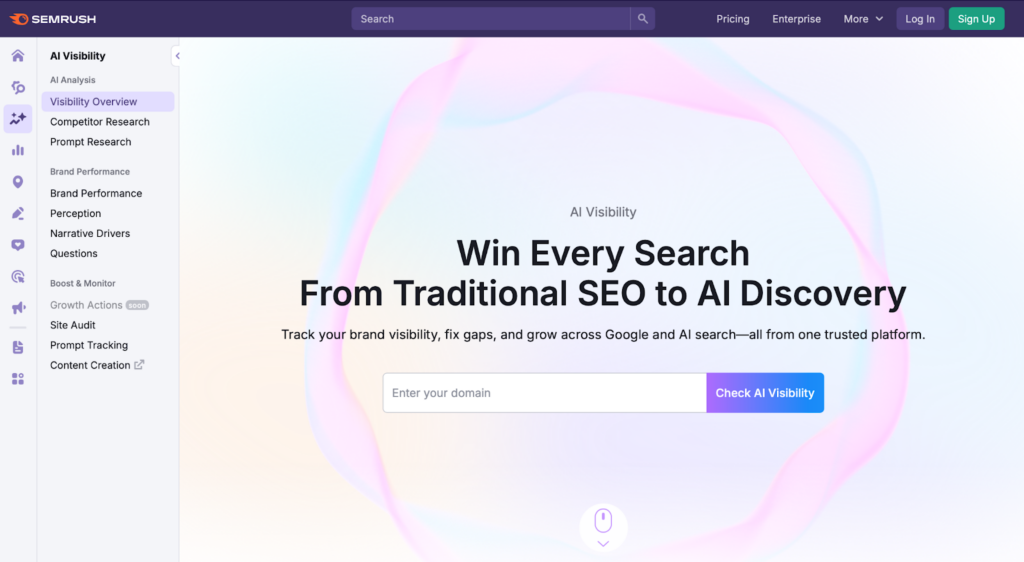
If you’re already in the Semrush ecosystem, it’s the path of least resistance into AI visibility; one platform, one reporting workflow, no new onboarding.
It’s built on a database of over 100 million LLM queries from around the world, covering Google AI Overviews, AI Mode, Gemini, Perplexity, and ChatGPT.
The Prompt Research feature is the standout keyword research for AI search, showing you which topics are generating AI answers in your category and where the gaps are.
Key Features
- AI Visibility Score benchmarks brand presence in AI answers vs. category competitors
- Prompt Research discovers what users ask AI platforms about your industry and brand
- Daily Prompt Tracking monitors performance against high-priority prompts
- Competitor Research maps visibility gaps, shows which prompts competitors win that you don’t
- AI Readiness Audit checks for llms.txt, structured data, and crawlability issues blocking AI citations
- Brand Performance reports with sentiment analysis and location/language customization
- Semrush One bundle combines SEO + AI visibility from $199/month
Pros and Cons
| Pros | Cons |
| Seamless for Semrush users, no new tools, no data fragmentation | No free trial on the AI Visibility Toolkit |
| Semrush One bundle delivers real savings vs. separate subscriptions | Too expensive as compared to other tools in the market |
| Daily Prompt Tracking keeps competitive data current |
Pricing: The paid plan starts at $199/month.
How to Choose an AI Visibility Tool?
Not every AI visibility tool is built for the same job. Before you start comparing pricing pages, get clear on what you actually need, because buying the wrong category of tool is expensive in time and money.
Start with this question: Do you need to monitor AI visibility, or do you need to change it?
Monitoring tools tell you where you stand. They track citations, share of voice, and sentiment across AI platforms and give you clean dashboards to report from. They’re excellent for visibility, not for moving the needle.
Execution-led platforms go further. They take the data and give you a workflow to act on it, whether that’s content optimization, internal linking, or AI-ready structuring. If you’re serious about growing your presence in AI-generated answers and not just measuring it, you need a platform in this category.
Once you’ve settled that, here’s what to evaluate:
Platform coverage. Not all tools track the same engines. Some cover just ChatGPT and Perplexity. Others include Google AI Overviews, Gemini, AI Mode, Copilot, Grok, and Meta AI. Match coverage to where your buyers actually spend time.
Data collection method. This one matters more than most vendors will tell you. API-based collection is faster, and some APIs can search the web, but an API answer can still differ from what the consumer app shows. Consumer-interface monitoring is slower and closer to what a user sees for the same prompt, surface and country. If you’re making strategic decisions from your data, you want to know which one you’re getting.
Prompt volume and refresh rate. A tool that refreshes weekly won’t tell you much during an active campaign. Look for daily tracking at a minimum, and check whether the number of prompts included in your tier is realistic for your actual keyword footprint, not just the headline number.
Integration with what you already use. If your team lives in Ahrefs or Semrush, starting with their AI add-ons is reasonable. If you’re running attribution through GA4 or Google Search Console, look for tools that connect AI visibility data to first-party traffic outcomes. Data siloed in a standalone dashboard rarely gets acted on.
Team size and learning curve. A solo marketer and an enterprise team with a dedicated analyst are not buying the same tool. Otterly AI and Peec AI are built to be usable out of the box. Profound and Scrunch are built for teams that want depth. Know which one you are.
Pricing model. Watch for per-prompt pricing that looks affordable at the base tier and scales steeply the moment you add real coverage. Flat-rate plans with unlimited seats (like Peec AI) are usually better value for growing teams.
If AI visibility is a genuine strategic priority for your business and not just a reporting metric, you want a platform that covers the full loop: discover where you stand, understand why, and have the tools to fix it without switching tabs.
Get the Right AI Visibility Tool for Your Team: Quattr
Here’s what I know for sure: the brands that start building AI search visibility now will have a compounding advantage in two years.
AI referral traffic already converts at 4.4x the rate of traditional organic traffic; the intent quality is simply higher when someone asks an AI chatbot for a recommendation.
The tools on this list give you the visibility layer. But visibility alone doesn’t make you citable.
That comes from the content, the authority, the structure, and the execution behind it. Start tracking, but don’t stop there.
Want to see see Quattr in action?
Frequently Asked Questions
SEO is about ranking in traditional search results, the blue links on Google. AI visibility is about whether your brand gets cited inside AI-generated answers on platforms like ChatGPT, Perplexity, Google AI Overviews, and Gemini.
You can rank #1 organically and still be completely absent from AI answers. SEO tracks rankings and clicks; AI visibility tracks citations, share of voice, and brand mentions inside generated responses.
Both Ahrefs (Brand Radar) and Semrush (AI Visibility Toolkit) now have AI visibility features built in. If you’re already deep in either ecosystem, starting there makes sense; you save on subscriptions and avoid data fragmentation. That said, if AI visibility is a genuine strategic priority, purpose-built platforms like Quattr, Profound, or Peec AI offer considerably more depth.
Otterly AI at $29/month with a full free trial is the most accessible starting point. Peec AI at €89/month is a strong step up if you need daily tracking across multiple platforms. Both have clean UIs that don’t require a dedicated analyst to get value from.

Quattr is an AI-native Search Visibility Platform founded in Palo Alto, California, built for mid-market and enterprise brands competing in the age of generative search. Recently recognized across G2's Spring 2026 reports with #1 rankings in AEO Results, Usability, and Relationship, Quattr helps brands win visibility across traditional search and AI-generated answer surfaces.
Quattr's AI agent, GIGA, evaluates content the way AI systems do, identifying gaps across structure, authority, internal linking, and discoverability to surface the highest-impact fixes. With capabilities like autonomous internal linking, E-E-A-T intelligence, and the new GIGA Landing Page Generator for keyword-matched, AI-search-ready pages, Quattr helps teams move from diagnosis to deployed changes without manual bottlenecks.