

Key Takeaways
- E-E-A-T is no longer abstract. Quattr turns it into something you can measure and act on.
- Trust is the limiting factor, and Quattr makes it clear what’s holding your score back.
- Instead of guessing, Quattr shows exactly what to fix based on search intent and competitive gaps.
- Today, credibility drives visibility, and Quattr connects that directly to what your team does next.
Ask any content or SEO team what their E-E-A-T score is, and you’ll get a blank stare. The framework has existed since 2014 and was elevated to E-E-A-T with the addition of “Experience” in 2022. Yet for most teams, it remains a checklist at best and a guessing game at worst.
The core problem is that E-E-A-T has never had a measurement layer. There’s no API, no native Google signal, no dashboard that tells you: “Your trust score is 15 out of 100, here’s exactly why, and here’s how to fix it.”
That’s the gap Quattr’s E-E-A-T Intelligence feature is built to close.
Inside the E-E-A-T Intelligence Feature
Quattr’s E-E-A-T Intelligence operates across two tightly integrated modules: the Score Card and the Guidance Tab, which turn gaps into clear next steps.
1. The Score Card: How Your Page Actually Performs
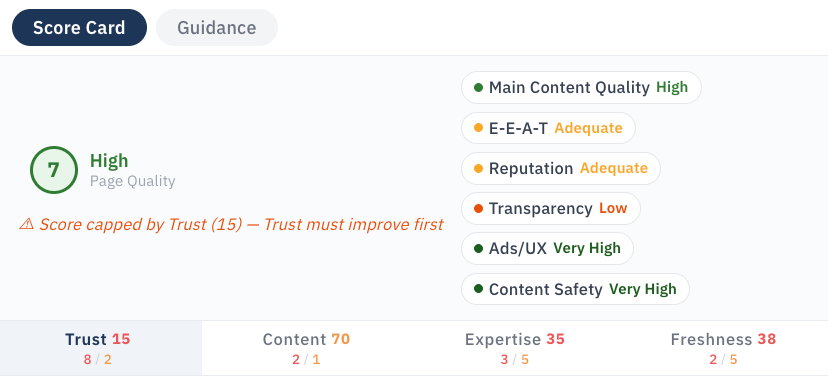
Every page is scored for quality. That score is split across four key areas, so you can quickly spot what’s holding it back.
- Trust — Trust looks at the basics: who wrote this, who’s behind it, and whether the page gives users a reason to believe it. Author identification, contact information, editorial accountability, organizational identity, privacy policies, structured data completeness, and YMYL adequacy.
- Content — the depth and quality of the main content itself.
- Expertise — credential relevance, demonstration of real-world experience, and subject-matter authority.
- Freshness — date transparency, content freshnesst, and recency signals.
Each dimension is scored granularly. Under the hood, Trust is broken into multiple signals, from authorship, contact information, editorial accountability, to structured data, and surfaces a single, clear score.
The scoring logic(0-10) mirrors how Google’s own quality raters are trained to evaluate pages. Most critically, if Trust is low, the overall Page Quality score is capped, no matter how strong the content or expertise signals are. This reflects a foundational truth in Google’s framework: a page cannot be considered high quality if it cannot be trusted.
Key insight: A page with excellent content quality can still receive a capped score if its Trust dimension is weak. Quattr makes this relationship explicit and actionable — “Score capped by Trust (15) — Trust must improve first.”
2. The Guidance Tab: Built Around Search Intent
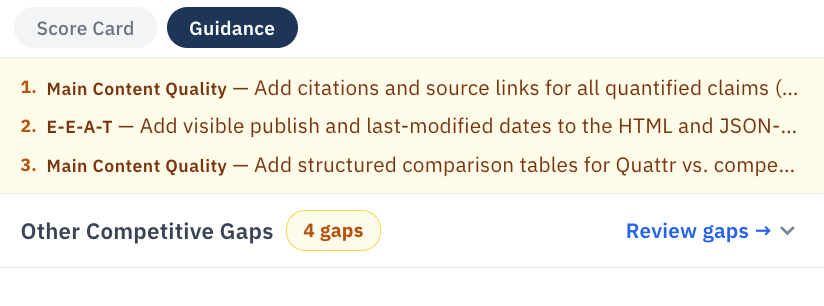
Where most competitive content tools benchmark your page against top-ranking competitors and tell you to “add more content,” Quattr’s Guidance Tab takes a fundamentally different approach.
Rather than relying solely on competitor data, the Guidance module uses query intent to identify the specific content facets a page must address to satisfy searcher needs. It goes beyond topic coverage to answer a more precise question: what is this query actually asking for, and is this page fully delivering it?
The output is a prioritized list of actionable fixes like:
- “Transparency — Add a clearly identified author with name, bio, and relevant credentials”
- “E-E-A-T — Add citations and references to support specific quantitative claims”
- “Main Content Quality — Add at least 1–2 real-world case studies or concrete examples”
Each gap is tied to a competitor benchmark (e.g., “Your page: low → Best competitor: adequate”). And instead of sitting in a report, these fixes are built into the workflow. You can apply them, dismiss them, and re-score the page as you go.
This turns E-E-A-T from something you audit occasionally into something your team improves continuously.
Why E-E-A-T Matters for AEO and GEO
The launch of Quattr’s E-E-A-T Intelligence is timed deliberately. As AI-powered answer engines, Google AI Overviews, ChatGPT, Gemini, Perplexity, and Claude become dominant discovery surfaces, the criteria for content inclusion have fundamentally shifted.
These systems do not look for keyword matches. They retrieve the most trustworthy, authoritative, and experience-backed content that can be reliably cited as a source. To put it simply, they operationalize E-E-A-T at scale, automatically and algorithmically.
For brands investing in AEO (Answer Engine Optimization) and GEO (Generative Engine Optimization), this means E-E-A-T is not a background quality signal. Content that fails on trust, author transparency, or credential signals is simply less likely to be retrieved, regardless of how well it covers a topic.
Quattr is built around this shift. The platform was built as an execution-led AI search visibility platform, one that not only identifies where you appear in AI-generated answers, but equips you to change what those answers say and who they cite. E-E-A-T Intelligence is the content layer of that execution loop.
Most AI search visibility platforms are good at detection; they show you citations and mentions. Quattr goes further: it connects AI search visibility with SEO and AEO, and turns insights into live changes. Quattr’s E-E-A-T Intelligence is the bridge between content quality and AI retrieval.
E-E-A-T as Part of a Unified Execution Platform
E-E-A-T Intelligence does not exist in isolation inside Quattr. It is one layer of a broader platform built for execution, not just monitoring. The goal isn’t to show you a score. It’s to help you change it, deploy the fixes, and measure what moves.
Here is how E-E-A-T connects into Quattr’s larger execution loop:
GIGA: The AI Agent That Acts on Gaps
Identifying a content gap is only useful if something gets done about it. GIGA, Quattr’s AI SEO agent, closes that gap by drafting and optimizing content up to 3x faster, restructuring pages for machine-readability, and working in your brand’s voice. When the E-E-A-T Guidance Tab surfaces a fix, GIGA is what executes it. No manual efforts or developer bottlenecks.
The results are measurable. As one customer put it:
We pick an underperforming page. GIGA runs a competitive analysis against our competitors. It identifies specific content gaps, not generic “write more about X” suggestions, but precise gaps in topic coverage, heading structure, content depth, and internal linking. Then it fills those gaps in our brand voice, adds contextual internal links that connect to our broader content structure, and produces CMS-ready output. The results have been measurable. Pages we optimized with GIGA started ranking higher within weeks. Read more here.
Content AI: From Insight to Published Page
Quattr’s Content AI extends the insight-to-execution cycle. Teams can create new, high-quality pages from scratch, auto-write and refresh existing content at scale, and publish directly to WordPress without leaving the platform. Optimized content goes live faster, and the E-E-A-T signals that matter, author transparency, structured data, and credible sourcing are built in from the start.
GEO Tracking: Visibility Across Every AI Engine
Quattr tracks citations and brand mentions across Google AI Overviews, Google AI Mode, ChatGPT, Gemini, Claude, and Perplexity, with sentiment analysis and share-of-voice benchmarking against competitors. This is how you know whether E-E-A-T improvements are actually being reflected in AI-generated answers, not just in traditional rankings.
Internal Linking AI: Authority That Scales
A single credible page should amplify trust across your entire topical cluster. Quattr’s autonomous internal linking AI ensures high-trust, high-expertise pages pass authority efficiently through your site architecture, and keeps links updated automatically as new content is published. Through APIs and CMS plugins, these changes are deployed at scale without manual edits or development sprints.
Unified Data Consolidation
Analytics lives in one place, Search Console in another, and visibility data in a third. Quattr consolidates them: GSC queries, GA4 conversions, AI citation tracking, bot crawl analytics, and technical SEO monitoring all feed into the same dashboard. Visibility analysis becomes a revenue analysis. You’re not watching a dashboard, you’re running a business case.
First-Party Data That Closes the Loop
Quattr’s Market Share Metric connects directly to Google Search Console and GA4. E-E-A-T improvements are mapped to real outcomes, changes in impressions, clicks, conversions, and competitive share of voice. You’re not evaluating “exposure.” You’re evaluating impact.
The distinction is straightforward: a monitoring tool tells you your E-E-A-T is low. Quattr tells you what to fix, gives you an AI agent to fix it, deploys the change, tracks its impact across AI engines, and ties the outcome to revenue, all within the same platform.
What This Looks Like in Practice
Here is a concrete example of how the workflow operates for an enterprise content team:
Step 1: Diagnose
A team runs an E-E-A-T Score Card on a high-priority landing page. The page scores 6 (Medium+) on Page Quality. The Trust dimension scores 15 out of a possible 80, primarily because the page has no identified author, no organizational identity signals, and zero structured data. The overall score is capped.
Step 2: Prioritize
The Guidance Tab surfaces three ranked fixes: add a clearly identified author with bio and credentials, add citations and references for quantitative claims, and include at least one real-world case study. Each fix is mapped to a competitive gap against the best-performing competitor page.
Step 3: Execute
The team applies the fixes. Author bio added. Structured data updated. Citations added. The page is re-scored inside Quattr using the Re-score function, and the new Page Quality score reflects the improvements in real time.
Step 4: Measure
Quattr’s Market Share Metric and GSC integration track whether the improved page gains impressions, appears in AI Overviews, or is cited in generative engine answers, connecting a content quality improvement directly to a visibility outcome.
E-E-A-T Goes Beyond a Checklist with Quattr
Being “aware” of your E-E-A-T gaps is the baseline. Winning requires the ability to act on them, governed, scaled, and measured against business outcomes.
The brands that win in AI search won’t be the ones publishing the most content. They’ll be the ones publishing content that AI systems actually trust and cite. That starts with E-E-A-T, and it requires more than a one-time audit.
Quattr delivers the full loop: diagnose gaps, execute fixes with GIGA, deploy at scale, and measure whether the change moved the needle in AI-generated answers.
That’s the difference between a monitoring tool and an execution platform, and it’s the difference between appearing in AI answers and shaping what those answers say.
In Answer Engine Optimization (AEO) and Generative Engine Optimization (GEO), content is selected based on credibility and cite-worthiness, not just keyword relevance. E-E-A-T directly influences whether your content gets picked.
Content quality matters, but without clear signals of expertise and trust, AI systems may not consider it reliable enough to include in answers.
c[By adding clear authorship, credible sources, structured data, real-world examples, and regularly updating content to reflect current information.

Quattr is an AI-native Search Visibility Platform founded in Palo Alto, California, built for mid-market and enterprise brands competing in the age of generative search. Recently recognized across G2's Spring 2026 reports with #1 rankings in AEO Results, Usability, and Relationship, Quattr helps brands win visibility across traditional search and AI-generated answer surfaces.
Quattr's AI agent, GIGA, evaluates content the way AI systems do, identifying gaps across structure, authority, internal linking, and discoverability to surface the highest-impact fixes. With capabilities like autonomous internal linking, E-E-A-T intelligence, and the new GIGA Landing Page Generator for keyword-matched, AI-search-ready pages, Quattr helps teams move from diagnosis to deployed changes without manual bottlenecks.