
Key Takeaways
- AirOps works well for structured content workflows at a moderate scale, but starts to break when teams need to connect visibility, decisions, and outcomes.
- As workflows grow, teams face fragmentation: insights live in one place, execution in another, and revenue impact somewhere else.
- Enterprise teams don’t just need content generation; they need systems that turn AI visibility into action and measurable performance.
- The real decision isn’t “which tool is better”. It’s what your team needs after seeing the data
AirOps earned its place by making SEO workflows easier to run. For smaller teams, that’s enough. You can spin up templates, generate content quickly, and keep things moving without much overhead.
But that is not where enterprise teams struggle.
The problems show up later. After workflows scale. After expectations move beyond content generation. After teams try to turn these systems into something they can actually rely on.
This isn’t a broad list of “tools like AirOps.” It’s a narrow look at what breaks when visibility tracking, execution, and revenue impact sit in different systems, based on a mix of observed workflows, product evaluations, and what teams consistently surface in community reviews and discussions.
Why Enterprise Teams Start Moving Beyond AirOps
Most teams don’t outgrow AirOps overnight. They start with straightforward use cases, content briefs, programmatic pages, and repeatable workflows that save time and reduce manual effort. It works well at this stage.
As the scope expands, teams try to bring performance data into the loop and move from generating content to deciding what to do next. That’s when limitations start showing up, usually as small workarounds that compound over time.
The same friction points show up across teams:
- Workflows start to multiply. What begins as a few templates turns into dozens with slight variations, each requiring upkeep. Governance becomes a separate task, not something built into the system.
- Cost starts influencing execution. Task-based pricing feels manageable early on, but at scale, every run carries a tradeoff. Teams slow down not because of a lack of ideas, but because usage becomes a constraint.
- Workflows stop being linear. Enterprise SEO isn’t just content generation; it involves iterating on data, testing assumptions, and feeding results back into execution. When the system can’t support that loop, those steps move elsewhere.
- Insights and execution drift apart. Tracking visibility is one workflow; acting on it is another. When they stay disconnected, insights don’t translate into action fast enough.
As usage grows, the platform moves away from the center of the workflow. Analysis and prioritization happen elsewhere, making the system harder to justify.
That’s when alternatives start to make sense, systems built for how teams already operate at scale.
What Teams Look for in an AirOps Alternative
Before evaluating or committing to any tool, it is important to be precise about what “better” actually means for a team at your scale.
- You need execution depth. A dashboard that shows you where your brand appears in AI-generated answers. Platforms that connect those insights to deployed content changes, internal linking automation, and measurable traffic outcomes are categorically more valuable.
- You need multi-engine AI visibility. Google AI Overviews are one channel. ChatGPT Search, Perplexity, Gemini, and Claude are shaping buyer discovery in parallel. Any tool that only tracks one engine is giving you a partial picture.
- First-party data integration is essential. AI visibility metrics that don’t connect to GSC clicks, GA4 conversions, or revenue outcomes are hard to defend in a budget conversation. Enterprise teams need the link between AI search performance and business impact to be explicit.
- The alternative to AirOps’s template fatigue isn’t no structure, it’s structure that scales. Look for platforms with clear multi-domain, multi-market, and multi-CMS support baked in.
- Pricing that doesn’t penalize growth. Per-task or per-credit models create anxiety at volume. Predictable pricing, whether flat-rate or clearly tiered, matters more at enterprise scale than it does for a five-person team.
None of this makes AirOps a poor product. It makes it the wrong fit for teams whose requirements have matured past what it was designed to solve. Below is not a quick comparison but a look at how these tools actually hold up once workflows scale.
Quick Comparison Table of AirOps Alternative Platforms
| Tool | Best For | Growth & Enterprise Pricing | Core Advantage Over AirOps |
|---|---|---|---|
| Quattr | Execution-led SEO + GEO at enterprise scale | Custom enterprise pricing | Connects AI visibility directly to deployed optimizations and revenue outcomes |
| Profound | Enterprise AI visibility monitoring and optimization | $399/month; Custom enterprise pricing | Monitors 10+ AI engines, pairs brand visibility data with real user prompts |
| Writesonic | All-in-one GEO + SEO + content execution | $399/month; Custom enterprise pricing | Real-prompt tracking across 10+ AI engines with integrated content creation |
| Scrunch AI | AI visibility, narrative control, brand sentiment | $250/month; Custom enterprise pricing | Unique focus on structuring content for AI agent interpretation |
| AthenaHQ | Deep GEO analytics and brand perception | $295/month;Custom enterprise pricing | Detailed AI brand perception reports and competitor citation mapping |
| Peec AI | AI search visibility monitoring and brand citation tracking | $295/month; Custom enterprise pricing | Tracks brand mentions, position, and sentiment across LLMs, with competitive benchmarking and unlimited seats on all plans |
Top 6 Best AirOps Alternatives for Enterprise Teams
1. Quattr — Best for Execution-Led SEO + GEO at Enterprise Scale
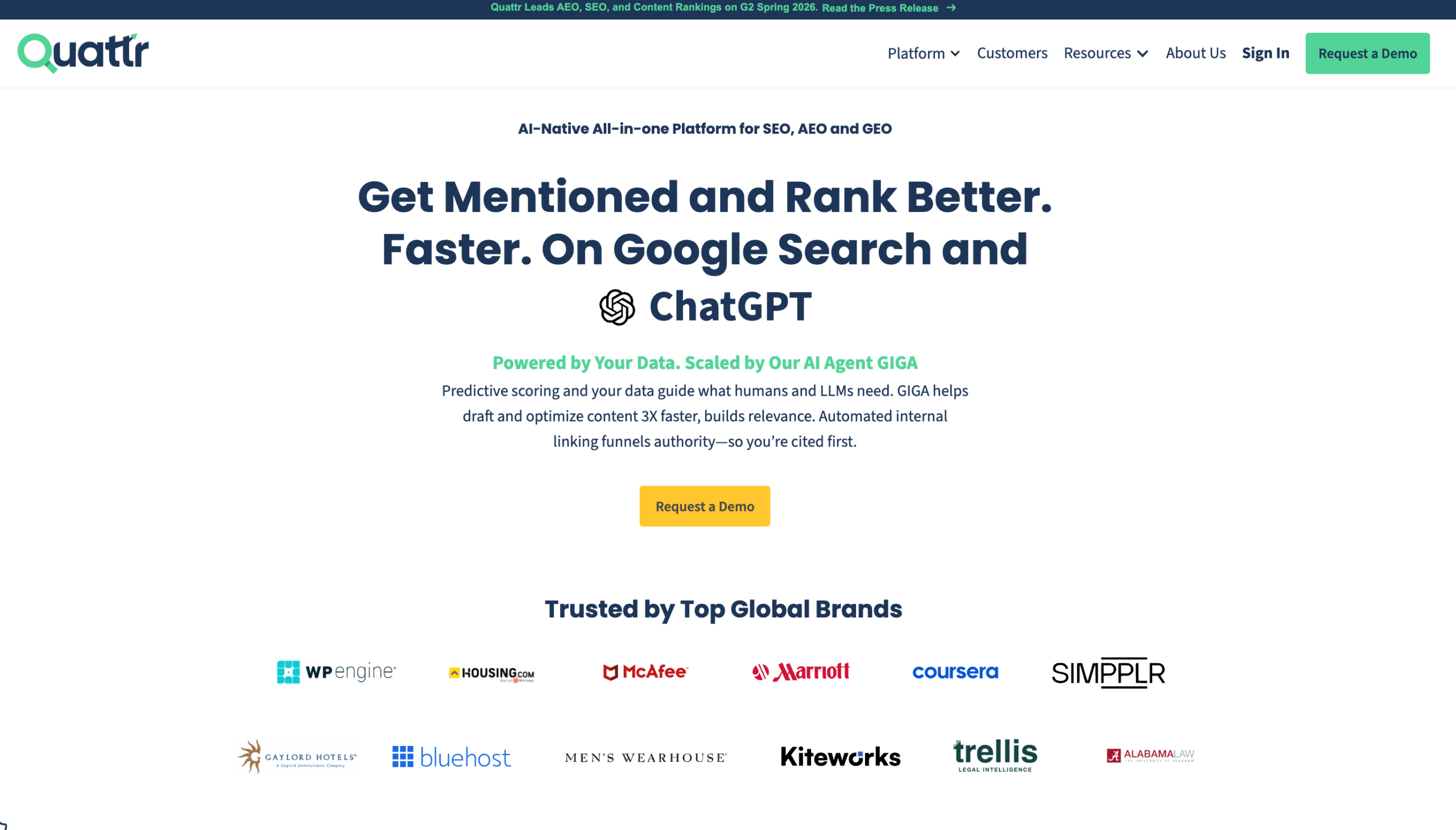
Most AI visibility tools stop at monitoring. Quattr is built to bring together monitoring, reporting, and execution.
Where AirOps focuses on configuring content workflows, Quattr connects AI visibility signals and tracking directly to live-site execution, content optimization, internal linking automation, CMS-integrated publishing, and ties those actions back to first-party data. That’s a meaningfully different value proposition for an enterprise SEO team that needs to prove impact. Quattr provides the first truly integrated workflow that turns your own first-party data into the definitive source for your industry.
Top Features
- AI Visibility and Share of Citation: Track brand mentions, sentiment, share of voice, and citation patterns across Google AI Overviews, ChatGPT, Perplexity, Gemini, and traditional SERPs, all surfaced through custom Looker dashboards.
- GIGA AI Content Optimization: GIGA AI analyzes your pages against top-ranking competitors to identify and fill semantic, structural, and intent gaps. It then drafts and optimizes content using predictive traffic-lift scoring, brand-voice-aware generation, and signals from both SERP and AI search data.
- Autonomous Internal Linking: Internal linking automation at scale, using semantic understanding, relevance, authority, and demand signals to build topical authority and strategically flow link equity, without manual intervention.
- Live-Site Content Execution: Deploy changes through APIs, CMS plugins (including WordPress), or edge injection, no dev bottleneck, and validated through sandbox A/B testing before full rollout.
- Revenue Attribution: Tie AI citations and answer engine visibility directly to GSC clicks, GA4 conversions, Adobe Analytics, and more. This is where Quattr separates from most alternatives: it makes AI search performance measurable in business terms, not just visibility terms.
- Dedicated SEO Concierge Support: Access to SEO and GEO specialists with 10+ years of experience, available through Slack, Teams, or scheduled sessions for strategy, prompt planning, and implementation support.
- E-E-A-T Intelligence & Automated Scoring: Quattr quantifies quality guidelines into scores across Trust, Content, Expertise, and Freshness. It provides guidance and one-click fixes to improve E-E-A-T scores of every page.
Pros
The combination of deep visibility tracking and live-site execution in one platform. Most tools make you choose between knowing where you stand and actually moving the needle. Quattr does both. Its multi-domain, multi-language, multi-CMS support with hreflang governance makes it particularly well-suited for global enterprise teams managing complex site architectures.
Cons
Quattr is built for scale. The platform delivers maximum value for enterprises with meaningful content portfolios and a team equipped to act on its recommendations. It is not optimized for lightweight or early-stage use cases.
Pricing: Custom enterprise pricing. Book a demo for a tailored assessment.
Best For: Enterprise content and SEO teams that need AI visibility to translate into traffic, pipeline, and revenue.
2. Profound: Enterprise AI Visibility Monitoring
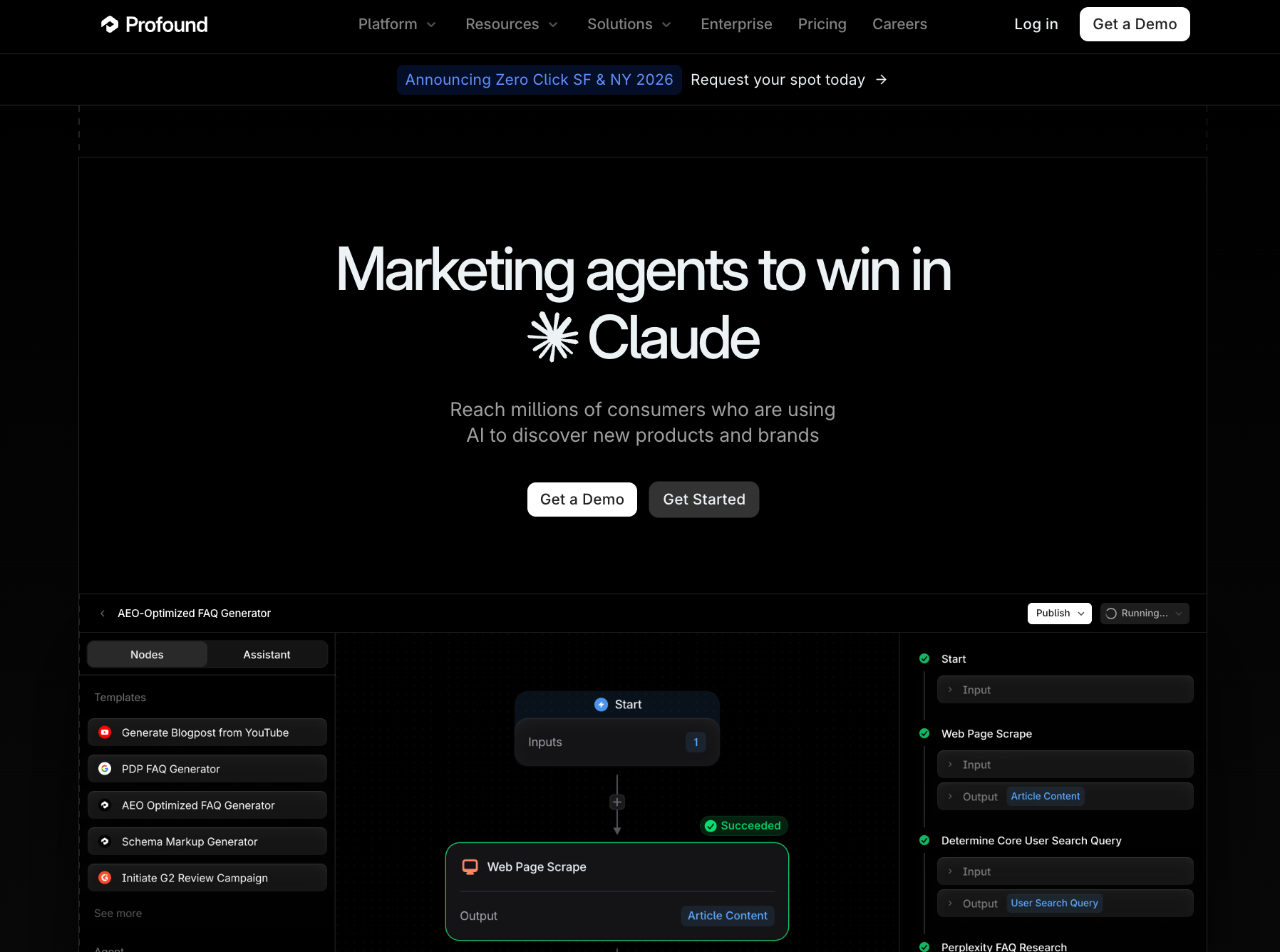
Profound mainly focuses on monitoring how brands appear in AI-generated answers and understanding the demand signals behind those answers. Where most GEO tools track whether a brand appears, Profound adds a layer of context: what users are actually asking, how AI engines respond, and how that changes over time.
The platform monitors 10+ AI engines, including ChatGPT, Claude, Perplexity, Google AI Overviews, Gemini, Copilot, DeepSeek, and Grok, and pairs that data with 400M+ real user prompts via its Conversation Explorer and AI crawler analytics.
Top Features
- Multi-Engine Brand Monitoring: Track brand mentions, share of voice, sentiment, and citation patterns across 10+ AI engines. Profound captures live, front-end answers, querying AI platforms directly, rather than relying solely on API outputs.
- Conversation Explorer: Access to 400M+ real user prompts showing what people actually ask AI engines in your category, which competitors are cited, and how responses vary by query type.
- Product Rankings in AI Shopping: Tracks placement and presentation of your products across ChatGPT shopping responses. It provides competitive benchmarking, retailer mapping gaps, and trend spotting to drive traffic & conversions, ideal for e-commerce GEO.
- Query Fanouts Analysis: Reveals how answer engines transform user prompts into multiple high-intent search queries before generating responses, showing total query count, average queries per execution, word transformations, and period-over-period trends.
- AI Crawler Analytics: Track how AI crawlers access your site, which URLs they visit, and how that activity maps to citations, useful for diagnosing why certain pages are or aren’t being surfaced.
- Content Optimization (Growth and above): Leverages template-based workflows for AEO gap analysis and structural edits on existing/draft content. The Growth plan includes content generation, though it is capped at 6 articles per month. Enterprise plans expand this capability.
Pros
The depth of monitoring data. Profound is the clear market leader by a wide margin, based on features, customer adoption, and the velocity of product evolution for enterprise teams that need auditable, multi-engine visibility data with real user prompt context.
Cons
Lacks built-in execution tools, no on-page editors or optimization workflows, so users must export insights to other platforms for action.
There is no free trial, and enterprise access requires going through a sales process. The most critical reviews share common concerns around the platform’s steep learning curve.
Pricing: Starter at $99/month (ChatGPT only). Growth at $399/month (3 engines). Enterprise at custom pricing (10+ engines).
Best For: Enterprise teams in regulated industries or organizations that need deep, auditable AI visibility data across multiple engines, with real user prompt context built in.
3. Writesonic — GEO + SEO Platform
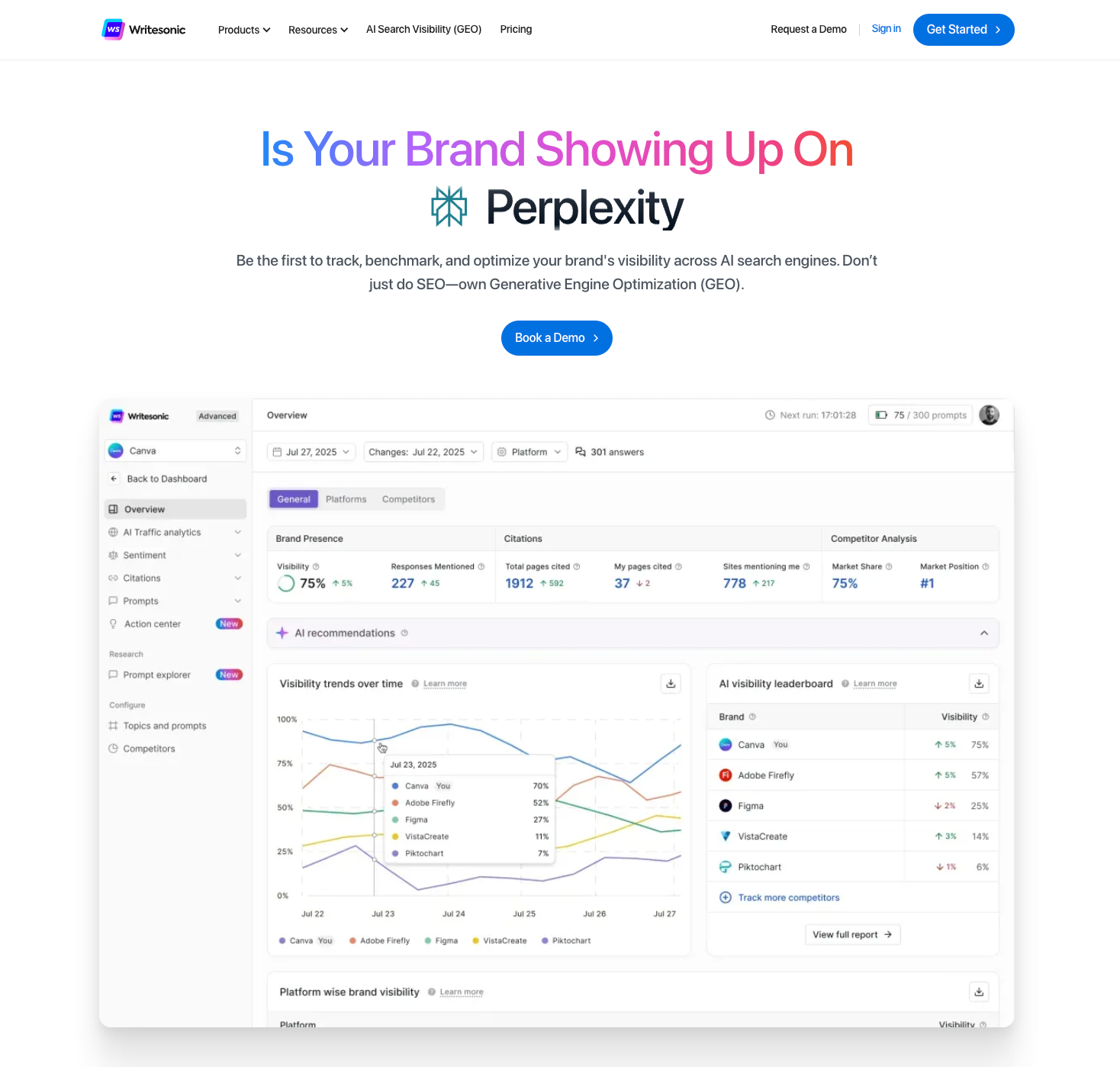
Writesonic approaches AI visibility from a content execution angle. It is one of the few platforms where analytics and optimizations live together, a distinction that matters for teams tired of toggling between monitoring dashboards and content tools.
The platform tracks brand performance across 10+ AI engines, pulling from 200M+ real AI conversations to surface visibility scores, prompt volumes, and sentiment analysis. That data then feeds directly into content creation and optimization workflows, SEO-optimized articles with bulk generation, 100+ source fact-checking, automatic internal linking, and brand voice customization.
Top Features
- AI Visibility Dashboard with real prompt tracking across ChatGPT, Perplexity, Claude, and more
- AI Bot Analytics tracking which crawlers visit your site and how often
- AI Visibility Action Center translating insights into prioritized content recommendations
- Integrated SEO suite with live Ahrefs and Google Search Console data
- AI-powered long-form content generation with bulk capabilities and automatic internal linking
Pros
The breadth of the platform. Writesonic covers GEO tracking, SEO tooling, and content creation in a single subscription, a stack consolidation play for teams that currently use separate tools for each of those functions.
Cons
Generated content often requires significant editing for accuracy, tone, and originality; prone to generic or robotic outputs.
Overwhelming interface, steep learning curve for advanced features, and credit-based limits on lower plans.
Pricing: Professional at $199/month (billed annually). Advanced at $399/month. Enterprise pricing available.
Best For: Teams that want one platform to replace their entire organic marketing tech stack, from AI visibility to content production.
4. Scrunch AI — AI Visibility, Narrative Control, and Brand Sentiment
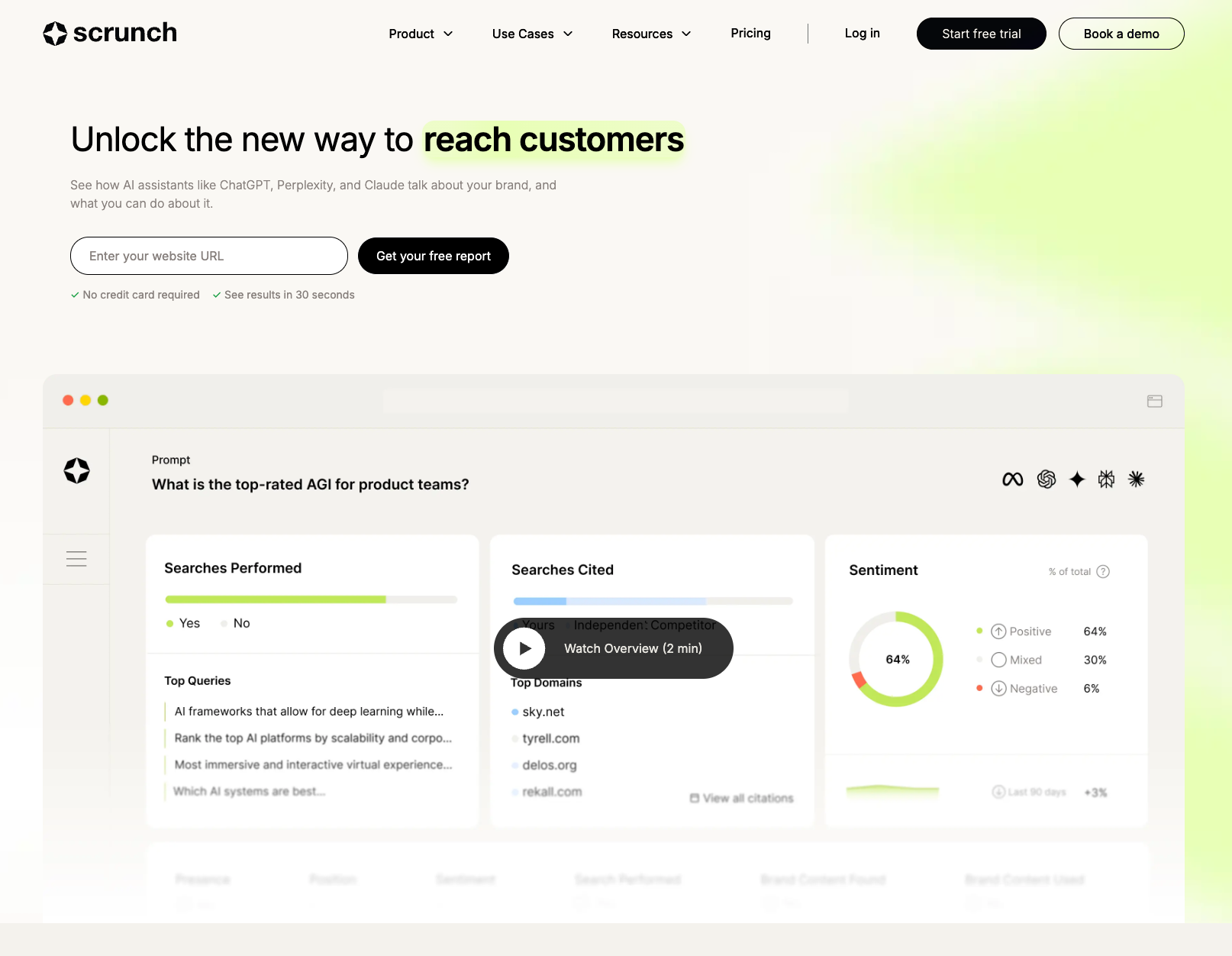
Scrunch AI occupies a distinct position in this space. It is not trying to be a content creation platform. It is built for teams that want to understand and influence how AI systems perceive and describe their brand.
Its Agent Experience Platform (AXP) creates parallel, machine-readable site versions with extracted meta, titles, descriptions, keywords, and headers, optimized for AI agent interpretation without disrupting human UX. That is a capability most platforms in this space do not offer.
Top Features
- Citation tracking and share of voice across ChatGPT, Perplexity, Claude, and other LLMs
- Sentiment monitoring with Net Sentiment Score and hallucination detection alerts
- Persona-based visibility insights, see how AI answers shift for different audience segments
- Competitor citation and ranking comparisons by topic and geography
- SOC 2 Type II compliance, RBAC, multi-brand, and multi-region support
- AI crawler audits comparing human vs. agent webpage delivery
Pros
The combination of visibility tracking with content-layer optimization for AI interpretability is genuinely differentiated. For enterprise brand, PR, and CMO-level stakeholders who need to manage narrative consistency across LLMs, Scrunch AI is purpose-built for that use case.
Cons
The AXP feature is still in early access for some users. Pricing escalates quickly for smaller teams or single-site operations. It does not include SEO tooling or traditional content creation workflows.
Pricing: Starter at $250/month. Growth at $417/month. Enterprise pricing available.
Best For: Enterprise brand managers, PR teams, and marketing leaders who need to monitor and protect brand narrative across AI-generated answers.
5. AthenaHQ — GEO Analytics and Brand Perception
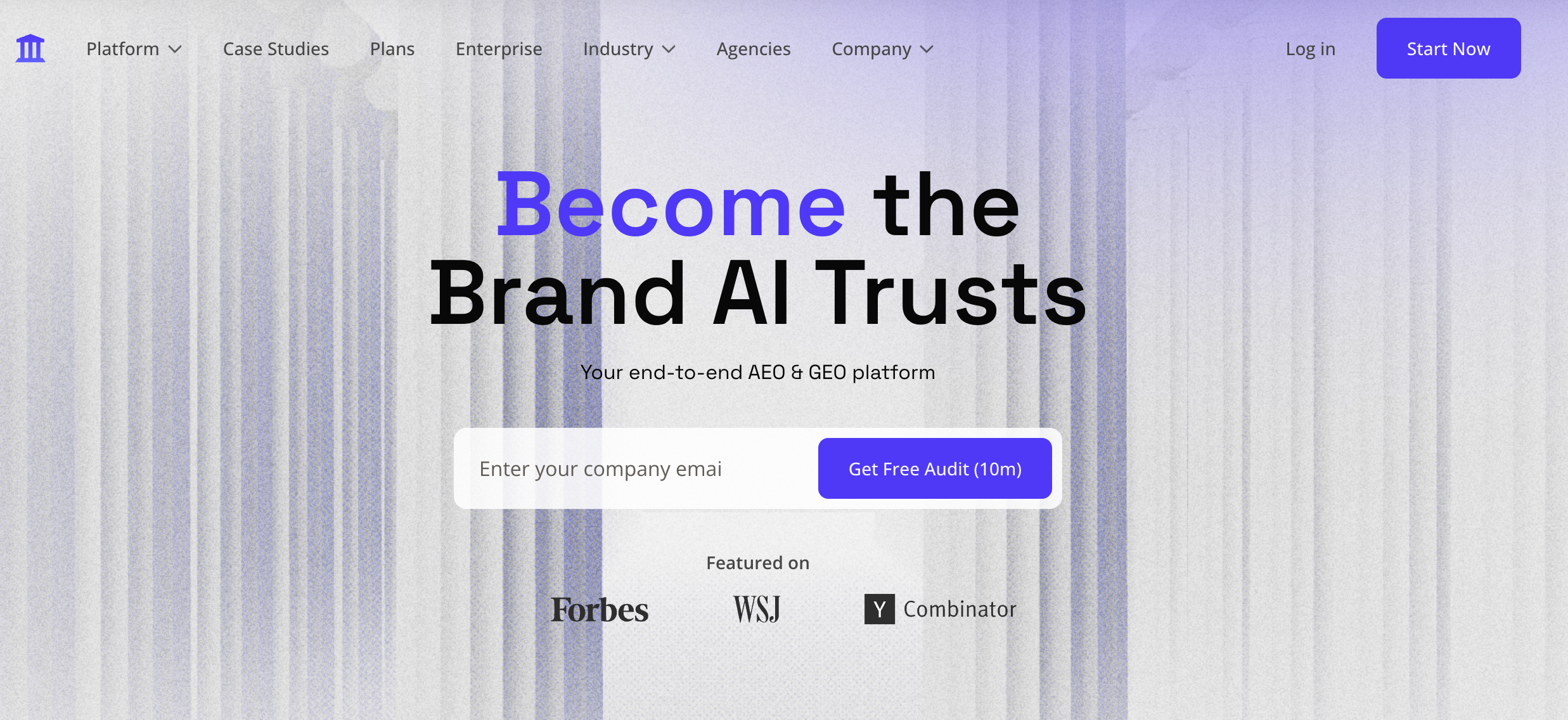
AthenaHQ is focused on one thing: understanding how AI platforms reference, describe, and position your brand. As an alternative platform to AirOps that focus translates into detailed analytics that broader platforms often sacrifice in favor of coverage.
The platform tracks AI citations across ChatGPT, Perplexity, Gemini, Claude, and Google AI Overviews, then surfaces brand perception analysis showing how AI models describe your category, your competitors, and you, relative to each other.
Top Features
- Tracks AI citations and visibility across major engines like ChatGPT or Perplexity.
- Analyzes brand perception, shows how AI describes your brand compared to competitors.
- Spots authority sources, like which third-party sites boost your AI presence.
- Monitors competitors and impersonators, catching where they show up in your prompts.
- Measures Share of Voice in AI searches, giving you hard numbers on dominance.
Pros
The depth of brand perception reporting. For enterprise teams managing brand positioning across multiple markets, understanding not just whether you appear in AI answers but how you’re described is a meaningful analytical step beyond what most tools offer.
Cons
AthenaHQ focuses on AI visibility analytics rather than content creation or direct execution workflows. Teams will likely still need separate tools for writing and SEO execution. Bugs, glitches, and frequent updates that disrupt workflows and require constant relearning.
Pricing: Self-Serve at $295/month. Enterprise pricing available.
Best For: Enterprise teams and agencies that want dedicated GEO analytics and detailed brand perception reporting as a core part of their AI search strategy.
6. Peec AI — AI Visibility and Prompt Intelligence Platform
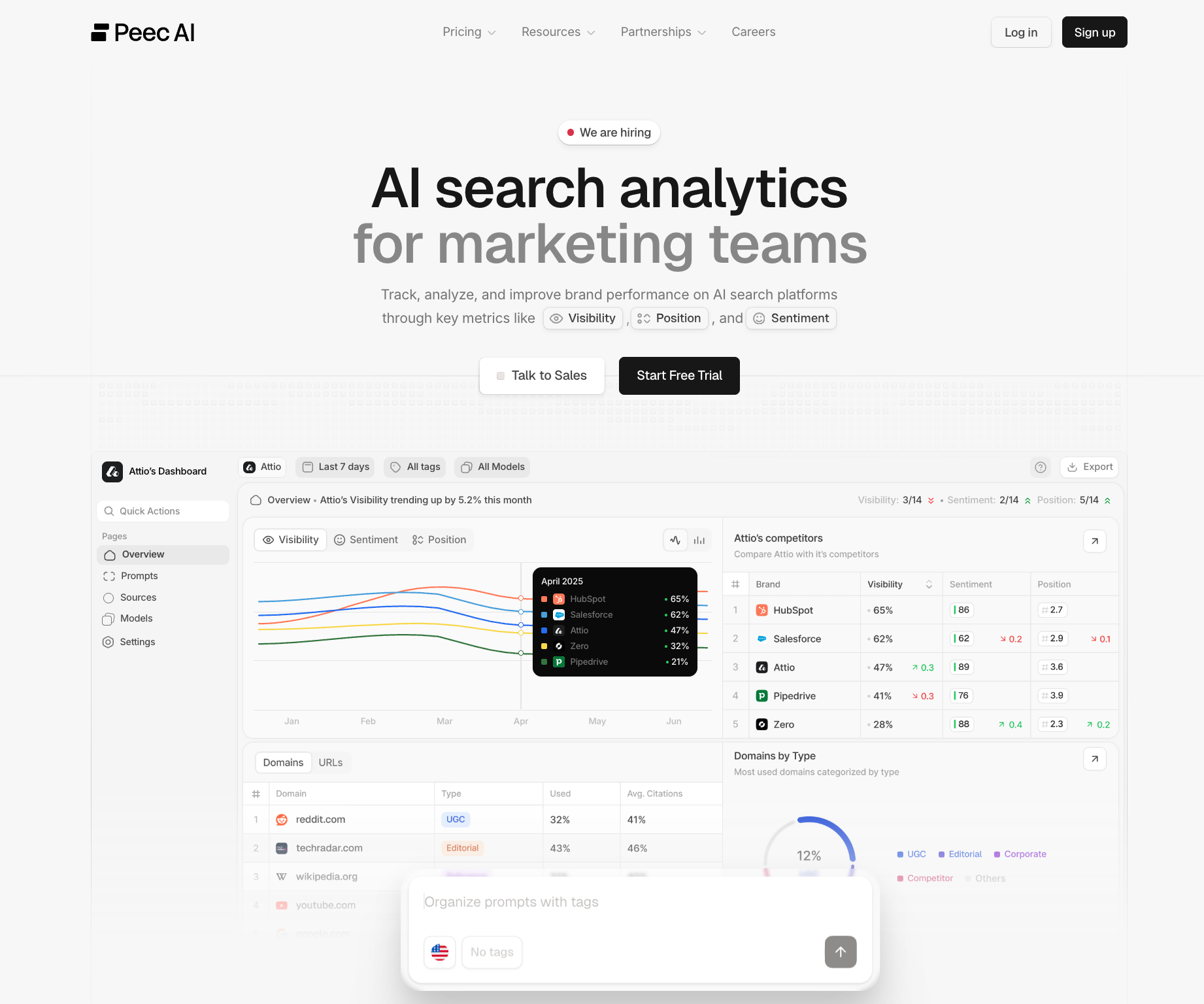
Peec AI stands out by focusing on real-time prompt intelligence and conversational AI tracking, helping brands understand and shape how users interact with AI engines through actual queries and responses.
Unlike monitoring-only tools, Peec AI combines visibility data with prompt engineering insights, showing not just what AI says about you but why, based on user query patterns, response triggers, and conversational flows across engines like ChatGPT, Perplexity, and Gemini.
Top Features
- Prompt Intelligence Tracking: Analyzes millions of real user prompts to reveal query patterns, intent clusters, and how they lead to brand citations or gaps.
- Conversational Flow Mapping: Tracks multi-turn conversations in AI chats, identifying where competitors enter responses and opportunities to insert your brand.
- AI Response Trigger Analysis: Pinpoints the exact phrases, sources, and signals that make AI engines cite your content over others.
- Visibility Forecasting: Predicts citation trends based on prompt volume growth, seasonal queries, and emerging topics.
- Custom Alerting & Workflow Integration: Real-time notifications for citation wins/losses, integrated with Slack, email, or CMS for rapid response.
Pros
Peec AI bridges the gap between passive monitoring and active prompt strategy. Its conversational focus gives marketing teams a window into user-AI interactions that pure visibility tools miss, making it ideal for content teams optimizing for dynamic AI responses.
Cons
Limited emphasis on traditional SEO or on-site execution, strong on insights but requires pairing with content tools for full implementation. Data feels thin, with no historical performance data. Best for established sites, not startups, and monitoring-only without execution or traffic attribution.
Pricing: Starter at $149/month. Pro at $349/month. Enterprise custom.
Best For: Content and growth teams wanting to master AI prompt dynamics and turn user conversations into citation opportunities.
Quattr vs Profound vs AirOps: Enterprise Comparison
Quattr → Execution layer
Built to close the loop between AI visibility and action. Connects citations and visibility signals directly to live-site changes, internal linking, and measurable outcomes tied to first-party data.
Profound → Intelligence layer
Focused on deep AI visibility monitoring, prompts, citations, and how answers are generated across engines. Strong on insight, but execution happens outside the platform.
AirOps → Workflow layer
Designed for content generation and optimization workflows. Combines visibility insights with content production, but execution is largely limited to content, not full-site systems. The distinction is structural, not feature-based:
Quattr is built to change the outcome and measure it. Profound shows you what’s happening. AirOps helps you produce content around it
How to Choose the Right AirOps Alternative?
The decision comes down to one question: what does your team need to do after it sees the data?
If your priority is execution at scale, deploying content optimizations, automating internal linking, and attributing AI visibility to revenue, Quattr is built for exactly that. It is the only platform on this list that closes the loop from citation monitoring to live-site changes to measurable business outcomes.
If you want to consolidate GEO, SEO, and content creation into one platform without managing separate subscriptions for each function, Writesonic offers the broadest coverage at a transparent price point.
If brand narrative and sentiment across AI engines is your primary concern, especially for PR, brand, or CMO-level stakeholders, Scrunch AI’s focus on how AI describes your brand, not just whether it mentions you, is a meaningful differentiator.
If you need deep GEO analytics and detailed AI brand perception reporting without a content creation layer, AthenaHQ delivers that focused analytical depth.
One broader framework worth applying: separate the tools that observe AI search from the tools that change outcomes. Monitoring tells you where you stand. Execution determines whether you move. For enterprise teams, the distinction matters because reporting on AI visibility without a path to improving it is an incomplete solution.
Where This Leaves Enterprise Teams
AirOps solves a real problem. For teams running templated workflows and producing content at a steady volume, it still works.
But most enterprise teams aren’t struggling to generate content anymore. They’re struggling to decide what to do next, and to prove that those decisions actually move the business.
That’s where the gap shows up.
Not in content creation, but in everything around it, connecting visibility to action, action to outcomes, and outcomes back to strategy.
The tools in this space are starting to split along that line.
Some help you understand how AI systems see your brand. Others are starting to close the loop between insight and execution. Platforms like Quattr are built around that second approach, where visibility data feeds directly into changes on your site and can be tied back to performance.
AI visibility is becoming easier to measure. Acting on it and proving impact is still the harder problem.
If a team is still building visibility, monitoring is enough. If it’s accountable for traffic, pipeline, or revenue, monitoring alone starts to fall short.
That’s the shift this category is going through. And for teams that need to move from visibility to execution, the system they choose needs to reflect that.
Quattr is built for that. Book a demo to see how AI visibility connects directly to execution and measurable outcomes on your site.
FAQs on AirOps Alternatives
Partially. It covers basic AI visibility, but enterprise teams often need deeper, multi-engine tracking alongside it.
Not as a dedicated system. Internal linking is handled within content workflows, but it doesn’t offer automated, site-wide linking optimization at scale.
Yes. Some platforms go beyond monitoring by connecting insights directly to execution, deploying content updates, internal links, and measurable changes on the site.
Yes. It provides visibility into citations across AI engines, including ChatGPT, but the depth of analysis may be more limited than specialized monitoring platforms.
In most enterprise setups, yes. Teams often add analytics platforms, deeper monitoring tools, or execution layers as workflows and data needs expand.
It sits in between, but leans toward content workflows. It helps generate and optimize content, with visibility insights supporting those decisions.

Quattr is an AI-native Search Visibility Platform founded in Palo Alto, California, built for mid-market and enterprise brands competing in the age of generative search. Recently recognized across G2's Spring 2026 reports with #1 rankings in AEO Results, Usability, and Relationship, Quattr helps brands win visibility across traditional search and AI-generated answer surfaces.
Quattr's AI agent, GIGA, evaluates content the way AI systems do, identifying gaps across structure, authority, internal linking, and discoverability to surface the highest-impact fixes. With capabilities like autonomous internal linking, E-E-A-T intelligence, and the new GIGA Landing Page Generator for keyword-matched, AI-search-ready pages, Quattr helps teams move from diagnosis to deployed changes without manual bottlenecks.