

Key Takeaways
- Everyone is talking about AI visibility right now. How often your brand appears in AI-answers. But appearing in an AI answer and being described well in one are two very different things.
- Two brands can show up equally in AI-generated answers and feel completely different to the person reading them. One sounds trusted, recommended, and authoritative. The other sounds like just another option. That difference is sentiment and it is quickly becoming one of the most important things brands need to track.
- Business Insider’s report shows that Google AI Overviews can show more negative brand sentiment compared to some other AI platforms, making reputation management increasingly important.
- Brands with strong authority, positive reviews, active community discussions and consistent trust signals are more likely to receive positive AI sentiment.Makes AI platforms and search engines see the brand as trustworthyOften becomes the first thing people notice online.
What makes this tricky is that AI platforms do not just look at your website to form that perception. They pull signals from across the internet, reviews, community discussions, news coverage and everything in between. Brands with strong authority, consistent trust signals, and positive conversations happening around them online are far more likely to come out sounding good in AI answers.
The question is no longer just “Are we showing up in AI search?” It is “What impression are AI platforms creating about us when someone asks?”
That is what AI sentiment helps you understand and that is why it matters.
What is AI Sentiment?
When someone writes a review, leaves a comment or asks an AI a question about your brand, they are sharing more than information. They are sharing how they feel. Sentiment analysis is the technology that helps computers understand those feelings.
In simple terms, sentiment analysis is a way of teaching machines to read text and figure out whether the tone is positive, negative, or somewhere in between. It sounds straightforward, but doing it well is actually quite hard. Human language is full of sarcasm, context, and nuance that even people sometimes miss.
How It Started and How It Has Changed
Early sentiment analysis tools worked by looking for specific words. If a review had the word “amazing” in it, the tool marked it positive. If it had the word “terrible,” it marked it negative. This worked well enough in simple cases but broke down quickly in real life. Something like “not bad at all” would confuse the system completely because it saw the word “bad” and assumed the worst.
Over time, the technology got smarter. Machine learning models learned from thousands of examples and started picking up on patterns rather than just single words. Then came more advanced models that could understand the full context of a sentence. Today, tools can detect not just whether something is positive or negative but also what specific emotion is behind it and what part of a product or service the person is actually talking about.
It Goes Deeper Than Positive or Negative
Most people think sentiment analysis just tells you whether something is good or bad. But when it comes to how AI search platforms talk about your brand, it goes much further than that.
Take this example. ChatGPT might describe your product as “a powerful tool but comes with a steep learning curve.” That single sentence has two very different tones in it. One part builds trust and one part raises doubt.
A surface level reading would call it neutral and move on. But a deeper analysis tells you that your product strength is landing well in AI answers while ease of use is creating hesitation. Those are two completely different content problems that need two completely different fixes.
This is why understanding AI sentiment at a deeper level matters so much. It is not just about knowing whether AI mentions you positively or negatively overall. It is about knowing which parts of your brand story are coming across well and which parts are quietly working against you every time someone asks an AI a question about your category.
Why Tracking AI Sentiment is Not Optional Anymore
A few years ago you could afford to not know how AI was describing your brand. AI search was new and most brands were still figuring out whether it mattered. That window has closed.
Today millions of people are getting their first impression of your brand through an AI generated answer. They are reading one answer and moving on. If that answer describes you as a solid option but complicated to use, or good for enterprises but not for smaller teams, that is the perception they carry with them.
The problem is most brands have no idea this is happening. They are not tracking what AI platforms are actually saying about them. They are not seeing how that language has shifted over the past few months or how it compares to what AI says about competitors in the same breath..
Quattr does exactly this. The AI Visibility Trends dashboard tracks how positively your brand is referenced across major AI platforms.
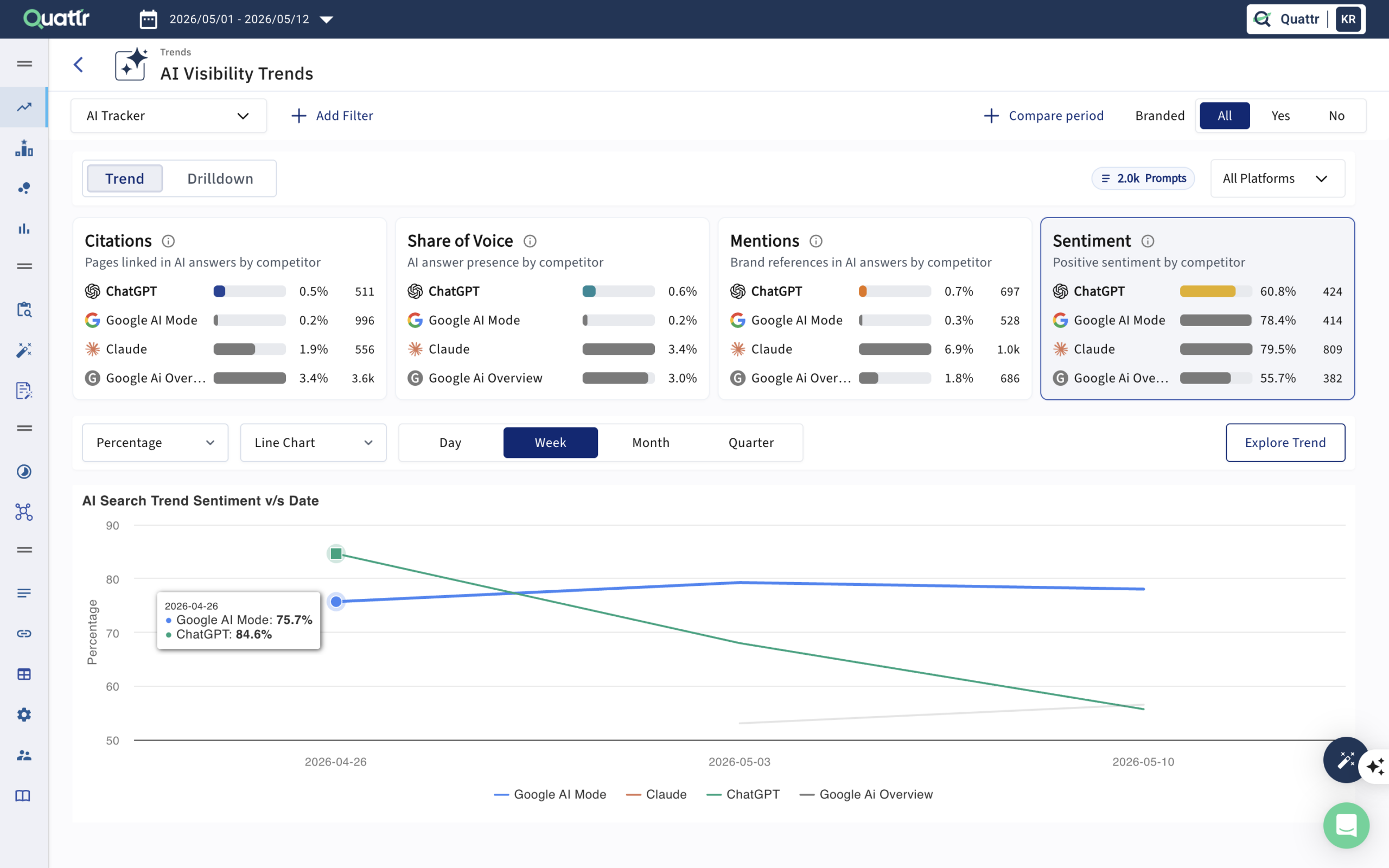
Looking at data, the differences are pretty striking. Claude had a positive sentiment score of 79.5 percent across AI answers, Google AI Mode came in at 78.4 percent, ChatGPT at 60.8 percent, and Google AI Overview at 55.7 percent. Knowing these numbers helps brands understand where they stand and what kind of content is likely to shift those numbers in their favor.
How AI Sentiment Works?
The process starts with text. That could be a customer review, a social media post, a news article or even an AI generated answer about your brand. The system takes that text and breaks it down into smaller pieces so it can study the language more carefully.
First the tool cleans up the text by removing things that do not carry much meaning on their own like common words such as “the” or “and.” Then it looks at what is left and tries to understand the relationship between words rather than just reading them one by one.
This is important because meaning often depends on how words sit next to each other. The phrase “not great” means something very different from “great” even though one of those words is shared. So if someone writes “not the most intuitive tool but very powerful” the system understands that powerful is a positive signal and not intuitive is a concern and it scores them separately.
Modern sentiment analysis uses large language models that have been trained on massive amounts of text. These models have learned to pick up on patterns that earlier tools completely missed. They can handle phrases that flip meaning and understand when something is being said with doubt rather than confidence.
For example if Google AI Mode says your platform is “worth considering for growing teams” that sounds fine on the surface but a trained model picks up that worth considering is a weak endorsement compared to something like “the go to choice for growing teams.” That difference in tone matters.
The output is usually a score or a label. A piece of text might come back as 85 percent positive. Or it might be broken down further to show that one part of the answer was confident and another part was hesitant. So instead of just knowing your brand came up, you know exactly how it came up.
Quattr’s Sentiment Analysis and What It Shows You
Quattr tracks sentiment in a way that is built specifically for the AI search era. Instead of just telling you how customers feel on review sites or social media, Quattr measures how positively your brand is being referenced inside AI generated answers.
This matters because AI platforms are now one of the primary places people go to learn about products, services, and brands. If an AI tool describes a competitor warmly and describes you cautiously, that shapes perception before a user even clicks on anything.
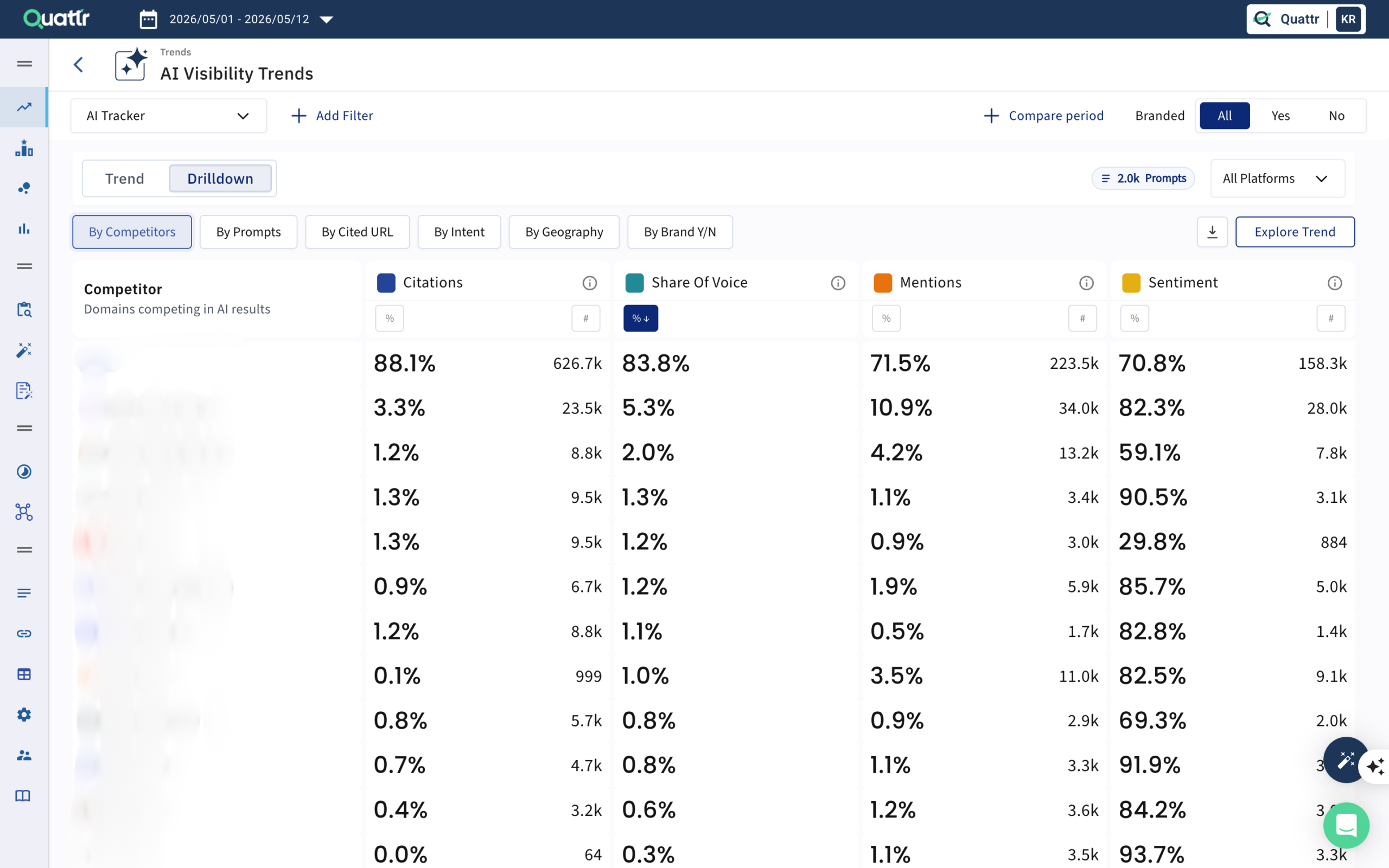
There is the Drilldown view in Quattr, which is where things get really useful. You can break your AI visibility data down by Prompts, Cited URLs, Intent, Geography, and more.
This means you are not just looking at an overall sentiment number. You can see exactly which types of questions are driving positive references to your brand, which URLs are being cited most often and where in the world your AI visibility is strongest or weakest. It helps you to build a strategy.
Quattr’s AI Visibility and Why It matters
Sentiment is one piece of a bigger picture. Quattr’s AI Visibility Trends dashboard tracks four key metrics together – Citations, Share of Voice, Mentions and Sentiment so you can see the full story of how your brand shows up in AI search, not just whether it shows up.
This combination matters because each metric tells you something different.
You might have strong visibility but weak sentiment, meaning AI tools are referencing you often but not in a way that builds trust. Or you might have great sentiment but low Share of Voice, meaning the positive references are there but not nearly enough people are seeing them. Looking at all four together tells you where the real gap is so you can fix the right thing instead of guessing.
What This Means for Your Content
If AI tools are referencing your brand in a cautious or neutral way, it usually means the content they are pulling from is either too vague, too promotional, or not deep enough to be trusted. The good news is that this is something you can change.
AI platforms tend to favour content that answers a question fully, uses clear and straightforward language and does not feel like it is trying to sell something. When your content does those things well, AI tools are more likely to cite it and more likely to frame it positively when they do.
Here is what you can do right now to start moving in the right direction.
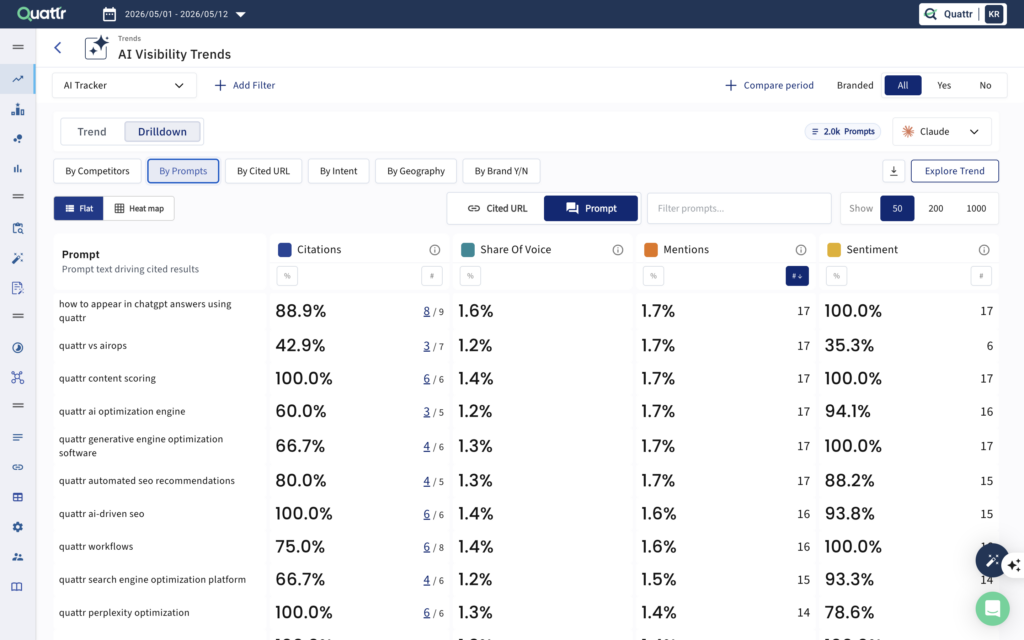
Go into Quattr’s “By Prompts” view and find the questions where your competitors are getting cited with high positive sentiment. These are the gaps in your content. Pick the most relevant ones and write pieces that answer those questions better than anything already out there.
Then look at your Sentiment score alongside your Mentions and Citations. If your sentiment is low but your mentions are high, the problem is not visibility. The problem is how your content reads. Focus on rewriting existing pieces to be clearer and more direct rather than creating new ones.
If your sentiment is high but your Share of Voice is low, you are doing the right things but not covering enough ground. Expand into related topics and questions that are driving AI citations in your category.
Check back in Quattr weekly to see if the numbers are moving. Sentiment shifts do not happen overnight but they do happen, and tracking them regularly is the only way to know whether your content is actually making a difference.
The Bottom Line
AI search is where your customers are right now. They are not scrolling through results anymore. They are asking questions and trusting whatever the AI says back. That makes showing up in those answers, and showing up well, one of the most important things your brand can focus on today.
Sentiment is the piece most brands overlook. Being cited in an AI answer is good. Being cited positively, consistently across every major AI platform is what actually moves people. That difference is what Generative Engine Optimization is built around and it is where the real opportunity sits.
Quattr gives you everything you need to compete in this space. You can see exactly where your brand appears, understand how your sentiment and Share of Voice compare, find the gaps in your content and most importantly fix them. Most tools tell you what happened in traditional search. Quattr tells you what is happening in the search that actually matters now.
FAQs
It helps brands understand how AI systems perceive and recommend them, not just whether they appear in results.
AI analyzes reviews, articles, forums, social discussions, comparisons, and other public content to understand how people talk about a brand.
Yes. A brand may appear frequently in AI answers but still be described negatively or with cautionary language.
Brands can improve sentiment by building trust online, encouraging positive reviews, publishing useful content, and improving customer experience.
Yes. Positive sentiment builds trust faster and can influence clicks, buying decisions, and shortlist selection.
AI sentiment should be monitored regularly because AI-generated answers and online discussions change frequently.

Quattr is an AI-native Search Visibility Platform founded in Palo Alto, California, built for mid-market and enterprise brands competing in the age of generative search. Recently recognized across G2's Spring 2026 reports with #1 rankings in AEO Results, Usability, and Relationship, Quattr helps brands win visibility across traditional search and AI-generated answer surfaces.
Quattr's AI agent, GIGA, evaluates content the way AI systems do, identifying gaps across structure, authority, internal linking, and discoverability to surface the highest-impact fixes. With capabilities like autonomous internal linking, E-E-A-T intelligence, and the new GIGA Landing Page Generator for keyword-matched, AI-search-ready pages, Quattr helps teams move from diagnosis to deployed changes without manual bottlenecks.