
Key Takeaways
- Google ranks by backlinks and relevance signals. AI engines don’t. They pick pages they can pull a clean, verifiable answer from, which means a page on page 3 of Google can get cited more often than the #1 result if it answers the question directly.
- ChatGPT does not browse answers from training data, so older, established content has the advantage. Perplexity runs a live search every time and leans on Bing. Google AI Overviews overlaps with SEO but isn’t identical. Check your brand in each; the fix is different for each one.
- Reddit, YouTube, LinkedIn, and Quora are absorbing more SERP real estate than AI Overviews themselves, and growing faster week-over-week. If you’re optimizing for AI citation without tracking UGC encroachment, you’re solving half the problem.
Let me be honest with you.
You’ve probably typed your brand name into ChatGPT or Perplexity, expecting it to show up, and found your competitor there instead. Even though you rank higher on Google. Even though your content is better. Even though you’ve put months into your SEO.
It’s frustrating. And the reason it happens is that AI doesn’t pick sources the way Google does. The rules are completely different. And once I explain how it actually works, it’ll make a lot more sense.
One quick note before we dive in. Google just published its own guide on optimizing for generative AI search, and it’s worth a read. The short version: Google’s AI features, AI Overviews, and AI Mode sit on top of its existing Search ranking systems, so foundational SEO best practices still apply for showing up in them.
And one bigger thing while you’re here. AI Overviews aren’t even the most important shift happening in search right now. We’ll get to that toward the end of the blog.
How AI Engines Actually Choose Sources
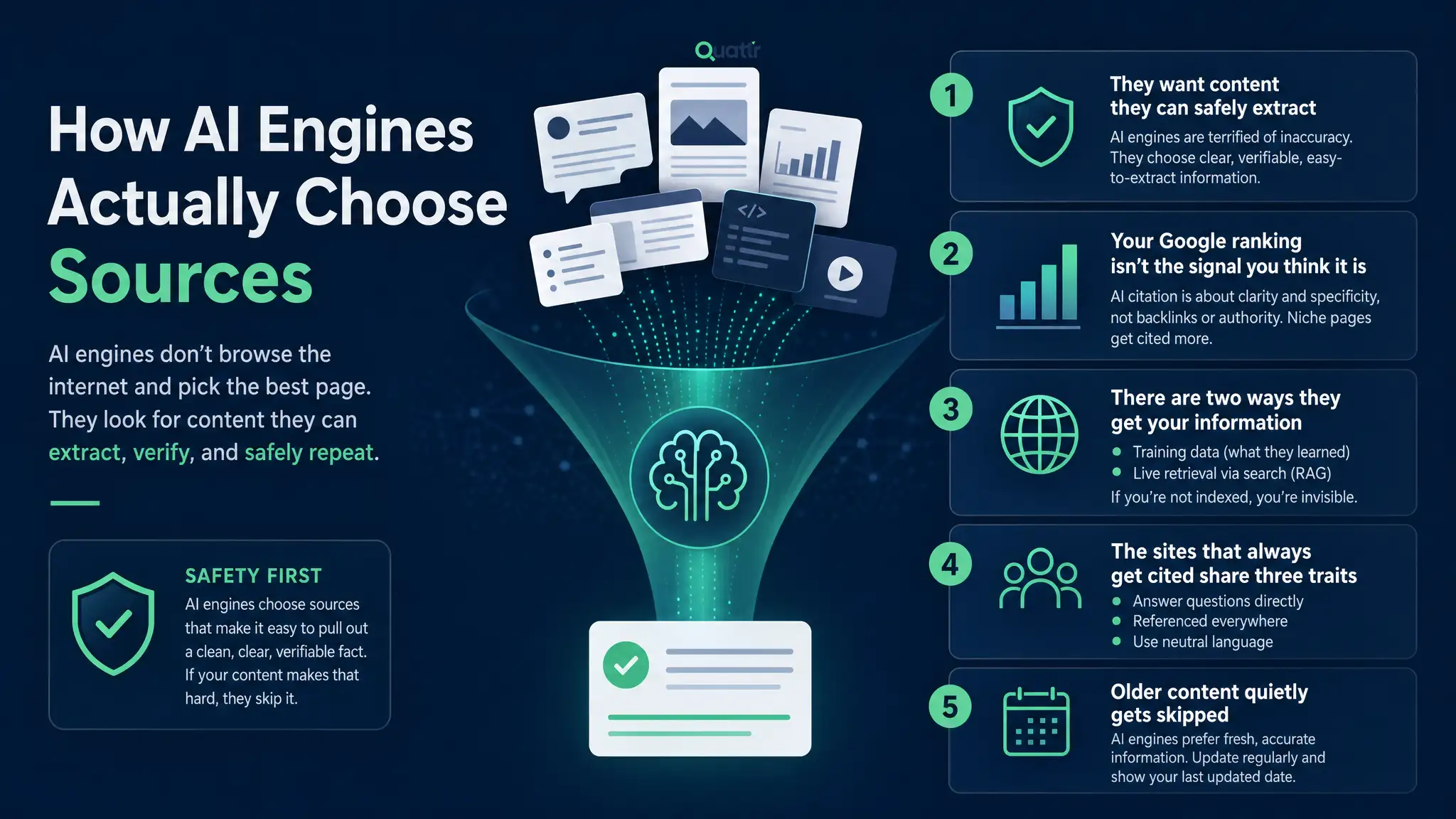
The thing that makes AI source selection feel random is that you’re reading it through an SEO lens. Once you understand what these systems are actually optimizing for, the pattern is pretty consistent.
1. They Want Content They Can Safely Extract
When someone asks ChatGPT or Perplexity a question, the AI isn’t browsing the internet and picking the best page. It’s doing something much more specific. It’s looking for content it can extract, verify, and safely repeat without getting something wrong.
That’s the key-word, safely. AI engines are terrified of saying something inaccurate. So they pick sources that make it easy to pull out a clean, clear, verifiable fact. If your page makes that hard, they skip it.
That’s it. That’s the most important part of the whole game.
2. Your Google Ranking Isn’t the Signal You Think It Is
Yes, this one stings.
Google ranks pages based on backlinks, authority, and relevance signals. AI engines don’t work that way. They don’t count your backlinks. They don’t care if you’re #1 for a keyword. A page that ranks on page 3 of Google can get cited constantly in AI answers if it’s written clearly and answers a specific question directly.
Search visibility in AI features is still highly fluid: Google AI Overviews appeared on 6.5% of queries in January 2025, surged to just under 25% in July, and then dropped back to under 16% by November, based on an analysis of more than 10 million keywords.
What this tells you: AI engines are looking for the clearest, most direct answer to a question, and they find it in focused, specific content more often than in broad authority sites.
3. There Are Two Ways They Get Your Information
There are two ways AI engines pull information, and you need to understand both.
The first is training data. This is everything the AI learned before it was released: billions of web pages, articles, forums, and documents. If your brand or content was part of that training, the AI already “knows” about you. But this has a cutoff date, so anything recent won’t be there.
The second is live retrieval. Most modern AI tools, such as ChatGPT with browsing on, Perplexity, and Google AI Overviews, actively search the web when you ask them something. They pull fresh pages, scan them, and use them to build their answer. This is called RAG (Retrieval-Augmented Generation), and it’s what makes real-time content matter.
Here’s the practical point: if your pages aren’t being crawled and indexed by Google and Bing, you’re invisible to AI tools that do live retrieval. Perplexity leans heavily on Bing. If you’re not there, you don’t exist in Perplexity’s world.
4. The Sites That Always Get Cited Share Three Traits
You’ve noticed it too, Reddit, Wikipedia, G2, Forbes, HubSpot. They show up in AI answers constantly across every topic.
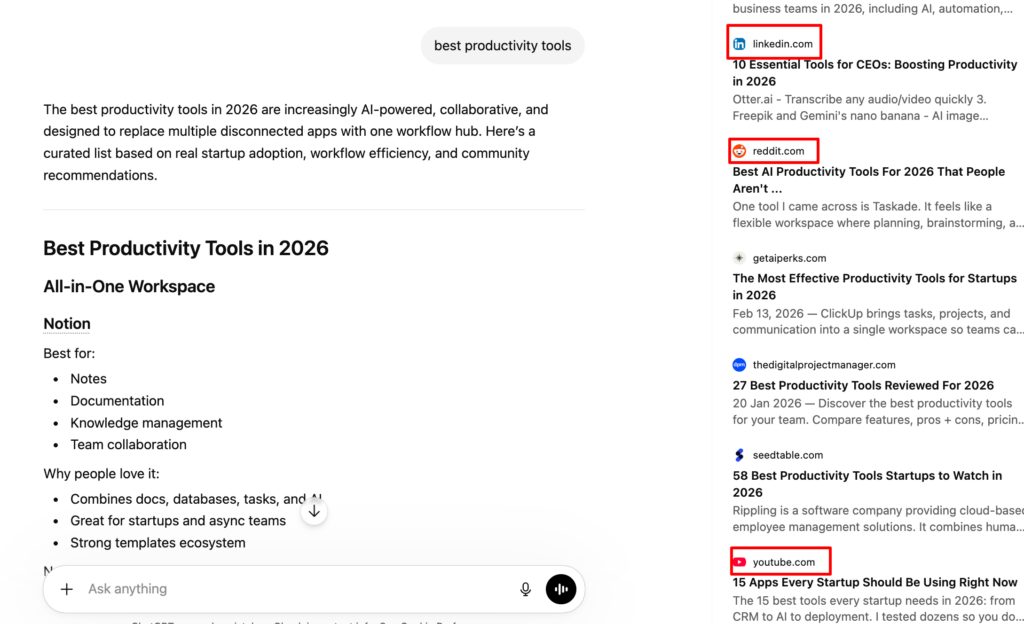
It’s not luck. They have three things in common.
They answer questions directly. Reddit threads are messy, but they get to the point fast. G2 reviews are structured and specific. Wikipedia leads every article with a definition.
They’re referenced everywhere else. AI engines pick up on how often a source is mentioned or linked to across the internet. When thousands of independent pages point to the same source, that’s a trust signal, not just for Google, but for AI systems reading the web too.
They Have Strong E-E-A-T Signals. This overlaps heavily with Google’s concept of E-E-A-T: Experience, Expertise, Authoritativeness, and Trustworthiness.
Think about the sites that appear constantly in AI answers:
- Reddit has massive real-user experience signals.
- Wikipedia has an editorial structure and citation standards.
- Forbes and HubSpot have established authority and broad web references.
- G2 has structured reviews tied to identifiable products and use cases.
AI engines may not calculate E-E-A-T the way Google Search does, but they still rely on many of the same trust indicators underneath:
- consistent mentions across the web
- citations from other trusted sources
- clear authorship
- topical depth
- factual consistency
- strong brand/entity recognition
When thousands of independent pages reference the same source, that becomes a trust signal not just for search engines, but for AI systems trying to reduce the risk of hallucinations.
5. Older Content Quietly Gets Skipped
Here’s something that catches a lot of marketers off guard: AI engines treat outdated content almost like it doesn’t exist.
If your page has a 2022 statistic on a topic that’s moved fast, pricing, software features, market data, an AI engine is going to skip it and find something more recent. It doesn’t want to repeat something that might now be wrong.
Research into AI search behavior shows that AI‑generated answers increasingly favor pages updated within the last 12 months, and pages with last‑updated dates older than 24 months receive citations at less than half the rate of recently refreshed content on the same topics.
The fix is simple but requires discipline. Update your key pages. Add a visible “last updated” date. Refresh any statistics that are more than 12 months old. A lightly updated page with current data will often outperform a deeply written older page in AI citation.
LLMs and AI Search Work Differently
This is important: don’t treat them as the same thing.
Perplexity AI runs live web retrieval for most queries, which makes it behave more like a real-time search engine layered on top of an LLM. Recency, clear structure, and being indexed in search engines (especially Bing) matter a lot here.
OpenAI behaves differently depending on whether browsing is enabled. Without browsing, responses are generated primarily from pretraining data and model knowledge, which can favor older, more established sources that appeared frequently in training data. With browsing enabled, ChatGPT can retrieve live web content, but it still tends to favor pages with clear structure, extractable answers, and strong source confidence.
Google is built on top of Google Search systems, so traditional SEO signals still matter significantly. Strong rankings help, but they are not a guarantee of inclusion in AI Overviews. Content structure, schema markup, source trustworthiness, topical authority, and Google’s E-E-A-T signals all influence whether content gets surfaced and cited.
Check your brand visibility across each platform separately. You may perform well in one system and be nearly invisible in another, because retrieval methods, ranking systems, and citation behaviors differ across platforms.
How to Structure Your Content So AI Picks It Up
This is where most people can make immediate improvements.
Lead with the answer. Don’t warm up for three paragraphs before making your point. AI engines scan for the first clear, complete sentence that answers a question. If it’s buried, they move on. Open every section with the actual answer, then explain it.
Use headings that are real questions. Not vague ones like “Our Approach”, but actual questions your audience would type into an AI. “What is X?” “How does Y work?” “What’s the difference between A and B?” These match the query structure that AI engines are trying to answer.
Keep sentences short and factual. Long, winding sentences are hard to extract. Aim for one idea per sentence. State facts. Avoid hedging phrases like “it may be the case that” or “one could argue.” Be direct.
Add FAQ sections. Genuinely useful ones, not fake ones. A clear Q&A at the bottom of a page maps almost perfectly to how AI engines look for answers. And FAQ schema markup helps them parse it even faster.
The Bigger Shift Most Teams Are Missing
While everyone’s been focused on AI Overviews, something larger has been happening alongside it. User-generated content, Reddit threads, YouTube videos, LinkedIn posts, and Quora answers are now occupying significantly more SERP real estate than AI Overviews themselves, and it’s growing faster week-over-week.
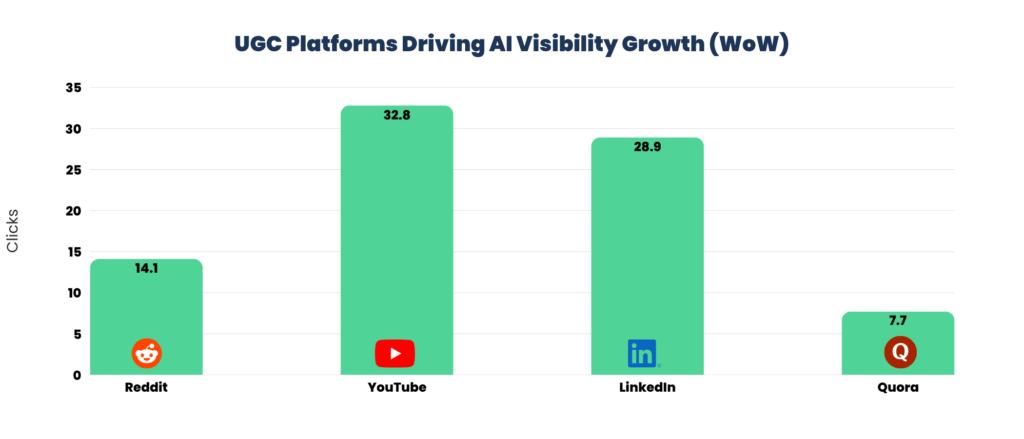
The reason this matters here: the same things that get content cited by AI engines, direct answers, neutral language, and specificity, are also what’s letting community content outrank brand pages on category-defining queries. If you’re optimizing for one without considering the other, you’re solving only half the problem. We’ve broken down the UGC side of this in a separate piece if you want to go deeper.
The Simplest Thing You Can Do Right Now
Pick a page on your site that should be getting cited, your best explainer, your comparison page, or your most common FAQ.
Open it and ask yourself: if an AI engine lands on this page looking for a clean answer to one specific question, what does it find in the first two sentences of each section?
If the answer is “not much”, that’s your starting point.
Rewrite the opening of each section to lead with the answer. Update any outdated stats. Check that it’s indexed on Google. Make the headings sound like real questions. Remove any language that sounds like a sales pitch.
That’s not a small tweak. That’s the difference between being cited and being skipped.
AI search isn’t replacing SEO. It’s sitting on top of it with different rules. The marketers who understand those rules now are going to look very smart in 12 months’ time. The ones who wait are going to spend that time explaining to their leadership why visibility dropped without a clear story for where it went.
See Where You Stand Before You Start Optimizing
Before you rewrite anything, it helps to know what you’re actually working with. Which of your pages are getting cited in ChatGPT and Perplexity right now? Which AI Overviews are pulling from your content versus your competitors’? And which of your query categories are quietly being taken over by Reddit threads and YouTube videos while no one was watching?
That’s the gap Quattr fills.
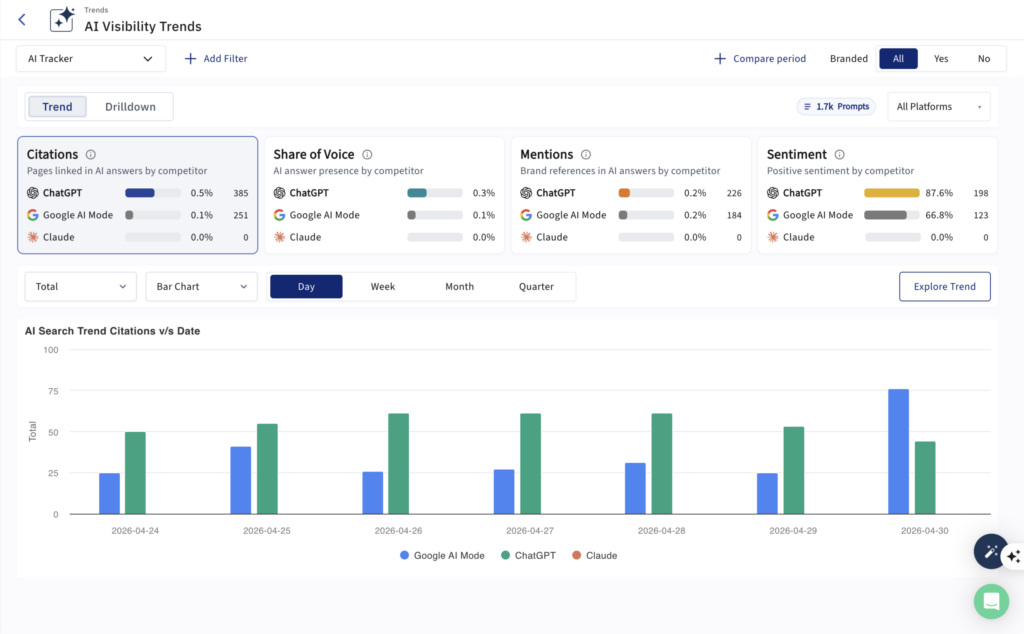
It tracks your AEO footprint across ChatGPT, Perplexity, and Google AI Overviews, so you can see where you’re already being cited and where you’re missing entirely. And it helps you map that against your UGC exposure on Reddit, YouTube, LinkedIn, and Quora, broken down by query category rather than aggregate.
No synthetic data. No sampled dashboards. Your GSC and GA4 data, connected to daily SERP monitoring across AI surfaces and UGC platforms.
A standard rank tracker can’t show you either of these. That’s the whole point.
See your AI and UGC exposure across your query portfolio with Quattr →
FAQs on How AI Chooses Sources to Cite
AI engines like OpenAI’s ChatGPT prioritize content that is easy to extract, verify, and summarize, not just pages with the strongest backlink profiles. A lower-ranking page can outperform a top Google result if it answers a question more directly, uses neutral language, and presents information in a structured format that AI systems can safely reuse.
Start by restructuring content around direct answers instead of long introductions. Use question-based headings, concise factual sentences, updated statistics, and clear FAQ sections. Make sure your pages are indexed on both Google and Bing, since tools like Perplexity AI rely heavily on live retrieval from search indexes. Refreshing older content regularly also improves citation likelihood in AI-generated answers.
Traditional SEO focuses heavily on rankings, backlinks, authority, and click-through traffic. AI search optimization (AEO) focuses on whether an AI engine can confidently extract and cite your content inside generated answers. That means clarity, structure, freshness, entity recognition, and answer completeness matter more than keyword density or raw ranking position alone.

Quattr is an AI-native Search Visibility Platform founded in Palo Alto, California, built for mid-market and enterprise brands competing in the age of generative search. Recently recognized across G2's Spring 2026 reports with #1 rankings in AEO Results, Usability, and Relationship, Quattr helps brands win visibility across traditional search and AI-generated answer surfaces.
Quattr's AI agent, GIGA, evaluates content the way AI systems do, identifying gaps across structure, authority, internal linking, and discoverability to surface the highest-impact fixes. With capabilities like autonomous internal linking, E-E-A-T intelligence, and the new GIGA Landing Page Generator for keyword-matched, AI-search-ready pages, Quattr helps teams move from diagnosis to deployed changes without manual bottlenecks.