
Key Takeaways
- Most first-generation AEO platforms are built primarily for monitoring visibility, not executing the content, linking, and deployment workflows required to improve AI citations at scale.
- AI search changes too quickly for fragmented workflows. Teams relying on disconnected dashboards, manual handoffs, and probabilistic tracking data struggle to respond fast enough to shifting citation patterns across ChatGPT, Google AI Overviews, Perplexity, Reddit, and YouTube.
- The next phase of AEO is orchestration: unified systems that connect visibility insights with content generation, E-E-A-T optimization, internal linking, deployment, and first-party performance data in a single execution pipeline.
If you currently have an AEO tool in your stack, or if you’re currently sitting through sales demos trying to choose one, this is your reality check.
Right now, you are at a crossroads. You can either buy a glorified thermometer that watches your brand lose visibility in real-time, or you can build an execution pipeline that actually wins citations.
Most marketing teams are making the wrong choice because the first generation of AEO tools looks incredible in a slide deck. They show you slick charts of your “Share of Voice” in ChatGPT and track your brand sentiment in Perplexity. It feels like control. It feels like a strategy.
But there is a massive difference between tracking a problem and fixing it.
If you are about to sign a contract for a platform that leaves the manual writing, the data mapping, and the deployment entirely on your team’s shoulders, you aren’t buying an optimization tool. You are buying a spreadsheet of chores.
Before you commit your 2026 budget to a stack that only lets you look but won’t let you act, let me help you pull back the curtain on how these tools actually work and why just tracking visibility without a connected execution workflow makes it harder to respond quickly.
What Are “Monitoring-Only” AEO Tools (And What Do They Actually Do?)
When GenAI search exploded, a first generation of specialized monitoring platforms emerged to help brands track their “share of voice” inside LLMs.
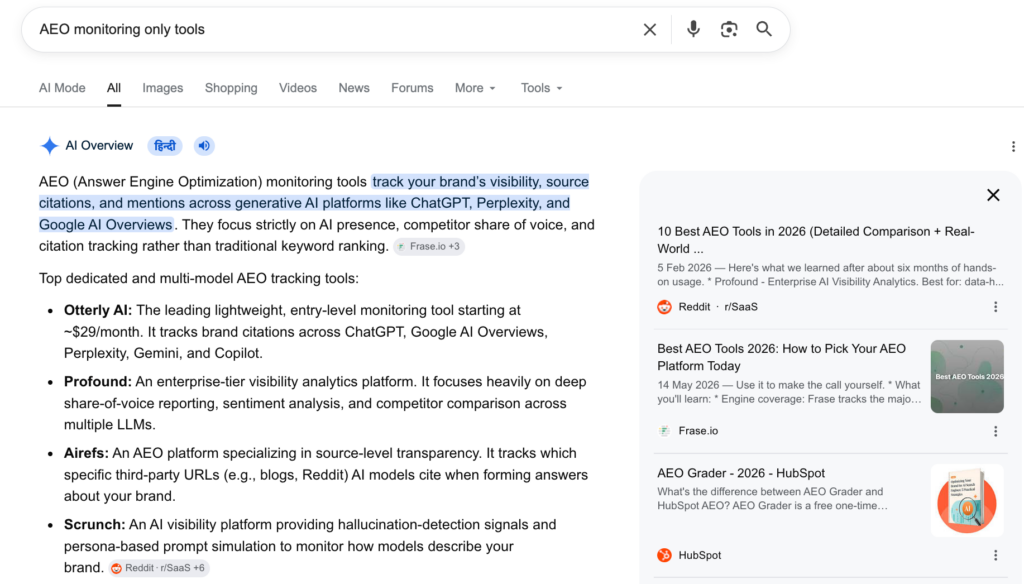
Platforms like Profound, AirOps, and Peec AI quickly became the industry standard for visibility tracking. They do exactly what traditional rank trackers did for Google, but tuned for the LLM era. These offer a highly sophisticated set of modules:
- AI Share of Voice (SoV): High-level dashboards charting how often your brand is mentioned across ChatGPT, Perplexity, or Claude.
- Prompt Volume Insights: A database showing estimated prompt demand, the AI search equivalent of keyword search volume.
- Templated Citation Builders: These platforms offer templated frameworks based on historically cited pages to help your writers structure copy.
Similarly, workflow automation platforms like AirOps stepped into the space to solve the production problem. AirOps uses a no-code, grid-and-spreadsheet interface to help teams chain together SEO prompts, allowing you to generate content briefs, build programmatic FAQ sections, or draft pages using pre-set templates.
AEO monitoring only tools are like an elite thermometer that tells you exactly how your brand is being interpreted, and may offer template factory for scaling text production. The issue is that a thermometer cannot inject the medicine, and a template factory cannot run without a map.
They leave enterprise teams stuck in a fragmented half-measure: you use one tool to spy on a visibility gap, another tool to run a template draft, a third tool to pull Google Search Console data, and your development queue to actually push the code.
They give you data and generic workflows, but zero unified execution capability.
Why Probabilistic Data Gives You Half the Picture
The deeper problem with standard monitoring platforms isn’t just that they lack editing buttons; it’s how they collect their data. Most legacy AEO trackers rely on probabilistic, simulated scraping data.
They use headless browsers or backend APIs to run thousands of just appending with new time automated queries through LLMs at a specific moment in time. They take those isolated responses, run an algorithm to synthesize them, and present you with an “average” probability of your brand being cited.
Check out here, “why raw query data from Google Search Console is your secret weapon for winning visibility and driving growth in today’s AI and LLM-driven search ecosystem”.
Here is why relying on probabilistic tracking data is incredibly risky for an enterprise brand:
1. The RAG Reality Gap
Modern AI engines use Retrieval-Augmented Generation (RAG) to dynamically fetch real-time web data. An LLM’s response to a synthetic API query run by a scraper in a data center is often completely different from what a real, authenticated human consumer sees on their phone in Chicago or London, for example. You end up spending human capital and engineering resources optimizing your pages for phantom data that real users never actually see.
2. Disconnected from First-Party Reality
Probabilistic trackers sit completely outside your actual business ecosystem. They show you your AI visibility score, but they have no idea if that specific query is driving an extra $100,000 in pipeline or zero clicks. Because they don’t integrate with your actual Google Search Console (GSC) or Google Analytics (GA4) data layers, you are forced to make optimization bets based on theoretical visibility metrics rather than actual traffic and conversion signals.
1. The Real-World Bottlenecks of “Look-But-Don’t-Touch” AEO
When you try to manage AEO for an enterprise site using fragmented dashboard tools, you run headfirst into four brutal, ground-level realities.
Challenge 1: The Rapidly Changing Answer Loop
Traditional SEO rankings change over weeks. AI engine answers change hourly based on real-time web scraping, user conversational context, and algorithmic updates.
A monitoring tool might tell you that you lost an AI Overview citation on Tuesday morning. But because you are using a fragmented stack, you have to extract that data, create a ticket, pull a copywriter, rewrite the section, and pass it to a developer. By the time your team pushes the fix to production on Friday, the AI engine has already shifted its source criteria three times. Monitoring tools flag a fire that has already changed shape by the time you arrive with water.
Challenge 2: The Multi-Platform Context Switching Problem
Right now, your workflow probably looks like this: You analyze your AI visibility gaps in one specialized dashboard. Then, you jump into Google Search Console or an analytics hub to see if that gap is actually killing your traffic.
Next, you open ChatGPT or an LLM playground to test new prompts, and finally, you move into your CMS to actually write the content.
Every time your data moves between different platforms, context is lost. You end up optimizing for isolated data points rather than a cohesive, multi-channel strategy.
Challenge 3: Enterprise Scale and the Manual Handoff Chokehold
If your site has thousands of pages, manual updates are an operational impossibility. When a dashboard tells you that 400 core product pages are losing citation share because the content isn’t structured for safe extraction, what happens?
The workflow grinds to a halt. Manual handoffs between SEO managers, content writers, legal reviewers, and engineering teams create a massive delay in the cycle. While your internal team is passing drafts back and forth, agile competitors using automated execution pipelines capture the citations.
Challenge 4: The Internal Linking and E-E-A-T Gaps
Winning an AI citation isn’t just about tweaking a single sentence on a single page. LLMs evaluate your entire site’s topical authority and E-E-A-T (Experience, Expertise, Authoritativeness, Trustworthiness) signals. If you publish a highly optimized new section to win a Perplexity citation, but that content sits isolated without deep, structured internal links from your legacy pages, the AI crawlers will never find it.
Manually mapping and building internal links across thousands of enterprise pages to support a new AEO pivot takes weeks. Monitoring platforms typically stop at visibility insights and don’t address deeper internal linking workflows.
2. The Advanced Challenges Threatening Your 2026 Strategy
If those operational delays weren’t enough, the underlying tech behind AI search has evolved. If you are relying on first-generation tracking tools, you are likely blind to these two critical blind spots.
Challenge 5: The UGC (Reddit & YouTube) Cannibalization Problem
Content teams frequently treat AI search as an isolated problem. In reality, AI search engines heavily scrape and cite User-Generated Content (UGC) platforms like Reddit, Quora, and YouTube.
A standard dashboard won’t tell you if a specific query cluster is being entirely dominated by Reddit threads. Without that visibility, your team will waste months writing standard, corporate blogs for queries that the AI engines have permanently decided are “community-owned.”
3. The 2026 Shift: Moving From Monitoring to Orchestration
To survive this shift, your tech stack has to evolve from AEO Monitoring to AEO Orchestration. You need a unified system that closes the loop: Detect ➔ Diagnose ➔ Generate ➔ Deploy ➔ Verify in a single pipeline.
This is exactly the gap Quattr fills.
Quattr doesn’t just show you a graph of your missed opportunities and wish you good luck. It acts as the execution layer for your entire search ecosystem, converting insights into live, revenue-driving content/pages.
Here is how the paradigm shifts when you move from legacy monitoring to Quattr’s optimization platform:
Real-User Capture Meets First-Party Ground Truth
Quattr doesn’t guess based on generic, third-party API samples. It captures results directly from real consumer-facing AI responses across ChatGPT, Perplexity, Claude, and Google AI Overviews.
More importantly, it unifies this live AI data layer and your actual first-party data (Google Search Console and GA4 via BigQuery) in a single platform. You aren’t chasing vanity terms; you are optimizing the exact pages that have the highest traffic and revenue potential.
Brand Mention & Sentiment Intelligence
Quattr breaks down your visibility into Citation Share and Sentiment Scores (Positive, Neutral, Negative) across all primary AI surfaces.
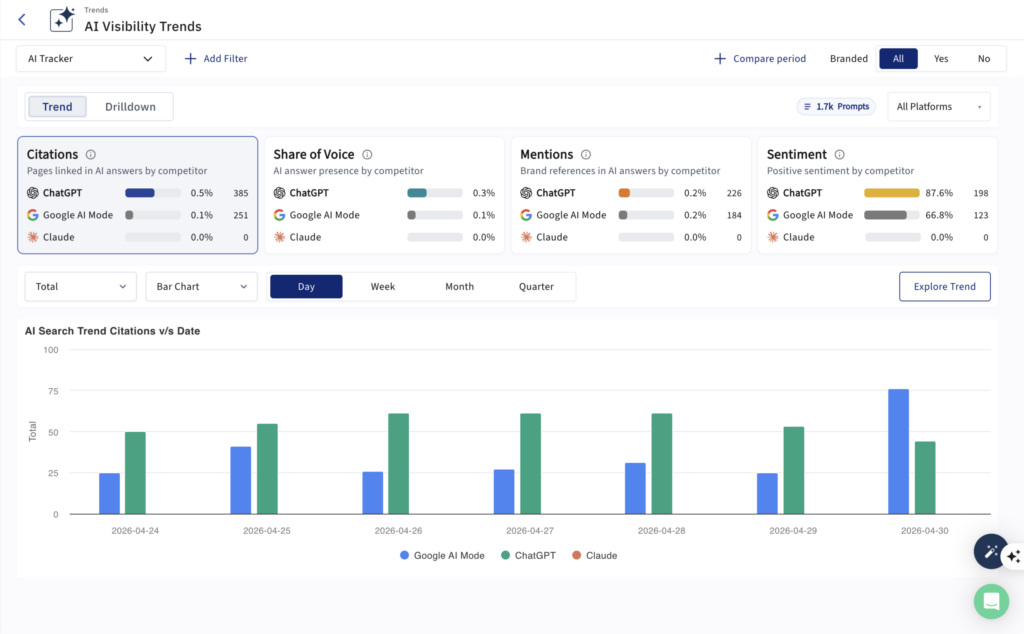
If the data shows a model is framing your brand poorly or hesitating to recommend you, you don’t just sit there with a bad score. You jump straight into action. Right inside the content workspace, Quattr’s E-E-A-T Intelligence lets you actively audit your draft or live page against a real-time Score Card and Guidance Tab mapped to the competitors the AI chose. It gives you prioritized, actionable fixes right in the editor, flagging exactly where to back up quantitative claims or add depth, so you can optimize your content to shift the AI’s opinion on the fly.
Unified Query Portfolio Mapping (AI Overviews vs. UGC)
Most teams find out they have a UGC problem when traffic drops. By then, the queries are already community-owned.
Instead of forcing you to hunt through fragmented silos, Quattr maps your AI Overview exposure against your UGC footprint—by query category, not in aggregate. This granular portfolio intelligence means you know exactly which query categories are still worth fighting for with standard content, and which ones require a completely different strategy.
The GIGA Agent & Automated Internal Linking
Quattr eliminates the velocity chokeholds that stall enterprise teams. When an AI visibility gap or structural flaw is flagged, you don’t need to write a creative brief from scratch.
Quattr’s AI agent, GIGA, instantly crafts or updates AI-ready content that is structurally optimized for safe extraction, natively grounded in your site’s historical performance.
Once the content is ready, Quattr automates the complex internal linking architecture, injecting structured paths across thousands of enterprise pages so search bots and LLMs instantly recognize your updated topical authority, without a single manual handoff or engineering bottleneck.
The Landing Page Generator: Fix Gaps Instantly
When a tracking tool flags a brand-new query category where competitors are winning, your immediate thought is: “We need a page for this.” In a legacy workflow, that means waiting weeks for copy, compliance, design, and engineering queues to clear.
Quattr bypasses this entire roadblock with the Landing Page Generator. It allows you to build and launch PPC ready, keyword-matched, brand-compliant landing pages in under 15 minutes through a 5-stage supervised workflow, covering everything from live multi-surface competitive analysis and brand CSS layout cloning to knowledge-grounded copywriting and a 9-category E-E-A-T and compliance audit. The platform outputs self-contained HTML deployable directly to your CMS, turning an open visibility gap into a live, citation-ready revenue asset in a single afternoon.
The Choice Ahead
| Feature Strategy | The Legacy Approach (Monitoring Stacks) | The 2026 Approach (Quattr’s Optimization Layer) |
| Data Integrity | Probabilistic/Sampled: Relying on simulated backend API scrapes that run in isolation. | Deterministic/First-Party: Real consumer-facing capture paired with your live GSC & GA4 data layers. |
| Workflow State | Fragmented Hubs: Check stats in tool A, manually write in tool B, update dev tickets in tool C. | Unified Workspace: Seamless SEO, GEO, and AEO workflows from insight to live automated deployment. |
| Actionability | Obsessive Tracking: Alerts you when you lose a citation, leaving the manual fix entirely to you. | Immediate Execution: Leverages GIGA and internal link automation to close visibility gaps. |
Monitoring-only tools were great for the experimental phase of AEO. They helped us understand that the landscape was changing.
But now that the rules are established, simply watching your metrics drop isn’t a strategy. In 2026, the brands that win AI search aren’t the ones with the prettiest dashboards; they are the ones with the fastest execution cycles.
Stop observing the gap. Close it.
See your real AI and UGC exposure across your query portfolio with Quattr →

Quattr is an AI-native Search Visibility Platform founded in Palo Alto, California, built for mid-market and enterprise brands competing in the age of generative search. Recently recognized across G2's Spring 2026 reports with #1 rankings in AEO Results, Usability, and Relationship, Quattr helps brands win visibility across traditional search and AI-generated answer surfaces.
Quattr's AI agent, GIGA, evaluates content the way AI systems do, identifying gaps across structure, authority, internal linking, and discoverability to surface the highest-impact fixes. With capabilities like autonomous internal linking, E-E-A-T intelligence, and the new GIGA Landing Page Generator for keyword-matched, AI-search-ready pages, Quattr helps teams move from diagnosis to deployed changes without manual bottlenecks.