Key Takeaways
- AEO is not SEO with a new name. When an AI returns one answer instead of ten links, ranking strategies don’t apply. The problem is fundamentally different, and so is the tooling required to solve it.
- Most platforms stop at the dashboard. Knowing your brand isn’t being cited is not the same as fixing it. The critical divide in this category is between tools that surface the gap and tools that close it; very few do both.
- The closed loop is the only thing that matters to stakeholders. Citation tracking impresses marketers. What moves the budget is a documented chain: content change → crawler validation → citation event → business outcome. Platforms that can’t show that chain are selling reporting, not results.
There is a specific moment this guide is written for.
A procurement lead at a multi-site hospital asks Perplexity which EHR vendor handles compliance best. A CFO asks ChatGPT to compare financial planning platforms before a board meeting. A SaaS buyer asks Google AI Mode which platform is best for enterprise onboarding workflows.
In each case, the AI returns a single synthesized recommendation layer. Not ten blue links. Not a traditional SERP. One answer interface built from a narrow set of sources the model considers trustworthy enough to retrieve, compress, and present as the canonical response.
That answer layer is rapidly becoming the new battleground for enterprise visibility.
The industry often calls these answer slots. But competing for them is fundamentally different from competing for rankings.
Traditional SEO optimized for discoverability inside a list of links. AI search optimizes for inclusion inside generated answers. The traffic loss is not going to a competitor outranking you on Page 1. It is being absorbed by an AI system that never mentions you at all.
This is also where GEO and AEO begin to diverge.
GEO asks:
Is your brand visible across the generative ecosystem?
AEO asks a harder operational question:
When an AI system generates a direct answer to a high-intent commercial query in your category, does your brand become part of the answer generation layer itself?
The tools required to solve those problems are not the same.
Visibility dashboards can tell you whether your brand appeared. They cannot necessarily explain:
- why a competitor was retrieved instead of you,
- whether your content was structurally extractable,
- how entity trust signals affected retrieval,
- or which deployment change actually improved citation share.
This is the emerging gap between AI visibility monitoring and AI Search Operations.
Monitoring tells you what happened.
AI Search Operations is the execution layer that systematically improves retrieval readiness, deploys structural optimizations, validates citation impact, and connects AI visibility back to measurable business outcomes.
Most platforms in the market still operate at the monitoring layer.
This guide focuses on the platforms attempting to move beyond it.
The Three Layers of AI Search Visibility
Most platforms in the market are currently grouped together under labels like AEO, GEO, or AI visibility tooling. In practice, they solve very different problems.
Some monitor mentions. Some improve extractability. A small number attempt to operationalize the full retrieval-to-revenue workflow.
That distinction matters because enterprise AI visibility is no longer a reporting problem alone. It is becoming an operational discipline.
Across the market, AI search platforms are beginning to separate into three distinct layers.
Layer 1: AI Visibility Monitoring
This is where most platforms operate today.
These systems track:
- citations,
- mentions,
- sentiment,
- share of voice,
- and prompt-level brand visibility across engines like ChatGPT, Gemini, Claude, Perplexity, and Google AI Overviews.
They answer questions like:
“Are we appearing in AI-generated answers?”
This layer is useful for awareness and benchmarking, but monitoring alone does not improve retrieval likelihood. A visibility dashboard can tell you that a competitor owns an answer slot without explaining the structural reason why.
Layer 2: Retrieval & Answer Optimization
This layer focuses on making content understandable, extractable, and trustworthy enough for AI systems to retrieve confidently.
AI systems do not consume pages the way humans do. Retrieval pipelines prioritize:
- structurally extractable answer blocks,
- entity clarity,
- schema consistency,
- canonical topical authority,
- citation reinforcement,
- and E-E-A-T trust signals.
This is where modern AEO workflows emerge.
A platform operating at this layer may:
- restructure content into retrieval-ready answer blocks,
- identify entity inconsistencies,
- improve internal linking architecture,
- surface citation gaps,
- and optimize pages for RAG-based extraction systems.
This layer improves retrieval readiness, but often stops short of operational execution.
Layer 3: AI Search Operations
This is the emerging enterprise layer.
AI Search Operations connects:
- monitoring,
- retrieval optimization,
- deployment,
- testing,
- attribution,
- and iteration into a continuous operational loop.
Instead of simply surfacing visibility gaps, these systems attempt to:
- deploy structural fixes,
- validate crawler access,
- measure citation changes,
- connect AI visibility to first-party analytics,
- and continuously improve answer-slot ownership over time.
This is also the layer where the market is still immature.
Many vendors currently market AI visibility dashboards as “AEO platforms,” even though execution, deployment, and attribution remain disconnected workflows handled manually by internal teams.
The gap between monitoring AI visibility and operationalizing it is becoming one of the defining differences between enterprise-grade AI search platforms and lightweight visibility tooling.
The platforms in this guide are evaluated according to which layer they actually operate in, not simply which AI engines they monitor.
How We Evaluated Enterprise AEO Platforms
The AEO market is becoming increasingly noisy. Many vendors now claim “AI visibility” capabilities because they can detect mentions inside ChatGPT or monitor Google AI Overviews. But monitoring AI answers is not the same as operationalizing AI search visibility.
Most platforms today still function primarily as reporting layers. They surface mentions, citations, or share of voice, but stop short of improving retrieval readiness, deploying structural fixes, or connecting AI visibility gains to measurable business outcomes.
To separate enterprise AEO platforms from lightweight visibility tooling, we evaluated vendors against four operational requirements.
1. Answer Slot Visibility
Can the platform identify:
- which prompts generate dominant AI answers,
- which competitors own those answer slots,
- and whether your brand appears in the retrieval layer itself?
2. Retrieval Readiness & Content Extractability
Can the platform improve how AI systems retrieve and interpret content?
We evaluated whether vendors actively optimize:
- answer-block structure,
- entity clarity,
- schema consistency,
- internal linking,
- and E-E-A-T trust signals.
3. Deployment & Operational Execution
Can the platform move beyond recommendations and operationalize fixes through:
- CMS integrations,
- APIs,
- edge deployment,
- testing environments,
- Or automated optimization workflows?
4. Closed-Loop Attribution
Can the platform connect:
structural change → citation gain → measurable business outcome?
Enterprise teams increasingly need to understand whether AI visibility improvements influenced:
- traffic,
- conversions,
- pipeline,
- or revenue impact.
We assessed only capabilities supported by public documentation, release notes, customer reporting, and verified practitioner discussions across G2, Reddit, and Quora.
The platforms in this guide were evaluated not by how many AI engines they monitor, but by how deeply they participate in the operational workflow of AI search visibility.
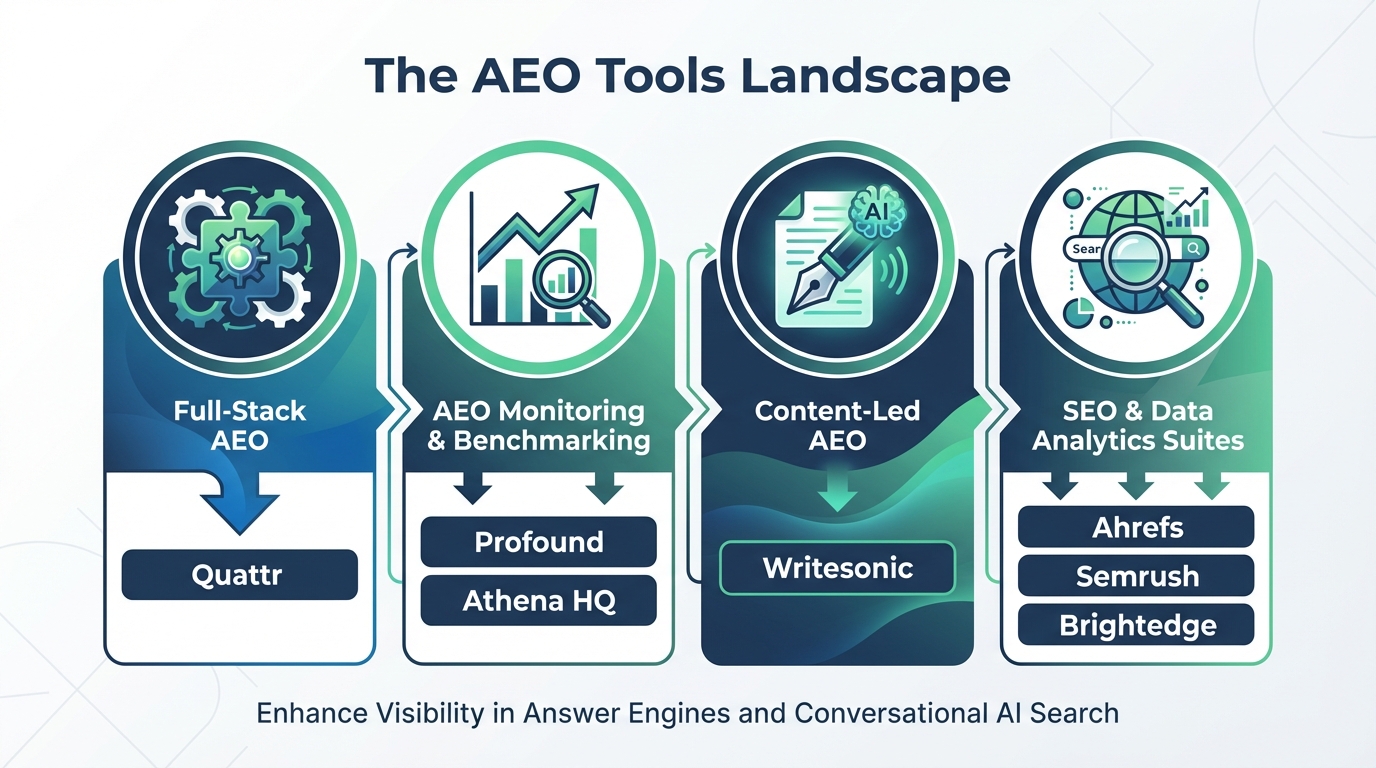
Category 1: AI Search Operations Platforms
Tracks answer slot visibility, executes structural fixes, and connects changes to measurable business outcomes, inside one platform.
1. Quattr
Most AEO platforms stop at monitoring.
They surface AI citations, benchmark competitor visibility, and track answer-slot presence across engines like ChatGPT, Gemini, Claude, Perplexity, and Google AI Overviews. But execution, deployment, and attribution often remain disconnected workflows handled manually across SEO, engineering, and content teams. Quattr approaches AEO differently.
The platform combines:
- multi-engine answer visibility,
- retrieval-readiness optimization,
- deployment orchestration,
- and citation-to-revenue attribution inside a unified operational workflow.
By connecting AI visibility data with first-party GSC and GA4 signals, Quattr enables teams to trace how structural content changes influence crawler access, citation inclusion, traffic movement, and downstream business impact.
Where many platforms surface the gap, Quattr is designed to help operationalize the fix.
AEO Capabilities
- Answer slot tracking: Monitors brand citation, mention, and sentiment across all major AI engines at the query level. Customizable Looker dashboards and exports connect this data to GSC and GA4.
- E-E-A-T Scorecard: Evaluates every target page for trust signals AI systems use to determine citation worthiness: author credentials, primary research, entity consistency, and schema correctness. Surfaces prioritized fixes rather than generic recommendations.
- GIGA (AI Execution Agent): Prioritizes content gaps, refreshes existing pages for answer-slot readiness, and creates new content structured for RAG extraction. Goes beyond drafting, it scores changes against competitors before deployment.
- Automated internal linking: Uses semantic logic rather than keyword matching to route authority toward canonical answer pages. This is the step most teams skip when restructuring content, and where citation gains stall.
- Deployment at scale: Changes can be tested in a sandbox, scored against competitors, and deployed via API, CMS plugins, or edge injection. Rollback capability is documented.
- Closed-loop attribution: GSC and GA4 data is connected directly to citation events, enabling teams to prove whether an AI mention drove traffic, a micro-conversion, or pipeline movement.
- Quattr Strategist: Every customer works with a dedicated SEO/GEO expert for prompt selection, AEO strategy, and ongoing collaboration via Slack and regular meetings.
What Users Say
| Pros | Cons |
|---|---|
| Streamlines complex data into actionable insights without requiring a multi-tool stack | Steep learning curve, extensive features require time and deliberate onboarding |
| Strong data integration connecting content performance directly to revenue signals | Initial setup is time-consuming, though users report the investment pays off |
What the Market Is Saying
AEO practitioners consistently cite Quattr as their go-to for identifying which pages have the best chance of being picked up in AI answers. The broader frustration reflects a category problem: too many tools, bloated UX, and dashboards full of vanity metrics. Quattr gets closest to consolidating the stack.
Best For
Enterprise teams that need to move from answer slot identification to deployed fix inside a single platform, and prove the revenue impact of that work to stakeholders who don’t speak SEO.
Pricing: Custom pricing.
Category 2: AEO Monitoring & Benchmarking
Strong on visibility and competitive benchmarking across AI engines. Execution and deployment happen outside the platform.
2. Profound
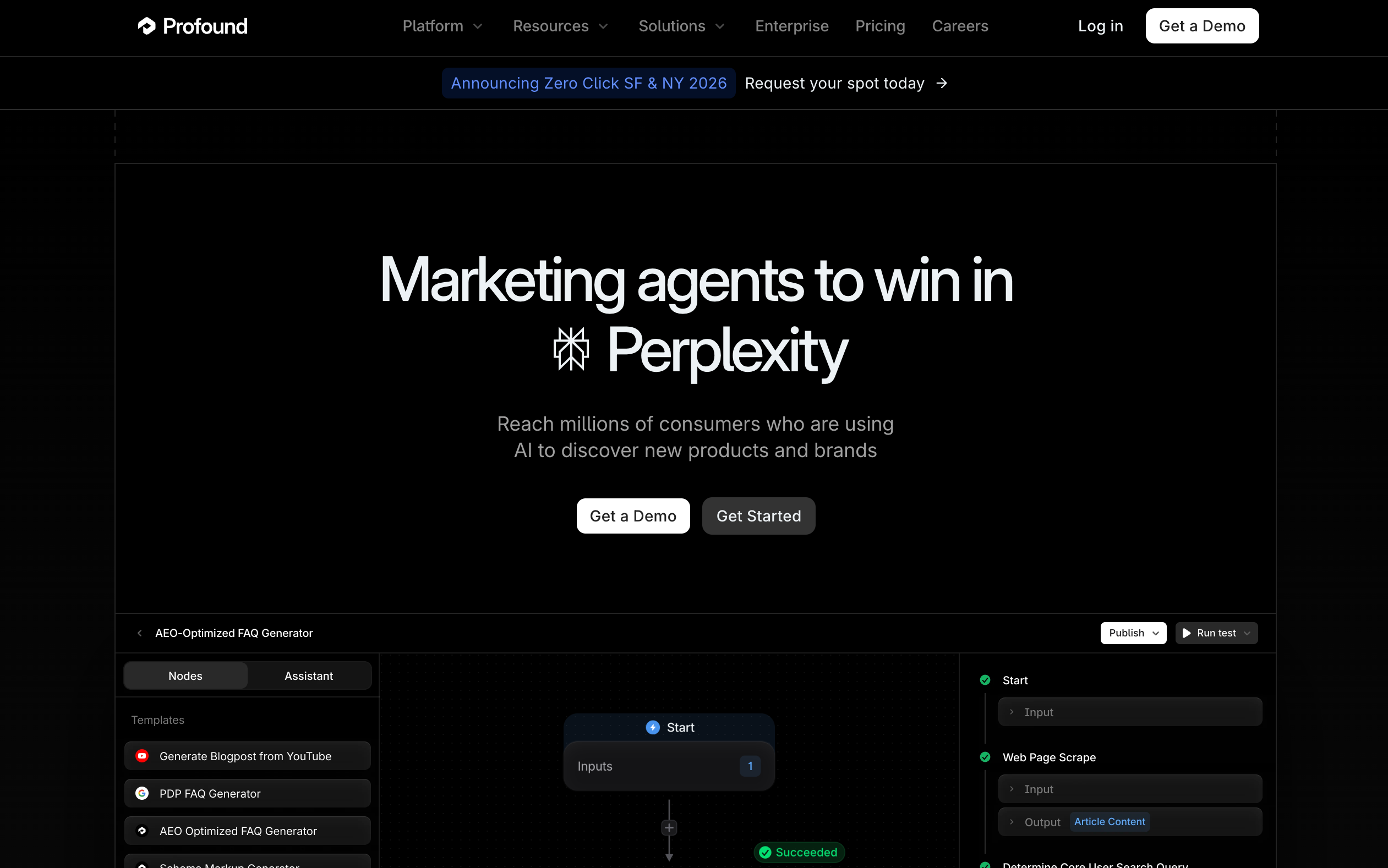
Profound is a monitoring-first AEO platform. It tracks brand inclusion, share of voice, and sentiment across ChatGPT, Claude, Perplexity, and Google AI Overviews, and validates AI crawler activity at the server log level, which gives compliance and governance teams something more defensible than screenshots. Through an AEO lens, its value is in visibility and benchmarking. It surfaces where you’re being cited, where competitors are winning answers, and which prompts matter for your category. What it doesn’t do is help you fix it.
AEO Capabilities
- Conversation Explorer: Tracks brand inclusion and share of voice across major AI engines at the prompt level
- Agent Analytics: Validates AI crawler activity via server logs, confirming which pages AI bots are actually accessing and parsing
- Competitive benchmarking: Measures citation share against competitors across engines over time
- Prompt functionality: Identifies which prompts are most relevant to your category and informs content strategy around them
- ChatGPT Shopping signals: Tracks product presence and placement within ChatGPT’s shopping interface
- Engagement Managers: Dedicated point of contact to guide teams through AI visibility strategy on the platform
What Users Say
| Pros | Cons |
|---|---|
| High quality data with comprehensive AI visibility coverage | Platform requires too many clicks, teams frequently export data just to build the views they need |
| Prompt functionality is genuinely useful for identifying content gaps | Dashboard is confusing, unclear what is working, why, and what has improved |
What the Market Is Saying
Community feedback on Profound is consistent: the data quality is acknowledged, but the platform’s value ceiling is visible quickly. Practitioners note that it works well if your only requirement is knowing when your brand shows up in AI answers. If you need to understand why a competitor is recommended over you, or take action on that gap, Profound doesn’t go deep enough.
Best For
Agencies, compliance teams, and federated organizations that need cross-brand AI visibility monitoring and benchmarking, and have internal ops or a separate execution stack to act on what Profound surfaces.
Pricing: Custom pricing for enterprises.
3. AthenaHQ
AthenaHQ is a brand monitoring and sentiment platform built around a specific AEO concern: not just whether you appear in AI answers, but how you’re being represented. Its Olympus dashboard aggregates citation count, sentiment, and competitive share into a unified GEO score across 8+ LLMs. Through an AEO lens, its strength is narrative intelligence, identifying where AI systems are misrepresenting your brand, surfacing competitor citation patterns, and generating content briefs to address specific gaps. Execution remains outside the platform.
AEO Capabilities
- Unified GEO Score (Olympus Dashboard): Aggregates citation count, sentiment, and competitive visibility into a single executive-level score across ChatGPT, Claude, Perplexity, and others
- AI Blindspot Detection: Identifies queries where AI engines hallucinate outdated information or struggle to answer questions about your brand accurately
- Competitive benchmarking: Tracks how competitor citation share shifts over time and surfaces the specific prompts driving those changes
- Generative Action Center: Produces first drafts of FAQ blocks, press kits, and content briefs specifically structured for AI citation
- Sentiment monitoring: Flags negative or inaccurate brand representation in AI answers for PR and communications teams
- Dynamic AI crawl monitoring: Tracks how AI bots interact with your content and identifies pages that aren’t accessible to RAG systems
What Users Say
| Pros | Cons |
|---|---|
| Valuable competitive visibility insights that inform targeted content decisions | Minor bugs reported, though the support team resolves them promptly |
| Data accuracy is a consistent strength, users trust the tracking | Minor bugs are reported |
What the Market Is Saying
Concensus positions AthenaHQ as a platform that earns trust through data accuracy and competitive intelligence. Users who are running content strategy workflows value the Action Center for generating AEO-structured briefs quickly. The friction points include: key features sitting behind higher pricing tiers frustrate teams evaluating ROI at mid-level plans, and the gap between insight and execution remains.
Best For
Brand and communications leaders at mid-to-enterprise SaaS and e-commerce teams who need to monitor narrative accuracy in AI answers and want a data-backed content brief to act on, with execution handled internally or through an agency.
Pricing: Custom pricing for enterprises
Category 3: Content-Led AEO
Structures and produces answer-ready content at scale. Monitoring is present; technical deployment is limited.
4. Writesonic
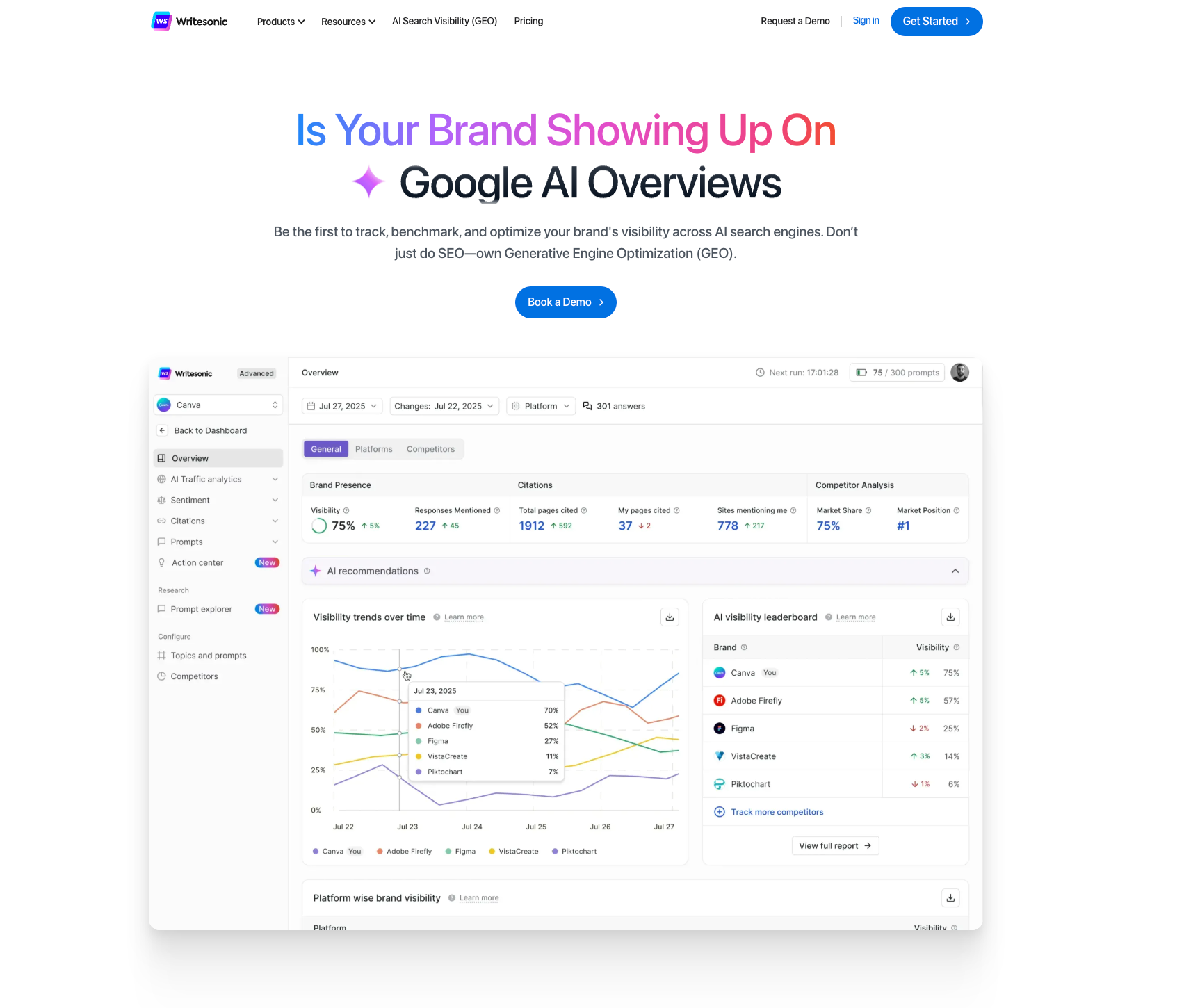
Writesonic started as a general-purpose AI writing tool and has since added AEO-adjacent monitoring capabilities, AI crawler tracking, page-level recommendations, and GEO-structured content workflows. Through an AEO lens, its value is speed of content production with some structural awareness. It can help teams produce answer-block formatted content at volume. However, the GEO/AEO monitoring layer is newer, less stable, and does not connect content changes to citation outcomes. It is a content production tool with AEO features, not an AEO platform with content capabilities.
AEO Capabilities
- AEO-structured content workflows: Templates pre-formatted for RAG extraction including FAQ blocks, how-to guides, and listicles with brand voice controls
- AI crawler visibility: Identifies which AI bots are accessing your pages and when, helping teams prioritize updates on pages that AI systems are actively reading
- Page-level recommendations: Flags missing citations, content gaps, and competitor moves with suggested fixes at the individual page level
- GA4 integration: Connects content activity to session and behavior data for basic traffic context
- Automated article generation: Multi-step content generation process covering competitor research, internal linking suggestions, and writing style instructions
What Users Say
| Pros | Cons |
|---|---|
| Fast production of structured drafts across multiple content formats | Expensive relative to output quality, pricing is a consistent friction point, especially for agencies |
| Easy to use with a low onboarding barrier | Output requires significant human editing before it meets publishable quality standards |
What the Market Is Saying
Community feedback on Writesonic is candid: the tool is useful for breaking through production bottlenecks, but the output is rarely publish-ready without substantial editing. Practitioners describe it as a first-draft accelerator, not a content engine. On the AEO side, the GEO monitoring feature has faced reliability issues; users report it being non-functional for extended periods, with slow support resolution. At the professional plan pricing tier, teams expect a production-grade AEO workflow. What they get is a capable writing assistant with AEO features that are still maturing.
Best For
Content-heavy marketing teams that need to scale answer-structured content production quickly and have editors in place to refine output, not teams looking for a reliable AEO monitoring or execution layer.
Pricing: Custom pricing for enterprises.
Category 4: SEO Suites with AEO Layers
Established SEO platforms with AI visibility features added. Not purpose-built for AEO, useful for teams already standardized on these suites.
1. Ahrefs: Brand Radar & AI Indexing
Ahrefs launched Brand Radar as a specialized module to bridge the gap between backlink tracking and AI mentions. It functions more like a massive research database than a simple tracker, leveraging a database of over 230 million real-world prompts to see where your brand surfaces.
Strengths:
- Brand Radar Discovery: Unlike tools where you provide the keywords, Brand Radar shows you where your brand appears across a vast ocean of “unseen” user queries in ChatGPT, Perplexity, and Google AIO.
- Cited Domain Analysis: A standout research feature that shows which third-party websites AI models are referencing when they discuss your brand. This is a “goldmine” for identifying new PR and backlink targets that influence AI narrative.
- Multi-Surface Monitoring: Beyond LLMs, it tracks mentions across the broader “discovery ecosystem,” including Reddit, YouTube transcripts, and TikTok, providing a holistic view of brand presence.
Considerations:
Ahrefs is a research and monitoring powerhouse, but it offers zero automated execution. It will tell you that a competitor is being cited more for a specific topic, but it won’t help you restructure your site or automate the internal links needed to fix it.
Best for: Research-heavy teams and SEO purists who want to identify the “source of truth” domains that AI engines trust most.
2. Semrush: AI Overview (AIO) & Sensor Intelligence
Semrush has integrated AEO by expanding its existing Position Tracking and Sensor tools. Its focus is primarily on Google’s ecosystem (AI Overviews and AI Mode), providing high-level volatility data for the search landscape.
Strengths:
- AIO Visibility Tracking: Seamlessly integrates AI Overview tracking into your existing keyword campaigns. It identifies which of your target keywords trigger an AI response and whether you are featured in the carousel.
- Market Volatility (Sensor): Semrush Sensor tracks the “AI Weather,” showing how often Google is swapping organic results for AI answers across different industries like Finance, Healthcare, or E-commerce.
- Competitive Gap Analysis: Uses its massive keyword database to show you the “commercial intent” of queries triggering AI answers, helping you prioritize high-value transactional AEO targets.
Considerations:
Semrush is not purpose-built for AEO. Its tracking is largely focused on Google’s AI surfaces, with less emphasis on conversational engines like Claude or ChatGPT compared to specialized tools.
Best for: Marketing teams already on Semrush who want a “baseline” view of how Google’s AI Overviews are impacting their existing organic traffic.
3. BrightEdge: Generative Parser & AI Catalyst
BrightEdge is the “Enterprise Choice” for CMOs who need to manage brand risk. Its AI Catalyst and Generative Parser tools are designed to measure the pixel-height of AI answers and the sentiment of the brand mentions within them.
Strengths:
- Share of Pixel (AIO Height): Tracks how much “real estate” AI Overviews are taking up on the screen, helping SEOs explain to stakeholders why organic traffic is dropping even when rankings remain stable.
- Sentiment Risk Monitoring: A critical enterprise feature that flags “Negative Brand Sentiment” in AI answers (e.g., if ChatGPT cites an old lawsuit or a product recall), allowing PR teams to respond.
- Industry-Specific Benchmarking: Provides deep data on “Citation Overlap”, proving that in many industries, 80% of what an AI cites is not in the organic Top 10.
Considerations:
BrightEdge offers excellent governance and reporting, but like other suites, the execution is manual. It provides “Briefs” and “Recommendations,” but requires your internal dev team to implement the structural AEO fixes.
Best for: CMOs and Brand Governance leaders at large corporations who need to monitor brand sentiment and “Pixel Loss” across thousands of keywords.
Enterprise AEO Capability Comparison
| Platform | Answer Slot Visibility | Citation & Mention Tracking | Content Extractability | Deployment Capability | Closed-Loop Attribution | Retrieval Readiness Optimization | Concierge Support |
|---|---|---|---|---|---|---|---|
| Quattr | ✅ Query-level tracking across ChatGPT, Google AI Overviews, Claude, Gemini, Perplexity | ✅ Citation share, mention frequency, and sentiment across all major AI engines | ✅ E-E-A-T Scorecard, GIGA agent, answer-block structuring at page level | ✅ API, CMS plugins, edge injection, testing | ✅ Native deployment workflows via API, CMS plugins, and edge integrations | ✅ E-E-A-T scoring, answer-block optimization, semantic internal linking, and retrieval-readiness recommendations with deployment workflows | ✅ Dedicated Quattr Strategist |
| Profound | ✅ Brand inclusion and share of voice with server-log validation of AI crawler activity | ✅ Citation and mention tracking via Conversation Explorer across major AI engines | Template guidance | ❌ No | ❌ No | Limited optimization guidance; primarily focused on visibility monitoring and prompt-level benchmarking | ✅ Engagement Managers included |
| AthenaHQ | ✅ Unified GEO score across 8+ LLMs — tracks representation accuracy and narrative shifts | ✅ GSC/GA4 unified analysis | Content briefs and FAQ drafts | ❌ No | Limited with sentiment connectors | AI-generated content briefs, FAQ recommendations, and narrative-gap identification for AI retrieval improvement | ❌ No |
| Writesonic | ✅ Bot-level crawler tracking | Page-level visibility | ✅ AEO-structured templates and content workflows with brand voice controls | ❌ No | GA4 traffic context | Retrieval-structured content templates, FAQ formatting, and AI-friendly content generation workflows | ❌ No |
| Ahrefs | ✅ Brand Radar surfaces brand appearances across 230M+ real-world prompts including unseen queries | ✅ Cited domain analysis, shows which third-party sites AI references when discussing your brand | ❌ No | ❌ No | ❌ No | Identifies cited domains and topical authority gaps, but optimization execution remains manual | ❌ No |
| Semrush | Monitor Google’s AI Mode, AI Overview along with mentions across ChatGPT, Perplexity, Gemini, and more | AIO carousel inclusion | ❌ No | ❌ No | GA4 context available | AI Overview tracking with keyword and content gap insights; retrieval optimization workflows are limited | ❌ No |
| BrightEdge | ✅ Google AI Overviews via Generative Parser, tracks pixel height and organic displacement | Sentiment flagging on brand mentions | Briefs and recommendations | ❌ No | SEO and GEO metrics blended, not AEO-specific | Recommendations and content briefs for AI visibility improvement, with manual implementation required | ❌ No |
What Makes an AEO Tool Worthy of Trust?
In the AEO market, “trust” is often framed as a data or security problem. In practice, the bigger issue is operational credibility.
Many platforms can surface an AI mention, track citation share, or display screenshots of brand appearances inside ChatGPT or Google AI Overviews. Far fewer can explain:
- why a competitor was retrieved instead of you,
- what structural signal influenced retrieval,
- whether a deployment changed citation behavior,
- or how AI visibility translated into measurable business impact.
That distinction is becoming increasingly important as enterprise teams move beyond AI visibility reporting and into AI visibility operations.
A monitoring dashboard alone does not improve retrieval likelihood. Enterprise AEO increasingly requires:
- retrieval-readiness optimization,
- deployment orchestration,
- crawler validation,
- answer-slot tracking,
- and closed-loop attribution tying AI visibility gains back to traffic, conversions, or pipeline influence.
This is also where many platforms currently fall short.
The market is crowded with tools that can detect AI visibility. The harder challenge is operationalizing it consistently across content, engineering, SEO, and analytics workflows.
The most credible AEO platforms are not simply measuring AI answers. They are building systems capable of improving retrieval readiness, validating structural changes, and connecting answer-slot ownership to measurable business outcomes over time.
Don’t just evaluate whether a platform can monitor AI visibility.
Evaluate whether it can operationalize it.
The Next Phase of AEO Is Operational
The first generation of AEO platforms focused primarily on visibility:
- tracking citations,
- monitoring mentions,
- benchmarking competitors,
- and measuring share of voice across AI engines.
That layer is rapidly becoming table stakes.
The next phase of the market is shifting toward operational AI visibility systems, platforms capable of:
- improving retrieval readiness,
- deploying structural optimizations,
- validating crawler accessibility,
- measuring answer-slot ownership,
- and connecting AI visibility gains to measurable business outcomes.
This is a fundamentally different challenge from traditional SEO.
Ranking in a list of links was largely a discoverability problem. Competing inside AI-generated answers is increasingly an orchestration problem involving:
- entity authority,
- retrieval structure,
- deployment speed,
- citation reinforcement,
- and continuous optimization across AI systems that evolve constantly.
As AI-generated answer layers absorb more commercial discovery behavior, enterprise teams will need more than monitoring dashboards.
They will need operational systems designed to influence how AI engines retrieve, interpret, and prioritize information in the first place.
The platforms leading the next phase of AEO will not simply report on AI visibility.
They will operationalize it.
FAQs on AEO Tools
While they share DNA, the intent differs:
SEO (Search Engine Optimization): Focuses on ranking in a list of links to drive clicks.
GEO (Generative Engine Optimization): Focuses on brand visibility and share of voice across the entire generative landscape.
AEO (Answer Engine Optimization): Focuses on being the specific, direct answer provided by an AI. It’s about becoming the “canonical truth” that the model retrieves to fulfill a user’s question.
Standard SEO suites are built on the “Keyword/Rank” model. AEO requires an “Entity/Answer” model. While your SEO suite is great for monitoring traditional search traffic, it likely lacks the specialized tools needed for prompt-level tracking, AI-crawler validation, and E-E-A-T scoring. If you are in a competitive or research-heavy industry, a dedicated AEO layer is becoming a necessity to protect the “Zero-Click” portion of your funnel.
The “AEO Intensity” of an industry depends on the length of the research journey. If your customers ask complex, comparative, or “How-to” questions before buying, as is common in SaaS, Finance, Healthcare, and B2B, AEO is critical. If your business is purely transactional or impulse-based, traditional SEO and social remain your primary drivers. A quick test: ask a few major LLMs to recommend a product in your category. If the answers are currently populated by your competitors or outdated third-party reviews, you have an AEO problem.

Quattr is an AI-native Search Visibility Platform founded in Palo Alto, California, built for mid-market and enterprise brands competing in the age of generative search. Recently recognized across G2's Spring 2026 reports with #1 rankings in AEO Results, Usability, and Relationship, Quattr helps brands win visibility across traditional search and AI-generated answer surfaces.
Quattr's AI agent, GIGA, evaluates content the way AI systems do, identifying gaps across structure, authority, internal linking, and discoverability to surface the highest-impact fixes. With capabilities like autonomous internal linking, E-E-A-T intelligence, and the new GIGA Landing Page Generator for keyword-matched, AI-search-ready pages, Quattr helps teams move from diagnosis to deployed changes without manual bottlenecks.