

Key Takeaways
- AI Overviews are not the biggest shift. UGC footprint — Reddit, YouTube, LinkedIn, Quora, is 3.5× larger than AI Overview footprint across enterprise portfolios, and growing 6× faster week-over-week.
- YouTube is the most underestimated threat. At 32.8% WoW growth, video results are displacing text-based content at a pace most content strategies aren’t built to respond to.
- Reddit is eating category-defining queries. Specific subreddits are absorbing high-intent queries at scale, r/wordpress alone accounts for 16,636 query exposures. These aren’t niche communities; they’re capturing the queries your content should own.
- UGC is a volatility problem, not just a positioning problem. With 145,056 thread churn events in a single update window, weekly monitoring misses the threat entirely. The SERP moves daily.
- AI Overviews and UGC compound each other. When Google generates an AI Overview, it often cites the same Reddit threads and YouTube videos, displacing you in organic results. Losing a query to UGC and losing the AI citation can happen simultaneously, from the same source.
- The response requires two distinct strategies. For AIO-heavy queries: optimize to be cited, not clicked. For UGC-heavy queries: compete with freshness and coverage, or redirect investment away from permanently community-owned queries.
- Neither decision can be made well from a standard rank tracker. The data required to sequence these responses correctly isn’t available in traditional SEO tooling.
Everyone Is Watching AI Overviews. The Bigger Shift Is Happening Elsewhere.
The SEO industry has spent the better part of two years fixated on AI Overviews. Fair enough, when Google inserts a generative response above organic results, the click-through math changes. The threat is real.
But here’s the data most teams don’t have: across enterprise portfolios we monitor, AI Overview footprint sits at 29,443 query-day units. UGC footprint, Reddit, YouTube, LinkedIn, Quora, appearing in page-one results, sits at 105,186 query-day units.
That’s 3.5× the exposure. And while AI Overviews grew 2.3% week-over-week during the March 2026 update window, UGC grew 14.5%.
If your 2026 content strategy is primarily an AIO mitigation play, you may be optimizing for the wrong threat.
What the UGC Data Actually Shows
The 105,186 UGC query-day figure isn’t evenly distributed; it has a platform and vertical structure that makes it tactically addressable.
Platform breakdown (week of March 2026 core update):
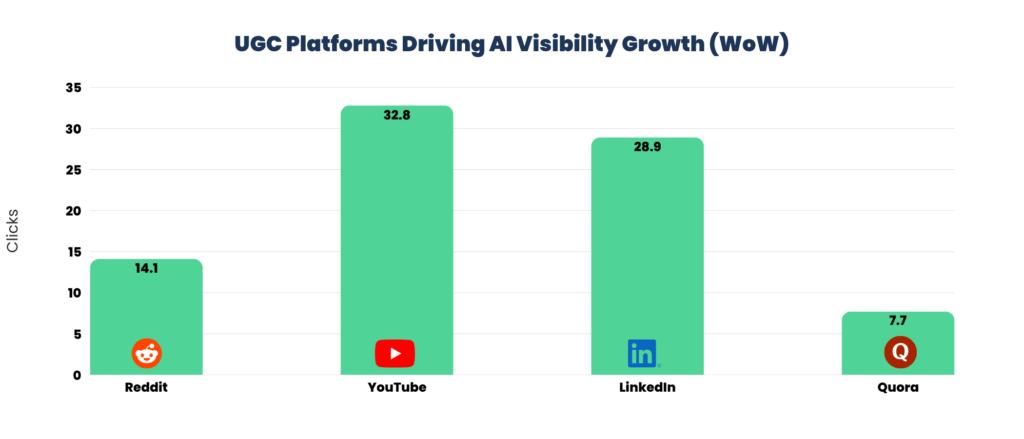
- Reddit: +14.1% WoW
- YouTube: +32.8% WoW
- LinkedIn: +28.9% WoW
- Quora: +7.7% WoW
YouTube’s 32.8% growth is notable. Google is not shy about surfacing video results for queries that previously went to text-based content. If your informational content is text-only and you’re competing against a well-optimized YouTube tutorial for the same query, you’re running the wrong play.
The subreddit-level story is even sharper. This isn’t “Reddit is growing generally.” It’s specific communities absorbing specific query categories:
- r/wordpress: 16,636 query exposures — the dominant UGC force in web hosting and CMS queries
- r/seo: 4,131 exposures — capturing meta-queries that should be driving to your thought leadership
- r/webhosting: 3,294 exposures
- r/webdev: 2,679 exposures
These aren’t peripheral communities. They’re eating category-defining queries.
Thread Churn: Why Static Monitoring Misses This
The 145,056 thread churn events we tracked during the update window surface a critical nuance: Reddit results aren’t stable. A thread that ranks today may not rank next week. A new thread on the same subreddit may surface and outrank everything.
This means the UGC threat isn’t just a positioning problem; it’s a volatility problem. You can’t monitor your way out of it with weekly or monthly scrapers. The daily cadence matters because the SERP moves daily.
AI Overviews and UGC Are Not Separate Threats
Here’s where the framing gets more nuanced. AI Overviews often cite community content. When Google generates an AI Overview for a web hosting comparison query, it may pull from Reddit threads, YouTube reviews, and brand pages simultaneously. The two threats compound.
A brand that loses a query to a Reddit result is also at risk of having that Reddit thread cited in an AI Overview. The page-one displacement and the AI citation loss can happen at the same time, from the same source.
Which is why the response isn’t “focus on AIO” or “focus on UGC”, it’s understanding which of your query categories are vulnerable on each dimension and sequencing responses accordingly.
The Strategic Split
For queries where AI Overviews are absorbing impressions: your goal is citation inclusion, not ranking recovery. Optimize to be cited, not clicked. This means structured, authoritative content that AI systems can extract and reference with attribution.
For queries where UGC is absorbing rankings, your goal is coverage and freshness. These are often comparison, review, and how-to queries where community credibility outweighs brand credibility. The response is either producing content that legitimately outperforms the community result or understanding that the query is permanently community-owned and redirecting your investment elsewhere.
Both decisions require data. Neither can be made well from a standard rank tracker.
See Where UGC and AI Overviews Are Hitting Your Query Portfolio
Most teams find out they have a UGC problem when traffic drops. By then, the queries are already community-owned.
Quattr maps your AI Overview exposure against your UGC footprint — by query category, not in aggregate — so you know which queries are still worth fighting for and which need a different strategy entirely.
No synthetic data. No sampled dashboards. Your GSC and GA4 data, connected to daily SERP monitoring across AI surfaces and UGC platforms.
See your AI Overview exposure vs. UGC exposure across your query portfolio

Quattr is an AI-native Search Visibility Platform founded in Palo Alto, California, built for mid-market and enterprise brands competing in the age of generative search. Recently recognized across G2's Spring 2026 reports with #1 rankings in AEO Results, Usability, and Relationship, Quattr helps brands win visibility across traditional search and AI-generated answer surfaces.
Quattr's AI agent, GIGA, evaluates content the way AI systems do, identifying gaps across structure, authority, internal linking, and discoverability to surface the highest-impact fixes. With capabilities like autonomous internal linking, E-E-A-T intelligence, and the new GIGA Landing Page Generator for keyword-matched, AI-search-ready pages, Quattr helps teams move from diagnosis to deployed changes without manual bottlenecks.