

Key Takeaways
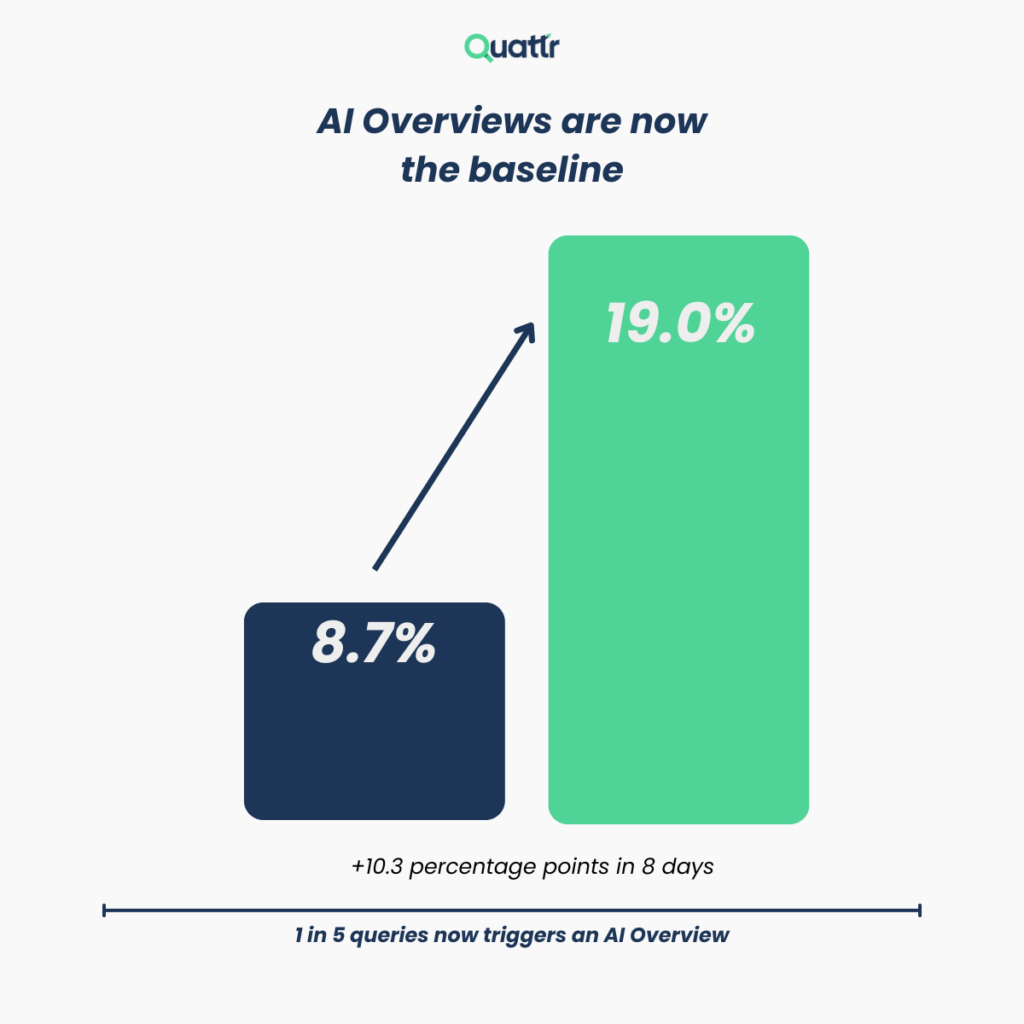
- AI Overview query share doubled in eight days, from 8.7% to 19.0%, and held. This is structural, not a test. Measured across 14 enterprise portfolios, every vertical, every geography.
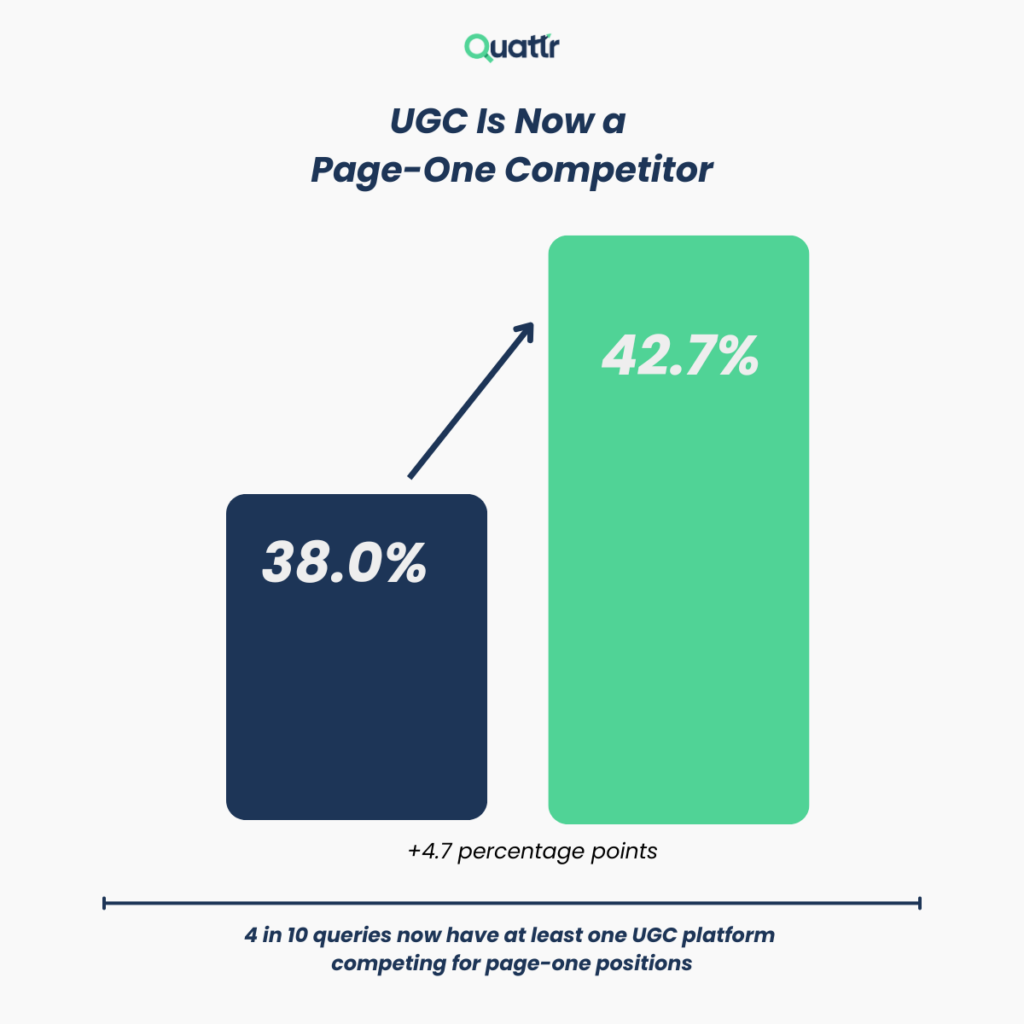
- UGC prevalence climbed from 38% to 42.7% during the March core update window. 4 in 10 queries now have at least one platform domain in the top 10. This happened while the industry was watching AI Overviews.
- The Reddit displacement narrative is vertical-specific, not universal. Reddit’s top-3 share is flat at 10–11% across verticals. The real signal is broader UGC prevalence, distributed across Reddit, YouTube, Quora, LinkedIn, Medium, StackOverflow, and GitHub.
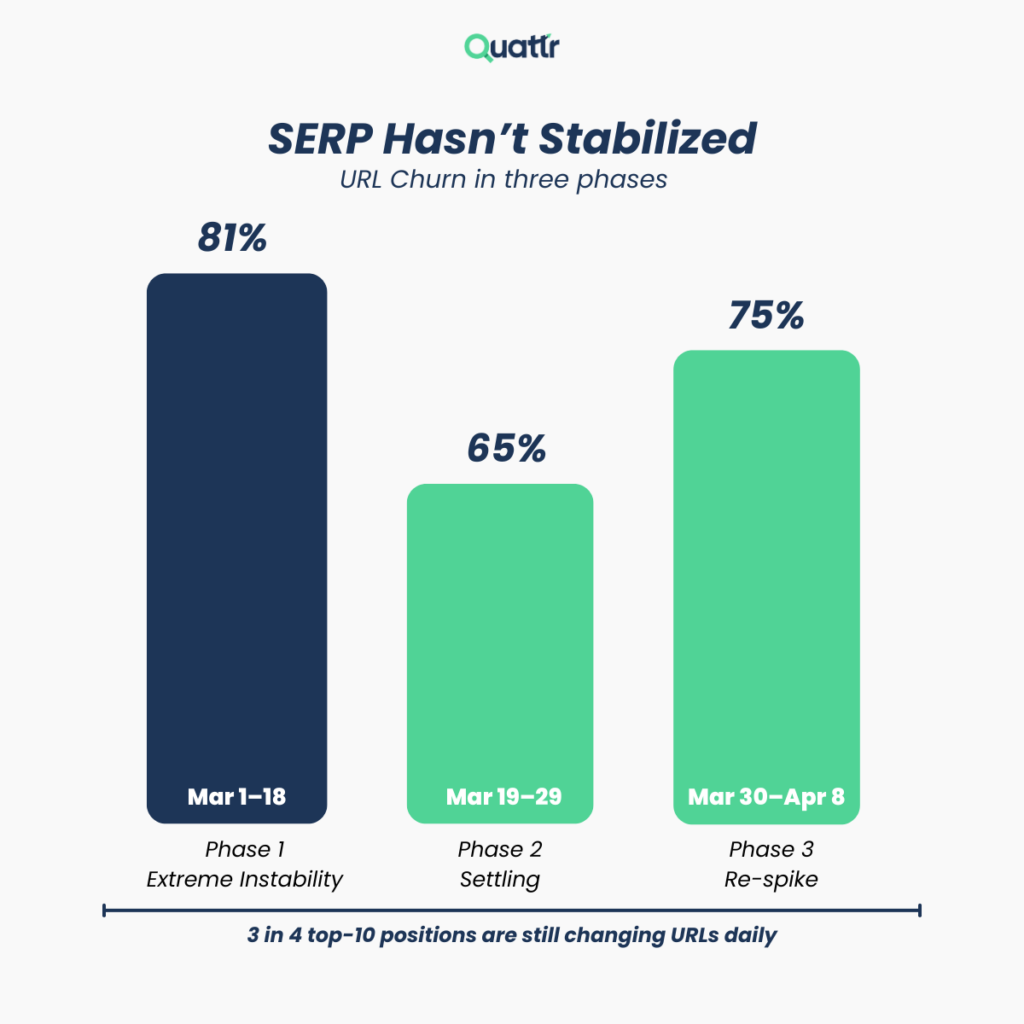
- URL churn hit 81% in early March, dropped to 65% after the spam update cleaned out low-quality pages, then re-spiked to 75% when the core update landed. The SERP has not found its new equilibrium.
- The organic surface is being compressed from two directions simultaneously, AI Overviews shrinking the ceiling, UGC raising the floor, while the positions in between remain structurally unstable.
The Surface Changed. Not the Channel.
Organic search still works. Traffic and conversion data confirm that. What broke in Q1 2026 is the relationship between the positions you hold and the surface those positions occupy.
Three things happened in 10 days. Each one changed the SERP structure in a different way. Together, they compressed the addressable organic surface from both ends and left the middle unstable.
Understanding each shift separately is the difference between building the right Q2 strategy and defending the wrong Q1 results.
For 30 consecutive days (March 1–30), the 7-day trailing average of the AI Overview query share held between 8.5% and 8.8%. Flat line.
Then three events fired in sequence:
- March 24–25: Google’s spam update removed low-quality pages from the index.
- March 27: The core update began restructuring ranking signals.
- March 31: AI Overview expansion became visible across verticals.
Within eight days of the core update trigger, AIO query share jumped from 8.7% to 19.0%. It held at 19.0% for three consecutive days, confirming this as a new structural baseline, not an A/B test.
Scale matters here. This isn’t a single-client observation. It’s measured across 14 enterprise portfolios, and 1.6 million domains. The expansion is universal; every vertical, every geography in our tracking set shows the same pattern.
The practical consequence: nearly 1 in 5 queries now triggers an AI Overview. Each one pushes traditional organic results further down the page, reducing the visible click surface for every brand ranking on those queries. The ceiling moved.
What to do about it: Separate your query portfolio into two buckets. Queries where AIO now appears need a citation-first strategy, structured data, authoritative sourcing, and the content signals that get pulled into AI-generated answers. Queries where AIO hasn’t appeared are your click-recoverable set. Treat them differently. Optimizing both the same way wastes budget on one and under-invests in the other.
Shift 2: UGC Is Gaining Ground — But Not Where the Industry Thinks
We measure UGC prevalence as the percentage of tracked queries where at least one UGC or platform domain, Reddit, YouTube, Quora, LinkedIn, Medium, StackOverflow, GitHub, appears in the top 10.
During the March update window, UGC prevalence climbed from 38.0% to 42.7%. That’s +4.7 percentage points. Not dramatic in isolation, but persistent, unidirectional, and structurally significant. 4 in 10 queries now have at least one platform domain competing for the same page-one positions brands occupy.
Here’s the finding the industry is getting wrong: The dominant narrative is that Reddit is displacing brand content. Across verticals scale, that narrative doesn’t hold.
Reddit’s share of top-3 positions is flat at 10–11% across all 14 portfolios. It hasn’t moved. The Reddit displacement signal that made headlines, a 9-percentage-point surge in top-3 share, was measured in US tech verticals specifically. It’s real, but it’s vertical-specific.
The universal signal is broader UGC prevalence. The platforms are gaining collectively, Reddit, YouTube, Quora, LinkedIn, and others, not individually. When you measure only Reddit, you miss the structural shift. When you measure all UGC, the floor is rising.
What to do about it: Stop treating UGC as a competitive threat you can outrank with better content alone. On queries where platform domains hold multiple top-10 positions, your realistic organic ceiling is lower than your rank tracker suggests. A page ranking #4 on a query where Reddit holds #2, YouTube holds #5, and Quora holds #8 has a different click opportunity than a #4 surrounded by other brand domains. Measure your effective addressable surface, not just your position.
Shift 3: The SERP Hasn’t Stabilized
URL churn, the percentage of top-10 positions where the ranking URL changed day-over-day, reveals three distinct phases in the March data:
Phase 1: Extreme instability (March 1–18). Churn ran at 80–82%. Google was actively testing new position assignments. More than 4 out of 5 top-10 slots changed URLs daily.
Phase 2: Settling (March 19–29). The spam update on March 24–25 removed low-quality pages from the shuffle. Churn dropped to 65%, the lowest point in the window. Positions were consolidating.
Phase 3: Re-elevation (March 30 onward). The core update re-spiked churn to 75%. Positions are reshuffling again. As of April 8, 3 out of 4 top-10 positions are still changing URLs daily.
The SERP has not found its new equilibrium. The rankings you see today are not the rankings that will hold next week. Any strategy built on current positions as if they’re stable is building on a surface that’s still moving.
What to do about it: Delay major content pruning or redirect decisions until churn drops below 70% and holds for at least two consecutive weeks. Positions measured during active churn are unreliable baselines. Instead, use this window to identify which of your pages are gaining stability (holding position through the churn) versus which are rotating in and out. The pages that hold are your structural anchors. The pages that rotate need intervention once the SERP settles.
The Three Signals Tell One Story
AIO compressed the ceiling. UGC is raising the floor. And the positions in between are still churning.
The addressable organic surface is shrinking from both directions at once, and it hasn’t finished moving yet. Brands that measure rank without measuring the surface that rank occupies are optimizing a number that no longer means what it used to.
The Q2 question isn’t “how do we rank higher?” It’s “how much clickable surface exists on the queries we rank for, and what share of it can we realistically capture?”
Your Q1 Data Has the Signal. Your Dashboard Might Not.
The three shifts in this piece are already in your data, but most enterprise dashboards weren’t built to surface them. Rank trackers don’t measure AIO displacement. Market share tools don’t separate UGC prevalence from competitive share. And nobody’s standard reporting shows URL churn as a stability indicator.
Quattr connects your first-party GSC and GA4 data with systematic AEO tracking across ChatGPT, Perplexity, Gemini, and Google AI Overviews, so you can see your click-recoverable queries, your citation-targetable queries, and your LLM referral signal in one view.
No synthetic data. No sampled dashboards. No guessing which shift is hitting your portfolio hardest.
See your Q1 query portfolio split by click-recoverable vs. citation-targetable.

Quattr is an AI-native Search Visibility Platform founded in Palo Alto, California, built for mid-market and enterprise brands competing in the age of generative search. Recently recognized across G2's Spring 2026 reports with #1 rankings in AEO Results, Usability, and Relationship, Quattr helps brands win visibility across traditional search and AI-generated answer surfaces.
Quattr's AI agent, GIGA, evaluates content the way AI systems do, identifying gaps across structure, authority, internal linking, and discoverability to surface the highest-impact fixes. With capabilities like autonomous internal linking, E-E-A-T intelligence, and the new GIGA Landing Page Generator for keyword-matched, AI-search-ready pages, Quattr helps teams move from diagnosis to deployed changes without manual bottlenecks.