
Key Takeaways
- The March 2026 Google Core Update, early signs saw structural, not volatile, three shifts (authority bias, fragmentation, UGC absorption) reshaped the SERP simultaneously
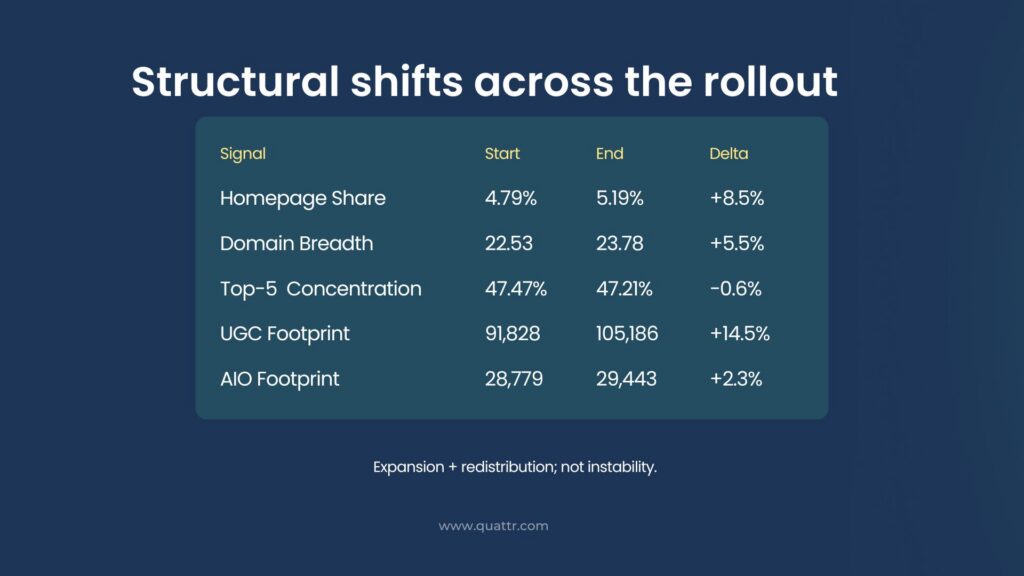
- Homepage authority gained ground (+8.5%), signaling a shift toward consolidated domain trust over distributed page-level ranking
- Competition expanded (+5.5% domain diversity), reducing the share of voice even where rankings appeared stable
- UGC platforms surged (+14.5%), with Reddit actively absorbing query space previously owned by brand content
- The real change wasn’t ranking position, it was available SERP surface area for brands shrinking
- Traditional rank tracking missed the signal, understanding SERP composition is now critical to diagnosing performance loss
- Recovery depends on identifying why you lost visibility: authority gaps, new entrants, or UGC displacement, each requires a different response
- The teams that adapt fastest are those that interpret structural shifts early, not those that wait for rankings to stabilize
The Update Didn’t Change One Thing. It Changed Three.
When Google’s March 2026 core update rolled through, most enterprise SEO teams did what they always do: they watched their rankings dashboard, waited for the dust to settle, and tried to figure out whether they were up or down.
The problem isn’t the waiting. Is a rankings dashboard the wrong instrument for reading a structural event?
Across the enterprise portfolios we monitor, the March 2026 update registered a portfolio VIX (volatility index) of 35.77, medium-range volatility, but with a signature that a standard rank tracker wouldn’t surface. Our SERP compression analysis classified the update as three simultaneous structural shifts: authority bias, surface fragmentation, and community absorption. Not one. Three. Running at the same time, hitting different industries differently, and requiring different responses.
Here’s what that actually means.
Layer 1: Authority Bias — Homepages Got Bigger
Homepage slot share increased by 8.5% across monitored verticals during the update window. That’s not a fluke; it’s Google recalibrating toward consolidated domain authority in response to content proliferation. Sites with thin page authority scattered across thousands of URLs lost ground to sites with strong root-domain signals.
If your content strategy relies on a high volume of long-tail pages that don’t carry strong internal linking support, you feel this. The fix isn’t deleting pages, it’s connecting them to existing authority structures.
Layer 2: Surface Fragmentation — More Sources, More Competition
Domain diversity in page-one results increased 5.5%. This sounds like good news (more variety), but for enterprise teams, it means your share of voice is being split across a larger competitive set. In several verticals, we saw mid-tier domains appear for queries that had been stable for 12+ months. The update lowered the barrier for new entrants on informational queries, which means the moat you thought you had is narrower.
Layer 3: Community Absorption — Reddit and UGC Are the New Incumbents
The largest structural shift, and the one most enterprise teams are least prepared for, is UGC expansion. Across our monitored portfolio, UGC footprint grew 14.5% week-over-week during the update window. Reddit alone accounts for more than 86,900 query exposures across the verticals we track. In web hosting queries specifically, r/wordpress registered 16,636 query exposures with a week-over-week delta of +852, meaning that the subreddit is actively absorbing queries your blog content used to own.
This isn’t trend commentary. It’s a specific, trackable structural shift with named communities eating named query categories.
This shift isn’t isolated. As one recent market read put it:
“Your rank didn’t change. Your surface did.”
The implication is straightforward: when UGC platforms hold 60%+ of page-one slots and brands control ~1.5 of ~14 positions, ranking improvements alone stop translating into traffic gains.
The reason most enterprise teams misread this update isn’t that they lack data. It’s that they’re reading the wrong data. Rankings tell you what happened. SERP compression tells you why it happened, whether you lost because a homepage absorbed your query (authority bias), whether a new domain appeared (surface fragmentation), or r/wordpress is now ranking above you (community absorption).
The response to each is different. The first requires strengthening internal authority signals. The second requires freshness and competitive content coverage. The third requires a different strategy entirely, one that acknowledges you cannot outrank Reddit, but you can own the queries that Reddit isn’t capturing.
Quattr’s SERP compression intelligence classifies every update type in real time, so your response is structured from day one, not reverse-engineered three weeks later after you’ve read four different agency takes on what the update “was about.”
What to Do Now
If your VIX spiked during the March update, your priority order should be:
- Run the authority bias check first. Which pages are losing internal link equity? Which high-traffic sections of your site are orphaned or weakly connected?
- Map the community absorption. Which of your query categories now have Reddit or YouTube results in positions 1–5? These are your exposure areas.
- Identify the click-recoverable queries. Queries where you have impressions but zero CTR are the fastest recovery path; they don’t need new content, they need optimization.
The March 2026 update is a stress test. The teams that recover fastest won’t be the ones who waited longest to act; they’ll be the ones who had the structural read within days.
See your portfolio’s volatility profile and update impact analysis: Request a demo

Quattr is an AI-native Search Visibility Platform founded in Palo Alto, California, built for mid-market and enterprise brands competing in the age of generative search. Recently recognized across G2's Spring 2026 reports with #1 rankings in AEO Results, Usability, and Relationship, Quattr helps brands win visibility across traditional search and AI-generated answer surfaces.
Quattr's AI agent, GIGA, evaluates content the way AI systems do, identifying gaps across structure, authority, internal linking, and discoverability to surface the highest-impact fixes. With capabilities like autonomous internal linking, E-E-A-T intelligence, and the new GIGA Landing Page Generator for keyword-matched, AI-search-ready pages, Quattr helps teams move from diagnosis to deployed changes without manual bottlenecks.