
Key Takeaways
- Search is moving from “clicking links” to “getting answers instantly,” making AI visibility more important than traditional rankings alone.
- Nearly 60% of Google searches now end without a click, showing how quickly zero-click search behavior is growing.
- Strong SEO rankings do not always guarantee strong AI visibility because AI systems evaluate content differently.
- Brands that appear consistently in AI-generated answers can build more awareness, trust and authority during the customer research journey.
- Measuring AI visibility is becoming essential for understanding how customers discover and interact with brands online.
Today, people can ask AI tools like Gemini for recommendations, comparisons or quick answers and get information instantly without visiting a website. Users can now discover brands and make decisions directly inside AI-generated responses, reducing traditional search clicks and changing how online discovery works.
This shift is changing how marketers measure success.
For many years, search followed a simple process: users searched for something, clicked on a website and eventually converted. That made performance easier to track.
But over time, tracking became more difficult as people started using multiple devices, platforms, and channels where clicks are not always visible.
AI-powered search has made this even more challenging. Since many interactions now happen without a website visit, brands can no longer rely only on rankings and clicks to understand visibility and performance. As AI-generated answers become a bigger part of online discovery, understanding and tracking AI visibility has become increasingly important for businesses.
Why AI Visibility has Become Critical for Brands?
As more users rely on AI-generated answers for research and recommendations, brands need to understand how visible they are across these platforms. Here are some key reasons why AI visibility has become important for businesses today:
1. Users are Getting Answers Without Clicking Websites
Search behavior has changed significantly. Many users now get answers directly from AI tools and search result summaries instead of visiting multiple websites. If a brand is not mentioned in those AI-generated responses, it may never become part of the customer’s consideration process.
This is especially important in B2B research journeys. For example, when someone asks an AI assistant for the best software vendors, manufacturing suppliers or service providers, the brands included in the response immediately gain visibility, while others may not be seen at all.
2. AI Platforms are Becoming Major Discovery Channels
AI-driven platforms are quickly becoming a common way for people to research products, services and business solutions. Tools like OpenAI’s ChatGPT and Perplexity AI are now used by millions of people for everyday discovery and decision-making.
As usage grows, brands that appear consistently in AI-generated answers are gaining more exposure and traffic. Over time, repeated mentions can strengthen a brand’s authority because AI systems often continue referencing sources they already consider reliable.
3. Strong SEO Performance Alone is No Longer Enough
Many businesses are realizing that ranking well on traditional search engines does not automatically mean strong visibility in AI-powered search experiences. AI systems evaluate content differently from traditional ranking algorithms.
Instead of focusing only on keywords and backlinks, AI tools also look at how clearly information is structured, whether answers are easy to extract, how trustworthy the source appears and how consistently the brand is referenced across the web. Content designed only for traditional SEO may not perform well in AI-generated search results.
4. Brands Adapting Early are Building an Advantage
Companies that are already optimizing content for AI discovery are building stronger visibility early. As AI systems continue learning from trusted and frequently referenced sources, brands that establish authority now are more likely to appear repeatedly in future responses.
Businesses that delay adapting may find it harder to compete later, especially if competitors have already become established as trusted sources within AI-powered search ecosystems.
What are the Key Metrics to Measure AI Visibility?
As AI search becomes more popular, brands need new ways to measure visibility. Rankings and clicks alone are no longer enough. These metrics can help businesses understand how visible they are across AI-powered search platforms.
1. Citations
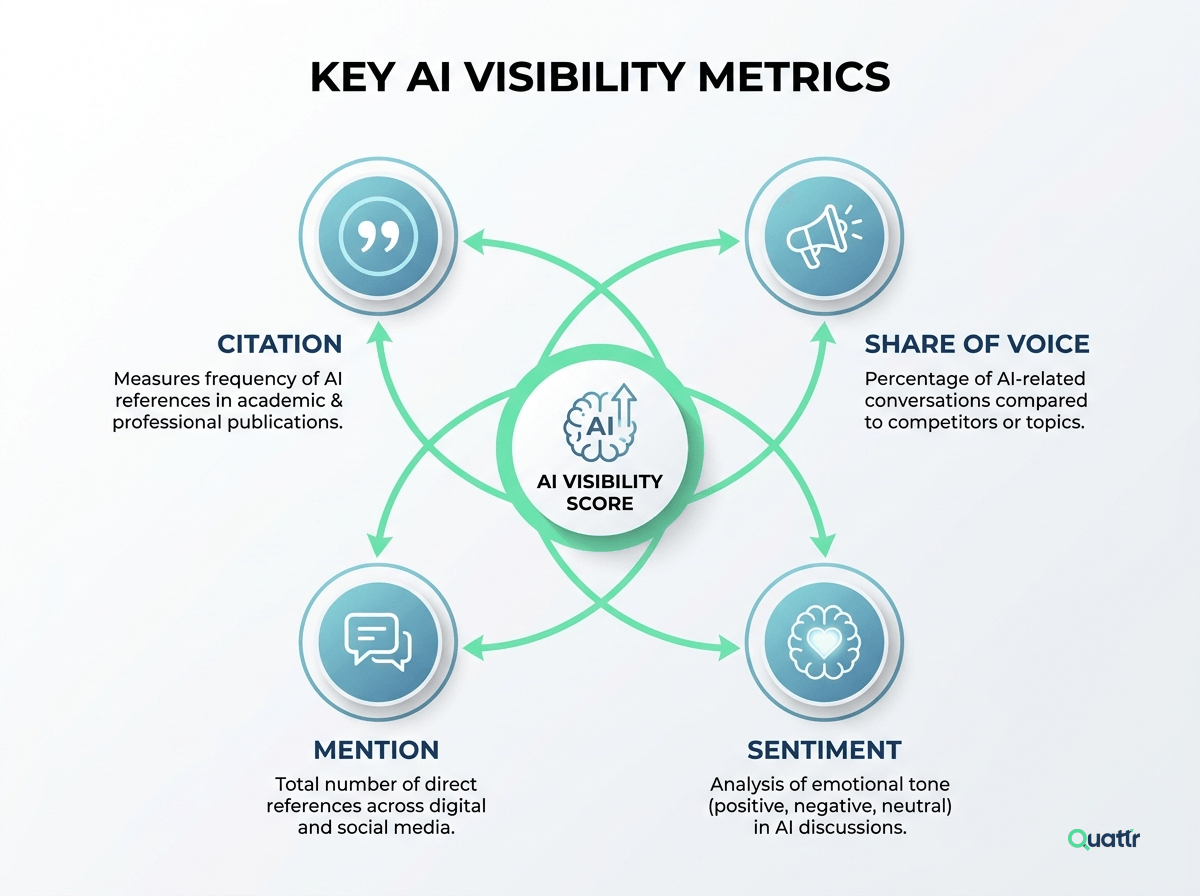
This metric shows how often your website pages are directly linked in AI-generated answers across platforms like ChatGPT, Google AI Mode, Gemini, and Claude.
Tracking: Track which pages are getting cited and how often they appear compared to competitors.
Impact: More citations usually mean AI systems trust your content as a reliable source.
2. Share of Voice
Your overall AI visibility, calculated using both citations and mentions, with citations weighted 1.25× higher because linked sources carry stronger authority.
Tracking: Measure how much space your brand occupies across important prompts and topics.
Impact: A higher share of voice means your brand is appearing more often during customer research.
3. Mentions
This metric tracks how often your brand name appears in AI answers without a direct website link.
Tracking: Monitor how frequently AI systems mention your brand across different topics.
Impact: More mentions can increase brand awareness, even without citations.
4. Sentiment
This metric measures whether AI responses talk about your brand positively or negatively.
Tracking: Analyze the tone of AI-generated answers where your brand is mentioned.
Impact: Sentiment helps businesses understand how AI platforms are describing their brand.
| Metric | Definition | Business Goal |
|---|---|---|
| Citations | Number of times your website pages are directly cited or linked in AI-generated answers. | Increase trusted visibility and AI citations across platforms. |
| Share of Voice | Measures how visible your brand is compared to competitors in AI-generated responses. | Improve overall AI search presence within your industry. |
| Mentions | Number of times your brand is mentioned in AI answers without a direct citation link. | Increase brand awareness and recognition across AI platforms. |
| Sentiment | Measures whether AI-generated responses describe your brand positively or negatively. | Build stronger brand trust and positive perception in AI search. |
How AI Visibility affects Business?
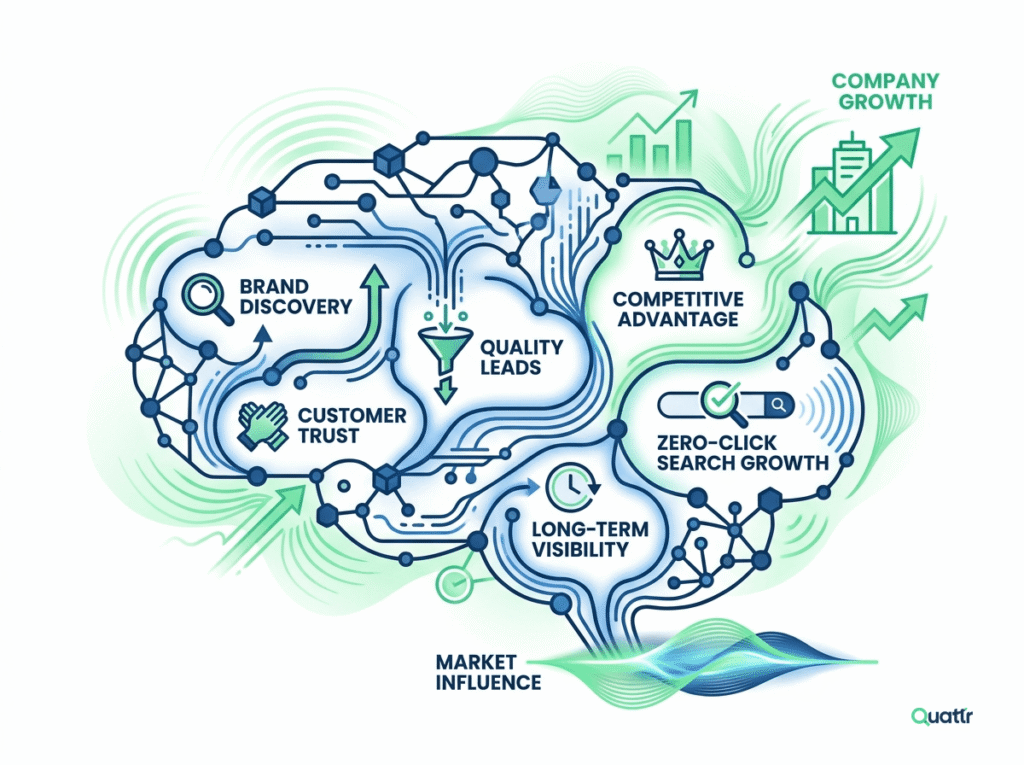
AI visibility is changing how businesses get discovered online. When a brand appears in AI-generated answers, more people can notice, trust and remember that business during their research process. Here are some ways AI visibility can impact your business:
1. Better Brand Discovery
Many users now get direct answers from AI systems instead of visiting multiple websites. This means brands that appear in AI-generated responses can gain visibility faster while businesses missing from those answers may lose attention to competitors.
2. More Customer Trust
When users repeatedly see a brand mentioned in AI answers, it can help build familiarity and trust during the research process.
3. Higher Quality Leads
Users coming from AI recommendations are often more informed because they already know about the brand before visiting the website.
4. Stronger Competitive Advantage
Businesses that improve AI visibility early may build stronger authority as AI systems continue referencing trusted and useful sources.
5. Growth of Zero-Click Search
Many users now get answers directly from AI summaries without clicking websites, making AI visibility more important than traditional rankings alone.
6. Better Long-Term Visibility
Brands that create clear, trustworthy and useful content have a better chance of staying visible across future AI-powered search experiences.
Understanding visibility is only the first step. To improve performance over time, brands also need to know how to analyze and interpret AI visibility metrics correctly.
How to Interpret AI Visibility Metrics?
Tracking AI visibility is only valuable when you understand what the metrics actually reveal. Looking at a single number in isolation rarely gives the full picture. The real insight comes from watching trends over time and comparing your visibility against competitors across the same prompts and topics.
This becomes especially important when analyzing mentions and citations. In AI search, a mention means your brand name appears in an AI-generated answer; a citation means the AI platform visibly references or links to your website as a source. They are measured separately and can coexist in one answer. In Quattr, AI citation rate is your share of all citations awarded across the tracked competitor set for a prompt basket, not the proportion of answers that cited you. Citations are usually considered stronger signals because they show that AI systems trust your content enough to use it directly in responses.
Understanding the difference between these signals helps brands identify whether AI systems simply recognize their brand or actually trust their content enough to surface it consistently in AI-generated answers.
When Mentions Increase But Citations Stay Low
Sometimes a brand may appear in AI-generated answers but still receive very few citations or direct references. This usually means AI systems recognize the brand name but do not see enough clear, structured or trustworthy information on the brand’s own website.
In many cases, improving content clarity can help. AI systems prefer content that is direct, well-structured, easy to scan and built around clear answers rather than long, vague explanations.
Low Visibility Often Signals Weak Topical Authority
If your brand rarely appears in awareness-stage searches, it may indicate limited topical authority. AI systems usually connect brands with topics based on how deeply and consistently they cover a subject online.
For example, publishing only product pages may not be enough. Brands also need educational content, guides, comparisons, FAQs, and supporting topic coverage to strengthen their visibility across broader industry conversations.
As AI visibility becomes more important, brands also need reliable ways to measure where they appear, how often they are referenced and how their presence compares against competitors across AI-driven search platforms.
How Quattr Helps You Measures AI Visibility?
As AI-powered search becomes more common, brands need to understand how often they appear inside AI-generated answers across platforms like ChatGPT, Google AI Mode, Gemini, Claude, and Perplexity.
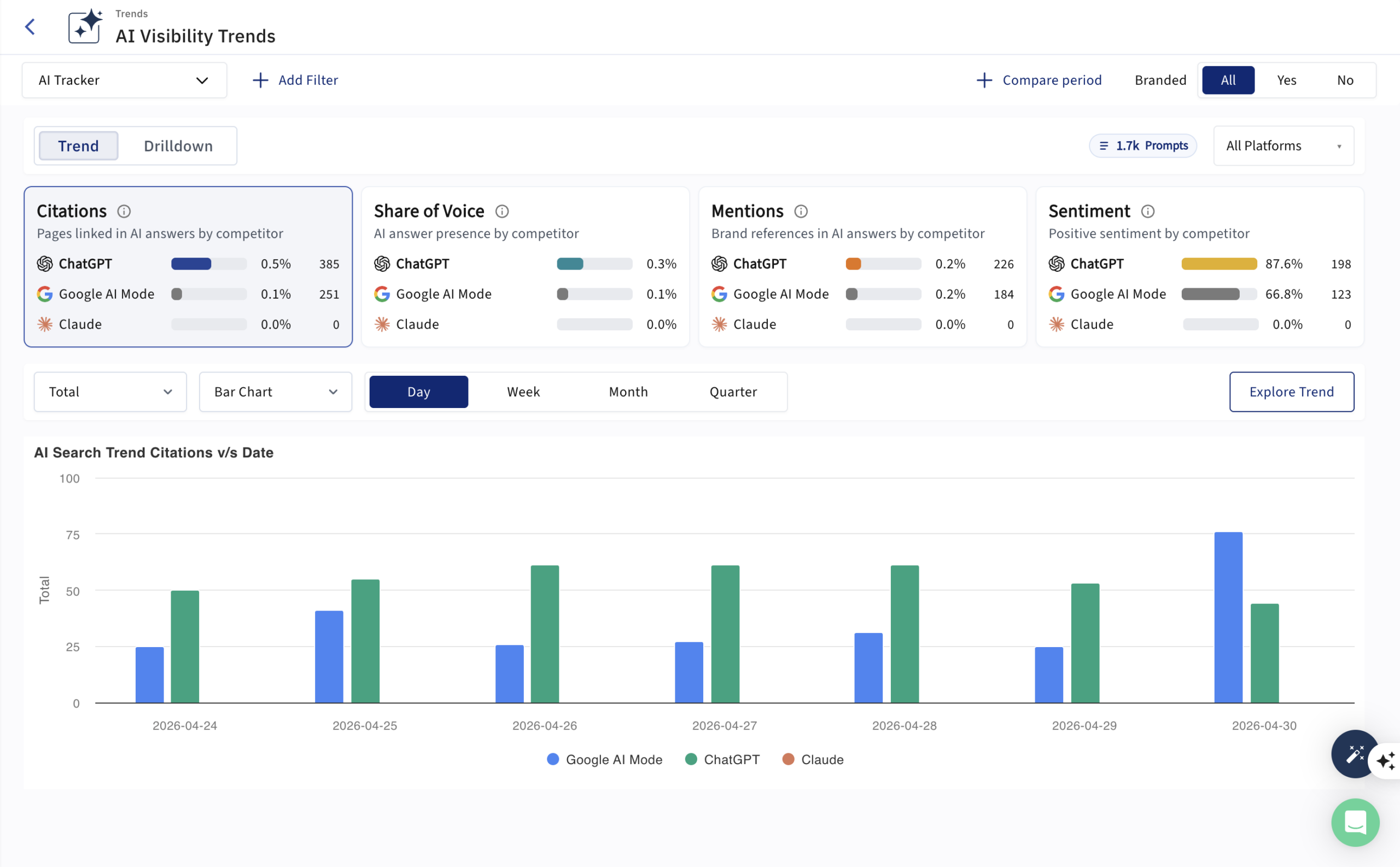
Quattr makes this easy by bringing everything into one unified dashboard. Many tools only let teams analyze one platform or one metric at a time, making it difficult to understand the complete picture. Quattr helps businesses see all the metrics across multiple AI models in a single view. Teams can also drill deeper into prompts, cited URLs, intent groups, etc., without rebuilding filters every time.
The platform is designed to be fast, simple, and practical for both executives and SEO teams. Instead of manually checking different AI platforms and combining reports, businesses can quickly understand their AI citation share, where they are gaining visibility, where competitors are outperforming them, and which content is driving AI citations. What belongs in that readout, and what each figure can and cannot tell you, is set out in the AI visibility report reference. As AI search continues growing, having one place to measure and understand AI visibility will become increasingly important for modern brands.
FAQs
More users now get answers directly from AI tools instead of clicking websites, making AI visibility critical for brand discovery and awareness.
Yes, because AI systems evaluate content differently and may not surface brands that only optimize for traditional SEO rankings.
AI visibility measures how often and how prominently a brand appears in AI-generated answers, citations, and recommendations across platforms.
Brands with clear, trustworthy, and well-structured content are more likely to be repeatedly selected and referenced by AI systems.
Strong AI visibility can improve brand awareness, trust, qualified traffic, and customer consideration during the research journey.

Quattr is an AI-native Search Visibility Platform founded in Palo Alto, California, built for mid-market and enterprise brands competing in the age of generative search. Recently recognized across G2's Spring 2026 reports with #1 rankings in AEO Results, Usability, and Relationship, Quattr helps brands win visibility across traditional search and AI-generated answer surfaces.
Quattr's AI agent, GIGA, evaluates content the way AI systems do, identifying gaps across structure, authority, internal linking, and discoverability to surface the highest-impact fixes. With capabilities like autonomous internal linking, E-E-A-T intelligence, and the new GIGA Landing Page Generator for keyword-matched, AI-search-ready pages, Quattr helps teams move from diagnosis to deployed changes without manual bottlenecks.