

Key Takeaways
- Google processes more than 5 trillion searches per year, showing the massive scale of online search today.
- Search engines handle roughly 13-16 billion searches per day , highlighting how deeply search is embedded in everyday behaviour.
- Research shows that nearly 60% of Google searches now end without a click, as users increasingly get answers directly on the search results page.
- At the same time, search has evolved from simple keyword matching to smarter AI-driven systems that understand meaning, context, and user intent.
- AI-powered search is changing how people discover information by delivering faster, more direct answers instead of just lists of links.
- Because of this shift, content today needs to be clear, trustworthy, useful, and easy for both users and AI systems to understand.
- Visibility is no longer only about ranking first on search engines. It is about creating content that search engines and AI systems trust enough to surface as part of the answer itself.
As a result, search today looks very different from what it did just a few years ago.
For years, search was mostly about matching keywords better than competitors. Find the right terms, build pages around them, rank higher, and capture traffic. The system was relatively predictable.
But search does not work like that anymore.
Modern search engines are no longer just scanning for repeated phrases. They are interpreting intent, evaluating trust, understanding relationships between topics, and deciding whether content is reliable enough to become part of the answer itself.
This evolution has completely changed how content needs to be created. Strategies focused only on keywords and rankings are no longer enough.
To stay visible today, content must genuinely help users, answer questions clearly, and demonstrate expertise and trustworthiness.
You can already see this shift in the way Google is expanding its AI-powered search experience. As Elizabeth Reid recently explained, newer features like AI Mode and AI Overviews are focused on helping people explore topics more naturally while still surfacing original articles, trusted sources, and creator perspectives.
It’s another sign that search is becoming less about showing a list of links and more about helping users quickly understand and explore information.
To understand why this shift matters, it helps to look at how search evolved from simple keyword matching to understanding real user intent.
From Keyword Matching to Understanding Intent
Before modern search improvements, search engines mainly ranked pages based on how many times a keyword appeared and how many links pointed to the page.
To rank higher, many publishers started stuffing pages with repeated keywords instead of creating genuinely useful content.
Google’s 2011 Panda update changed that dynamic permanently. Panda penalized thin, repetitive content and rewarded depth and originality.
Two years later, the Hummingbird algorithm introduced semantic search, shifting evaluation from individual words to the meaning behind a query. A search for “best way to treat a sprained ankle” was now understood as a medical question, not a collection of isolated terms.
The shift mattered because it forced content to become genuinely useful rather than technically optimized.
Publishers who had relied on keyword density as their primary strategy had to reconsider the substance of what they were publishing and the content industry began its slow pivot toward quality over volume.
This shift laid the foundation for the way modern search engines work today.
How Modern Search Works Today?
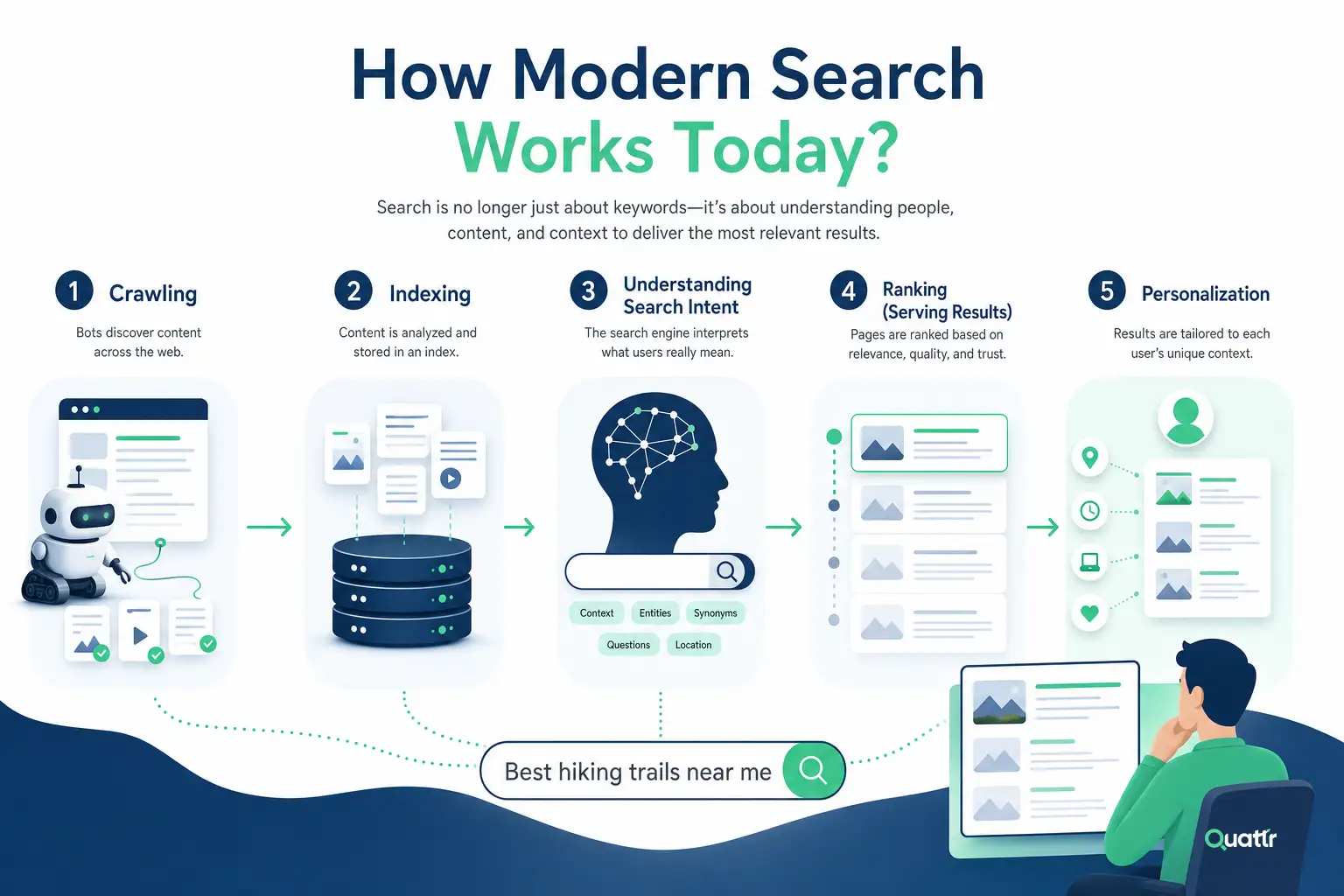
Search engines do not create results from scratch every time you search. They constantly scan and organize information from across the web, so a database of web pages is already ready when you type a query.
Here’s how modern search works:
1. Crawling – Discovering New Content
Search engines use automated bots (called crawlers or spiders) to explore websites. These bots follow links, find new pages, and revisit existing ones to check for updates.
This process runs continuously, not just at the time of a search.
2. Indexing – Storing and Understanding Content
Once a page is discovered, search engines analyze its content, headings, images, videos, and structure and store it in a large database called the index.
This indexed content is what search engines use later to show results.
3. Understanding Search Intent
When a user searches, AI systems try to understand the meaning behind the query.
For example, “best laptop for students” is interpreted as a need for recommendations and comparisons, not just pages containing those exact words.
4. Ranking – Choosing the Best Results
After understanding the query, search engines retrieve relevant pages from the index and rank them based on factors like:
- Relevance to the search
- Content quality
- Authority and trust
- User experience
- Page speed
- Freshness
- Location and device
The goal is to show the most useful and reliable results first.
5. Personalized Search Results
Search results are often personalized. Two people searching the same query may see different results based on their location, language, device, or search history.
For example, “coffee shop near me” will show different results in different cities.
Together, these steps work continuously in the background to deliver fast and relevant search results. What users see on the screen is the output of this constant cycle of discovery, understanding, and ranking.
How AI is Changing Content?
AI is reshaping the way content is discovered, ranked, and shown in search results. Today, content performs better when it answers questions clearly, delivers real value, and is easy for both users and AI systems to understand.
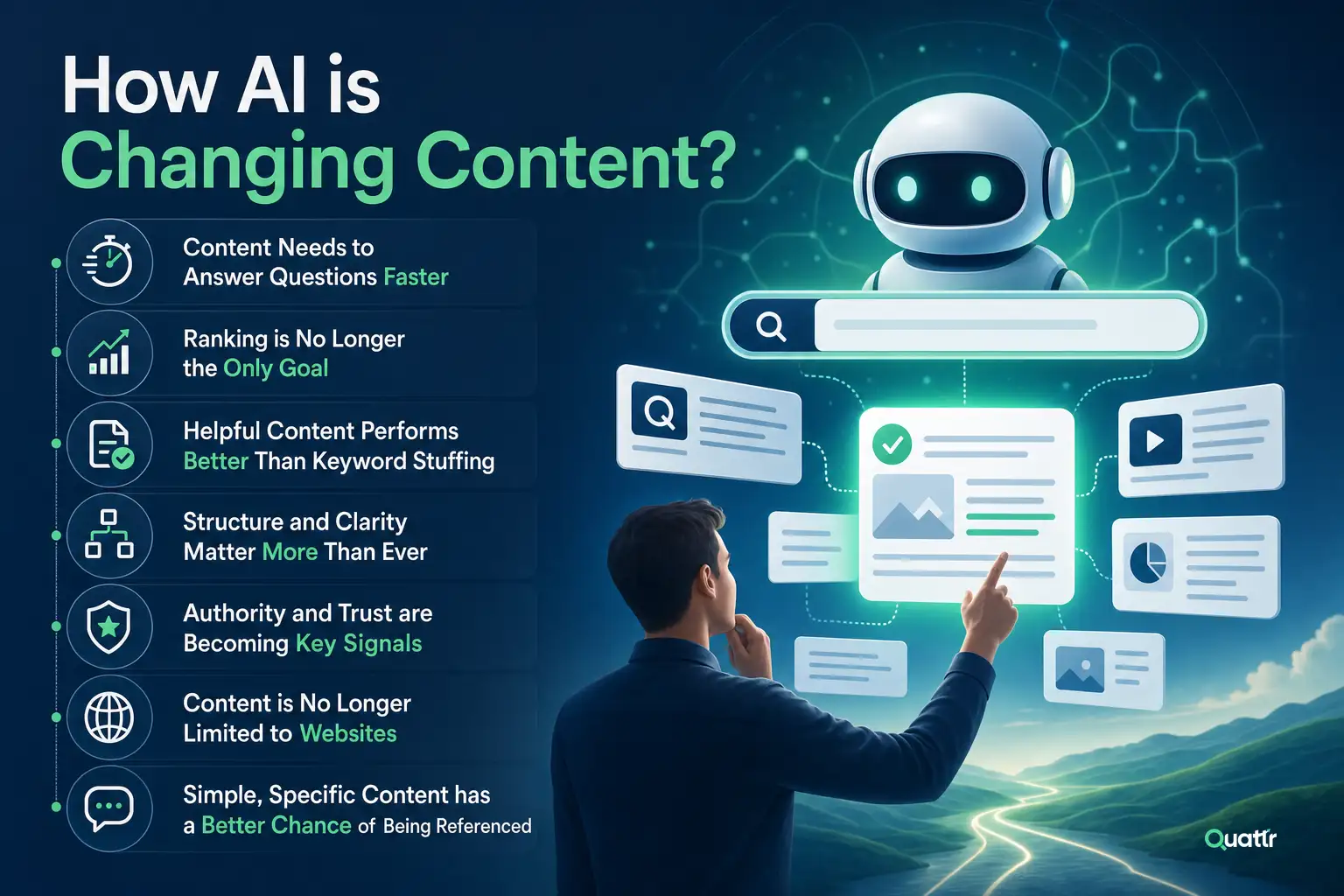
1. Content Needs to Answer Questions Faster
People no longer want to go through multiple pages to find information. AI-powered search tools now give direct answers instantly, which means content needs to be clear, direct, and easy to understand from the beginning.
2. Ranking is No Longer the Only Goal
Traditional SEO still matters, but simply ranking on Google is no longer enough. Today, content also needs to be good enough for AI systems to reference in summaries and answers. Visibility is shifting from “being found” to “being chosen.”
3. Helpful Content Performs Better Than Keyword Stuffing
Modern AI systems focus more on quality and usefulness than keyword repetition. Content that clearly explains a topic, answers real questions, and provides trustworthy information has a much better chance of appearing in AI-generated results.
4. Structure and Clarity Matter More Than Ever
AI tools prefer content that is easy to scan and understand. Short paragraphs, clear headings, direct explanations, bullet points, and simple language help both users and AI systems process information faster.
5. Authority and Trust Are Becoming Key Signals
AI systems now prefer content that feels helpful, trustworthy, and based on real experience. That is why Google’s shift from E-A-T to E-E-A-T was an important update, something Lily Ray has highlighted while discussing search quality improvements.
6. Content is No Longer Limited to Websites
Search now includes information from social media, forums, videos, and other platforms. This means brands and creators need to think beyond blog posts and create useful content across different channels.
7. Simple, Specific Content Has a Better Chance of Being Referenced
Generic writing is less likely to appear in AI answers. Content that includes clear facts, direct explanations, and specific insights is easier for AI systems to understand and surface in search results.
The Future of Search Belongs to Helpful Content
Search today rewards content that is clear, useful, and easy to understand, not just content filled with keywords. As AI-driven search grows, brands need content that answers real questions, explains topics clearly, and helps users find information easily.
Quattr helps brands improve content for modern search. The GIGA agent identifies missing topic coverage, improves readability, and suggests internal links to build stronger topical authority. Quattr’s AI Visibility Tracking feature helps brands measure how their content is performing across AI-powered search experiences and track how often their brand appears in AI-generated results, helping teams understand and improve visibility beyond traditional rankings.
FAQs
Search has moved from showing a list of links to giving direct answers using AI. It now focuses more on meaning and intent than just keywords.
Yes, SEO is still important, but it is not enough on its own. Content now also needs to be clear, helpful, and structured for both users and AI systems.
Content that is simple, easy to understand, and directly answers user questions performs better. Clear structure and useful information are key.
Because AI often shows answers directly on the search page, users don’t always need to click on websites for basic information.
Brands need to create helpful content that is trustworthy, well-structured, and focused on real user intent.

Quattr is an AI-native Search Visibility Platform founded in Palo Alto, California, built for mid-market and enterprise brands competing in the age of generative search. Recently recognized across G2's Spring 2026 reports with #1 rankings in AEO Results, Usability, and Relationship, Quattr helps brands win visibility across traditional search and AI-generated answer surfaces.
Quattr's AI agent, GIGA, evaluates content the way AI systems do, identifying gaps across structure, authority, internal linking, and discoverability to surface the highest-impact fixes. With capabilities like autonomous internal linking, E-E-A-T intelligence, and the new GIGA Landing Page Generator for keyword-matched, AI-search-ready pages, Quattr helps teams move from diagnosis to deployed changes without manual bottlenecks.