

Key Takeaways
- It shows how often AI tools choose your brand in answers. It matters more than just being seen in search results.
- Brands with community mentions are more likely to be cited, especially when people talk about them on platforms like Reddit or Quora.
- AI tools avoid content they cannot verify, so if your data is not clear or backed by evidence, your chances of getting cited drop quickly.
Today citations do more than just show your presence; they help bring traffic, build trust and drive real results. But in the world of AI, being cited once isn’t enough. What really counts is how often your brand shows up across different queries and platforms.
That is where AI Citation Share becomes important. Just like we used to track Share of Voice to measure visibility in traditional search and media, AI Citation Share helps you understand your true presence in AI-generated answers.
It shows whether your brand is consistently being chosen as a trusted source. The more often you are cited, the stronger your authority becomes, and the more likely you are to win over competitors in this new AI-driven search landscape.
In this blog, we’ll break down what AI Citation Share really is, how you can calculate it, and practical ways to improve it so your brand stays visible in the new AI-driven search landscape.
Citation Share is a simple way to understand how often your brand shows up compared to others. It measures how many times your brand, website, or content is mentioned within a set group of sources.
In easy terms, it is your share of all mentions. If there are 100 total mentions and your brand appears 20 times, your citation share is 20%. This helps you see how visible and influential you are compared to competitors.
In SEO and AI search, this becomes even more important. It shows how often your content is picked in search results or AI-generated answers versus other sources.
To make this metric actionable, the next step is understanding how to calculate it accurately.
AI Citation Share = (Your Citations ÷ Total Citations) × 100
Steps
i. Collect AI-generated answers for your target queries.
ii. Count how many times your brand/content is cited as a source (with attribution or link).
iii. Count the total number of citations across all answers.
iv. Apply the formula.
This gives you a clear view of your visibility as a trusted source. Now let’s understand how this differs from share of voice.
| Aspect | Share of Voice (SOV) | AI Citation Share |
|---|---|---|
| What it measures | How often your brand appears in search results or media | How often your brand is chosen and cited by AI tools |
| Focus | Visibility | Authority and trust |
| Where it applies | Traditional SEO, ads, media coverage | AI search tools and generated answers |
| Number of results shown | Many results (pages of links) | Very limited (usually 3-10 sources) |
| Competition style | Broad and distributed | Highly concentrated and zero-sum |
| Content preference | Can include brand-owned content | Strong bias toward third-party, trusted sources |
| User behavior | Users choose what to click | AI chooses sources for the user |
| Impact | Drives awareness and traffic | Drives trust, clicks, and conversions |
| Winning factor | Ranking higher than competitors | Being selected as a credible source |
| Key takeaway | Being visible is enough | Being trusted and cited is everything |
This shift shows that visibility alone is no longer enough in an AI-driven world. To win, your brand must be trusted and consistently chosen as a reliable source. Now let’s look at the different ways AI citations actually appear.
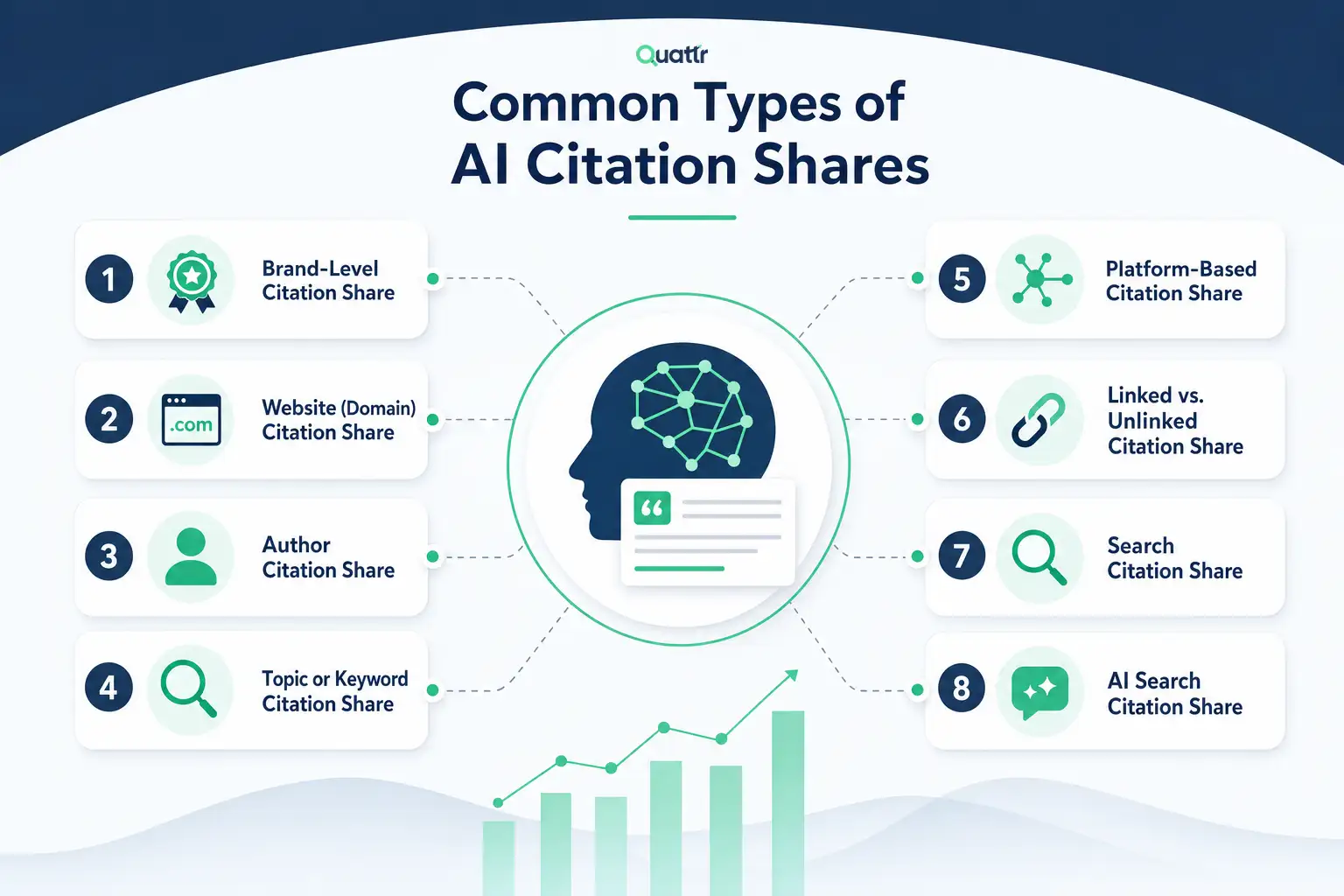
Citation share can be looked at from multiple angles, each helping you understand visibility and authority in a different way. Here are the key types:
1. Brand-Level Citation Share
Shows how often a specific brand or company is mentioned compared to others within the same industry or topic.
2. Website (Domain) Citation Share
Measures how frequently a particular website is referenced across all sources within a defined topic or competitive space.
3. Author Citation Share
Tracks how often a specific writer, creator, or expert is cited compared to others.
4. Topic or Keyword Citation Share
Focuses on how often content related to a specific topic or keyword group is mentioned.
5. Platform-Based Citation Share
Breaks down where citations are coming from, such as blogs, news websites, social platforms, or forums.
6. Linked vs. Unlinked Citation Share
Compares mentions that include a clickable link to those that only reference the name without linking.
7. Search Citation Share
Measures how often a source appears in both traditional search results and answer-based search features for a set of queries.
8. AI Search Citation Share
Specifically tracks how often a brand, website, or content is cited in AI-generated responses across platforms like ChatGPT or other AI tools.
Understanding these different types helps you analyze where your visibility is coming from next, let’s see how to interpret changes in citation share over time.
When looking at AI citation share, it’s important to focus on patterns, not one-time changes. AI tools do not show the same sources every time. They keep changing results, so small drops or spikes are normal. If your visibility goes down for a short time and then comes back, it usually is not a problem.
What really matters is how quickly you recover. If your content disappears and takes a long time to show up again, it may mean your authority is getting weaker. This can happen if your content is outdated, you have fewer mentions from other sites, or competitors are getting stronger.
It’s also important to understand that inconsistency is part of how AI works. Not all content appears in every answer, even if it is strong.
Instead of reacting to every small change, focus on a few key signals:
- How often your content comes back after it drops
- Whether your brand appears across different AI platforms
- Whether your visibility is growing or declining over time
The key idea is simple: treat citation share as a trend, not a daily score. What matters is steady presence and how reliably your content keeps showing up.
Understanding these patterns helps you ignore short-term noise. Now let’s explore why this metric matters even more in the AI-driven world.
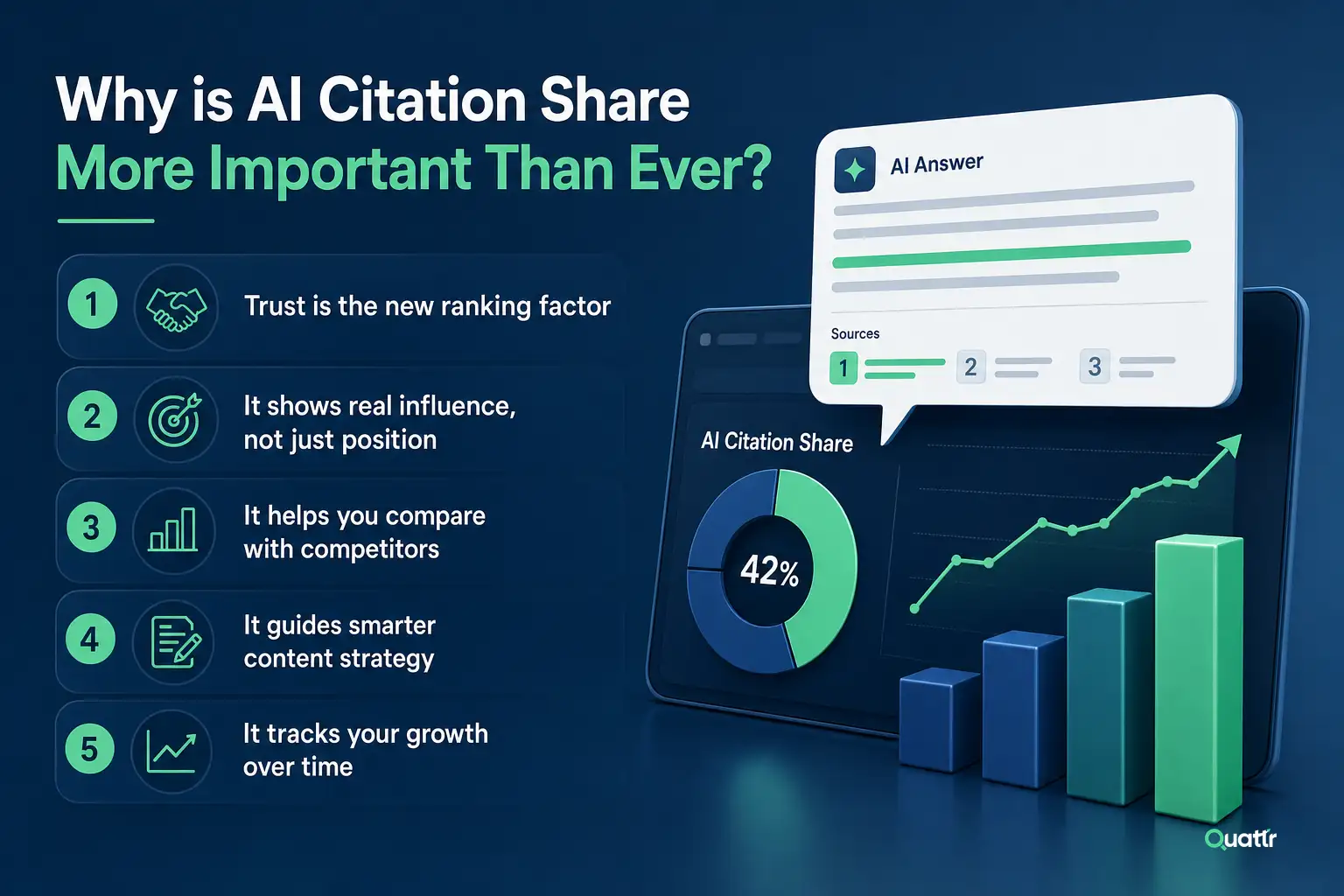
Search is no longer just about showing a list of links. AI now gives direct answers, and your visibility depends on whether your content is included in those answers. That’s why AI Citation Share is becoming a must-track metric.
1. Trust is the new ranking factor
AI tools pick sources they trust. If your content is cited, it means AI sees it as reliable.
2. It shows real influence, not just position
Rankings tell you where you appear. Citation share tells you if your content is actually being used.
3. It helps you compare with competitors
Since it is a percentage, you can clearly see how you perform against others targeting the same topics.
4. It guides smarter content strategy
You can spot where competitors are getting cited and you are not, helping you plan better content and outreach.
5. It tracks your growth over time
You can see if your visibility in AI answers is increasing, stable, or dropping.
AI Citation Share also works as an early signal of authority. It shows which brands AI is starting to trust, often before you see changes in traffic or rankings. That’s why tracking it is not optional anymore, it’s a high-impact priority.
If you are not measuring and improving your AI Citation Share, you risk missing where real visibility is shifting.
This makes it clear why AI Citation Share matters. Now let’s look at how you can track and improve it effectively.
Turn AI Visibility into a Clear Advantage with Quattr
Tracking AI Citation Share across different platforms can feel messy and unclear. Quattr’s AI Visibility Dashboard brings everything together in AI visibility is no longer just about being present, it’s about how consistently your brand shows up across platforms.
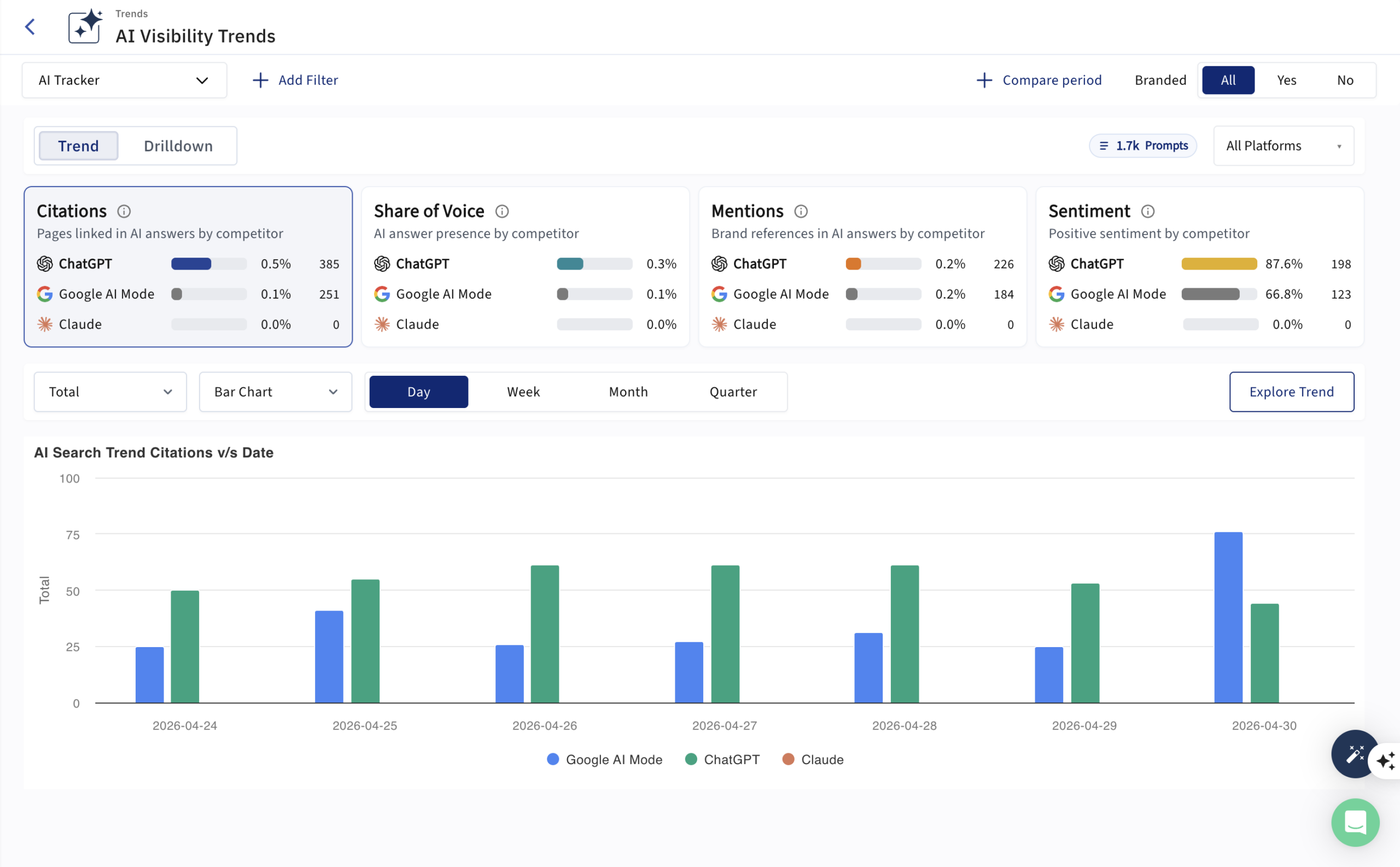
When you track trends over time, patterns start to emerge. You can see which platforms favour your content, where competitors are gaining ground, and how your visibility is shifting day by day. These insights help you move from guesswork to clear action.
By focusing on metrics like citation share, mentions, and sentiment together, you get a complete picture of your AI performance. This allows you to improve content, strengthen authority, and stay ahead of competitors.
In short, Quattr turns scattered data into clear insights, helping you understand your AI visibility and improve it with confidence.
Frequently Asked Questions
AI Citation Share shows how often your content is used as a source in AI-generated answers compared to others. It helps you understand your visibility in AI results.
2. How is AI Citation Share different from rankings?
Rankings show where your page appears in search results, but AI Citation Share shows if your content is actually used in answers. It focuses more on trust than position.
3. Why is AI Citation Share important?
Because AI tools are giving direct answers, being cited means your content is visible even without clicks. It shows your authority and influence in your niche.
4. How can I improve my AI Citation Share?
Create clear, helpful, and well-structured content, build authority through mentions and backlinks, and make sure your pages directly answer user questions.
5. How do I track AI Citation Share?
You can manually check AI answers or use Quattr which helps you track your brand’s citations across platforms like ChatGPT, Google AI etc.

Quattr is an AI-native Search Visibility Platform founded in Palo Alto, California, built for mid-market and enterprise brands competing in the age of generative search. Recently recognized across G2's Spring 2026 reports with #1 rankings in AEO Results, Usability, and Relationship, Quattr helps brands win visibility across traditional search and AI-generated answer surfaces.
Quattr's AI agent, GIGA, evaluates content the way AI systems do, identifying gaps across structure, authority, internal linking, and discoverability to surface the highest-impact fixes. With capabilities like autonomous internal linking, E-E-A-T intelligence, and the new GIGA Landing Page Generator for keyword-matched, AI-search-ready pages, Quattr helps teams move from diagnosis to deployed changes without manual bottlenecks.