

Key Takeaways
- SEO drives rankings and organic traffic on traditional search engines. AEO gets your content cited as a direct answer by AI engines like ChatGPT, Gemini, and Perplexity, often without a single click.
- AI platforms heavily favor already-trusted domains. Most answer engines retrieve information from sources that already rank well in traditional search, meaning strong SEO foundations directly influence which brands get cited in AI-generated answers.
- SEO rewards depth and keyword coverage. AEO rewards clarity, structure, and extractability, concise, well-organized answers that AI can lift and use without needing the full page.
- More than 65% of searches now end without a click. Optimizing only for rankings means you’re invisible in an increasingly large share of search interactions.
- It’s not either/or. AEO isn’t replacing SEO, it’s extending it. The smartest practitioners aren’t choosing between the two; they’re building workflows that optimize for both simultaneously.
SEO gets you ranked. AEO gets you answered. Both determine whether your brand shows up when it matters, but they’re playing completely different games.
A scenario you’ve probably already lived: you optimize a page, and it climbs to position one on Google. Traffic looks fine. Then someone on your team asks ChatGPT the exact query you’re ranking for, and a competitor’s brand gets cited instead. Your page doesn’t appear at all. You ranked. You just didn’t get an answer.
That’s the gap between SEO Vs AEO in one sentence.
SEO has always been about earning your place in a ranked list of links. AEO is about earning your place inside the answer itself, in Google AI Overviews, ChatGPT responses, Perplexity citations, and voice results.
Two very different surfaces, two very different content strategies, and increasingly, two very different sets of winners.
What makes this tricky for SEO practitioners is that the signals overlap, but they don’t align. AI consistently prioritizes domains with strong backlinks and authority, but it often pulls deeper subpages, blog posts, or documentation rather than the exact URLs ranking at the top of Google. You can have all your SEO fundamentals locked in and still be invisible in AI search.
This guide breaks down exactly how AEO and SEO differ, where they reinforce each other, and what it actually takes to win visibility on both fronts in 2026.
What Is SEO? (And Why It Still Matters)
Search engine optimization is the practice of earning organic visibility on traditional search engines. It works across three layers: technical health (crawlability, speed, Core Web Vitals), on-page content (keywords, structure, internal linking), and off-page authority (backlinks, brand mentions, editorial citations). When all three are firing, the compounding effect is real.
Simpplr is a clean example of what this looks like in practice. Before they invested in SEO, over 55% of their non-brand traffic came from paid. By optimizing 200+ existing pages, building topical content hubs through smart internal linking, and aligning SEO with their paid data, they doubled non-brand organic traffic year-over-year and became the #1 organic player in the employee intranet software space. Paid reliance dropped below 30%. That growth didn’t come from publishing more. It came from making existing content work harder.
That’s what mature SEO execution looks like.
What’s changed isn’t the fundamentals; it’s the finish line. A first-page ranking today shares the screen with AI Overviews, featured snippets, People Also Ask boxes, and knowledge panels. Over 65% of Google searches now end without a click. Ranking is still essential. It’s just no longer enough on its own.
That’s the gap AEO fills.
What Is AEO? (And Why It’s Not Optional Anymore)
Answer Engine Optimization is the practice of structuring your content so AI-powered platforms, such as ChatGPT, Google AI Overviews, Perplexity, and Microsoft Copilot, can understand it, trust it, and surface it as a direct answer to a user’s question.
Where SEO is about ranking, AEO is about being cited. The goal isn’t position one. It’s being the source the AI quotes.
The stakes are tangible. Over 400 million people use OpenAI products every week. Traffic from AI search converts at 4.4x the rate of traditional organic. This isn’t a future trend; it’s the environment your content is competing in right now.
What makes AEO mechanically different from SEO is how AI engines actually work. They’re not matching keywords to indexed pages. They’re running queries through Large Language Models trained to predict the most accurate, relevant, and trustworthy response. Most also use Retrieval Augmented Generation (RAG), pulling live information from trusted sources before generating an answer. That’s how Perplexity and Google AI Overviews stay current and cite specific URLs.
Practically, your content needs to clear two bars to get cited. First, trustworthiness, domain authority, backlink profile, factual accuracy, and how often you’re referenced elsewhere. Second, extractability: Is your content structured so that an AI can lift a clean, direct answer from it? Clear headings, answers up front, schema markup, conversational language.
AEO isn’t about abandoning what works in SEO. It’s about making sure the content you’ve already built is eligible to be cited, not just ranked.
AEO VS SEO: Core Differences
The easiest way to understand the gap is to think about the unit of optimization.
In SEO, you’re optimizing a page. In AEO, you’re optimizing a passage. AI doesn’t read your full article before deciding whether to cite you. It scans for the chunk that most directly answers the question, evaluates whether it’s trustworthy, and either uses it or moves on.
That one shift has downstream implications for everything: how you write, how you structure, and what you measure.
Here’s how the two strategies compare across the dimensions that actually matter:
Key Differences Between AEO & SEO
| Aspects | SEO | AEO |
|---|---|---|
| Primary goal | Rank high in traditional SERPs | Be cited as a direct answer in AI-generated results |
| How results appear | Multiple ranked links on a SERP | One synthesized answer with source credits |
| Unit of optimization | Full page | Specific passage or chunk |
| Content approach | Depth, keyword coverage, internal linking | Clarity, structure, extractability |
| Key signals | Backlinks, keyword relevance, technical health | Domain authority, schema, E-E-A-T, entity clarity |
| Success metrics | Rankings, organic traffic, CTR | AI citations, brand mentions, share of voice |
| User journey | Search → click → visit site | Question → AI answer → source mention (or no click) |
A few of these rows deserve more than a table cell.
On content approach: SEO rewards comprehensiveness. AEO rewards precision. A 3,000-word guide can rank well on Google and still be completely ignored by AI if the answers are buried in paragraphs five and six. The fix isn’t shorter content, it’s an answer-first structure. State the answer in the first sentence of each section, then support it.
On metrics: This is where most teams get stuck. AI citations don’t show up in Search Console. There’s no equivalent to position tracking for ChatGPT. Right now, AI visibility analytics means setting up a GA4 custom channel to track AI referral traffic, monitoring your key queries manually, and using tools built for AI visibility tracking.
On user journey: The zero-click reality cuts both ways. You can lose the traffic you used to get from a ranking. But you can also earn brand visibility in AI answers for queries where you never ranked at all. AEO opens up surface area SEO couldn’t reach.
Strong SEO is what gets AI platforms to trust your domain enough to cite it. AEO is how you make sure the right content, structured the right way, is what they actually pull.
The difference becomes clearer when you compare how the same question appears in Google versus an AI answer engine.
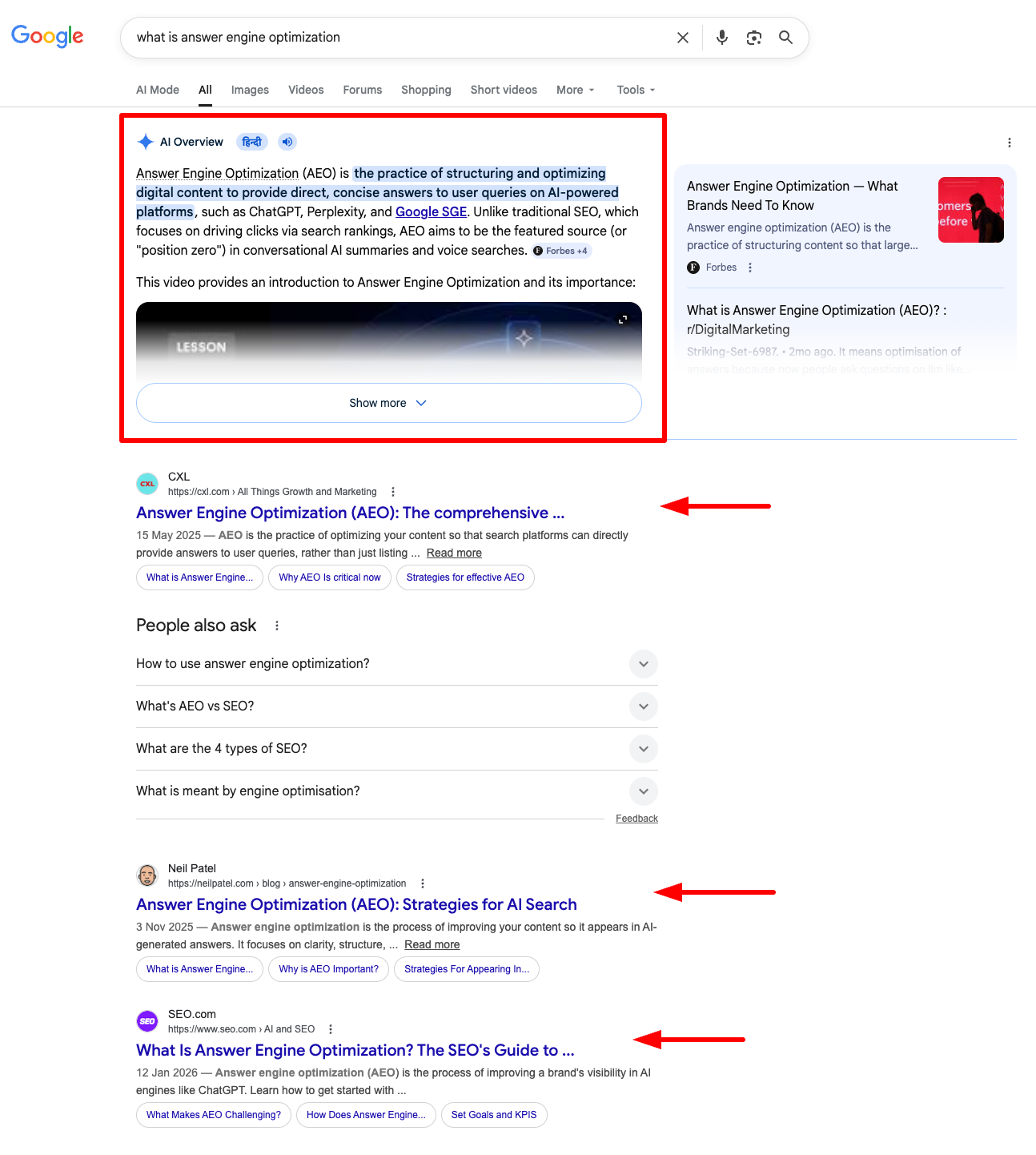
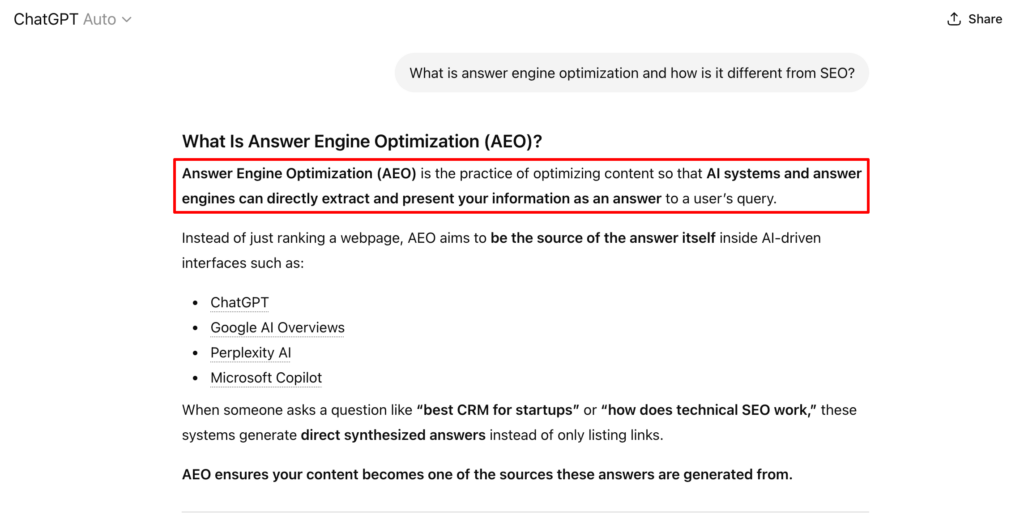
Where AEO Vs SEO Overlap
The most important thing to understand about AEO and SEO is that they share the same trust infrastructure.
AI platforms don’t build their own authority signals from scratch. They lean heavily on the web’s existing credibility layer — the same backlinks, domain authority, and topical depth that traditional search engines have rewarded for years. The data makes this concrete:
- 87% of ChatGPT Search citations come from domains already in Bing’s top 20
- 38% of Google AI Overview answers cite pages from Google’s top 10
- 70% of Bing Copilot answers are sourced from Bing’s top 20
- Perplexity pulls 60% of its cited answers from Google’s top 10
The implication is direct: if your SEO foundation is weak, your AEO ceiling is low. Domain authority isn’t just an SEO metric anymore; it’s the entry ticket for AI citation.
But here’s the nuance most practitioners miss. AI doesn’t simply promote your best-ranking page. It digs. It surfaces blog posts, documentation pages, FAQ sections, and subpages from within trusted domains that most directly answer the specific query, often pages that don’t rank in Google’s top ten at all.
This is actually good news if you know how to use it. A strong domain with well-structured content across multiple pages has more citation surface area than a strong domain with one optimized hero page. Depth compounds.
Simpplr’s trajectory illustrates this. Their SEO work didn’t just build rankings, it built the domain authority that made their content eligible for AI citation. The internal linking structure that connected 750+ pages wasn’t just an SEO tactic. It created the semantic network that AI engines use to understand a domain as a coherent, authoritative knowledge base rather than a collection of disconnected pages. You can’t separate the two outcomes. One infrastructure drove both.
The overlap also extends to content quality signals. E-E-A-T, Experience, Expertise, Authoritativeness, Trustworthiness, was Google’s framework long before AI search existed. It maps directly onto what LLMs reward. Named authors with real credentials, cited sources, original data, and factual accuracy; these signals matter to Google and to every AI platform pulling from the web.
Where SEO and AEO diverge is in what happens after trust is established. SEO rewards the page that best matches a query across the full set of ranking factors. AEO rewards the passage that most cleanly answers a specific question within a trusted domain. Same foundation, different finish line.
Build for both. The work isn’t doubled, it’s shared.
How to Win at Both: 5 Strategies for 2026
The good news is that most of what works for AEO builds directly on what you’re already doing for SEO. The adjustments are real, but they’re not a rebuild. They’re a layer.
1. Structure Content for Extraction
This is the single highest-leverage AEO change most teams can make without creating new content.
AI engines extract passages. They look for the section that most directly answers a question, evaluate whether it’s trustworthy, and lift it. If your answer is three paragraphs deep, buried under context and qualifications, the AI finds a source that leads with it instead.
The fix: answer first, explain second. Every H2 section should open with a direct 1-2 sentence answer to the question implied by the heading. Then support it. This structure serves human readers and AI extraction equally, and it’s the single fastest way to improve citation probability on existing content without a full rewrite.
Pair this with question-based headings, short scannable paragraphs, and FAQ sections for your most common queries. Schema markup, particularly FAQ, HowTo, and Article, adds a translation layer that makes your content’s structure machine-readable.
2. Build Topical Depth
A single optimized page is a start. AI engines evaluate your domain’s authority on a subject, not just one URL. A pillar page with no supporting cluster is a standalone signal. A pillar page connected to ten deep subtopic pages is a knowledge base.
CloudEagle’s AI Citation Share didn’t triple because one page got optimized. It tripled because 33 pages were semantically connected through demand-weighted internal linking, building a network that told AI engines this domain owns this topic. The internal linking wasn’t decoration. It was architecture.
Build content clusters. Interlink them with anchor text that reflects real buyer language, not generic keyword phrases. The goal is for AI to treat your domain as the authoritative reference on a topic, not a page that happens to mention it.
3. Earn Citations & Brand Mentions Beyond your Own Site
Being mentioned in industry publications, referenced in research, and cited by other credible sources does two things simultaneously: it builds the backlink profile that SEO needs, and it trains AI models to associate your brand with authority on a topic.
Unlinked mentions matter here in a way they never quite did in traditional SEO. LLMs process text. When your brand appears repeatedly across trusted sources, in articles, forums, research papers, and comparison pages, it becomes part of the web of associations the model draws on when generating answers. You don’t need the link to register that signal.
Original research is the highest-leverage tactic for earning both. Proprietary data, internal benchmarks, original studies, these get cited because they’re uniquely attributable. Generic, widely-repeated information is already in every LLM’s training data. What they can’t get elsewhere is yours.
4. Demonstrate E-E-A-T Explicitly
AI engines don’t infer credibility. They look for signals. Named authors with real bios. Credentials stated clearly. Sources cited. Facts are accurate and current. “Last updated” dates visible.
Generic surface-level content struggles in AEO even when it ranks in traditional SEO, because ranking is about relevance, while citation is about trust. The bar is different.
Audit your highest-traffic pages: is it clear who wrote this, why they’re qualified, and when it was last verified? If not, that’s your starting point. These aren’t cosmetic changes. They’re the signals AI uses to decide whether your content is worth repeating.
5. Keep Content Fresh
RAG-based answer engines pull live information from trusted sources before generating a response. Outdated statistics, deprecated tools, or factual errors don’t just hurt your SEO; they actively signal unreliability to AI systems that are evaluating whether to stake their answer on your content.
Build a content audit cadence. Update statistics. Refresh examples. Add sections covering recent developments. Remove references to tools and practices that no longer exist. Add visible “last updated” dates; it’s a trust signal for both AI and human readers.
The pages most worth auditing first aren’t your lowest performers. They’re your highest-traffic pages that haven’t been touched in 12+ months. Those are the ones with the most citation potential and the most staleness risk.
How to Measure AEO Vs SEO Success
SEO measurement is well-understood. Rankings, organic traffic, CTR, domain authority, the tooling is mature, and the metrics are standardized. AEO measurement is not. There’s no Search Console equivalent for AI citations. No position tracking for ChatGPT. And AI responses vary by user, context, and conversation history, which makes consistent benchmarking genuinely hard.
That doesn’t mean you’re flying blind. It means you measure differently.
SEO Metrics (The Familiar Ones)
Keep tracking what you’ve always tracked: keyword rankings, organic traffic by page, click-through rate, domain authority, and Core Web Vitals. These haven’t become less important; they’re the foundation that makes AEO possible. What changes is how you interpret them. A page holding position one while organic clicks decline isn’t a ranking success. It’s an early signal that AI is absorbing the query above it.
AEO Metrics (The New Layer)
AI referral traffic. Set up a GA4 custom channel group that separates answer engine traffic from standard referral using regex to filter sources like chatgpt.com, perplexity.ai, gemini.google.com, and copilot.microsoft.com. Do this before you start any AEO work; you need a clean baseline. Even small initial numbers matter. AI-referred visitors arrive with intent and convert at significantly higher rates than standard organic.
Citation monitoring. Build a list of high-intent questions your audience is asking. Run them regularly across ChatGPT, Perplexity, and Google AI Overviews. Log whether your brand is cited, mentioned, or absent. Track it over time. Not glamorous, but it’s ground-truth data that no third-party tool fully replicates yet.
AI visibility and share of voice. Platforms built specifically for AI citation tracking are maturing fast. They automate citation monitoring, provide competitive benchmarking, and surface trends across platforms. Most are still developing, but useful for directional insight at scale.
Featured snippet and AI Overview presence. AI models pull heavily from featured snippets. Winning these positions correlates strongly with citation probability; monitor them as a leading indicator.
The Measurement Mindset Shift
The most important change isn’t adding new metrics. It’s accepting that session volume and keyword rankings tell an incomplete story in a zero-click world.
A page that earns consistent AI citations for high-intent queries is building brand authority every time someone gets that answer, whether they click through or not. That compounding visibility doesn’t show up in your traffic dashboard. But it shows up when buyers already know your brand name by the time they reach your sales page.
Measure both. Weight them accordingly.
How Quattr Helps You Win Both
Most tools tell you where you stand. Quattr tells you what to do about it, and helps you do it, all in one place.
Winning at SEO and AEO simultaneously means managing a lot of moving parts: content quality, technical health, internal linking, citation tracking, and competitive benchmarking. Most teams end up stitching together three or four point solutions, each with its own dashboard, its own data model, its own workflow. The insight is fragmented. The execution is slow. And the AI search landscape doesn’t wait.
Quattr connects AI visibility tracking, content optimization, and technical site health into a single integrated workflow. When you identify a citation gap, you can diagnose the cause, optimize the content, and monitor the impact without switching platforms.
AI Visibility Tracking — Monitor citation and mention share across Google AI Overviews, ChatGPT, Perplexity, and Gemini. Track how your share of voice trends over time and benchmark against competitors for your most important queries.
Content Intelligence — Quattr analyzes existing content against both SEO and AEO ranking factors, structure, question alignment, topical depth, keyword relevance, and content freshness, and surfaces page-level recommendations tied to actual visibility gaps. Not generic best practices.
Internal Linking AI — Build the semantic content architecture that AI engines use to evaluate topical authority. Quattr’s autonomous internal linking connects pages based on real buyer intent, not keyword proximity. The same infrastructure that helped CloudEagle triple its AI Citation Share in 12 weeks.
Technical Health Monitoring — AI engines can only cite content they can access. Quattr continuously monitors for schema errors, indexability issues, and rendering problems before they become visibility problems.
Integrated Workflow — From spotting a citation gap to briefing a content update to tracking the result, everything lives in one place. No tab-switching. No coordination overhead.
The result is an SEO and AEO strategy that doesn’t just generate reports. It generates movement.
FAQs on AEO Vs SEO
No. AEO builds on top of SEO, it doesn’t replace it. A weak SEO foundation means a low AEO ceiling. The brands winning at AEO aren’t the ones that abandoned SEO. They’re the ones who did both.
SEO gets users to find your content through a ranked link. AEO gets your content cited as the direct answer in AI-generated responses. GEO goes deeper; it’s about shaping how AI models represent and recommend your brand across longer, multi-turn conversations. They’re not competing strategies.
Yes, and you should. A page with keyword depth, clear heading structure, answer-first writing, named authorship, and schema markup serves both channels simultaneously. The tactics aren’t in conflict. Answer-first structure improves readability for humans and extractability for AI.

Quattr is an AI-native Search Visibility Platform founded in Palo Alto, California, built for mid-market and enterprise brands competing in the age of generative search. Recently recognized across G2's Spring 2026 reports with #1 rankings in AEO Results, Usability, and Relationship, Quattr helps brands win visibility across traditional search and AI-generated answer surfaces.
Quattr's AI agent, GIGA, evaluates content the way AI systems do, identifying gaps across structure, authority, internal linking, and discoverability to surface the highest-impact fixes. With capabilities like autonomous internal linking, E-E-A-T intelligence, and the new GIGA Landing Page Generator for keyword-matched, AI-search-ready pages, Quattr helps teams move from diagnosis to deployed changes without manual bottlenecks.