

Key Takeways
- A mention means a model knows you exist. A citation means it trusts you enough to send users to your content.
- Citations drive traffic. Mentions drive awareness. They require different strategies and different measurements.
- Most teams aren’t tracking either one systematically, let alone both against competitors.
- Rankings and AI visibility are not the same problem. A page sitting at position 8 can outcite a page at position 1.
- Brand Visibility, Citation Rate, and Share of Voice are three separate KPIs. Treating them as one is where most AEO strategies break down.
An AI brand mention means a model named you. An AI citation means a model trusted you enough to send users to your content. Both show up in AI-generated answers, but they do completely different jobs, and conflating them is one of the most common mistakes practitioners are making right now in AEO strategy.
Mentions build presence. Citations build authority and drive traffic. You need both, but they require different inputs, different content strategies, and different measurement frameworks.
The problem is, most teams are tracking neither of them systematically. They’re noticing when a client shows up in a ChatGPT answer and calling it a win, without distinguishing whether that appearance came with a source link or was just a name drop in a list. That distinction determines whether AI search is delivering pipeline or just awareness.
The gap between the two is also widening. According to Gartner, traditional search engine volume will drop 25% by 2026 as AI-powered interfaces absorb more queries. Citation authority is increasingly decoupled from ranking position. That changes the optimization playbook significantly.
This post breaks down exactly what separates a mention from a citation, how to measure each, and what you actually need to do, technically and editorially, to move both metrics in the right direction.
What Is an AI Brand Mention (And Why It’s Not Enough)
AI brand mentions occur when a large language model references your brand by name inside a generated answer, no link, no source attribution, just recognition. A user asks ChatGPT for the best employee intranet software, and your brand appears in the list. That’s a mention. The model knows you exist, associates you with the category, and surfaces you as relevant. Nothing more.
That’s valuable, but it’s the floor, not the ceiling.
How LLMs decide what to mention comes down to training data density. Models are trained on a massive collection of public web content: news coverage, blog posts, forum discussions, review platforms, and social media. The more consistently your brand appears across those sources, and in the right context, the stronger the association the model builds between your name and your category. It’s less about any single piece of content and more about a cumulative signal across the web.
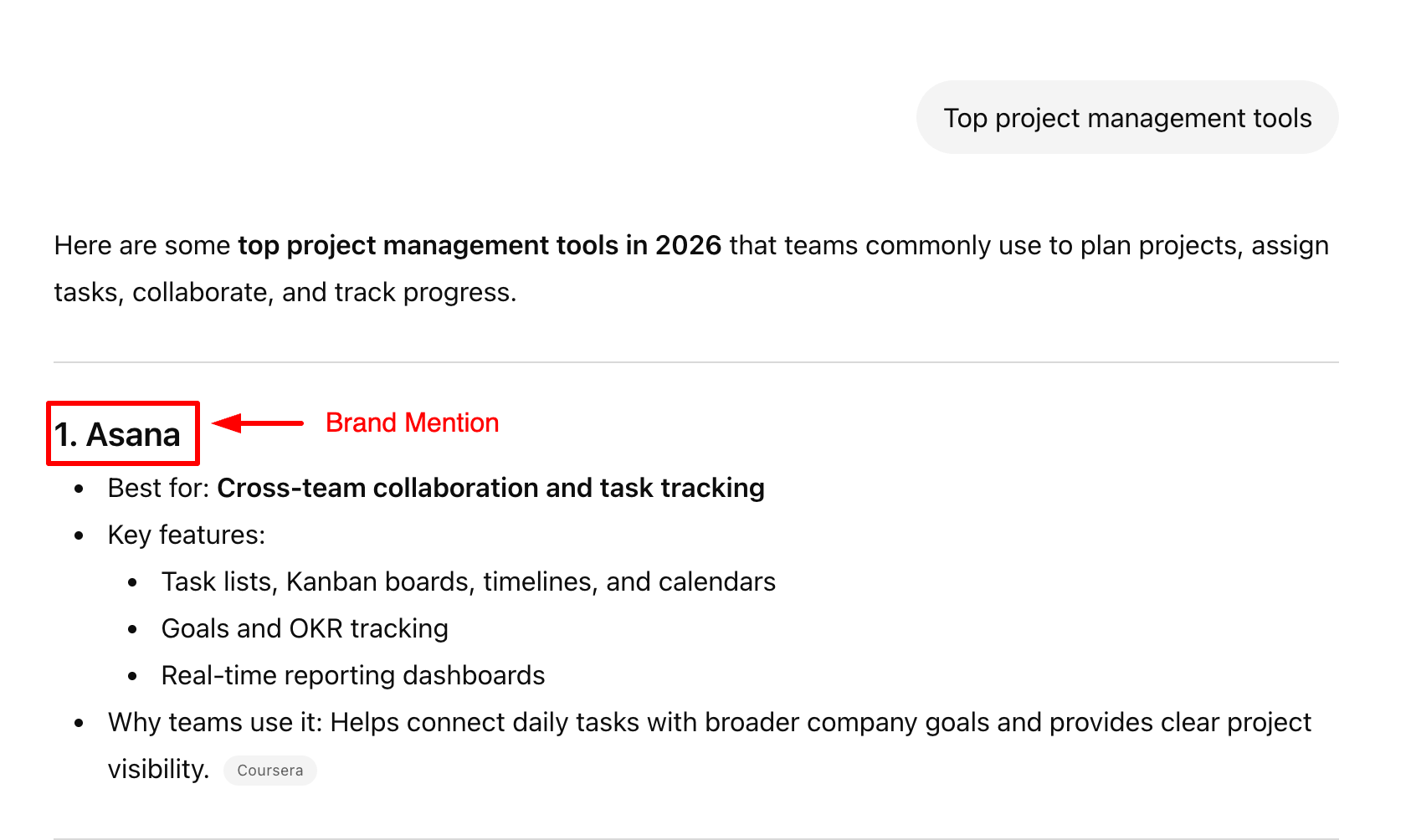
This is why PR, third-party reviews, community presence, and earned media aren’t soft brand plays anymore. They’re direct inputs into whether a model treats your brand as a recognizable entity in its category or leaves you out of the answer entirely.
What Mentions Actually Signal
A mention tells you the model has learned your brand exists and considers it relevant to a query. It’s a measure of mindshare, how present you are in the category conversation across AI platforms.
At scale, mentions matter. If your brand consistently surfaces when users ask about your category across ChatGPT, Gemini, and Perplexity, you’re shaping perception for a significant audience that may never click a traditional search result. That’s real reach.
But practitioners need to be clear-eyed on one thing: a mention without a citation is essentially brand awareness with no verifiable trust signal attached. The model named you, but it didn’t stake its credibility on your content. It didn’t point users to your site. It didn’t treat you as a source.
And in a world where AI answers are replacing the first scroll of search results, being named in a list is table stakes. Being cited as the source is the actual competitive advantage.
What Is an AI Citation (And Why It’s the New Backlink)
An AI citation is when a model doesn’t just name you, it points to your content as the source of its answer. A numbered footnote in Perplexity, a linked source card in Google AI Overviews, and an inline “According to [your site]” in a ChatGPT response. The model is telling the user: this is where this information comes from.
That’s a fundamentally different signal than a mention. The model isn’t just aware of your brand, it’s staking the credibility of its answer on your content. Think of it as the AEO equivalent of a high-authority backlink, except it’s embedded directly inside the answer a user reads before they ever see a search result page.
Seer Interactive analyzed 3,119 queries across 42 organizations and found brands cited in AI Overviews earned 35% higher organic CTR and 91% higher paid CTR compared to brands that weren’t cited on the same queries. That’s the business case for citations in a single number.
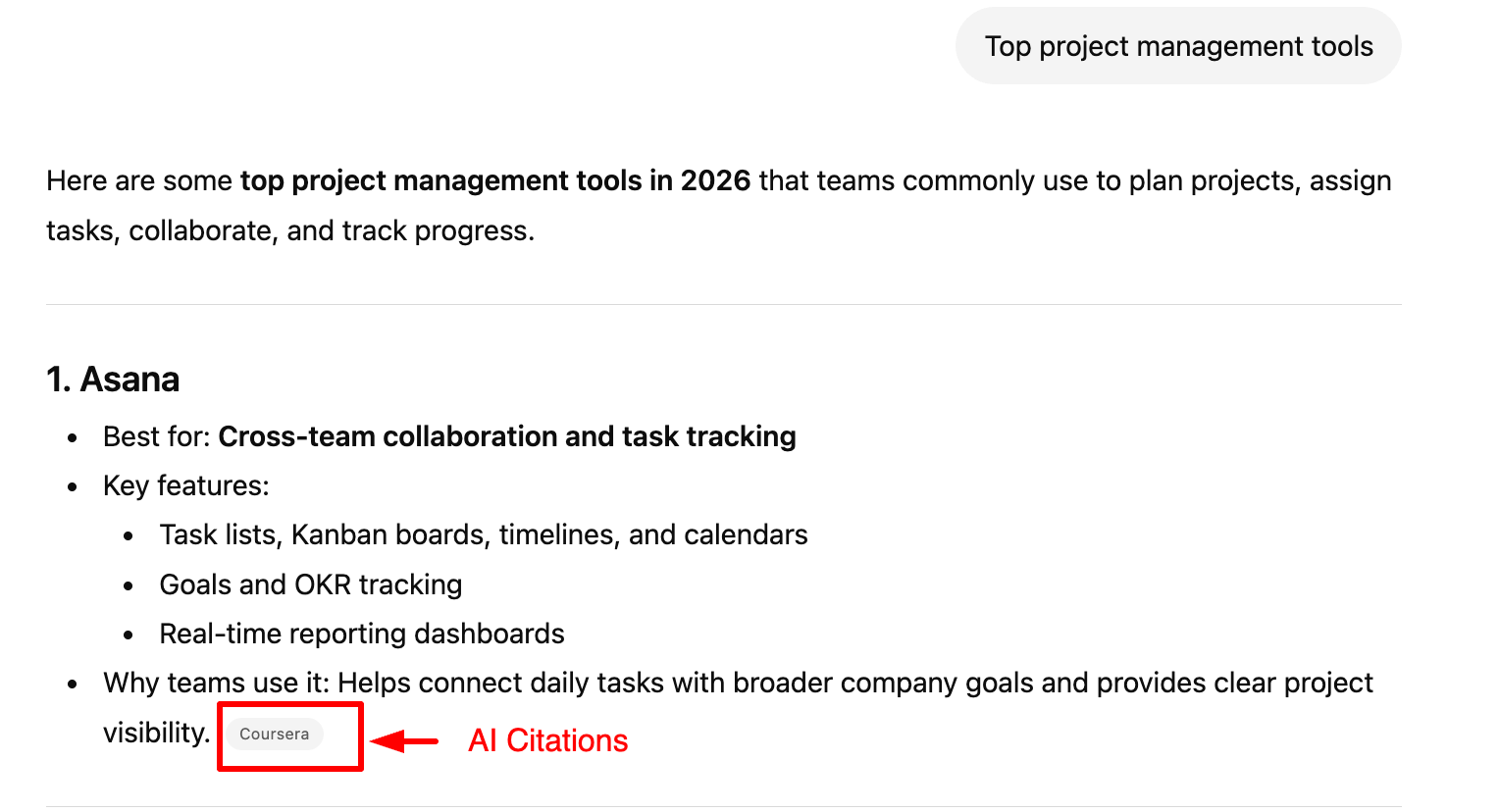
How LLMs Decide What to Cite
Citations go to content that answers a specific question directly, carries clear authorship signals, and demonstrates topical depth rather than surface coverage. Original research and proprietary data punch above their weight; a unique dataset gives the model something to attribute. Generic content that restates what’s already widely known gives it nothing to cite.
Schema markup reduces friction between your content and the model’s ability to trust it. An llms.txt file, the emerging standard for directing AI crawlers to your most important pages, is quickly becoming a baseline hygiene requirement.
The compounding effect matters too. The more your content gets cited, the more likely future model passes are to include it again. A brand with a 10% citation rate is building a durable asset. A brand with strong mentions but near-zero citations is renting attention without building equity.
Mentions vs. Citations: Comparison
The easiest way to internalize the difference is to think about what each signal actually requires from the AI model.
A mention requires familiarity. The model has seen your brand name often enough, in enough relevant contexts, to surface it as part of an answer. It’s a recognition signal, useful, but passive.
A citation requires trust. The model has evaluated your content, determined it’s the most credible source for a specific claim, and is willing to direct users there. That’s an active endorsement with accountability attached.
Here’s how they stack up across the dimensions that matter most for practitioners:
| Dimension | Brand Mention | AI Citation |
|---|---|---|
| What it signals | Brand familiarity | Content authority |
| Traffic impact | None directly | Direct referral potential |
| Optimization lever | PR, earned media, community presence | Content depth, schema, original research |
| Measurement KPI | Brand Visibility rate | Citation Rate/Share of Citation |
| Compounding effect | Moderate | High |
| Decoupled from rankings | Partially | Strongly |
The bottom row is the one most practitioners are underweighting right now. Both signals are increasingly independent of where you rank in traditional search, but citations especially so. A page sitting on position 8 with strong topical authority and clean structure can earn citations that a position 1 page never does.
That’s not an argument to deprioritize rankings. It’s an argument to stop assuming rankings and AI visibility are the same problem with the same solution.
How to Measure Both: Brand Visibility & Citation Rate
Before you can optimize either signal, you need a measurement framework that treats them as separate KPIs, because they are.
Brand Visibility measures the percentage of relevant AI answers where your brand is mentioned by name, with or without a link. AI Citation Rate measures the percentage of your content that is explicitly credited as a source, typically with a link or direct attribution.
The calculation is straightforward. Define 100 queries your audience is realistically running across ChatGPT, Gemini, and Perplexity. Run them, then track:
- How often your brand appears in the output → Brand Visibility rate
- How often those appearances include a direct source reference → Share of Citation or AI Citation Rate
If your brand appears in 40 of 100 answers, Brand Visibility is 40%. If 12 include a direct attribution to your pages, Citation Rate is 12%.
One measurement detail that matters: tracking needs to pull from actual consumer-facing AI responses, not API outputs. The two don’t always match. Quattr captures data directly from real consumer-facing AI responses, so the Brand Visibility, Share of Citation, sentiment, and competitor presence numbers reflect what your audience is actually seeing.
Where Share of Voice Fits In
AI Share of Voice is the percentage of relevant AI answers where your brand appears, mentions and citations combined, compared to competitors targeting the same queries. Neither Brand Visibility nor Citation Rate means much without it, because the benchmark is always relative.
- High visibility, low citation rate → content authority problem
- High citation rate, low visibility → distribution problem
Tracking both over time, against a defined competitor set, turns AI search into a concrete performance channel.
How to Grow Mentions Without Publishing New Content
Teams assume improving AI visibility means producing more content. It usually doesn’t, at least not at first. The bigger opportunity is making existing content work harder, and ensuring the signals AI models use to recognize your brand are consistent and dense enough to drive mentions.
The levers that move Brand Visibility are largely off-page:
- Earned media and press coverage — newsworthy appearances on reputable domains build the training data associations that make models recognize your brand as a category player
- Third-party review platforms — G2, Reddit, Trustpilot, and Quora are heavily indexed and consistently influence what LLMs associate with a brand name
- Community and discussion presence — participating in relevant conversations where your category is being debated puts your brand name in context, repeatedly, across sources models trust
- Consistent brand naming — using your full brand name across every touchpoint, not abbreviations or informal shorthand, strengthens the entity association models build
But off-page work only goes so far if the on-page architecture isn’t set up to support it. Internal linking structure, content hierarchy, and semantic organization all influence how models navigate and weight your site, and restructuring these can unlock significant visibility gains without a single new piece of content.
CloudEagle’s results make this concrete. Working with Quattr, their team optimized 33 commercial pages without publishing any new content, focusing on semantic internal linking and content restructuring. In 12 weeks, they achieved 113% organic click growth and tripled their AI Citation Share. The content already existed. What changed was how it was organized, connected, and surfaced to both crawlers and AI models.
That’s the insight most teams miss: AI visibility isn’t always a content volume problem. It’s frequently a content architecture problem. Once the architecture is right, the next lever is teaching AI models to trust what you’ve built.
How to Build AI Citation Authority at Scale
If mentions are about being known, citations are about being trusted. And trust, at the content level, comes down to a consistent set of signals that tell AI models your pages are worth staking an answer on.
The content profile that earns citations is specific. It’s not about length or frequency; it’s about whether a page gives a model something it can’t get elsewhere and presents it in a way that’s unambiguous to parse.
Create Content With a Citable Core
Every page targeting citation should have at least one element a model can attribute: a proprietary finding, a named framework, a specific data point, an original definition. Something that exists on your page and nowhere else in quite the same form.
Generic content, category overviews, listicles that restate common knowledge, and introductory explainers rarely get cited because there’s nothing to attribute. The model already knows what it would say. Your page adds no marginal information worth sourcing.
The content types that consistently earn citations:
- Original research and data studies
- Deep-dive category guides with a defined point of view
- Expert-authored content with clear authorship signals and publication dates
- Pages that directly answer high-intent queries with evidence, not generalities
Get the Technical Fundamentals Right
Content authority without technical clarity is wasted. Models need to parse your pages cleanly to trust them. That means:
- FAQ, HowTo, Article, and Organization schema on all key pages
- Clear author bios and publication dates — these signals matter
- An llms.txt file directing AI crawlers to your most important pages and framing how your brand should be represented
- Fresh content — AI models demonstrably devalue outdated pages, even well-linked ones. A 90-day review cadence for high-priority pages is a practical baseline
These signals compound when you build them systematically rather than page by page. The problem is knowing which pages to prioritize, and whether what you shipped last month actually moved anything.
Quattr Connects What Other Tools Leave Separate
Most SEO teams are stitching together AI visibility data from three or four sources, none of which talk to each other. You’re context-switching between platforms, manually reconciling numbers, and making optimization calls on incomplete data.
Quattr consolidates the entire workflow. One platform to track mentions, citations, Share of Voice, and sentiment across every major AI engine, pulling from real consumer-facing responses, not API proxies.
- AI Brand Monitoring — Track every mention and citation across different LLMs, including ChatGPT, Gemini, Perplexity, and more in real time
- Citation Rate Tracking — Measure how often your content is credited as a source, by query and by platform
- AI Share of Voice — Benchmark your visibility against competitors across your full query set
- Content Optimization — Identify exactly which pages need restructuring to convert mentions into citations
- Sentiment Analysis — Know whether AI models are positioning your brand positively, neutrally, or negatively
FAQs on AI Mentions Vs AI Citations
A mention is when an AI model references your brand by name in an answer. A citation is when it credits your content as the source, typically with a link. Mentions build awareness. Citations build authority and drive traffic.
Yes, and this is increasingly common. AI models evaluate topical depth, content structure, and source credibility independently of ranking position. A well-structured page on position 8 can out-cite a position 1 result if it’s more authoritative on the specific query.
A minimum of 50–100 queries that genuinely reflect how your audience searches in your category. The set should cover head terms, comparison queries, and use-case specific prompts, not just branded or vanity keywords.

Quattr is an AI-native Search Visibility Platform founded in Palo Alto, California, built for mid-market and enterprise brands competing in the age of generative search. Recently recognized across G2's Spring 2026 reports with #1 rankings in AEO Results, Usability, and Relationship, Quattr helps brands win visibility across traditional search and AI-generated answer surfaces.
Quattr's AI agent, GIGA, evaluates content the way AI systems do, identifying gaps across structure, authority, internal linking, and discoverability to surface the highest-impact fixes. With capabilities like autonomous internal linking, E-E-A-T intelligence, and the new GIGA Landing Page Generator for keyword-matched, AI-search-ready pages, Quattr helps teams move from diagnosis to deployed changes without manual bottlenecks.