
Key Takeaways
- Pages with no internal links pointing to them are invisible to AI. It does not matter how good the content is if AI cannot find a clear path to it.
- Anchor text is a direct signal to AI. Descriptive anchor text tells AI what the linked page is about before it even reads it. Vague anchors like “click here” give AI nothing to work with.
- Link architecture tells the full story. A well connected site looks like genuine expertise to AI. Isolated topic clusters and disconnected pages signal the opposite, no matter how much content you have published.
- AI follows connections, not just keywords. The more your pages reference and link to each other around a topic the more confidently AI will treat your site as a reliable source on that subject.
Every brand wants to show up in AI answers. They are rewriting content, adding FAQs, chasing citations and studying what LLMs like ChatGPT and Perplexity seem to prefer. Some of it is working. Most of it is not.
What almost nobody is looking at is the one thing that quietly determines whether AI can even find your content in the first place. Not your keywords. Not your backlinks. Your internal links.
The way your pages connect to each other is how AI builds a picture of what your site actually knows. It is how AI decides whether your site is the kind of source worth pulling an answer from. And most sites are getting this completely wrong without realising it.
This is not a new concept. Internal linking has been part of SEO for years. But the way AI uses internal links is different and the brands that understand this are the ones showing up in AI answers.
What is Internal Linking in the Context of AEO?
Internal linking is simply when one page on your website links to another page on the same website. You have been doing it for years for SEO and it has always mattered. But in the context of Answer Engine Optimization it means something slightly different and the distinction is worth understanding.
Internal linking in traditional SEO helped Google crawl the site and pass authority between pages. The goal was ranking. Get the right pages indexed, point some link equity their way and hope they climb the results. But AEO is a different game.
When an AI tool goes to answer a question it does not just grab one page and call it done. It tries to build a complete picture of a topic by following the connections between pages. Internal links are essentially the map it uses to do that.
Think of it like a web of roads. If you are trying to get from one place to another and the roads are well connected, you get there quickly and confidently. If the roads are broken, missing or going nowhere useful, you either take a long time or give up and go somewhere else. AI does the same thing when it crawls your site.
When AI lands on one of your pages and finds internal links pointing to related pages it follows them. It reads those connected pages and starts building a picture of everything your site knows about that subject. The more clearly your pages connect around a topic the more confidently AI can say this site really understands this subject and is worth citing.
The anchor text you use in those links matters too. If a link says “click here” AI learns nothing from it. But if a link says “how AI retrieval works” or “internal linking for topical authority” AI now knows exactly what the next page is about before it even gets there. That context stacks up across your whole site and becomes one of the strongest signals AI has for understanding what you are genuinely an expert in.
Pages with no internal links are invisible in this process. AI may never reach them no matter how good the content is.
Why Link Architecture Matters for AI Retrieval?
So if individual internal links are the roads, your link architecture is the entire city layout. And a badly planned city is hard to navigate.
Link architecture is just the way all your pages are organised and connected across your whole site. Which pages link to which. How many clicks it takes to get from your homepage to your most important content. Whether your topic clusters actually connect to each other or just exist as separate content with nothing tying them together.
For AI retrieval, this matters enormously. A well-structured site makes it easy for AI to understand what you cover, how deeply you cover it and how your content fits together. A poorly structured site makes AI work harder and when AI has to work harder, it usually just moves on to a site that makes things easier.
There is also a trust element here. When AI sees a site where everything connects logically around clear topics it reads that as a sign of genuine expertise. You are not just publishing random articles. You have a body of knowledge that is organised and coherent. That is exactly the kind of source AI deeply cares bout.
This is also where topical authority comes in. You cannot claim to be an expert on a subject if half of your pages on that subject are buried with no links pointing to them. Real topical authority in the eyes of AI means your content on a topic is deep, well connected and easy to navigate from one piece to the next. Link architecture is what makes that visible to AI and without it even the best content strategy in the world stays invisible.
How Internal Links Help AI Understand Your Content?
Internal links do more than help people navigate your site. They help AI understand what your site actually knows.
Whether you are optimising for ChatGPT, Perplexity or Google AI Overviews, internal links work as a signal across all AI powered platforms. But the way AI reads them is different from how traditional search engines do.
i. Internal Links Show AI How Your Content Connects
When AI lands on one of your pages it does not just read that page and move on. It follows the internal links to understand how your content connects across your whole site. It is building a picture of everything you cover on a topic and how all those pieces relate to each other.
This matters because AI is not trying to find the best single page. It is trying to find the most complete and trustworthy source on a particular subject. A site where pages connect clearly around a topic looks like genuine expertise. A site where pages sit in isolation looks like scattered content even if individual articles are excellent. The internal links are what tell AI which one you are.
ii. Internal Links Make Your Content Easier for AI to Find
Here is something most people do not realise. AI platforms like Perplexity do not wait for you to tell them what to crawl. They follow links. That is how they find content.
So if you have a great page buried on your site with no internal links pointing to it, AI probably never finds it. It does not matter how well written it is. It simply does not exist from AI’s perspective.
This is exactly the problem a legal platform solved using Quattr. With AI-powered internal linking to 50,000 pages, they got 12% increase in organic clicks in the first week, that is +3.5 million additional annual clicks, just from pages that were already written but never properly connected. Read full case study here.
iii. Internal Links Build Topical Authority in AI’s Eyes
When multiple pages on your site link to the same piece of content AI reads that as a vote of confidence. Your own site is saying this page matters. And if your site consistently points toward a page, AI is far more likely to trust it and pull from it when creating an answer.
This is how topical authority actually gets built in AI search. It is not just about how much you have written on a subject. It is about whether your pages are aware of each other and actively pointing toward important content.
Fixing your internal link structure tends to show results faster than most other SEO changes. You are not waiting for backlinks to be earned or for content to age. You are giving AI a clearer map of what your site knows right now and letting it do the rest.
A Practical Strategy for Internal Linking that Works for Both AI and SEO
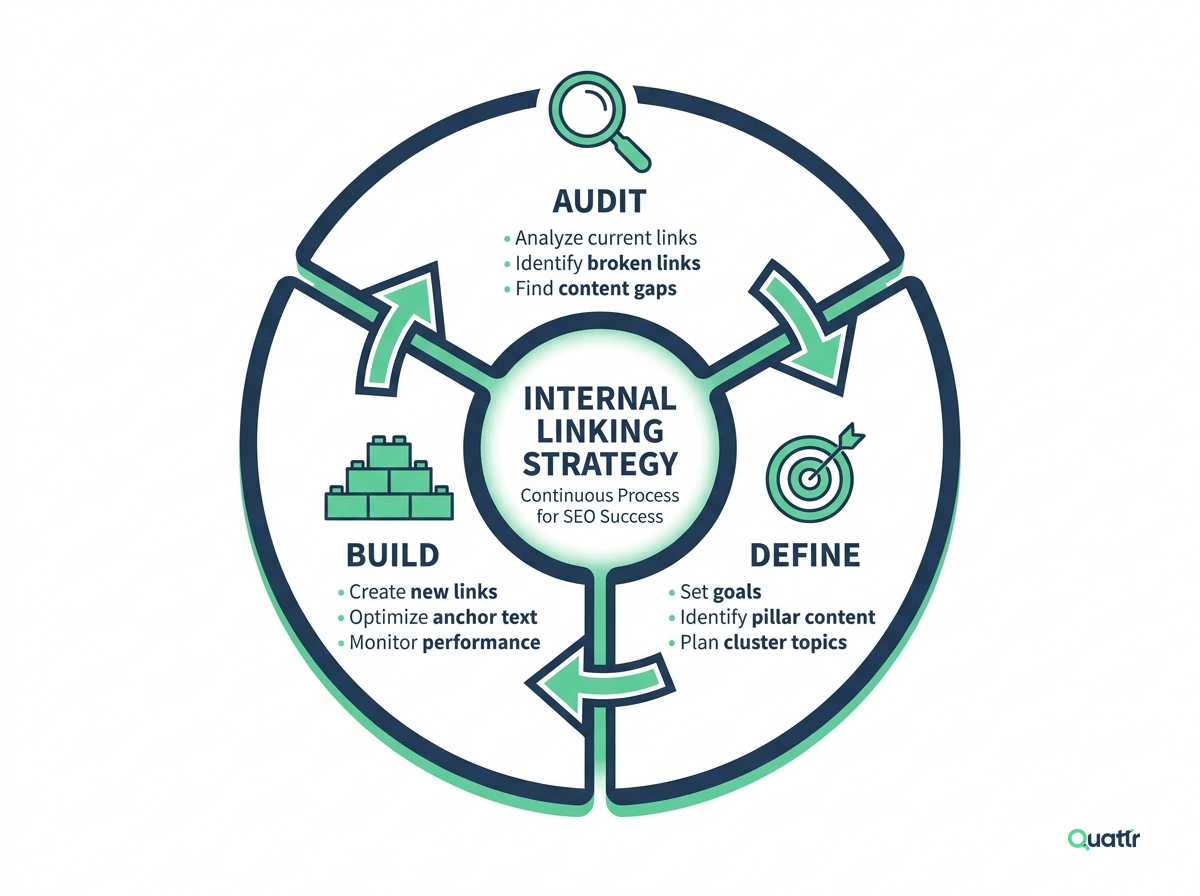
Most brands treat internal linking as something they do at the end of writing. They finish an article, drop in a couple of links and move on. That approach works just well enough to feel like you are doing something while doing almost nothing. If you want internal links to actually work for AI visibility and SEO together, you need a real strategy. Here are the steps you can follow.
Step 1: Audit What You Already Have
Before you add a single new link you need to understand the current state of your site. Start with Google Search Console. The Links Report shows you which pages have the most internal links, which ones have almost none and what anchor text is being used. If your most important pages are not getting the most internal links something is already wrong.
Then run your site through a tool like Screaming Frog to find orphan pages. These are pages with no internal links pointing to them and they are completely invisible to AI no matter how good the content is. Every page that matters to your business should have at least one internal link pointing to it and your most important pages should have between five and fifteen. Here is the step-by-step guide you can refer for internal linking audit.
Step 2: Define Your Pillar Topics
Pick three to five core topics that your business genuinely wants to own. Every piece of content you publish should either be a pillar page on one of these topics or a cluster page that sits underneath one and connects back to it. This structure is what tells AI your site has real depth on a subject and not just scattered articles on related keywords.
To find what to build clusters around use Google Trends to spot momentum, Exploding Topics to catch emerging subjects early, and your own Search Console data to see what people are already finding you for. Build around what people are actively searching right now.
Quattr’s Content Plan feature helps you stay ahead of this by surfacing new trends and telling you exactly what content to create next so your clusters stay current and competitive.
Step 3: Build Your Clusters and Link Everything Together
Once your topics are mapped create the content and connect it properly. Your pillar page should link out to each cluster page at the natural point in the content where that subtopic comes up. And each cluster page must link back to the pillar. This bidirectional linking is what most people miss and it is exactly what tells AI these pages belong to the same body of knowledge.
For an extra layer of clarity add RelatedLink schema on cluster pages and SignificantLink schema on pillar pages. It is a small technical step most sites skip and it gives AI a much cleaner map of how your content is organised.
How Quattr’s Intelligent Internal Linking does This for You
Knowing what good internal linking looks like is the easy part. Actually doing it across hundreds or thousands of pages, every time you publish something new, is where most teams fall apart. You cannot hire enough people to keep up with it and you cannot do it manually without missing things. That is the gap Quattr fills.
i. It Reads Your Entire Site
Quattr starts by crawling everything. Not just the pages in your main navigation but every piece of content, every product page, every article sitting quietly without any links pointing to it. Most sites have more orphan pages than they realise.
ii. It Understands What Your Pages are Actually About
This is where Quattr’s Internal Linking is different from every manual approach. Quattr’s AI takes internal linking beyond keywords. It reads the meaning behind each page using the same technology that powers AI tools like ChatGPT. So it can connect a page about data protection with a page about compliance requirements even if they share no common words because it understands they are talking about the same thing from different angles.
iii. It Finds the Right Links
Every linking suggestion Quattr makes is based on two things. How relevant the connection is to what the user is trying to understand and how much authority the destination page already carries. It also writes the anchor text for you, varied naturally so nothing looks forced or over-optimised.
iv. It Never Stops Working
Publish a new page today and Quattr links it to the right existing content automatically. It does not need someone to remember to go back and add links. It does not need a quarterly audit to catch what was missed. The system updates itself as your site grows and gets better at understanding your content the longer it runs.
AI platforms like ChatGPT, Perplexity and Gemini follow internal links to understand what your site knows and how deeply it knows it. Quattr is built specifically with that in mind. When your internal link structure is organised the way AI thinks about topics your pages are far more likely to show up in AI generated answers.
Your links are always yours. You can export them any time or connect Quattr’s API so your site always serves the most current links without anyone lifting a finger. Book a demo today and in under 30 minutes you will know exactly where your site stands and what needs to change.
FAQs
Internal linking in AEO is how you connect related pages on your site so AI can understand what your content covers and how it all fits together.
Yes, AI platforms use your link structure to decide which pages are important enough to pull answers from.
There is no fixed number but pages with strong contextual links from multiple related pages tend to get cited far more often.
Using vague anchor text like “click here” or “read more” instead of descriptive text that tells AI exactly what the linked page is about.

Quattr is an AI-native Search Visibility Platform founded in Palo Alto, California, built for mid-market and enterprise brands competing in the age of generative search. Recently recognized across G2's Spring 2026 reports with #1 rankings in AEO Results, Usability, and Relationship, Quattr helps brands win visibility across traditional search and AI-generated answer surfaces.
Quattr's AI agent, GIGA, evaluates content the way AI systems do, identifying gaps across structure, authority, internal linking, and discoverability to surface the highest-impact fixes. With capabilities like autonomous internal linking, E-E-A-T intelligence, and the new GIGA Landing Page Generator for keyword-matched, AI-search-ready pages, Quattr helps teams move from diagnosis to deployed changes without manual bottlenecks.