Quattr Leads AEO, SEO, and Content Rankings on G2 Spring 2026.
Quattr Leads AEO, SEO, and Content Rankings on G2 Spring 2026.

You’ve optimized keywords, metadata, content, and backlinks, yet some pages still struggle to rank?
Often, the issue is orphan pages pages that exist on your site but have no internal links pointing to them. These disconnected pages are hard for users to find and easy for search engines to miss, leading to poor indexing, wasted crawl budget, and lost traffic. In this blog, we’ll show you how to identify and fix orphan pages so every page on your site contributes to stronger visibility, better crawlability, and improved SEO performance.
9.
10.
Orphan pages, also known as an orphan web page, are pages on your site that have no internal links pointing to them. This means users can’t reach them through menus, categories, or related content. They can only be found through direct URLs or an XML sitemap. In orphan page SEO, this is a serious issue because search engines depend on internal links to discover, crawl, and understand pages. Without those links, these pages become isolated and often go unnoticed.
When it comes to orphan pages and SEO, the impact is negative. These SEO orphaned pages do not support your site’s rankings and instead weaken overall performance. Whether it’s an old blog post, an unlinked landing page, or a page published without proper internal linking, orphan pages quietly harm your site’s SEO health if left unfixed.
Orphan pages fundamentally undermine your SEO strategy. Here's why they're detrimental to your search performance:
Search engines find pages by following internal links, especially if you don't have sitemap. When a page has no links pointing to it, Google may skip it or remove it from the index over time. If a page is not indexed, it cannot rank or bring in organic traffic, no matter how good the content is.
Search engines have a limited amount of time and resources to crawl your site. When many low-value orphan pages exist, crawlers may spend time on them instead of your important pages. This can delay indexing of new content and slow down overall SEO progress.
Internal links help pass authority and relevance across your site, which is why following solid internal linking best practices matters. Orphan pages miss out on these signals because no other pages support them. As a result, they often struggle to rank well, even if they target the right keywords.
A strong internal linking structure helps search engines understand how your content is connected. Orphan pages break this flow, making your site harder to interpret and less efficient from an SEO perspective, which is why running a regular internal link audit helps catch these gaps early.
Users cannot easily find orphan pages through menus or related links. If someone lands on one from search or an external source, they may not be able to navigate to other useful pages. This is one of the more common internal linking mistakes that leads to higher bounce rates and lower engagement.
Sometimes orphan pages are not low quality at all. They may be old blog posts, landing pages, or guides that still have value. Without internal links, this content stays hidden and fails to support traffic or conversions, similar to how pages suffer from content decay when they are left unmaintained and unlinked over time.
When content is created but not linked to existing pages, it can become orphaned, especially if it was added without a strategy for internal linking.
During website redesigns or structural changes, some pages may lose their internal links, leading to orphaning without proper oversight.
Moving content from one platform or structure to another can result in broken links or a lack of linking to the newly migrated pages.
Marketing efforts, such as campaigns that create specific landing pages, may overlook linking them within the main site structure.
Old or less relevant content may not be linked from other pages, causing them to fall into obscurity over time. Learn how to remove the outdated content using GSC in simple steps.
Let's find out how to discover orphan pages and reintegrate them into your internal linking strategy.
Identifying orphan pages requires more than a quick glance at your sitemap. These pages are buried within your site, often escaping notice because they aren’t tied into your internal linking structure. You need a methodical approach using advanced tools and strategies to properly address them.
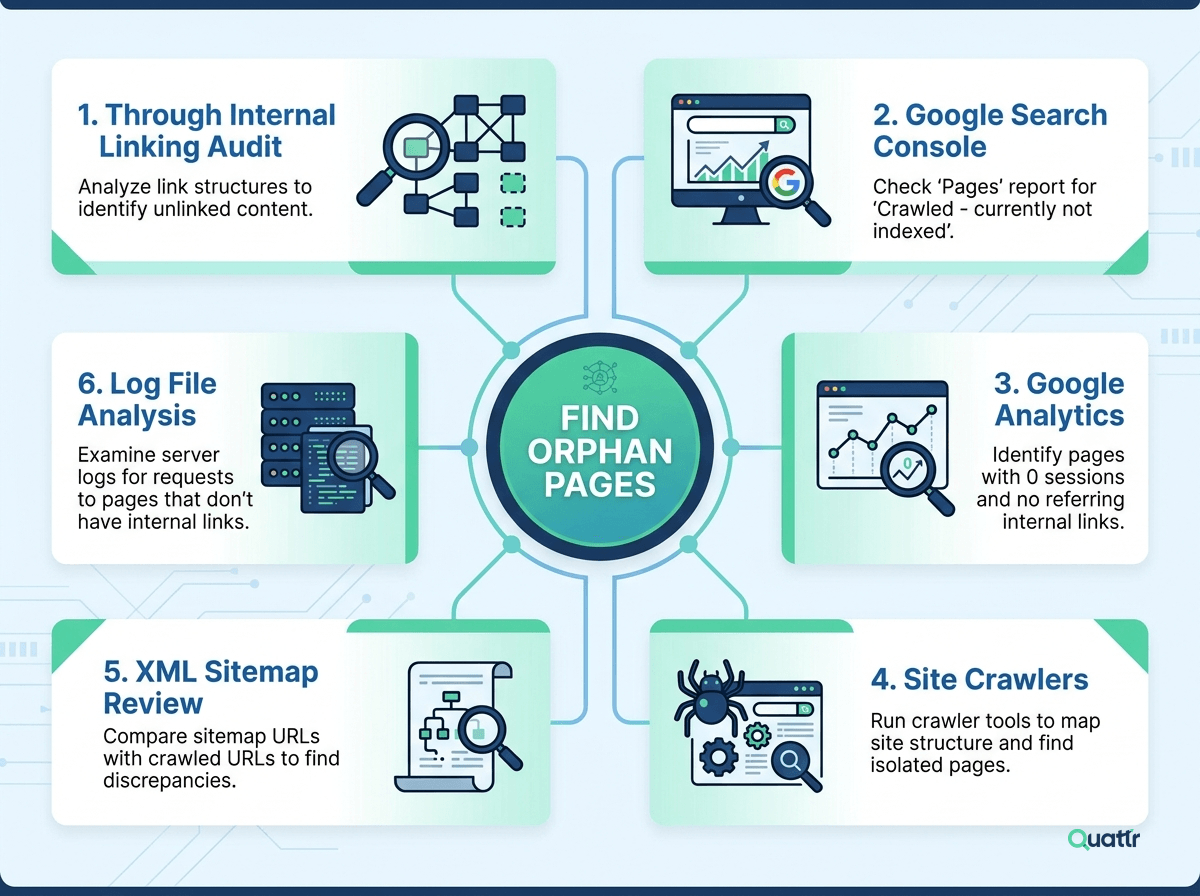
An internal linking audit is the most effective way to identify orphan pages. By examining your site's entire internal link structure, you can quickly spot pages with no incoming links.
This audit should be comprehensive, covering every section and URL on your site, ensuring that every valuable page is integrated into the overall SEO ecosystem.
Another simple way to find orphan pages in your website link structure is by comparing your sitemap against the pages indexed by Google. Pages indexed in Google Search Console but showing little or no traffic in often indicate orphaned content.
Follow the below steps:
i. Go to Google Search Console > Pages under the Indexing section.
ii. Review the Indexed pages report to identify which pages are being indexed.
iii. Export your indexed pages & compare this to your sitemap using a tool like Screaming Frog or Excel. If any pages in your sitemap aren’t indexed, they could be orphan pages.
It’s a quick way to flag potential SEO dead zones.
With Google Analytics, finding orphan pages requires a customized approach. Here's how you can find orphan pages with Google Analytics.
In GA4, you can create custom reports to track pages with little or no traffic. Here's how:
i. Go to Explore in the left-hand menu and click on Blank to create a new exploration.
ii. In the Variables panel, click + next to Dimensions. Then search for and select either Page path + query string or Page path and screen class, depending on your reporting needs, and then click Import.
iii. In the Variables panel, click + next to Metrics, then search for and select Event Count, Views, or Sessions as your metric. Click Import.
iv. Drag Page path + query string or Page path and screen class to the Rows section.
v. Drag Views or Event Count to the Values section.
vi. Add a filter to exclude pages with zero or very low page views by clicking the Filter section and setting a condition to filter pages with low traffic.
This will give you an idea of pages that are not receiving traffic, which might be orphaned pages.
Advanced site crawling tools like Screaming Frog are indispensable for uncovering orphan pages. These crawlers map your entire website’s internal linking architecture, allowing you to spot any isolated pages. Here's a step-by-step approach on how you can find orphan pages in screaming frog:
i. Start by crawling your website. Go to Configuration > API Access and connect Google Analytics and Google Search Console. This integration allows Screaming Frog to retrieve data on pages receiving traffic and indexed by Google.
ii. After the crawl, go to the Orphan Pages Report under the Crawl Analysis section. This will highlight pages that exist but have no internal links.
iii. Review the output to instantly identify which URLs are orphaned and further fix the internal linking gaps that are stunting your SEO efforts.
Pro Tip: Use site crawlers in conjunction with log file analysis to see which orphan pages have been recently crawled but remain unlinked. This hybrid approach ensures you focus on orphan pages that search engines are still actively trying to index.
Compare your XML sitemap with the actual internal navigation structure of your website. Any page that appears in your sitemap but is not discoverable through your internal links is a red flag.
It ensures that your most important pages, listed in the sitemap, are fully integrated and accessible to both users and search engines.
For the most thorough approach, analyze your server log files to track how search engine crawlers navigate your website. Pages with minimal or no crawler activity could be orphaned, signaling a lack of internal links. Here's how to do it:
i. Download the log files from your web server.
ii. Analyze them with a tool like Screaming Frog's Log File Analyzer.
iii. Cross-reference pages crawled by Google but not linked internally to uncover orphan pages.
Log file analysis is a deeper, more technical method but highly effective for identifying unlinked pages on larger enterprise sites. Especially when you can connect the list of the log file pages with other data sets like GSC and HTML crawling to find which URLs are absent from these lists. However, for smaller websites, simpler tools like Google Search Console or crawling software can offer more accessible alternatives.
While we now know how to identify orphan pages on a website, it is essential to establish that they are different from dead pages on any website. Let's quickly look at how both differ from each other:
i. Orphan Pages:
These are pages on your site that lack internal links, making them inaccessible through your site’s navigation. However, they might still be discovered via external sources, direct URLs, or sitemaps. To fix orphan pages, establish meaningful internal links that integrate them into your site’s structure, ensuring both search engines and users can find them easily.
ii. Dead Pages:
These are the pages that no longer exist or serve a purpose on your site (e.g., outdated or deleted content). They are addressed by either redirecting them to relevant content or properly handling them with a custom 404 error page to guide users and preserve a positive user experience.
Both orphan and dead pages can harm your website's performance and crawl efficiency.
Let us now look at how to fix orphan pages on a website.
Remember that the goal isn’t just to "fix" them but to re-integrate them into a comprehensive, optimized internal linking strategy that strengthens the entire site’s structure.
Start by strategically weaving orphan pages back into your internal linking framework. Identify the most relevant pages within your site and create contextual, authoritative links that guide users and search engines toward these isolated pages.
If the orphan page is a core page like a service or landing page, consider adding it to your main navigation or footer links.
Ensure that these links are placed naturally within high-authority, top-traffic pages to maximize their visibility and SEO impact.
Not every orphan page is worth saving. Conduct a thorough content audit to determine if these pages provide value. If a page lacks relevance, traffic, or engagement, it may be better to consolidate it with other content or redirect it to a higher-value page.
This not only declutters your site but also helps focus your SEO efforts on the most impactful content.
For orphan pages that still have potential, a fresh optimization is essential. Update outdated information, improve keyword targeting, and optimize meta tags.
Ensure the content aligns with current user intent. You can add images or infographics, to increase engagement and reduce bounce rates.
Incorporating orphan pages into your XML sitemap ensures that search engines are aware of these pages and can index them more effectively.
Submitting an updated sitemap to Google Search Console will expedite the re-crawling process and reintroduce the orphan pages into search results, improving their discoverability.
In the case of preventing orphan pages, one line goes a long way: "An Ounce of Prevention is Worth a Pound of Cure." Instead of scrambling to fix these issues after they arise, adopting a proactive approach can save time, effort, and resources.
Schedule periodic content audits to check for orphan pages. This helps you identify and address any isolated content before it becomes problematic.
When redesigning or migrating your site, have a checklist in place to ensure all pages maintain their internal links. Use tools to track any changes that might lead to orphaning.
Organize your website with a logical hierarchy that facilitates linking. Use categories and subcategories to ensure all pages are easily accessible.
Maintain an up-to-date XML sitemap that lists all your pages. This helps search engines discover all content and allows you to easily monitor for orphan pages.
Orphan pages won’t hurt your SEO all at once, but over time, they quietly slow your growth by hiding valuable content and wasting crawl budget. The fix is simple: keep your pages connected with smart internal linking so nothing gets left behind. Tools like Quattr make this easier by automatically adding internal links, helping prevent pages from becoming orphaned in the first place. When every page is linked and discoverable, your site works harder for you and grows stronger naturally.
Not necessarily. Landing pages can become orphan pages if no other page on your website links to them. Regularly review your internal links to avoid this.
Yes, orphan pages can still be indexed if search engines find them through sitemaps, old links, or external sources. However, without internal links passing authority, they struggle to rank and deliver strong organic performance.
Use crawling tools to identify orphan pages and review the content relevance. You can either remove it via CMS or use 301 redirects to the relevant page.
Yes, empty pages are bad for SEO because users leave immediately when they find no content, and search engines notice that. Regularly auditing and fixing empty pages helps protect rankings and user experience.

Quattr is an AI-native Search Visibility Platform founded in Palo Alto, California, built for mid-market and enterprise brands competing in the age of generative search. Recently recognized across G2’s Spring 2026 reports with #1 rankings in AEO Results, Usability, and Relationship, Quattr helps brands win visibility across traditional search and AI-generated answer surfaces.
Quattr’s AI agent, GIGA, evaluates content the way AI systems do, identifying gaps across structure, authority, internal linking, and discoverability to surface the highest-impact fixes. With capabilities like autonomous internal linking, E-E-A-T intelligence, and the new GIGA Landing Page Generator for keyword-matched, AI-search-ready pages, Quattr helps teams move from diagnosis to deployed changes without manual bottlenecks.


Try our growth engine for free with a test drive.
Our AI SEO platform will analyze your website and provide you with insights on the top opportunities for your site across content, experience, and discoverability metrics that are actionable and personalized to your brand.


.svg)
.svg)


