

Key Takeaways
- Athena HQ gave teams a way to track AI visibility when most tools couldn’t, but visibility without execution leaves the hardest part of the job, actually moving the numbers, still entirely on your team.
- The most common reason teams move on isn’t missing data; it’s that the gap between what the dashboard shows and what gets published stays too wide for too long.
- Monitoring-only tools are useful for diagnosing where you stand, but if your content operation is running at scale, the cost of separating insight from execution compounds quickly across every gap you find and don’t act on.
- Not all GEO platforms measure the same thing the same way; methodology differences between UI scraping, API sampling, and direct engine queries produce meaningfully different numbers, so trialing with your own brand prompts matters more than comparing feature lists.
- If the goal is to connect AI visibility to business outcomes rather than just citation counts, the platform you need is one that closes the loop from monitoring through execution through attribution, and Quattr is the only tool in this category built to do all three in one place.
A lot of teams that sign up for Athena HQ eventually arrive at the same question: we can see the data, so why does execution still feel so manual?
That’s not a knock on where the platform started. Athena HQ came out of stealth in early 2025 backed by Y Combinator, built by a team with roots in Google Search and DeepMind, and it addressed something real. Traditional SEO tools weren’t built to track what ChatGPT says about your brand.
Google AI Overviews were reshaping how buyers discovered products. Perplexity was pulling citations from sources most marketers had never thought to optimize. There was a genuine visibility blind spot, and Athena HQ gave teams a way to start closing it.
That was enough for a while.
The problem is that visibility without execution is just a more detailed version of the same anxiety. Knowing your brand appears in 12% of relevant AI responses doesn’t tell you which content changes would move that number, or whether the $295/month credit pool you’re drawing from will hold at the scale you actually need to operate.
The gap between knowing and doing stayed wide.
Why Teams Move On from Athena HQ
Credit costs are hard to forecast at scale. Every prompt across every AI engine draws from a shared credit pool. Add engines, geographies, and prompts, and the spend climbs without a ceiling. Full multi-engine, multi-geography coverage requires the Enterprise tier at $1500 or even more.
No AI SEO score or brand rank. There’s no normalized metric to report on, set targets against, or track improvement over time. Citation counts and share of voice estimates don’t give teams a number they can align around.
The execution tools aren’t production-ready. The Action Center flags gaps, but the optimization agents and outreach features aren’t reliable enough for teams deploying changes at scale.
No free trial. You commit to the budget before you can validate the data quality, which matters more in this category than most.
The five platforms in this guide are built around closing that gap. Some do it through deeper analytics that make the data actually trustworthy at scale. Some do it by connecting visibility insights directly to content workflows. Some do both.
The question we’re answering for each one is straightforward: does it give teams the tools to act, or does it hand them another dashboard? Let’s look at these platforms one by one.
Top Athena HQ Alternatives
Quattr
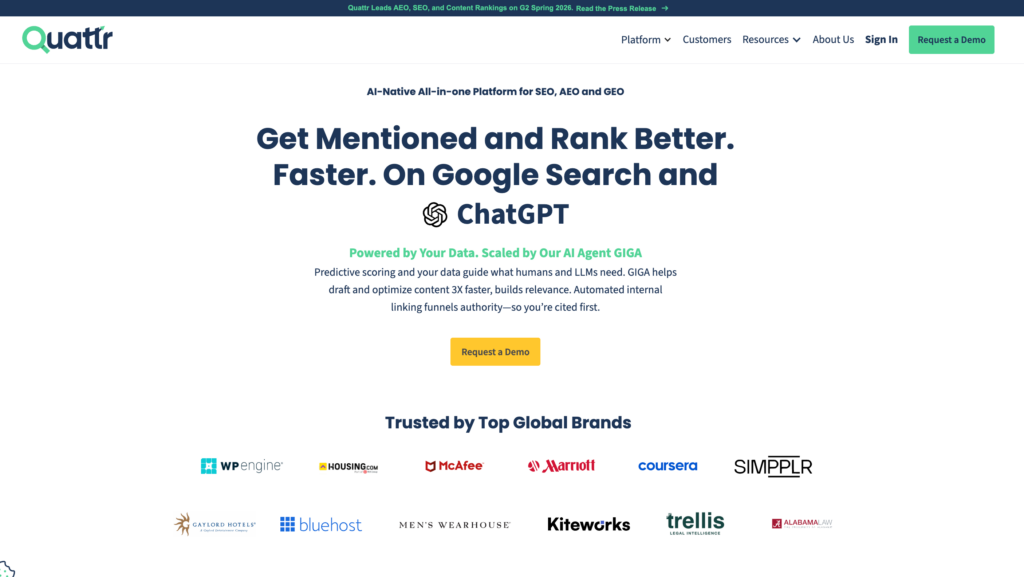
Quattr is an AI-native SEO, AEO, and GEO platform built for teams that need to close the loop between insight and execution. Where most GEO tools stop at showing you where your brand appears, Quattr connects that data to live content writing/optimizations, internal linking, CMS publishing, and technical SEO fixes, in one platform.
Key Features
AI Visibility Dashboard. Tracks brand presence across Google AI Overviews, ChatGPT, Gemini, and Perplexity. Customizable Looker dashboards connect visibility data to GSC and GA4 so teams can tie AI appearances to traffic and pipeline.
E-E-A-T Scorecard. Evaluates every target page against the trust signals AI systems use for citation decisions, author credentials, primary research, entity consistency, and schema, and surfaces prioritized fixes rather than generic recommendations.
GIGA (AI Execution Agent). Prioritizes content gaps, refreshes pages for answer-slot readiness, and creates new content structured for RAG extraction. Scores proposed changes against competitors before deployment.
Automated Internal Linking. Uses semantic logic to route authority toward canonical answer pages. Deployable via API, CMS plugin, or edge injection with sandbox testing and rollback capability.
Closed-Loop Attribution. Connects GSC and GA4 data directly to citation events, so teams can trace whether an AI mention drove traffic, a conversion, or pipeline movement.
Expert Growth Concierge. Every enterprise account includes a dedicated SEO/GEO strategist for prompt selection, AEO strategy, and ongoing collaboration via Slack.
Pricing: Custom Pricing
Athena HQ vs Quattr
Athena HQ is built around GEO visibility, tracking where your brand appears across AI engines, monitoring competitors, and surfacing action items inside the platform. Quattr starts from the same visibility data but extends into execution: content deployment, internal linking, and technical fixes that go live through your CMS. If Athena HQ answers “where do we stand,” Quattr answers “what do we do about it, and did it work.”
Pros and Cons
| Pros | Cons |
|---|---|
| Strong connection between content performance and revenue, users consistently highlight how clearly Quattr links SEO actions to business outcomes | Learning curve, the platform’s depth requires time and training before teams can use it effectively |
| Tight insight-to-action cycle, the workflow from identifying a gap to deploying a fix is more integrated than most competing platforms | The initial configuration investment is significant, though users report it pays off over time |
Best For
Quattr is the right fit for enterprise SEO teams running large-scale content operations who need their GEO monitoring and SEO execution in the same platform. If your bottleneck isn’t visibility data, it’s the speed at which your team can act on it. Quattr closes that gap more completely than any dedicated monitoring tool.
2. Profound
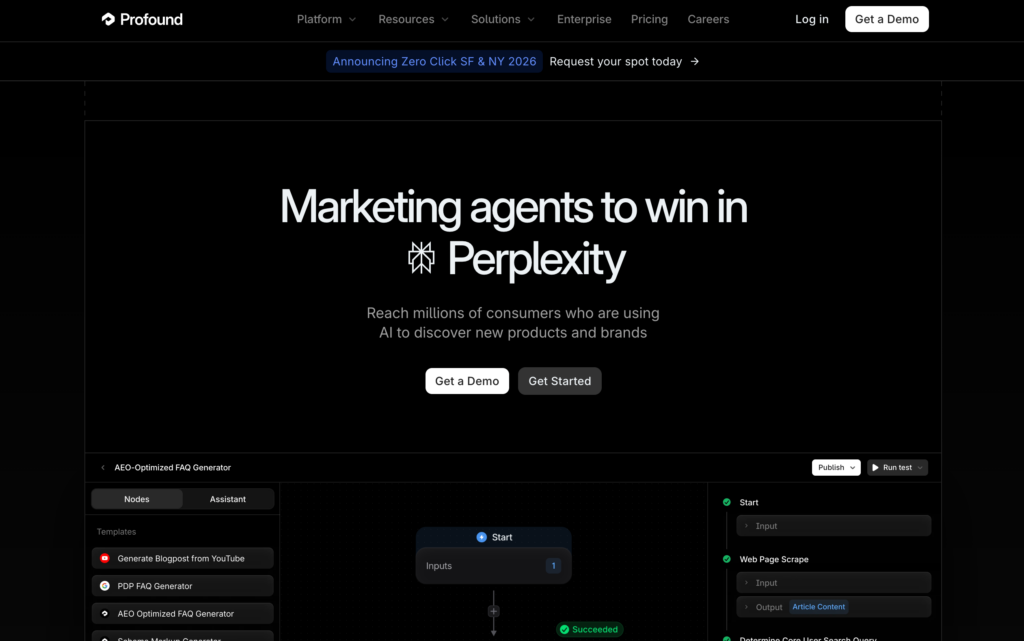
Profound tracks how AI engines represent your brand and gives you tools to act on that data through content workflows.
Key Features
Multi-Engine Brand Monitoring. Tracks brand mentions, share of voice, sentiment, and citation patterns across 10+ AI engines. Profound queries AI platforms directly via front-end scraping rather than relying solely on API outputs.
Conversation Explorer. Access to 400M+ real user prompts showing what people actually ask AI engines in your category, which competitors get cited, and how responses vary by query type.
ChatGPT Shopping. Tracks product placement and presentation inside ChatGPT shopping responses, competitive benchmarking, retailer mapping gaps, and trend data for e-commerce teams managing AI-assisted discovery.
Query Fanout Analysis. Shows how answer engines transform a single user prompt into multiple high-intent queries before generating a response, total query count, average queries per execution, word transformations, and period-over-period trends.
AI Crawler Analytics. Tracks how AI crawlers access your site, which URLs they visit, and how that activity maps to citations, useful for diagnosing why specific pages are or aren’t being surfaced.
Content Optimization. Template-based workflows for AEO gap analysis and structural edits on existing or draft content. Growth plan includes content generation capped at 6 articles/month. Enterprise plans expand this.
Pricing
| Plan | Price | What’s Included |
|---|---|---|
| Starter | $99/month | ChatGPT tracking only, 50 prompts, email support |
| Growth | $399/month | 3 answer engines, 100 prompts, 6 optimized articles/month, email support |
| Enterprise | Custom | Up to 10 answer engines, multiple companies, tailored prompt tracking etc |
Athena HQ vs Profound
Both platforms monitor AI visibility. Neither handles execution at scale; Athena HQ’s Action Center is still developing, and Profound’s content tools cap at 6 articles/month on the Growth plan. Where Profound pulls ahead is data depth: real user prompts, query fanout analysis, and ChatGPT Shopping tracking that Athena HQ doesn’t offer.
Pros and Cons
| Pros | Cons |
|---|---|
| Robust data depth, citation tracking, sentiment, and prompt volume data give teams more signal than most competing platforms | Steep learning curve, the volume of data and metrics requires dedicated time to navigate effectively |
| Strong customer support, users consistently flag the team’s responsiveness as a differentiator | Workflows feel slow in places, some users note that common tasks take more steps than they should |
Best For
Profound is the right fit for enterprise teams that need deep AI visibility analytics and have the internal resources to act on what they find. Use Profound if your priority is understanding how AI engines represent your brand at scale, across prompts, citations, and sentiment, and you have a content team to execute on those insights separately.
3. Scrunch AI
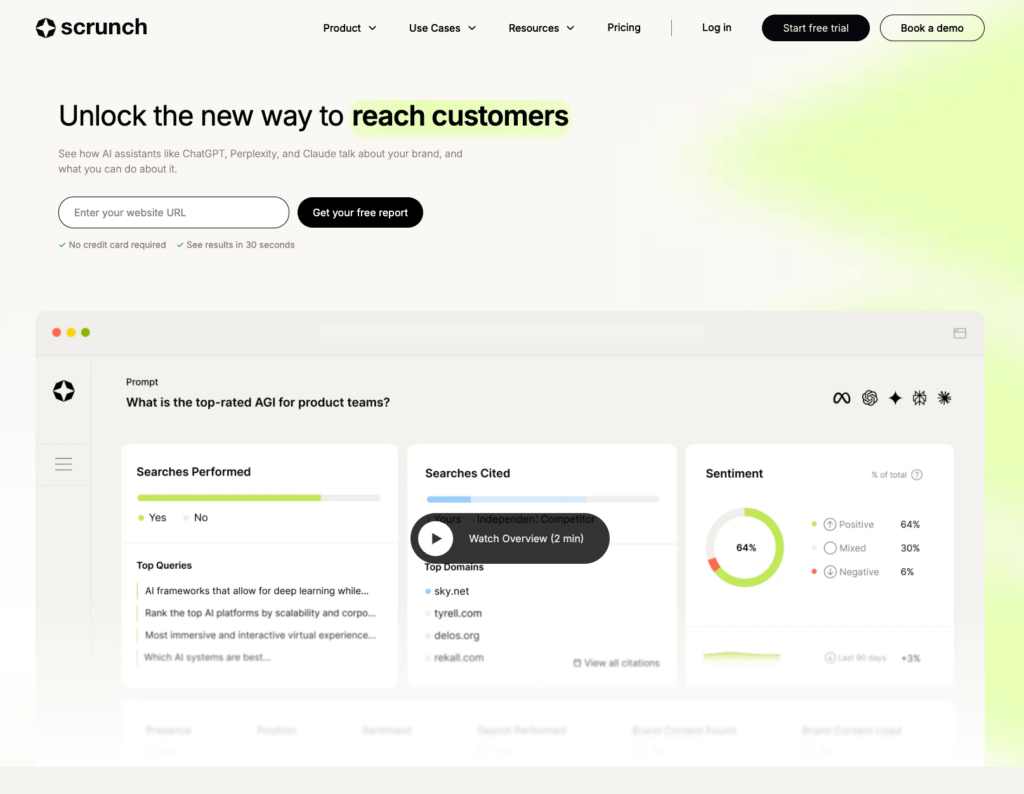
Scrunch focuses on the diagnostic layer of GEO, identifying which URLs AI engines are actually citing when your brand does or doesn’t appear, and why. It’s not a content production tool, but for agencies and growth teams that need attribution clarity before they can act, that granularity tends to be more useful than broad visibility scores.
Key Features
Multi-Engine Prompt and Citation Tracking. Tracks brand visibility across ChatGPT, Gemini, Perplexity, Claude, Meta AI, Google AI Mode, and Google AI Overviews — with source-level attribution showing exactly which URLs AI engines are pulling from for each response.
Persona and Funnel-Stage Segmentation. Filters visibility data by Ideal Customer Profile (e.g., CTO vs. Developer) and by buyer journey stage (awareness, consideration, decision). Let’s teams see where they’re visible to the right audience and where they’re not.
GA4 Integration for AI Referral Traffic. Connects AI citation data to actual site traffic, showing how AI-driven referrals behave post-click, not just whether your brand was mentioned.
Hallucination Detection. Flags instances where AI engines generate inaccurate information about your brand, giving PR and content teams an early warning system before misinformation spreads.
Agent Experience Platform (AXP). Serves AI-optimized content directly to AI crawlers at the CDN layer without altering the human visitor experience. Currently in limited rollout.
Agency Architecture. Multi-brand management with separate client workspaces, pitch environments for new business, and an agency partner program.
Pricing: $250 per month, with 4 LLMs tracking.
Athena HQ vs Scrunch AI
Athena HQ tracks prompt-level visibility and flags content gaps, but stops at the page level; it doesn’t show which specific URLs are being cited and why. Scrunch goes a level deeper with URL-level attribution, making its recommendations more actionable. The gap is content creation: Scrunch doesn’t have it, so teams still need a separate workflow to produce what the data points to.
Pros and Cons
| Pros | Cons |
|---|---|
| Clean data reporting, users consistently highlight how easy it is to read and present Scrunch’s outputs | Data limitations, some users find the analytics depth insufficient for more advanced use cases |
| Timely, actionable insights that translate directly into client-facing strategy | Platform restrictions on topic coverage and no native export options frustrate users who need flexible reporting |
Best For
Scrunch works best for agencies and in-house teams where client reporting requires specificity, not just “your brand appeared in 18% of responses,” but which sources drove those appearances and what to do about each one. The persona and funnel-stage filtering also make it useful for B2B teams tracking visibility across different buyer roles.
4. Peec AI
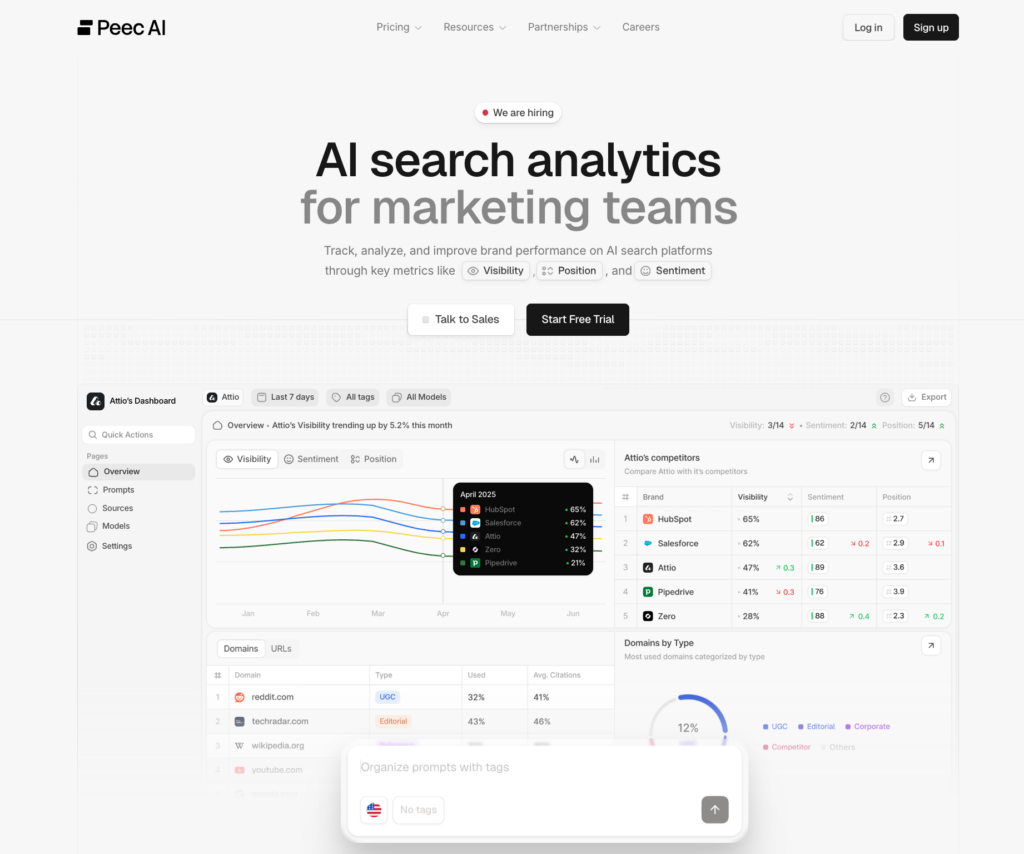
Peec AI is a monitoring-focused platform for tracking brand visibility across AI search engines. It’s built around simplicity: set up your prompts, see where you stand, and understand what sources AI engines are citing.
Key Features
Daily Prompt Tracking. Runs prompts once every 24 hours across your selected AI engines, with a visible countdown to the next run. Covers ChatGPT, Perplexity, and Google AI Overviews on all plans, Claude, Gemini, DeepSeek, and Grok available as add-ons.
UI Scraping Methodology. Peec queries AI platforms by simulating real browser sessions rather than calling APIs. This captures what actual users see, avoiding the accuracy gaps that API-based monitoring can introduce.
Brand Visibility vs. Source Citations. Distinguishes between brand mentions (your name appears in the response) and source citations (your URL is linked). Both are tracked separately, giving teams a clearer picture of whether they’re being referenced or cited.
Competitive Benchmarking. Compares your brand’s share of voice against competitors across regions and 115+ languages. Filters by model and geography, making it one of the more useful features for multi-market brands.
Sources and Gap Analysis. Shows which specific URLs AI engines are citing for your tracked prompts, categorized by domain type. Gap analysis surfaces sources that consistently cite competitors but not your brand, useful for outreach prioritization.
Sentiment Analysis. Tracks whether brand references are framed positively, neutrally, or negatively alongside raw mention counts.
Pricing: Starter plan $99pm with 50 prompts tracking.
Athena HQ vs Peec AI
Athena HQ and Peec AI are both monitoring tools; neither handles execution. Peec’s UI scraping methodology gives it a data accuracy argument over platforms using API sampling, including Athena HQ’s single-query approach. Athena HQ covers more engines on its base plan and has an Action Center for recommendations; Peec keeps the interface leaner and charges less for the core tracking function.
Pros and Cons
| Pros | Cons |
|---|---|
| Intuitive UI, users consistently note how quickly they can navigate the platform and extract what they need | Surface-level depth for advanced users, the platform works well for basic monitoring but doesn’t always deliver the analytical granularity some teams need |
| Strong customer support, responsive and helpful, particularly during setup | Limited integrations, Google Analytics connectivity is a frequently requested addition that isn’t yet available |
Best For
Peec AI is a good fit for marketing teams that need a clean, daily read on AI search visibility across markets, without the setup complexity or pricing of enterprise tools.
5. Otterly AI
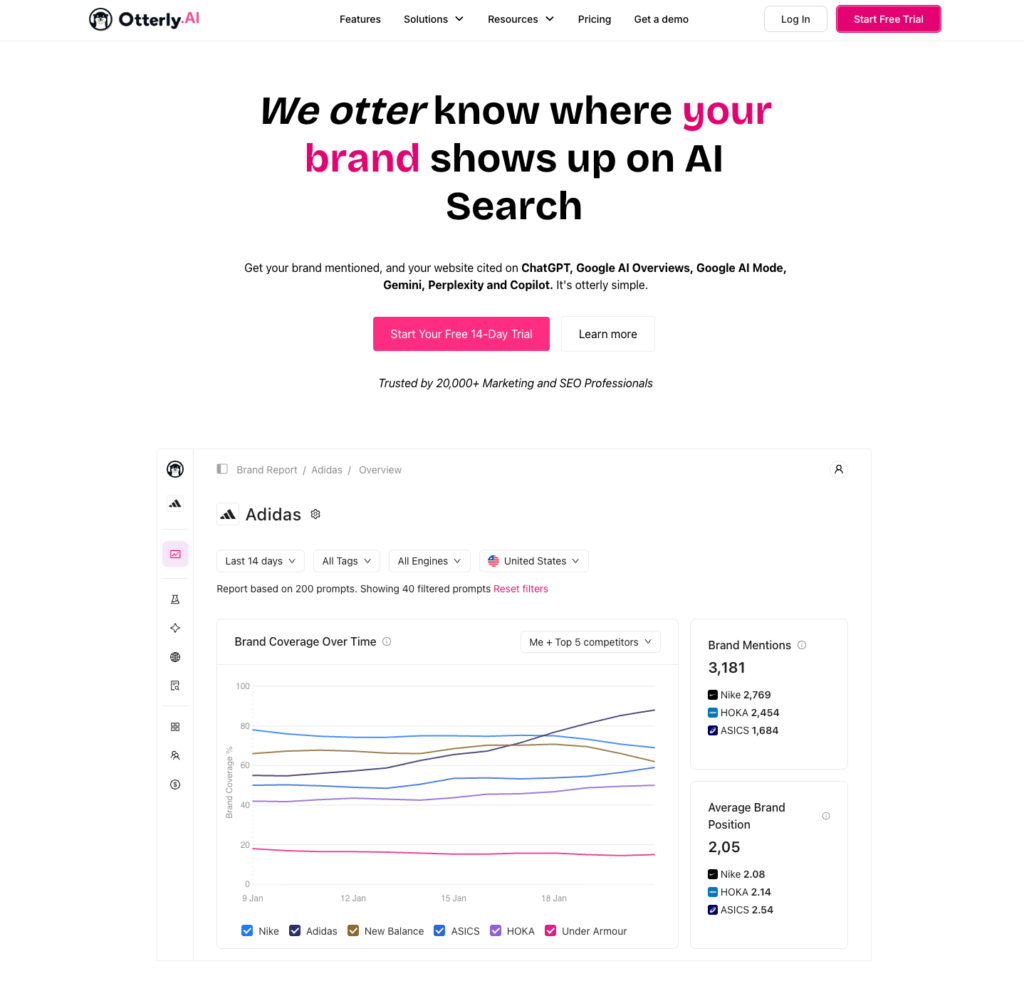
Otterly is a monitoring-first GEO tool built for teams that need a straightforward read on brand visibility across AI search engines without a steep price or complex setup. It tracks mentions, citations, and share of voice across ChatGPT, Google AI Overviews, Perplexity, Gemini, and Copilot, with a GEO audit layer and prompt research tools on top. It doesn’t handle content creation or execution, but its GEO audit feature gives teams more depth.
Key Features
Brand Visibility Monitoring. Tracks brand mentions, share of voice, and citation patterns across 6 AI platforms. Weekly link and citation tracking with position change monitoring over time.
GEO Audit. Analyzes 25+ on-page factors, including fluency, authority, and technical structure, to score pages model by model and identify what’s blocking content from being surfaced or cited in AI search.
AI Keyword and Prompt Research. Surfaces the conversational prompts your audience is actually using when querying AI platforms, helping content teams prioritize topics with the highest citation potential.
Link Citation Tracking. Identifies which specific URLs are being cited per prompt, not just whether your brand was mentioned. Includes domain-level ranking and gap analysis showing where competitors get cited but you don’t.
Agency Workspaces. Separate workspaces per client with individual team members, brand reports, prompts, and GEO audits — all under one subscription.
Looker Studio Connector. Pulls AI visibility data directly into Google Looker Studio for custom dashboards and automated client reporting.
Pricing
| Plan | Price | Prompts |
|---|---|---|
| Lite | $29/month | 15 prompts |
| Standard | $189/month | 100 prompts |
| Premium | $489/month | 400 prompts |
Athena HQ vs Otterly AI
Athena HQ covers more AI engines and runs more frequent monitoring, but starts at $295/month with a credit model that makes costs harder to predict. Otterly starts at $29/month with transparent prompt-based pricing and a free trial, making it a more practical entry point for teams that want to test AI visibility tracking before committing to a larger platform. Neither handles execution; both are diagnostic tools.
Pros and Cons
| Pros | Cons |
|---|---|
| Easiest setup in this category, users report being up and monitoring within an hour | Metrics take time to understand; there’s a learning curve in interpreting visibility scores and what they actually mean for strategy |
| Non-deterministic outputs, running the same prompt twice, can return different results, which affects data consistency | Metrics take time to understand, there’s a learning curve in interpreting visibility scores and what they actually mean for strategy |
Best For
Otterly is a good fit for solo marketers, small agencies, and teams new to GEO who need a low-cost way to start tracking AI visibility without a multi-hundred-dollar monthly commitment.
How to Choose the Right Athena HQ Alternative
The right platform depends less on feature lists and more on where your team actually gets stuck. Before you evaluate any alternative, answer one honest question: what happens after you see the data?
Most GEO tools stop at the dashboard. They’ll tell you your brand appears in 14% of relevant AI responses, which competitors are getting cited instead, and which pages have gaps. What they won’t do is help you close those gaps, and that’s where most teams stall.
If you need to act on what you find, look for platforms that connect visibility data to content workflows, not just recommendations. The difference between a flag that says “this page needs to be optimized for answer-slot readiness” and a platform that actually helps you make that change, and tracks whether it worked, is the difference between another tool in your stack and one that replaces several.
If you’re managing content at scale, the execution gap gets more expensive the longer it stays open. A dedicated monitoring tool adds signal. A platform with integrated execution adds speed. For teams publishing at volume, that speed compounds.
Consider total cost of ownership, not just the subscription line. A cheaper monitoring tool plus your existing content workflow plus a separate technical SEO tool often costs more, in time and budget, than a platform that handles the loop end-to-end.
And trial before you commit. Data quality in this category varies more than the marketing suggests. Use any free-trial window to run your own brand prompts, check the citations, stress-test the methodology, and push on the execution side. How fast can you go from identifying a gap to deploying a fix? That answer tells you more than any feature comparison.
Why Teams Running Content at Scale Choose Quattr
Most GEO tools hand you a dashboard and leave the rest to you. Quattr is built differently; it connects AI visibility data directly to the content changes, internal linking updates, and technical fixes that move the numbers.
If your team is spending time identifying gaps in one tool, writing fixes in another, and deploying changes through a third, Quattr consolidates that loop into one platform. The GIGA execution agent prioritizes what to fix, the E-E-A-T Scorecard tells you why specific pages aren’t being cited, and automated internal linking routes authority toward your canonical answer pages, all without leaving the platform.
Closed-loop attribution means you’re not guessing whether a fix worked. Quattr connects GSC and GA4 data directly to citation events, so you can trace whether an AI mention drove traffic, a conversion, or pipeline movement.
Enterprise accounts also include a dedicated SEO/GEO strategist, so you’re not reverse-engineering best practices on your own.
Quattr is the right fit if: you’re running a large content operation, your current stack separates monitoring from execution, and you need to tie AI visibility changes to traffic and pipeline, not just citation counts.
Frequently Asked Questions on Athena HQ Alternatives
Athena HQ is primarily a GEO visibility tool; it tracks where your brand appears across AI engines and surfaces recommendations through its Action Center, but execution remains largely manual. The strongest alternatives close that gap by connecting visibility data directly to content workflows, internal linking, and technical fixes. If your team’s bottleneck isn’t knowing what to fix but actually fixing it at speed and scale, that distinction matters more than any difference in dashboard features.
Quattr is the most direct answer here. Its closed-loop attribution connects GSC and GA4 data to citation events, so teams can trace whether an AI appearance drove a click, a conversion, or pipeline movement, not just a mention count. Most monitoring-only tools stop at visibility metrics, which makes it hard to justify the investment internally or set targets that mean anything to stakeholders outside the SEO team.
Quattr is built for this. It handles the full execution loop, content creation and optimization, automated internal linking, CMS publishing, and technical SEO fixes, in one platform, with closed-loop attribution connecting actions to business outcomes. Every enterprise account includes a dedicated SEO/GEO strategist, which matters for teams running complex, multi-market content operations. If you need visibility data plus the infrastructure to act on it at scale, it’s the most complete option in this category.

Quattr is an AI-native Search Visibility Platform founded in Palo Alto, California, built for mid-market and enterprise brands competing in the age of generative search. Recently recognized across G2's Spring 2026 reports with #1 rankings in AEO Results, Usability, and Relationship, Quattr helps brands win visibility across traditional search and AI-generated answer surfaces.
Quattr's AI agent, GIGA, evaluates content the way AI systems do, identifying gaps across structure, authority, internal linking, and discoverability to surface the highest-impact fixes. With capabilities like autonomous internal linking, E-E-A-T intelligence, and the new GIGA Landing Page Generator for keyword-matched, AI-search-ready pages, Quattr helps teams move from diagnosis to deployed changes without manual bottlenecks.