

As of July 7, 2026. This is tracking a Google deprecation on FAQ Schema in 2026, and that’s still mid-rollout, the API removal in August hasn’t happened yet. Reading this later? Check the FAQPage documentation changelog.
Key Takeaways
- FAQ rich results stopped appearing in Google Search on May 7, 2026. Search Console’s FAQ report and the Rich Results Test lose FAQ support in June 2026; the Search Console API loses it in August 2026.The
- FAQPage schema itself isn’t deprecated. Google says unused structured data doesn’t cause problems for Search.
- Google published its first official generative AI search guide on May 15, 2026, and said flatly that structured data isn’t required for AI Overviews or AI Mode, and there’s no special schema.org markup you need to add for them.
- The claim that the FAQ schema improves your odds of getting cited in ChatGPT, Perplexity, or AI Overviews isn’t confirmed by Google or any AI vendor. Treat it as unproven, not a fact.
- The real work now is a content audit, not a markup audit. Keep the FAQ sections that answer real questions. Cut the ones that only exist to chase a SERP feature.
On May 7, 2026, a note went up at the top of the FAQPage documentation saying the rich result was no longer showing up in Search.
If you’d spent the last few years building out FAQ sections specifically to win that Q&A dropdown under your listing, it’s done. Search Console loses its FAQ report, and the Rich Results Test drops FAQ support in June. API access goes in August.
None of that makes FAQ content less valuable. People still have questions after reading a page. They still want clarification before making a purchase, understanding a policy, comparing alternatives, or implementing a feature. Removing the visual FAQ accordion doesn’t change that behavior.
What disappeared was the search feature. The remains are the opportunity to answer questions that make your page more complete and more useful.
What is FAQ schema?
FAQ schema, the FAQPage type from Schema.org, is structured data, usually written as JSON-LD, that tells search engines “this block of content is a list of questions, each followed by an answer.” It doesn’t change what a human reader sees. It sits alongside your normal page content as a machine-readable layer.
For years, that markup had one obvious payoff: if Google recognized your FAQPage data, it could render an expandable Q&A accordion right in the search results. That payoff is gone now, for everyone.
Why Google introduced FAQ schema in the first place
It’s easy to look at the FAQ schema through the lens of rankings because that’s how most of the industry talks about it. But Google’s original goal was much simpler.
FAQ rich results were introduced to reward pages that genuinely answered the questions users were likely to ask next. Instead of forcing someone to click through multiple pages or run another search, Google could surface those answers directly beneath a search listing.
The markup itself wasn’t the value. The value was the content. FAQ schema simply gave Google a structured way to understand that a page contained a set of publisher-written questions and answers worth highlighting.
For websites that invested in helpful documentation, buying guides, pricing explanations, or onboarding content, FAQ rich results became a useful way to expose that work in Search.
What changed over time
As with many search features, the incentives gradually shifted.
Instead of treating FAQs as a way to answer genuine follow-up questions, many websites started treating them as extra space in the SERP. Pages that already covered a topic thoroughly suddenly ended with ten or fifteen keyword variations that added little new information.
Questions became increasingly repetitive. Answers often summarized content that already appeared higher on the page. Entire FAQ sections existed because a keyword tool suggested them, not because readers actually needed them.
Google had already begun tightening eligibility in 2023 by limiting FAQ rich results to authoritative government and health sites. By May 2026, it had retired the rich result altogether.
The markup survived. The reward for using it didn’t.
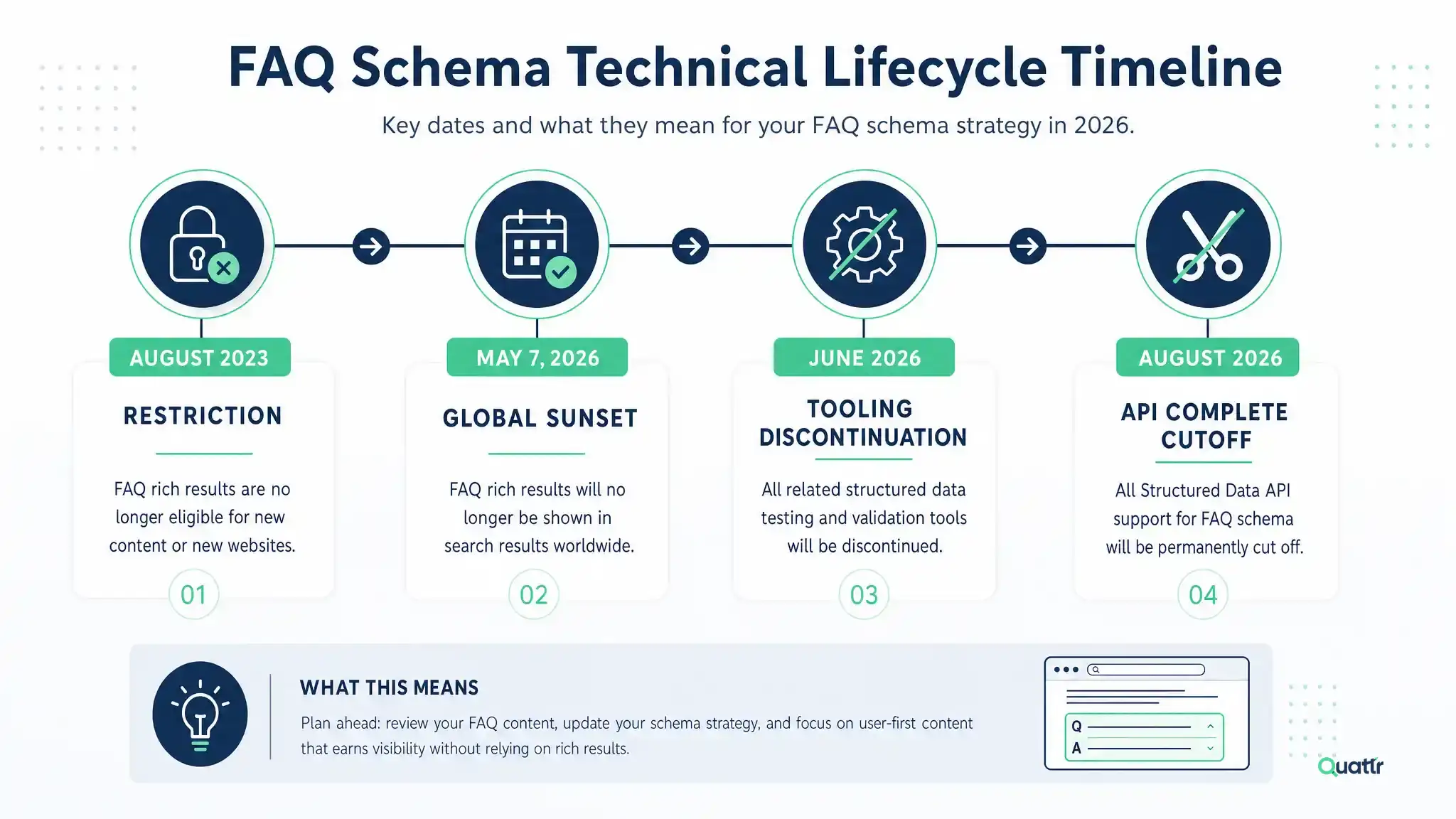
FAQ Schema Technical Lifecycle Timeline
A lot of posts round this off to “sometime in 2026.” Google’s documentation is specific, so here’s the real version.
| Date | Engine Action | Ecosystem Impact |
| 2019 | FAQ / HowTo rich results launch. | Broad eligibility across all valid web properties; massive SERP real estate gains. |
| August 2023 | Broad eligibility restriction. | FAQ rich results limited strictly to authoritative government and health domains. |
| May 7, 2026 | Official Deprecation Notice. | Google updates documentation and halts all FAQ rich result rendering globally. |
| June 2026 | Tooling deprecation. | Removal of the FAQ search appearance filter, Search Console reports, and Rich Results Test support. |
| August 2026 | API deprecation. | Full removal of FAQ metrics from the Search Console API; requests default to null. |
What Current Google Search Console Shows
Documentation notices are one thing. I wanted to see it on a live property before writing any of this up.
Open the Enhancements section in the sidebar on a property with valid, live FAQPage markup, and there’s no “FAQ” entry left at all. The Search Appearance breakdown under Performance shows the same thing: no FAQ row among the appearance types is still being reported.
One thing to be fair about here: a missing FAQ row on its own isn’t proof of anything, since a property could just have had too few FAQ impressions to show up in the report even before the deprecation. But its disappearance from the Enhancements list specifically, which tracks markup validity, not rich-result eligibility, is a solid, first-party sign that this is actually happening on real properties, not just written into a doc somewhere.
What’s confirmed, and what’s just a claim
Here’s what Google has actually said, next to what the SEO industry is saying on Google’s behalf.
Confirmed by Google, directly:
- FAQ rich results are no longer available for any site as of May 7, 2026.
- FAQPage remains a valid Schema.org type. You don’t have to remove the markup.
- Unused structured data doesn’t cause problems for Search, Google has said this more than once, going back to the 2023 restriction.
- On May 15, 2026, Google published its first dedicated generative AI search optimization guide. It says structured data isn’t required for AI Overviews or AI Mode, and there’s no special schema.org markup you need to add to appear in them. FAQ, Article, and the rest sit in the same bucket as ordinary SEO fundamentals here, useful for standard rich-result eligibility, not a special AI lever.
- Google also draws a distinction worth knowing: FAQPage is for content where you, the publisher, wrote both the question and the answer. QAPage is a separate type of page where users submit multiple candidate answers, like a forum thread. Using FAQPage for that second case is a mismatch, even though the JSON-LD looks similar.
Industry claims, not Google-confirmed:
- That FAQ schema specifically drives citations in AI Overviews, ChatGPT, or Perplexity. A few vendors throw numbers at this; one puts FAQ-format citation rates around two-thirds of relevant queries, another claims a 2.5 to 2.7x citation lift for pages with comprehensive schema. These are third-party panel numbers, not anything Google has verified, and none of them separate FAQ schema as the cause from it just being a marker of already well-structured, already well-ranked content.
- Those .llms.txt files, content “chunking,” or AI-specific rewriting help with Google’s AI features. Google’s own May 2026 guide says none of these are needed.
- You need to remove the FAQ schema urgently. Nobody, including Google, says this. If anything, Google says the opposite, leaving it in place is fine.
So what does this mean for you?
Two things have been treated as one for years and shouldn’t be:
- FAQ schema — the markup describing that a page has structured Q&A content.
- FAQ rich results — the visible accordion Google used to render from that markup.
Rich results are dead for everyone as of May 2026. FAQ schema as a Schema.org type isn’t, and Google’s AI features guide is now on record saying it isn’t a special AI lever either. That leaves you with a content decision, not a technical one: should this page have a visible FAQ section, and should that section carry markup? Decide both on the merits, not out of habit.
The takeaway most brands are missing
It’s tempting to read Google’s announcement as a signal that FAQ sections no longer matter. That’s probably the wrong conclusion.
The richer search appearance is gone, but the need for useful supporting content isn’t. If anything, FAQ sections now have to earn their place by answering questions that the main content doesn’t already cover.
The best FAQ sections don’t repeat the article in a different format. They address edge cases, common objections, implementation questions, comparisons, and details that naturally come up once someone has finished reading the page.
That’s the difference between writing FAQs for Google and writing FAQs for readers.
So what should you do about it?
Step 1 — Identify the questions your main content doesn’t answer
Instead of deciding whether a page needs an FAQ section, start by asking what questions remain after someone finishes reading.
Good FAQ candidates include pricing concerns, implementation details, comparison questions, eligibility requirements, limitations, troubleshooting, or anything readers regularly ask your support or sales teams.
If the answer already exists in the article, don’t rewrite it as another FAQ. If the question genuinely adds new context, it’s probably worth keeping.
Step 2 — Write answers that stand on their own.
Each answer should stand on its own while contributing information the page doesn’t already provide.
A strong FAQ section supplements the main topic instead of summarizing it. It fills topical gaps, resolves uncertainty, and answers questions that don’t naturally fit into the main flow of the article.
If every answer feels like a copy-and-paste version of the content above it, the FAQ section probably isn’t earning its place.
Step 3 — Mark it up correctly, and use the right type.
A minimal, valid FAQPage JSON-LD block:
{
  "@context": "https://schema.org",
  "@type": "FAQPage",
  "mainEntity": [
    {
      "@type": "Question",
      "name": "Does adding FAQ schema yield rich results in 2026?",
      "acceptedAnswer": {
        "@type": "Answer",
        "text": "No. Google fully retired the visual FAQ rich result accordion on May 7, 2026. The markup remains valid schema syntax but no longer alters SERP presentation."
      }
    },
    {
      "@type": "Question",
      "name": "Is removing legacy FAQ schema required?",
      "acceptedAnswer": {
        "@type": "Answer",
        "text": "No. Google's documentation confirms that unused structured data does not cause issues or search performance degradation. Removal is completely optional."
      }
    }
  ]
}
A few rules still apply, rich result or not:
- The `mainEntity` questions need to match visible, human-readable content on the page. No hidden or markup-only Q&A pairs.
- Use FAQPage only when you wrote the answers yourself. If it’s a forum-style thread where users submit competing answers, that’s QAPage, not FAQPage.
- Keep answers accurate and current. Stale FAQ markup describing an old price or policy is worse than no markup at all.
- Validate with a general structured-data tool rather than the old Rich Results Test’s FAQ-specific check, since that support is being phased out in June 2026.
Step 4 — Update your reporting before the deadlines hit.
Pull any historical FAQ search-appearance data out of Search Console now, before the June 2026 report removal. If FAQ rich result data feeds a BigQuery export or an internal dashboard, patch that pipeline before August 2026, otherwise you get silent nulls instead of an error you’d actually notice.
Step 5 — Don’t treat the AI-citation question as settled.
Adding FAQ content because it’s genuinely useful to readers is a good, low-risk move. Adding it because you expect a citation bump in AI Overviews or ChatGPT is a bet, not a strategy backed by anything Google has said.
Quattr Picks Up Where Schema Leaves Off
The disappearance of FAQ rich results doesn’t remove the need for FAQ content. It raises the bar for it.
Instead of asking how many FAQs belong on a page, the better question is which unanswered questions deserve to be there at all.
That’s exactly where Quattr fits in. GIGA analyzes your content to identify topical gaps, recurring user questions, and opportunities to make a page more complete. When an FAQ section is the best format for filling those gaps, it recommends questions that genuinely strengthen the content instead of simply increasing the FAQ count.
From there, Quattr helps ensure the supporting markup remains accurate, keeps your site technically healthy, and tracks how those improvements contribute to both traditional search performance and AI visibility.
It also scores your content on what actually earns AI citations: author credibility, original research, and consistency, with schema as just one piece. And you can track it all, seeing exactly where your brand gets cited or mentioned across AI search and regular rankings alike.
FAQs
Google fully retired the FAQ rich result on May 7, 2026. The expandable Q&A accordion that used to appear under search listings no longer renders for any site, and this applies globally, not to specific industries or regions.
No. FAQPage remains a valid Schema.org type, and Google has confirmed unused structured data doesn’t cause problems for Search. What’s gone is the visual rich result the markup used to trigger, not the schema itself.
This isn’t confirmed by Google or any AI vendor. Google’s May 15, 2026 generative AI search guide states plainly that no special schema.org markup is needed to appear in AI Overviews or AI Mode. Any citation-lift numbers circulating come from third-party vendors, not Google.
The FAQ report in Search Console and FAQ support in the Rich Results Test are removed in June 2026. Search Console API access to FAQ metrics is removed in August 2026, after which requests default to null instead of returning an error.
Audit content, not markup. Keep FAQ sections that answer real questions a reader would otherwise have to search or ask support for, cut ones that only exist to chase a old SERP feature, and make sure any remaining markup matches visible, current, accurate page content.

Quattr is an AI-native Search Visibility Platform founded in Palo Alto, California, built for mid-market and enterprise brands competing in the age of generative search. Recently recognized across G2's Spring 2026 reports with #1 rankings in AEO Results, Usability, and Relationship, Quattr helps brands win visibility across traditional search and AI-generated answer surfaces.
Quattr's AI agent, GIGA, evaluates content the way AI systems do, identifying gaps across structure, authority, internal linking, and discoverability to surface the highest-impact fixes. With capabilities like autonomous internal linking, E-E-A-T intelligence, and the new GIGA Landing Page Generator for keyword-matched, AI-search-ready pages, Quattr helps teams move from diagnosis to deployed changes without manual bottlenecks.