

Key Takeaways
- AEO and GEO are not the same thing. AEO is a formatting and structure problem. GEO is a credibility and ecosystem problem.
- AEO still works. It works better when you’re specific about which queries it’s the right tool for.
- GEO isn’t won on your site. It’s won across everything the web says about you. Most SEO teams are underinvested here.
- Mentions and citations are not the same metric. High mentions with low citations is a content structure problem, and it’s fixable.
- The brands winning on both surfaces aren’t running two programs. They’re applying the same content fundamentals with different distribution logic.
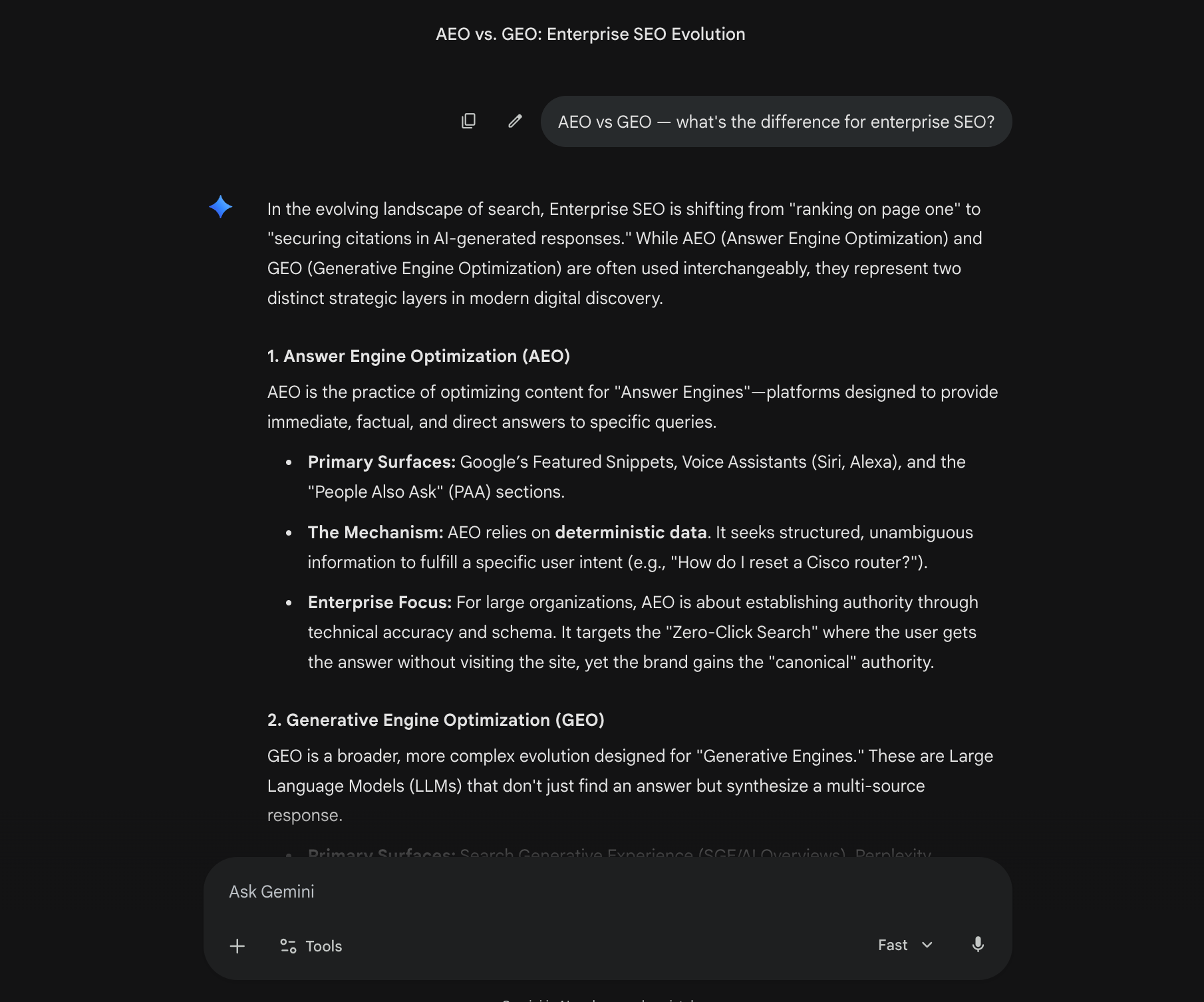
AEO and GEO are not the same thing. They’re related, they overlap in places, and yes, the best tactics for one usually help the other. But conflating them leads to strategy gaps that show up in your reporting before you notice them anywhere else.
What is AEO & GEO?
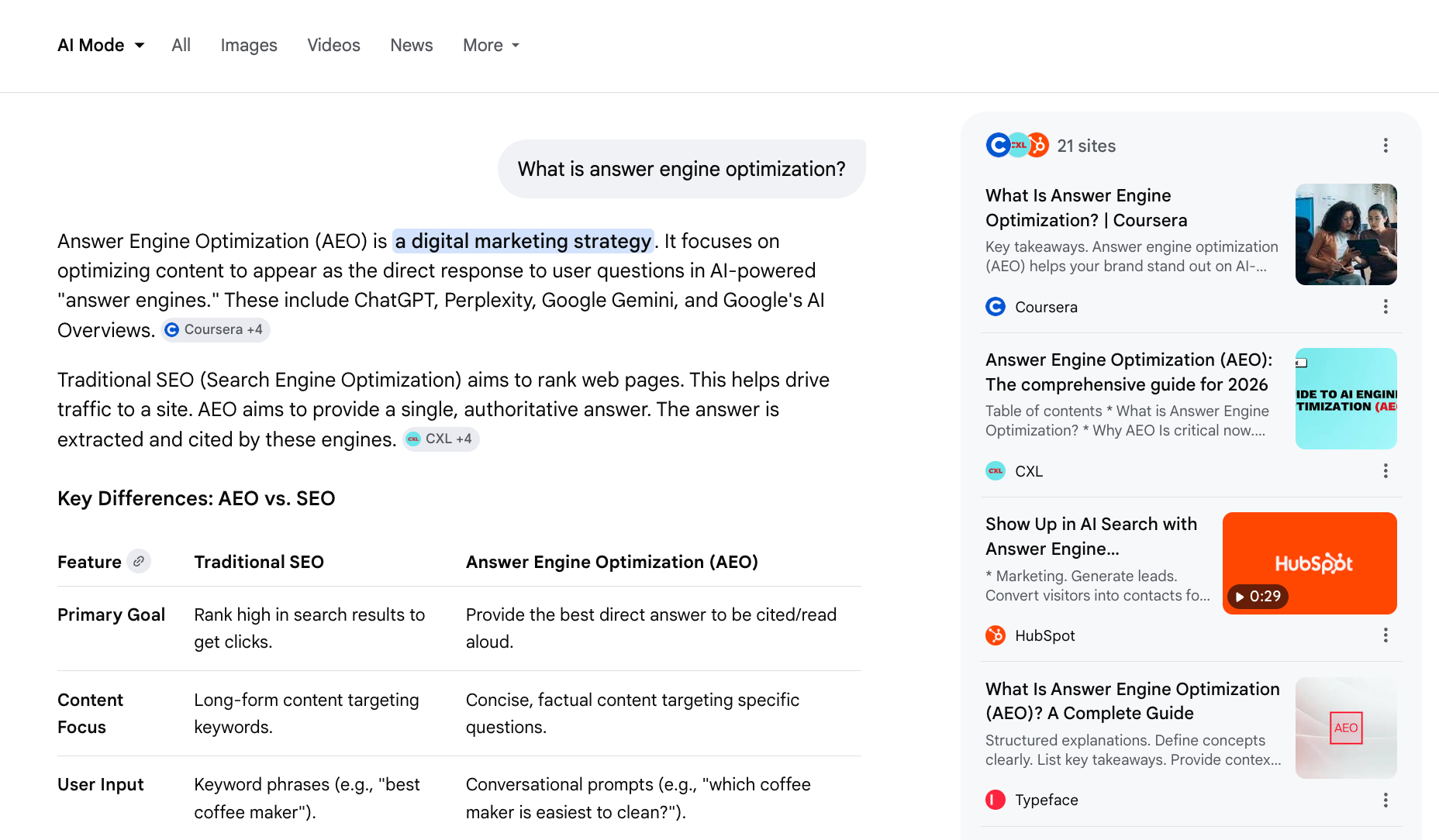
AEO is about formatting content so search engines can extract and surface a direct answer. GEO is about building enough authority and entity presence that AI systems cite you when they generate a response. One is a content formatting problem. The other is a trust and ecosystem problem.
This post breaks down where the two diverge, where they align, and what an integrated strategy actually looks like in practice.
The Core Distinction Between AEO and GEO
Answer Engine Optimization grew out of Google’s zero-click push, featured snippets, knowledge panels, and People Also Ask boxes. The underlying mechanic is straightforward: a search engine scans your page, identifies a passage that directly answers a query, and surfaces it above the ranked results. Your job is to make that extraction as easy as possible.
Generative Engine Optimization operates on entirely different logic. When someone asks an LLM which CRM to use for a mid-market SaaS company, no snippet is being pulled. A model is synthesizing a response from training data, indexed content, third-party mentions, reviews, and forum signals, weighted by how consistently and credibly your brand appears across all of it. You don’t control the output. You influence the inputs.
The tactics that serve one don’t automatically serve the other. That’s the gap most strategies miss.
How the Optimization Logic Differs
The tactics diverge at the execution level, different signals, different platforms, different content requirements.
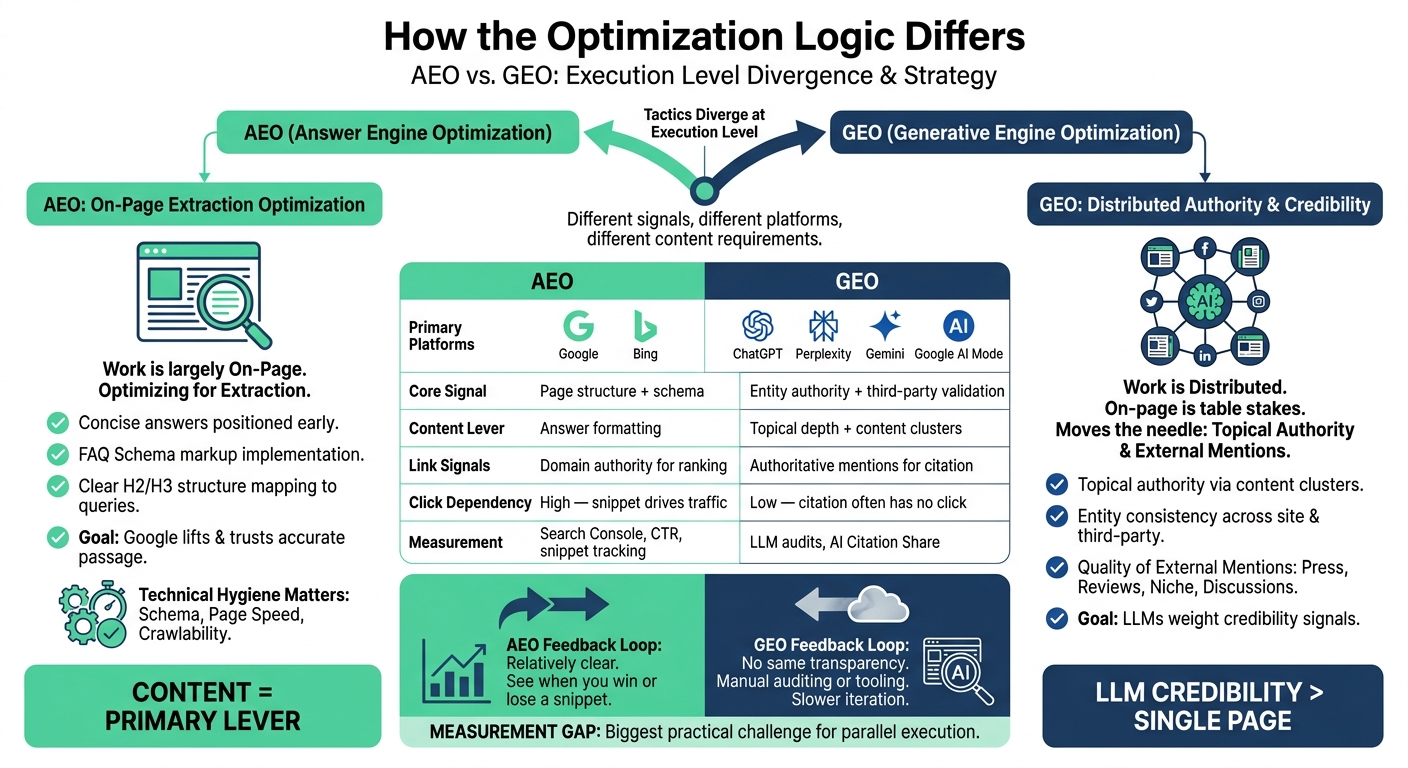
For AEO, the work is largely on-page. You’re optimizing for extraction: concise answers positioned early in the content, FAQ schema, clear H2/H3 structure that maps to how people phrase queries. Google needs to be able to lift a passage and trust it’s accurate. Technical hygiene matters, schema markup, page speed, crawlability, but the content itself is the primary lever.
For GEO, the work is distributed. On-page content still matters, but it’s table stakes. What moves the needle is topical authority built across a content cluster, entity consistency across your site and third-party properties, and the quality of external mentions, press coverage, review platforms, niche publications, community discussions. LLMs weight credibility signals that no single page can manufacture alone.
The platform split makes this concrete:
| Aspect | AEO | GEO |
|---|---|---|
| Primary platforms | Google, Bing | ChatGPT, Perplexity, Gemini, Google AI Mode |
| Core signal | Page structure + schema | Entity authority + third-party validation |
| Content lever | Answer formatting | Topical depth + content clusters |
| Link signals | Domain authority for ranking | Authoritative mentions for citation |
| Click dependency | High — snippet drives traffic | Low — citation often has no click |
| Measurement | Search Console, CTR, snippet tracking | LLM audits, AI Citation Share |
One other difference worth flagging: AEO has a relatively clear feedback loop. You can see when you win or lose a snippet. GEO doesn’t offer that same transparency; you’re auditing model outputs manually or through tooling, which makes iteration slower and measurement harder.
That measurement gap is one of the biggest practical challenges for teams trying to run both in parallel.
Where AEO Wins?
Featured snippets aren’t dying. They’re just sharing the page with more things now.
Google still processes an estimated 8.5 billion searches per day, and a significant portion, particularly informational and navigational queries, still resolve in traditional SERP features. For categories like healthcare, legal, local services, and education, users aren’t opening ChatGPT. They’re searching, scanning, and clicking.
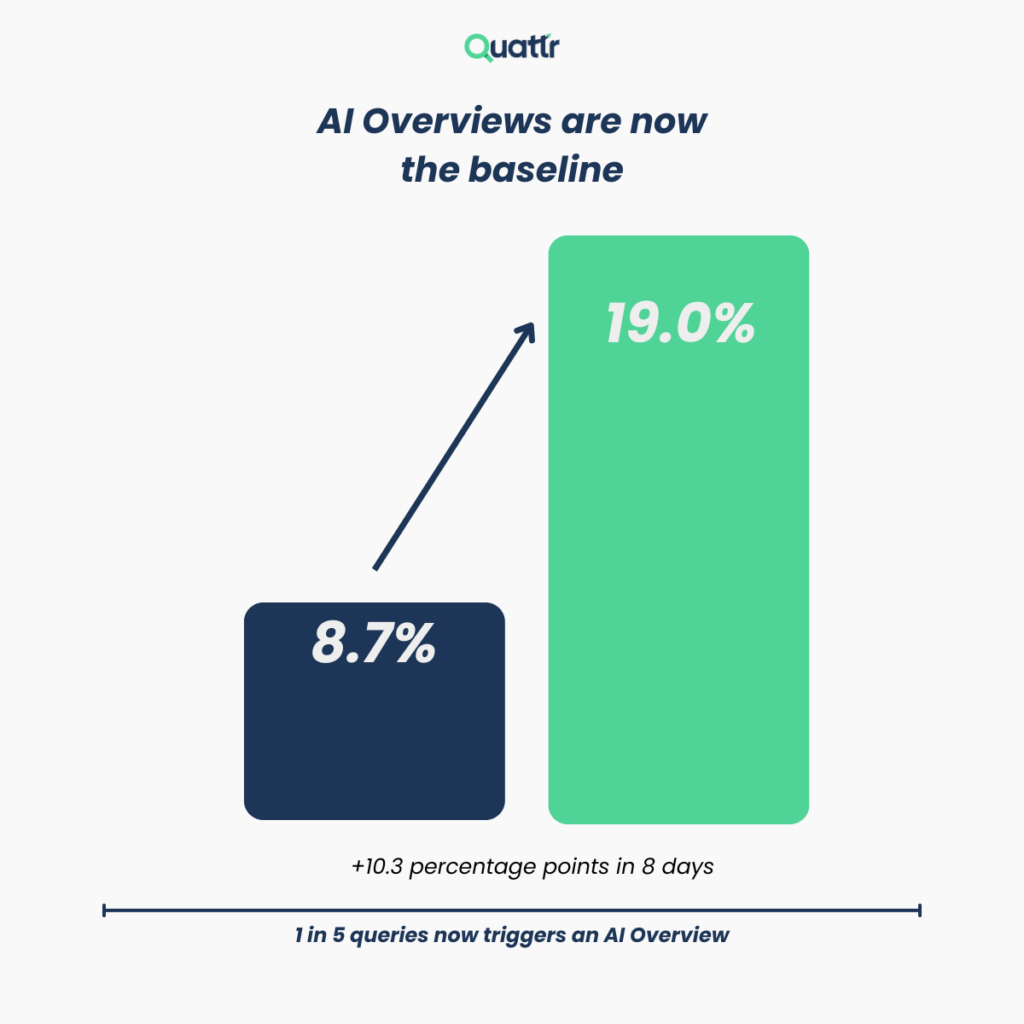
That said, the surface is compressing. Quattr’s Q1 2026 analysis across 14 enterprise portfolios found that AI Overview query share doubled from 8.7% to 19.0% in eight days following Google’s March core update and held. Nearly 1 in 5 queries now triggers an AI Overview, pushing traditional organic results further down the page.
Which means prioritization matters more than it used to. AEO still delivers clear ROI when:
- Query intent is transactional or local — “best accountant in Austin,” “how to file an LLC in Delaware”, these still resolve heavily in traditional SERP features
- Your audience isn’t using AI chat tools to research or compare, healthcare, education, and regulated industries still skew toward traditional search behavior
- You need a direct traffic feedback loop — snippet ownership is trackable in Search Console, attributable, and reportable in ways GEO signals currently aren’t
- Domain authority is a ceiling — up to 40% of featured snippet clicks go to pages outside the top three organic positions, meaning AEO can punch above your rank
The other underrated case for AEO: content built for extraction compounds. A well-structured FAQ doesn’t just win a snippet, it feeds People Also Ask, surfaces in voice search, and gets pulled into AI Overviews. The same asset does multiple jobs across surfaces.
Where GEO Changes the Game?
When an LLM generates a response, it’s drawing on a weighted synthesis of everything it knows about your brand — training data, indexed content, third-party mentions, review signals, and press coverage. Your on-page content is one input. Your broader digital footprint is the rest.
That changes what “optimization” means. You can’t schema-markup your way into an AI citation. What actually moves the needle:
- Topical authority through content clusters — LLMs weigh brands that cover a topic comprehensively, not brands with one well-optimized page
- Entity consistency — your brand, products, and key people need to appear the same way across your site, review platforms, and third-party publications
- Authoritative external mentions — press coverage, niche features, and community discussions all feed the credibility signals LLMs use to validate sources
The click dynamic is also different. A GEO citation may appear in an AI-generated answer with no link, no click, no attribution. Visibility and traffic are decoupled in a way traditional SEO never had to reckon with. That’s why AI Citation Share, how consistently your brand appears across AI-generated responses, becomes the metric that matters here.
The Q1 2026 data reinforces why this is urgent. UGC prevalence climbed from 38% to 42.7% during the March update window. LLMs and traditional SERPs are both shifting toward third-party validation signals. GEO is partly about your on-site content, and partly about what the broader web says about you. Most SEO teams have far less infrastructure for the second part.
What a Unified AEO + GEO Strategy Looks Like
The brands winning on both surfaces aren’t running two separate programs. They’re applying the same content fundamentals with different distribution logic, structured for extraction, deep enough for citation.
In practice, that means starting with your existing content before creating anything new.
Most sites have pages that rank but don’t convert on either surface, they’re not structured for snippets, and they’re not authoritative enough to earn AI citations. The highest-leverage move is usually restructuring what you already have.
CloudEagle did exactly that: 33 commercial pages, no new content published, just semantic internal linking and content restructuring through Quattr. The result was 113% organic click growth and a 3x increase in AI Citation Share in 12 weeks. The content existed. The architecture didn’t.
From there, the unified strategy has three layers:
Content structure for AEO — FAQ schema, question-framed H2s, concise answers positioned early in the content. Every page targeting an informational query should be built for extraction first.
Topical authority for GEO — content clusters that cover a topic end-to-end, not isolated pages. This is the difference between a brand an LLM cites once and a brand it treats as a default source. Simpplr built this out across 200+ pages with Quattr, developing topical content hubs that made them the #1 brand in organic traffic for employee intranet software, while cutting paid search reliance from 55% to under 30%. Topical depth reduced their cost per acquisition while expanding their AI surface simultaneously.
Entity and off-site signals for GEO — consistent brand naming across platforms, active presence in review ecosystems, and a deliberate PR and digital footprint strategy. This is where most SEO teams underinvest because it’s harder to attribute, but it’s what separates brands that get cited from brands that don’t.
The compounding effect matters here. AEO wins drive snippet visibility and traffic today. GEO investments build citation authority that pays out over months. Running both means you’re not betting the entire strategy on one surface that’s actively compressing.
Common Mistakes to Avoid When Implementing AEO and GEO
Most teams don’t fail because the strategy is wrong. They fail because the execution assumptions are off from day one.
- Treating AEO and GEO as the same thing. They’re not. One is a formatting problem, the other is a credibility problem. Applying the wrong fix to the wrong surface is how budgets disappear with nothing to show for it.
- Publishing new content before fixing what you have. Your highest-leverage move is almost always restructuring existing pages, not creating more of them. CloudEagle didn’t publish a single new page and still hit 113% click growth and a 3x lift in AI Citation Share. Audit before you build.
- Running AEO tactics on queries where GEO is the actual battleground. Featured snippet optimization on a query that resolves in an AI-generated answer is effort pointed at the wrong surface. Map your query portfolio first.
- Skipping off-site signals because they’re hard to attribute. Third-party mentions, press coverage, and review platforms are what separate brands that get cited from brands that don’t. Hard to attribute doesn’t mean optional.
- Celebrating mentions when citations are what matter. A mention means the AI recognizes your brand. A citation means it trusts your page enough to send users there. High mentions, low citations is a content structure problem, and it’s fixable, but only if you’re tracking both.
- Splitting AEO and GEO across separate teams. Separate teams build separate roadmaps. That’s how you get duplicated work and gaps right where the two strategies should be reinforcing each other.
- Measuring GEO too early or not at all. Snippet wins show up in weeks. Citation share builds over months. Pulling back because you don’t see results in the first 30 days is a pacing error, not a strategy one.
- Thinking schema alone covers your GEO bases. Clean structured data helps AEO. It doesn’t move AI Citation Share. LLMs aren’t pulling snippets, they’re synthesizing from everything the web says about you. Schema is a floor, not a strategy.
Measuring Both Without Losing Your Mind
AEO measurement is straightforward. Search Console tells you which queries trigger snippets, CTR tells you if they’re driving clicks, and rank trackers show you when you win or lose a featured position. The feedback loop is tight enough to iterate on quickly.
GEO measurement is a different problem. There’s no native report that tells you how often ChatGPT cites your brand, or whether Perplexity treats you as a default source for your category. Most teams are either ignoring it or auditing LLM outputs manually — neither scales.
The metrics that matter on the GEO side:
- Citation rate — how often a tracked AI engine selects your URL as a source in response to a monitored query. This is the closest proxy to traffic generation from AI surfaces.
- Share of Voice — your proportion of AI answer-space relative to tracked competitors, weighted toward citations over mentions
- Mentions without citations — brand references in AI answers that don’t include a link. High mentions with low citations is a content structure problem, not a credibility problem — and it’s fixable.
Quattr’s AI Visibility Dashboard tracks all four signals, Citations, Share of Voice, Mentions, and Sentiment, across ChatGPT, Google AI Mode, Gemini, Perplexity, and Claude. The toggle between branded and non-branded prompt sets is particularly useful: non-branded tracking tells you how well you’re being cited on category-level queries, which is the actual measure of AI discoverability for demand you haven’t captured yet.
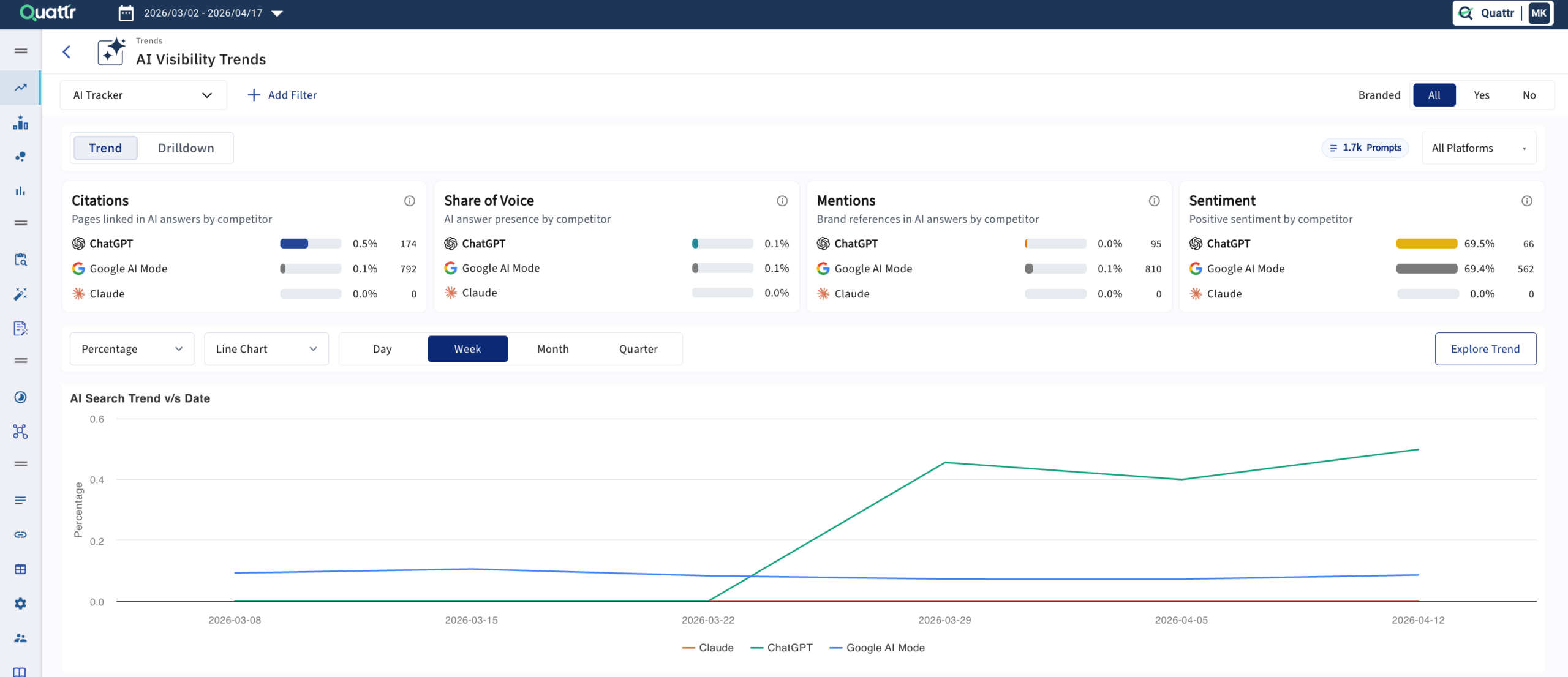
The drill-down by cited URL closes the loop between measurement and execution, once you know which pages are failing to get cited on specific prompts, you have a direct content brief, not just a number to report.
AEO and GEO Belong in the Same Room
Most enterprise SEO teams are running rank trackers, Search Console exports, and LLM audits in parallel, with no unified view of how performance on one surface connects to the other. Queries that need a citation-first strategy get treated the same as queries where snippet optimization still drives clicks. Budget goes to the wrong places. Reporting tells an incomplete story.
Quattr connects both surfaces in a single workflow, from content diagnosis to execution to AI visibility tracking, so the insight and the fix live in the same place.
- AI Visibility Dashboard — Citation rate, Share of Voice, Mentions, and Sentiment across ChatGPT, Google AI Mode, Gemini, Perplexity, and Claude in one view
- GIGA AI Agent — identifies and closes content gaps that prevent pages from being cited in AI-generated answers
- Semantic Internal Linking — builds the topical architecture that both search engines and LLMs use to validate authority
- Content Optimization Workflows — restructures existing pages for snippet extraction and AI retrieval without requiring new content
- Competitive Trends — tracks how your citation share moves relative to competitors, per model, per query segment
- E-E-A-T Intelligence– that not only tells you the gap but let’s you fix it in one click.
One platform. Both surfaces. No manual stitching.
FAQs on AEO Vs GEO
Not exactly. AEO is a specific subset of SEO that focuses on winning direct answer formats, featured snippets, knowledge panels, and People Also Ask. Standard SEO optimizes for ranked positions. AEO optimizes for answer extraction. The tactics overlap, but the goal is different.
Technically, yes, but in practice, your AEO work accelerates GEO. Well-structured, authoritative content that wins snippets sends the same credibility signals LLMs use to evaluate citation-worthiness. Starting with GEO on a weak content foundation is harder than building both in parallel.
Longer than AEO. Snippet wins can appear in weeks. AI citation share builds over months; it’s tied to how consistently your brand appears across indexed content, third-party mentions, and entity signals.
A citation means an AI engine linked to your specific URL in its response. A mention means your brand was referenced without a direct link. Mentions indicate brand recognition. Citations indicate retrieval authority; the AI engine trusts your page as a structured source worth sending users to.
No, and you shouldn’t. The teams that execute both well treat them as one integrated content strategy with two measurement tracks. Separate teams create separate roadmaps, which leads to duplicated work and gaps in the middle.

Quattr is an AI-native Search Visibility Platform founded in Palo Alto, California, built for mid-market and enterprise brands competing in the age of generative search. Recently recognized across G2's Spring 2026 reports with #1 rankings in AEO Results, Usability, and Relationship, Quattr helps brands win visibility across traditional search and AI-generated answer surfaces.
Quattr's AI agent, GIGA, evaluates content the way AI systems do, identifying gaps across structure, authority, internal linking, and discoverability to surface the highest-impact fixes. With capabilities like autonomous internal linking, E-E-A-T intelligence, and the new GIGA Landing Page Generator for keyword-matched, AI-search-ready pages, Quattr helps teams move from diagnosis to deployed changes without manual bottlenecks.