

Enterprise content programs move in a predictable sequence: keyword validated, brief written, research gathered, page still not live. The distance between a confirmed search opportunity and a published URL runs through four teams, two revision cycles, and a CMS queue that operates on its own timeline.
While that queue moves, ChatGPT cites a competitor’s page. Perplexity surfaces the category leader. Google’s AI Overview selects its reference source. The opportunity window that justified the keyword in the first place closes before the page that was built for it ever publishes.
This is not primarily a speed problem. It is a structural problem. The tools most content teams use to build landing pages were designed for a search environment where ranking and retrieval were the same thing, where a page that satisfied Google’s ranking factors would also show up everywhere that mattered. That is no longer true.
AI search systems operate on a separate grading model: entity completeness, factual grounding verified against external sources, E-E-A-T signals including author credentials and trust indicators, and inline citations that retrieval models can trace back to authoritative documents. A page that ranks in position two on traditional Google can be completely absent from AI Overview on the same query, because the two systems grade different criteria.
The keyword gap most teams are diagnosing in their traffic reports is actually a retrieval gap, and it will not close by publishing faster into the same workflow.
Why Standard Landing Page Tools Don’t Fix This
Traditional page builders
Unbounce, Instapage, and Leadpages are design tools. They give you a drag-and-drop editor, A/B testing infrastructure, and hosting. They do not generate content, do not conduct competitive research, and have no awareness of what AI search is currently retrieving on your target keyword.
You bring the keyword, write the brief, hire the copywriter, and hand the finished copy to a designer who assembles it inside a template. The tool is the last ten percent of a workflow that was already broken.
AI code generators
Tools like Lovable, Bolt, v0, generate pages from prompts at speed. The output is technically complete: modern stack, responsive layout, deployable. It has no knowledge of your keyword strategy, no connection to your competitive landscape, and no grounding in your product documentation.
The AI writes from its training data, which means the content is generic by construction. A page built in Lovable from a prompt knows nothing about the query it is supposed to rank for, the competitors it is supposed to outposition, or the E-E-A-T signals that determine whether an AI search system will cite it.
Generic AI writing tools
Jasper, Copy.ai, ChatGPT, generate copy. They do not generate pages. The output is text that still requires a designer to build into a layout, a developer to structure for CMS, and an SEO strategist to audit for retrieval signals.
Assembly is required at every stage after the writing is done, which means the handoff tax that exists in the current workflow is not removed; it is deferred to after the AI has drafted.
None of the three categories closes the structural gap between a validated keyword and a published, retrieval-ready page. Each solves a subset of the problem while leaving the rest of the production chain intact.
The GIGA Landing Page Generator
The GIGA Landing Page Generator is an agentic workflow inside Quattr’s GIGA AI Agent that takes a keyword, one you already have or one the platform surfaces from live demand signals, and produces a fully structured, brand-consistent, retrieval-ready landing page without leaving the platform.
It does not start where page builders start. It starts at the decision layer, before the keyword is confirmed, and it does not hand off until the page is generated, reviewed, and ready to publish. The research, the brief, the structure, the content, and the audit all run inside the same supervised session.
Quattr’s GIGA Landing Page Generator is the only tool that natively optimizes pages for Generative Engine Optimization, analyzing what AI surfaces are currently retrieving and building the page structure to match, before a word is written.
The Five-Stage Workflow
Stage 1 — Keyword Intelligence and SERP Analysis
Most landing page tools assume your keyword strategy is complete before you open them. GIGA does not.
Bring a target keyword or let Quattr surface the highest-opportunity term from live demand signals. Once confirmed, GIGA immediately analyzes search results across eight traffic sources, Classic Google, Google AI Mode, Google AI Overview, ChatGPT, Perplexity, Gemini, Claude, and Bing, to map which pages are being surfaced, cited, and retrieved at the moment your page is being planned. You select which surface to optimize against based on what matters for that specific page.
This is not a keyword difficulty score. It is a real-time retrieval picture tied to the exact term you are building for, validated and analyzed inside the same workflow where the page will be built. No tool-switching. No CSV export.
Stage 2 — Page Structure and Design System
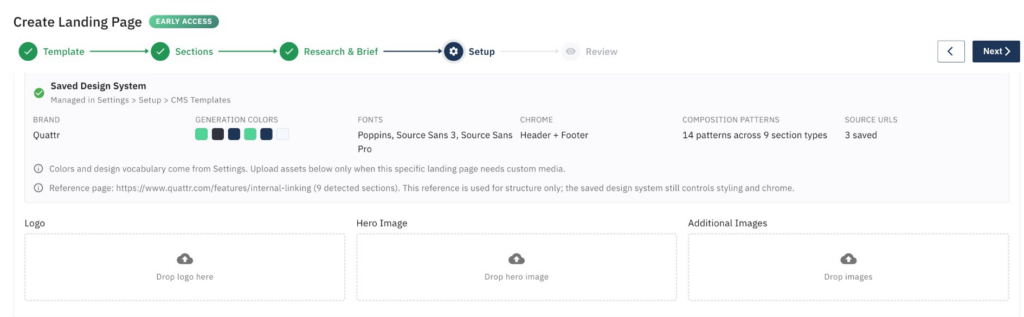
GIGA analyzes a reference URL and detects its Section DNA, Hero/Headline, Social Proof, Pain Points, Features, Trust Badges, Process/How It Works, Final CTA, and then uses it to scaffold the new page’s structure.
Your Saved Design System runs independently: brand colors, fonts, component patterns across different section types, Header, and Footer chrome. Reference pages inform the structure. Your brand governs style. The two do not override each other.
Stage 3 — Grounded Research and Human-Approved Brief
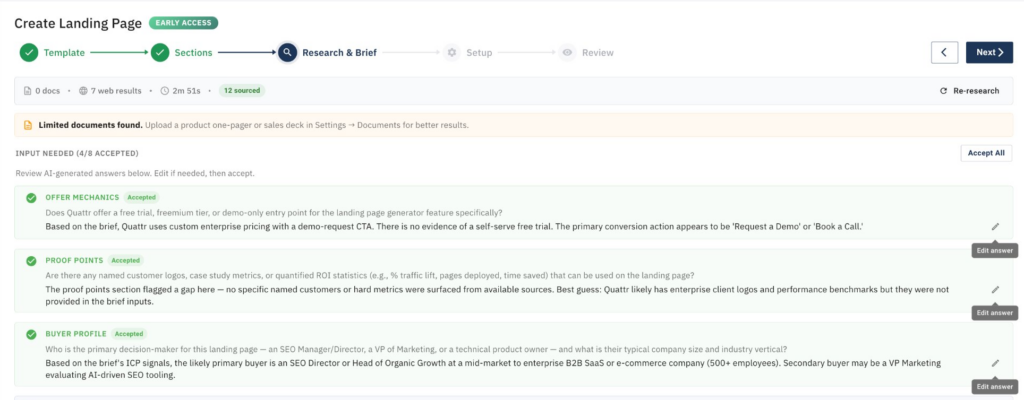
Before generating copy, GIGA reads uploaded product documents, brand guidelines, and live web sources to answer eight brief inputs: Offer Mechanics, Proof Points, Buyer Profile, Differentiators, Objection Handling, Internal Link Candidates, Competitive Positioning, and Page-Level Messaging.
Every AI-generated answer surfaces individually. You accept it, edit it, or reject it. The workflow does not advance on an answer you have not approved. This is not prompt-to-page generation. It is knowledge-grounded content production with a human at every decision point.
Stage 4 — Creative and Visual Generation
GIGA generates section-level visuals using OpenAI and Gemini image models, matched to the messaging and intent of each section. Upload your own product imagery and brand assets, or generate campaign-ready visuals per section with custom instructions. Creative does not require a separate design request or a stock image search.
Stage 5 — Review and Single-Pass Generation
The Review stage presents the complete configuration before generation runs: 7-section template structure, campaign identity, value proposition, messaging context, design system summary, and sourced documents. Every element is visible and editable.
When confirmed, hit Generate, and the full page is produced in a single pass.
Quattr GIGA vs. Standard Landing Page Builders
| Capability | Page Builders | AI Code Generators | AI Writers | Quattr GIGA |
|---|---|---|---|---|
| Visual landing page output | Yes | Yes | No | Yes |
| AI content generation | No | Generic/prompt-only | Generic/prompt-only | Knowledge-grounded |
| Competitive research | No | No | No | Automated, multi-surface |
| SEO and AEO content scoring | No | No | No | Built-in, 9-category audit |
| Brand design extraction | No | No | No | Learn-from-URL |
| Keyword-driven strategy | No | No | No | Core workflow, Stage 1 |
| Self-contained HTML export | No | Framework-dependent | No | One-click |
| No-code workflow | Yes | No | Yes | Yes |
| AI retrieval optimization | No | No | No | 8-surface analysis |
| Human approval at each stage | No | No | No | 5-stage sign-off |
Three Advantages Worth Leading With
1. Research runs before writing, not after
Page builders and AI writing tools start from a blank prompt or a template. GIGA starts from a live competitive intelligence pass on the target keyword, what is ranking, what is being cited in AI search, and where the structural gaps are. The content that is generated is positioned against actual competitors, not assembled from training data with no market context.
2. AI search is a separate grading system — GIGA builds for both
In 2026, appearing in a Google AI Overview or a ChatGPT response carries retrieval weight that a traditional blue link ranking does not. The grading criteria are different: entity completeness, factual grounding, E-E-A-T signal depth, and extractable section structure that citation models can parse.
GIGA’s 9-category content audit, which includes four E-E-A-T dimensions, verifies these signals before the page publishes. An Opus-class judge filter removes low-confidence findings before they surface, so every flagged item is worth acting on.
3. Closing the execution gap at the moment it matters
The brief exists. The competitive data is available. The page isn’t live because the execution layer, copy to design to CMS, broke somewhere after the keyword was confirmed. GIGA compresses that sequence into a single supervised session, which means the page goes live while the retrieval opportunity is still open, not six weeks after the SERP has already settled.
What Each Team Gets
SEO Directors and Heads of Organic Growth get pages calibrated against what AI search is currently surfacing, not a six-week-old competitive snapshot. Selecting the right traffic source and analyzing what it currently retrieves is built into the creation workflow itself, not a separate audit step.
Content and Demand Generation Teams get a brief grounded in actual product documents, approved before a word is written, and an execution cycle that compresses from weeks into a single session.
Web and Publishing Teams get a page that arrives CMS-ready: brand system applied, section structure confirmed, no design handoff required.
See It in Action
Pick three landing pages that should be live but aren’t. Run them through the GIGA Landing Page Generator and see what the execution gap has been costing you in retrieval share.
FAQs on Quattr’s AI Native Landing Page Generator
AI writing tools generate text from prompts and produce no visual output, no HTML, and no page structure. You still need a designer and developer to turn the copy into a live page. GIGA generates from uploaded knowledge, your product documents, brand guidelines, competitive SERP data, with a human approval gate at every stage, and delivers a self-contained, published page at the end of the same session.
Page builders are design tools. They give you a template and a drag-and-drop editor; they do not generate content, conduct competitive research, or analyze what AI search is currently retrieving on your target keyword. GIGA starts at keyword selection and handles research, brief, structure, content, and audit inside one workflow. The builder is not the handoff destination; it is removed from the process entirely.
Reference pages influence section structure and order only. Your Saved Design System remains the style authority regardless of which reference page is active. The two operate independently and do not conflict.

Quattr is an AI-native Search Visibility Platform founded in Palo Alto, California, built for mid-market and enterprise brands competing in the age of generative search. Recently recognized across G2's Spring 2026 reports with #1 rankings in AEO Results, Usability, and Relationship, Quattr helps brands win visibility across traditional search and AI-generated answer surfaces.
Quattr's AI agent, GIGA, evaluates content the way AI systems do, identifying gaps across structure, authority, internal linking, and discoverability to surface the highest-impact fixes. With capabilities like autonomous internal linking, E-E-A-T intelligence, and the new GIGA Landing Page Generator for keyword-matched, AI-search-ready pages, Quattr helps teams move from diagnosis to deployed changes without manual bottlenecks.