

Performance marketers running high-intent paid campaigns typically send that traffic to one of two destinations: a homepage that was not written for the search query, or a category page that approximates the keyword without matching it. Both choices generate the same consequence. Google grades landing page experience on keyword relevance and content depth, and a generic page fails both criteria on every ad group where the keyword and the page were never built together.
The suppressed Quality Score is visible in the platform. GIGA Landing Page Generator builds a keyword-matched page configured for the specific platform you’re buying on, with section-level creative generated against the same keyword intent, in a single supervised session, without a design or development handoff.
AI search systems, Google AI Overview, ChatGPT, and Perplexity are now retrieving pages for the same high-intent queries that performance marketers bid on. A team buying “enterprise contract management software” is not only competing in the Google Ads auction; the same keyword is generating an AI-retrieved answer somewhere above or alongside the paid result.
The page that gets cited in that answer is one that is entity-complete, factually grounded, and structurally matched to the query. A generic homepage or a repurposed product page does not meet those criteria, meaning the paid keyword is losing in the auction and is invisible in AI retrieval for the same structural cause.
Building a keyword-matched page closes both gaps at the same time. The challenge is that building one currently costs more than the campaign budget justifies.
Why Existing Tools Don’t Solve the Production Problem
Traditional page builders, Unbounce, Instapage, and Leadpages, require a copywriter, an SEO strategist, and a designer to produce a page that performs on a specific keyword. The builder handles the visual layer; you still write every headline, paragraph, and CTA from scratch, with no access to competitive research, no keyword-to-structure mapping, and no audit of what AI search is currently retrieving on the query.
For performance marketers running campaigns across ten ad groups, this means ten full production cycles with no shared infrastructure between them.
AI code generators, Lovable, Bolt, v0, produce pages fast. The output has no knowledge of your keyword strategy, your competitive position, or your product documentation. The AI writes from training data, which means the content is generic by construction, and the page has no structural relevance to the specific query it is supposed to match. The output also requires React or Node infrastructure to deploy, which is a development dependency that paid media teams cannot absorb mid-campaign.
Generic AI writing tools, Jasper, Copy.ai, and ChatGPT, generate copy from prompts. They produce no visual output, no HTML, and no page structure. The copy still requires a designer to build it into a layout and a developer to push it live.
For a performance marketer who needs a matched page published before the campaign flight starts, this is the same four-team handoff with an AI copy pass inserted at the front.
None of these categories produces a keyword-matched, grounded, published page without a production chain that takes longer than most campaign timelines can accommodate.
How Quattr’s Landing Page Generator Generates Keyword-Matched Pages for Paid Campaigns
GIGA’s five-stage supervised workflow starts at the keyword and ends at a published, self-contained HTML page, in a single session, without requiring design or development resources.
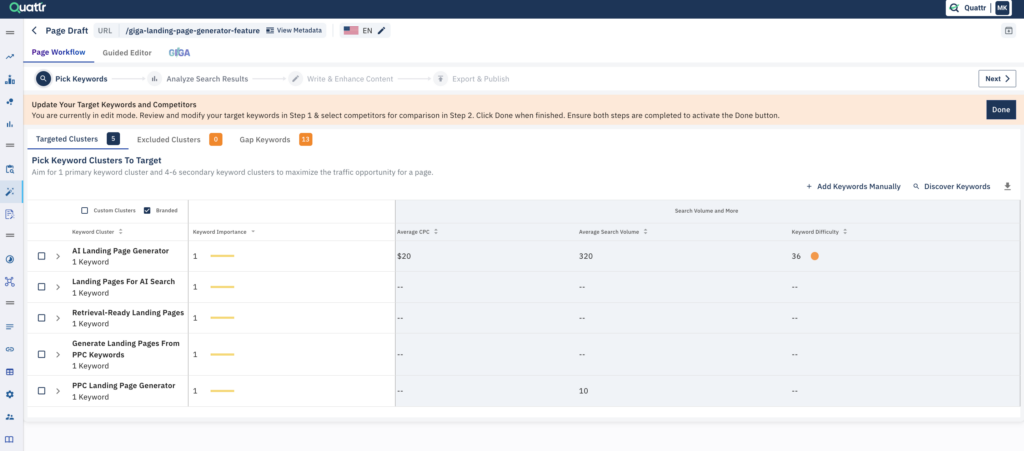
Stage 1 — Keyword Validation
Bring the exact keyword your campaign is buying, or let Quattr surface the highest-opportunity term from live demand signals. The keyword is validated inside the same workflow where the page will be built. The paid intent behind the keyword, transactional, comparative, and product-specific, shapes every downstream stage.
Stage 2 — Multi-Surface Competitive Analysis
GIGA analyzes the search result landscape across eight surfaces: Classic Google, Google AI Mode, Google AI Overview, ChatGPT, Perplexity, Gemini, Claude, and Bing. For a paid keyword, this means you see what is currently ranking on traditional search, what is being cited in AI search, and where the structural gaps are between the current top pages and a page you could build. You select which surface to optimize against based on the campaign’s primary channel.
Stage 3 — Page Structure from Reference URL
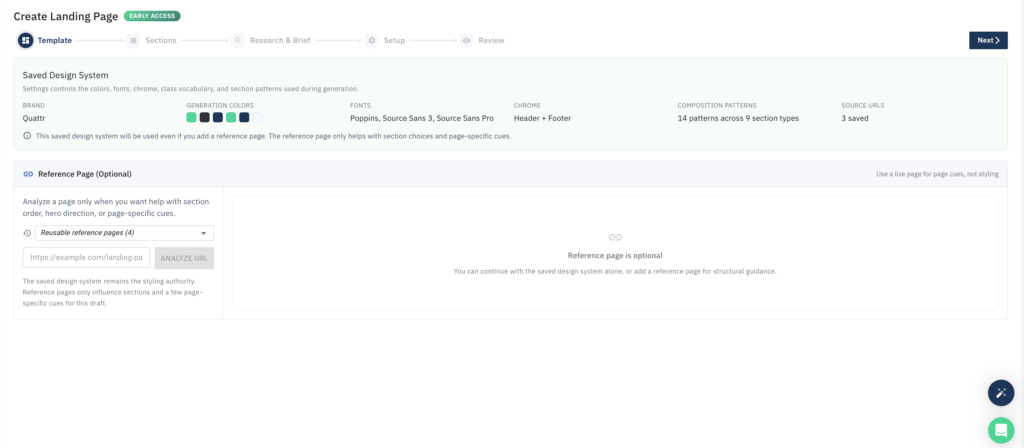
GIGA analyzes a reference URL, your highest-performing page, a competitor’s page, or your homepage, and extracts its full Section DNA: layout, structure, content flow, and conversion patterns. The page that generates isn’t approximating the reference; it’s structurally aligned to what already converts on that keyword. Your Saved Design System handles brand color, typography, and component patterns independently.
Stage 4 — Grounded Brief, Paid Platform Configuration, and Human Approval
Before generation begins, GIGA synthesizes product documentation, brand guidelines, live competitive sources, and campaign-specific requirements into a structured landing page brief. Performance marketers configure ad platform, Google Ads, Meta, LinkedIn, geo-targeting, and regulated industry requirements directly inside the workflow.
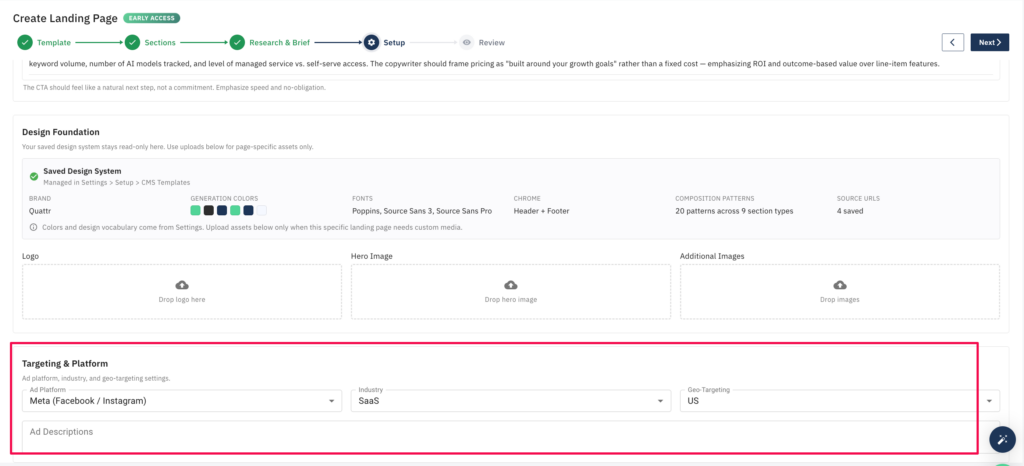
This ensures every generated page is aligned not only to the keyword, but also to the policy mechanics, compliance standards, and conversion expectations of the paid platform where spend is deployed.
Every brief input, offer, claim, and compliance requirement is individually reviewable before generation advances.
Stage 4.1— Creative and Visual Generation
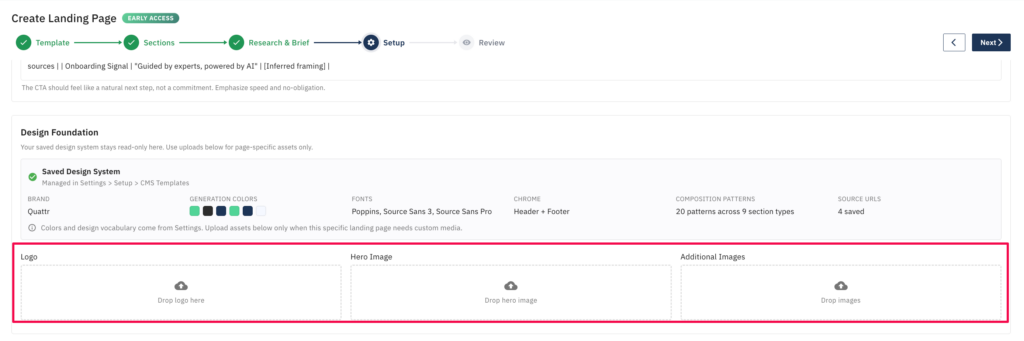
GIGA generates section-level visuals aligned to the keyword intent and campaign messaging using OpenAI and Gemini image models. Upload product imagery and brand assets per section, or generate campaign-ready visuals with custom instructions. No separate design request at any stage.
Stage 5 — Review and Single-Pass Generation
The complete configuration, section structure, campaign identity, value proposition, messaging, design system, and source documents are presented for review before generation runs. When confirmed, the full page generates in a single pass and delivers as self-contained HTML: one-click download, or direct CMS publish. The page is ready to be set as the destination URL in your campaign, in the same session it was built.
Built for Paid Platform Mechanics, Not Just Page Generation
Most landing page tools stop at design or copy. GIGA configures every landing page against the real operational mechanics of the paid platforms, driving your campaign before generation begins.
Whether you’re launching through Google Ads, Meta, LinkedIn, or regulated paid channels, GIGA aligns each page to the platform-specific requirements that determine approval, performance, and scalability.
Platform-specific configuration includes:
- Google Ads message match, landing page relevance, and Quality Score factors
- Meta ad compliance, conversion framing, and policy safeguards
- LinkedIn lead generation structure for B2B performance campaigns
- HIPAA, FINRA, Legal, and Real Estate compliance standards
- Claims substantiation, disclosures, and policy-specific trust requirements
The result: Every page is not just built for the keyword, it is built for the platform buying the click.
Every Page Is Audited Before Launch
Before a page goes live, GIGA runs a full content audit to validate whether the page is truly ready for paid deployment, AI retrieval, and enterprise compliance.
Automated audit checks include:
- Brand consistency
- Factual grounding
- Claims validation
- Compliance accuracy
- Conversion performance blockers
- Paid platform policy risks
The result:
Performance teams launch faster, reduce legal bottlenecks, minimize ad disapproval risk, and deploy pages with greater confidence across paid and AI search ecosystems.
Quattr’s Landing Page Generator vs. the Three Tool Categories
| Capability | Page Builders | AI Code Generators | AI Writers | Quattr GIGA |
|---|---|---|---|---|
| Keyword-matched page generation | No | No | No | Core workflow |
| Content grounded in product docs | No | No | Prompt-only | Automated, multi-source |
| Competitive SERP analysis | No | No | No | 8-surface, real-time |
| AI search retrieval optimization | No | No | No | Built-in, pre-publish |
| Brand-consistent output | Template-only | Generic | No output | Learn-from-URL |
| Self-contained HTML (no dev required) | No | Framework-dependent | No | One-click export |
| No-code workflow | Yes | No | Yes | Yes |
| Time-to-published page | Days to weeks | Hours (dev required) | Copy only | One session |
| Human approval at each stage | No | No | No | 5-stage sign-off |
Three Advantages for Performance Marketers
1. One keyword, one session, one live page
The production constraint on keyword-matched landing pages is not strategic; it is operational. Writing a specific LP for every ad group requires a brief, a copywriter, a designer, a developer, and a review cycle. GIGA compresses that into a supervised session where the paid media team is the only approver. The page is live before the campaign flight opens.
2. Keyword-matched pages win on two grading systems simultaneously
Google grades landing page experience on keyword relevance, content depth, and structural coherence, the same signals that AI search uses to determine retrieval eligibility. A page built around the exact keyword you are buying, grounded in your product documentation, and structured for entity completeness, satisfies both grading systems from the same asset. The paid keyword earns a better Quality Score in the ad auction and earns retrieval in AI search without requiring two separate pages or two separate production cycles.
3. Competitive intelligence runs before the page is structured
Most campaign LPs are built by briefing a copywriter on the product, not on the competitive SERP. GIGA’s Stage 2 analysis shows what top-ranking and top-cited pages are saying on the exact keyword before a single section is planned, which means the page that is generated is positioned against the actual competitive landscape, not assembled from the campaign brief alone.
What Each Role Gets
Performance Marketing Managers get a keyword-matched page live before the campaign starts, without waiting on design or development resources. Quality Score improves because the page is built for the keyword, not repurposed from one that approximates it.
Paid Media Agencies managing campaigns across multiple clients get a scalable production workflow where a matched page for each ad group or keyword cluster is a session’s work, not a sprint’s work. The Learn-from-URL feature clones brand structure from any existing page, which means client brand continuity does not require a design asset handoff for every new page.
Demand Generation Teams running paid and organic campaigns on the same keyword get a single page that is optimized for both, meeting the Quality Score requirements of the paid auction and the retrieval criteria of AI search surfaces that are increasingly appearing on the same SERP.
Try It on Your Next Campaign
FAQs on PPC Landing Page Generator
The keyword is Stage 1 of the workflow, not an input you add to a template at the end. GIGA’s SERP analysis in Stage 2 reads what is currently ranking and being cited on that specific keyword. The brief in Stage 4 is answered with content grounded in your product documentation against the competitive context of that keyword. Every section of the page is built around the query, not adapted from a page that was written for a different intent.
GIGA outputs self-contained HTML with all CSS inlined. The platform configuration stage, where you set ad platform, geo-targeting, and campaign requirements, runs before generation, so the output is already structured for the platform it will run on. Download and upload directly, set as a destination URL, or publish to WordPress via Gutenberg. No developer required.
Page builders handle the design layer only. You still write every headline and paragraph, conduct your own competitive research, and manage the SEO and retrieval optimization separately. GIGA handles research, brief, structure, content, and audit inside the same workflow, with human approval at each stage. The design system is applied automatically from a reference URL; no template selection is required.
Each GIGA session produces one page for one keyword. For campaigns with multiple ad groups, you run one session per keyword cluster. Because the brand design system and reference URL are saved, subsequent sessions inherit the same structural and visual baseline; only the keyword, brief, and competitive analysis change between pages.
For each client, you set a reference URL from their existing highest-performing page. GIGA extracts the Section DNA, structure, layout order, and content hierarchy, and your client’s brand design system handles color, typography, and component patterns. New pages for that client inherit both automatically. You are not rebuilding the brand configuration for every campaign; you are generating a new keyword-matched page on top of a saved baseline.

Quattr is an AI-native Search Visibility Platform founded in Palo Alto, California, built for mid-market and enterprise brands competing in the age of generative search. Recently recognized across G2's Spring 2026 reports with #1 rankings in AEO Results, Usability, and Relationship, Quattr helps brands win visibility across traditional search and AI-generated answer surfaces.
Quattr's AI agent, GIGA, evaluates content the way AI systems do, identifying gaps across structure, authority, internal linking, and discoverability to surface the highest-impact fixes. With capabilities like autonomous internal linking, E-E-A-T intelligence, and the new GIGA Landing Page Generator for keyword-matched, AI-search-ready pages, Quattr helps teams move from diagnosis to deployed changes without manual bottlenecks.