
Quattr MCP at work · Rankings
Is keyword cannibalization hurting your rankings?
Cannibalization means two of your own pages compete for one search, and it only hurts when both answer the same need and keep trading positions, so neither settles. Pages doing different jobs can share a query harmlessly. Sort real fights from harmless overlap before merging anything. In the video, only two of the flagged queries were real fights.
The recording below is the whole workflow: 3 ordinary questions, asked in an AI chat with Quattr connected.
On some queries, your toughest rival is your own other page.
◐ Recreated from an anonymized sessionFind your real fights, spare the rest
This run
In this video, it splits real ranking fights between a site's own pages from pairs that coexist fine.
What the run returned
The numbers set the scope of the problem; the decision names the work that moves it.
Run the same analysis in a Quattr-connected AI chat
Three prompts, copied exactly as written; the video shows what comes back.
Requires the Quattr MCP connection to read your organization's data. The prompt alone will not return your numbers.
- Prompt 1 Are any of our pages competing with themselves?
- Prompt 2 Which of those are really fighting, and which are on purpose?
- Prompt 3 So what do we do with the two real fights?
How Quattr produced the answer
An ordinary question, answered from your own named sources.
Quattr MCP is the read-only bridge between your AI client and Quattr's connected search data and analytical tools. Agents and Skills turn those tools into repeatable search work.
How the Quattr MCP works → See these sources joined in one answer →
When do two of your own pages hurt each other?
Five situations; each with the sign that reveals it and the fix that moves it.
01Two pages answer the same question
When two of your own pages serve one search need, Google cannot settle on either, so both hover lower than one strong page would. You will see the pair trading positions for months with neither climbing. The fix: merge the weaker page into the stronger one, or rewrite one to answer a clearly different question.
02An old page was never retired
Sites collect posts and landing pages on the same topic over the years, and the old one keeps ranking just well enough to interfere. You will see a years-old page surfacing under the same search as its replacement. The fix: redirect the old page into the new one and move its remaining links across.
03The overlap is there on purpose
A sign-in page beside a brand page, or a storefront beside a help article, can share a search while doing different jobs. You will see both pages holding steady positions all quarter with no trading. The fix: label the pair as intentional and leave it alone, because coexisting is working.
04The split is costing real clicks
Impressions divided across two mid-page results earn far fewer clicks than one result placed higher. You will see a large shared search with neither of your pages reaching the top spots. The move: price each fight in clicks a quarter, and let that number decide which reviews happen first.
05A flag turns into an automatic merge
A shared search is a candidate for review, never proof, and merging a page that was coexisting fine deletes traffic it quietly earned. You will see traffic drop after a merge nobody measured before and after. The fix: review each flagged pair for intent first, and measure any merge you do make.
Transcriptmachine-transcribed · corrected for product terms
0Publish long enough and it happens to everyone.
3Two of your own pages end up chasing the same search,
6and the rival above you is you.
8Let us go find ours.
10So, we ask the question directly.
14Are any of our pages competing with themselves?
17It scans our non-branded queries
20for the ones where more than one of our own pages draws impressions.
26Four queries, and on every one of them,
29two of our own pages are splitting the demand between themselves.
34The biggest splits, 84,000 impressions,
37across two of our own guides,
39but sharing a query is not a crime.
41So, one more read decides which of these are real fights.
46And that read is the question most tools skip.
49Which pairs are fighting and which are there on purpose?
53It checks whether each pair keeps trading rank,
56and whether the two pages are doing the same job or different ones.
1:02And here the list splits itself in half.
1:05Two of the pairs swapped places all quarter long,
1:08the other two never moved at all.
1:10The swappers do the same job,
1:13so Google cannot pick one and neither page settles.
1:16The steady pairs only look like rivals.
1:19A storefront beside a help article is not a fight, it is coverage.
1:24So that leaves us with just the two real fights,
1:27and it brings us to one last question.
1:30What would fixing those two actually be worth?
1:33It prepares the review list, and it is careful here.
1:37A flag is a candidate for review, never emerge order.
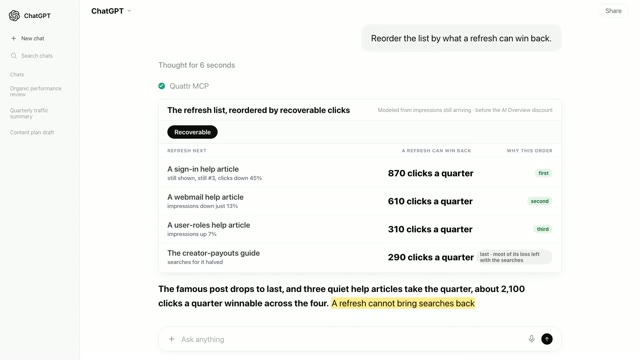
1:43Two candidates for this week's content review,
1:46worth about 4,000 clicks a quarter between them.
1:50And the pairs that were there on purpose are left alone.
1:54If the review agrees and the pages merge,
1:57the result gets measured properly before and after.
2:00No trend line eyeballing, and no merging pages that were never fighting.
2:06Two real fights found, and two false alarms cleared before anyone touched a page.
2:11That is the Quattr MCP.
2:13It finds the fights you are having with yourself,
2:16and knows which ones are not fights at all.
Frequently asked questions
Were the numbers in the video real?
This video is recreated from an anonymized session: the interaction is faithful to a real run on a connected account, and the figures shown have been changed or are illustrative rather than a customer’s own numbers.
Can the Quattr MCP check my site for pages competing with each other?
Yes. Connect Quattr to your AI chat once, then paste the three prompts above. The same sequence runs on your own queries: shared queries first, then which pairs trade rank and which coexist on purpose, then a review list with what each fight costs.
How does it tell a real fight from overlap that is fine?
It reads each shared query across the quarter and checks two things: whether the two pages serve the same need, and whether they trade positions or hold steady. Pairs that keep swapping rank while answering the same question are flagged; steady pairs doing different jobs are cleared. A flag is a candidate for review, never an automatic merge.
Where do these prompts run?
In any AI chat that can use connectors (the standard is called MCP). The prompt never names Quattr; the connection is what routes the question to your data, which is why it reads like an ordinary question.
What data can the Quattr MCP read?
Search Console clicks, impressions and rankings, web analytics, paid search, search market share against competitors, AI visibility across assistants, and Core Web Vitals. Every answer is pulled live from the connected account, so the numbers match what your dashboards show.
Find your real fights, spare the rest
Connect Quattr once and these prompts surface the queries where your own pages collide, split real fights from pairs there on purpose, and price each one in clicks.
Read-only · OAuth 2.1 · existing Quattr permissions · no API keys