

Key Takeaways
- AEO is not a replacement for SEO. You need both, but AEO is where the next wave of buyers is coming from.
- AI tools do not browse. They extract, compare and recommend. Your content needs to be built for that.
- AI agents are already completing purchases on behalf of people. If your product data is messy or incomplete, you lose a sale without ever knowing it.
- The traffic coming from AI tools converts significantly better than regular search traffic. These are high-intent buyers.
- Your reputation outside your own website matters. AI tools trust what others say about you more than what you say about yourself.
- Brands that started optimising for AI early are already pulling ahead. The gap is growing every month.
Google is no longer the only way people find products online. More and more buyers are asking AI tools to help them find, compare and even buy products. Some AI tools are already completing purchases on a buyer’s behalf, without them ever visiting a store.
This changes everything for ecommerce brands. Ranking on Google is still important. But if AI tools cannot understand your store, your products will be invisible to a growing number of buyers. Brands that started optimising for AI early are already pulling ahead, capturing higher-intent traffic, more sales and stronger visibility across AI answers. The gap is growing every month.
That is where AEO comes in. This blog covers what AEO is, why ecommerce stores need it and exactly what to do about it.
How AEO is Different from SEO?
SEO is about ranking on Google so people can find your website. You optimize your pages with keywords, backlinks and fast load times so that more people click on your link.
AEO is about making sure AI tools can read your content and recommend it when someone asks a question. Instead of showing links, these tools give a direct answer. You need to be that answer.
The biggest difference is who you are optimizing for. SEO targets human browsers who scroll, click and decide. AEO targets AI tools that extract information, compare options and sometimes complete purchases on their own, without a human ever visiting your site.
For ecommerce, this shift is critical. An AI shopping agent looking for “the best wireless earbuds under $100” does not browse Google results. It reads structured product data, checks specs and availability and picks a winner. If your store is not set up for AI to understand, you will not even be considered.
Why Should Ecommerce Brands Care About AEO?
The way people shop online is changing fast. AI tools are becoming the first stop for product discovery, not Google. And increasingly, these tools are not just making recommendations. They are completing purchases on their own. The numbers are hard to ignore:
- AI traffic to US retail websites grew by 4,700% year over year in July 2025.
- People coming from AI tools converted 42% better than those from regular search.
- AI agents drove 20% of global orders during the 2025 holiday season, worth $262 billion in sales.
People arriving through AI tools are not just browsing. They come in ready to buy. McKinsey projects that agentic commerce, where AI agents complete purchases on behalf of people, could reach $1 trillion in US retail by 2030.
ChatGPT shows products from retailers like Target, Sephora, and Best Buy and runs the largest AI product-discovery surface. Perplexity offers one-click “Instant Buy” checkout to all US users through a PayPal partnership. Amazon’s Rufus and Alexa+ can research, recommend, and even auto-buy items when a price drops below a threshold the shopper sets. Google has rolled out in-chat checkout across Search and Gemini. And voice assistants are now part of this too, with Alexa+ monitoring prices and automatically purchasing when thresholds hit. The buyer increasingly never lands on your site at all.
Retailers that started building for AI early already grew their sales faster than those that did not.
Getting your store AEO-ready is not optional anymore. It is how you stay visible as buying habits shift. But before jumping into what to do, it helps to understand why most ecommerce stores are already falling short, even the ones ranking well on Google.
Why does Ecommerce Content Fail AEO Even When It Ranks?
Ranking on Google and being recommended by AI are not the same thing. Here is why most ecommerce stores are missing the gap.
- Product descriptions are written to impress the reader and not to give them accurate inform. Words like “premium quality” and “best in class” mean nothing to an AI. AI tools look for specific facts like exact dimensions, materials and for whom the product is best suited. If your content does not answer these clearly, AI tools move on to a store that does.
- Pages are not structured for AI to read. AI tools do not browse like humans. They scan for structured data, clear headings and direct answers. If your product information is buried in long paragraphs or hidden in images, AI cannot extract it. No extraction means no recommendation.
- There is no FAQ or Q&A content. When someone asks an AI tool “which protein powder is best for beginners,” the AI looks for content that directly answers that. Most ecommerce pages have features and benefits but not answers to real buyer questions.
- Content is not built for agentic buying decisions. AI agents completing purchases on behalf of people need more than product descriptions. They need return policies, shipping timelines, stock availability and pricing clearly in one place. If that information is hard to find, the agent simply buys from a competitor.
To win in a world where AI tools are deciding what to recommend and what to buy, your content needs to be built for both machines and humans to read.
AEO Strategies That Work for Ecommerce
Here are the strategies that actually move the needle.
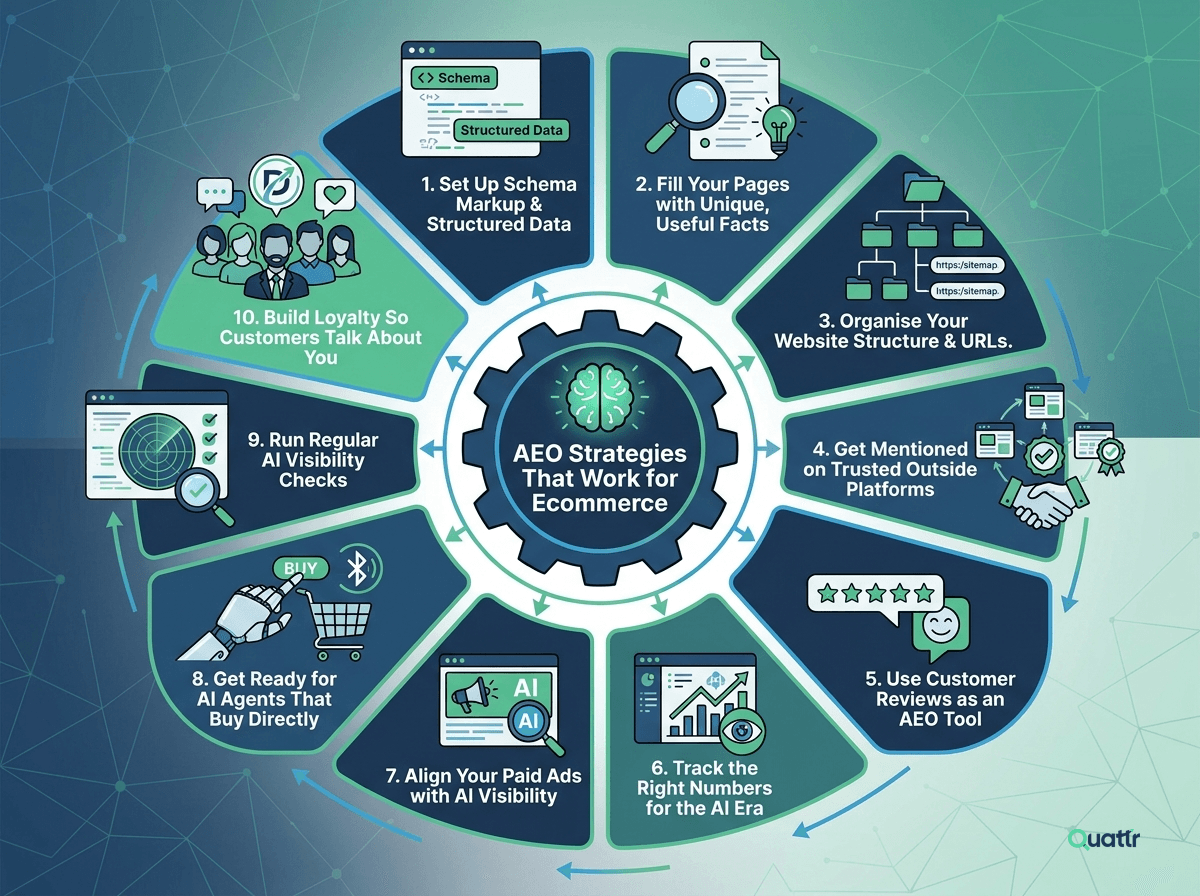
1. Set Up Schema Markup and Structured Data
Schema markup is a way of organising your product information so AI tools can read it without any confusion. Think of it as a label that tells AI exactly what your page contains, your product name, price, availability, reviews and shipping details.
When your data is structured well, AI tools can confidently pick it up and use it. Go beyond the basics. Add details like material, shipping policy and customer ratings. The more complete your structured data, the better your chances of being recommended.
2. Fill Your Pages with Unique, Useful Facts
AI tools are built to find the best answer, not the most popular one. If your product page repeats the same generic information found on ten other websites, there is no reason for an AI to choose you. Focus on adding information that is specific to your product and hard to find elsewhere.
Original specs, real usage data or honest comparisons give AI tools something worth citing. Quattr’s Content AI helps you create content that is factually rich and structured for AI tools to read, while keeping it readable for real people too.
3. Organise Your Website Structure and URLs
The way your website is built affects how well AI tools can understand it. Use clear, descriptive URLs that tell AI what the page is about, for example /womens-running-shoes/lightweight rather than /product?id=4829. Group your products into logical categories so AI tools can map what you sell and match it to the right buyer queries. A clean structure helps AI crawl your store faster and understand it better.
What this looks like in practice: Men’s Wearhouse
Men’s Wearhouse had good content but their blog pages were not connecting to product pages and AI tools had no clear path through their site. They used Quattr to fix this. Quattr’s GIGA Agent identified what needed restructuring and the Autonomous Linking API automatically built connections across the site, without any manual effort. The result was a 46% lift in product page clicks, 75% more Google AI Mode visibility and 50% more top-3 ChatGPT citations, all from making the site easier for AI to read and navigate.
4. Get Mentioned on Trusted Outside Platforms
AI tools do not just look at your website when deciding whether to recommend you. They also look at what others are saying about your brand on external platforms, blogs, press mentions and industry publications. Getting your brand mentioned in credible outside sources adds a layer of trust that AI tools respond to. Think of it as building a reputation that AI can verify, not just your own claims on your own website.
5. Use Customer Reviews as an AEO Tool
Customer reviews are one of the most powerful inputs for AI tools because they contain real, natural language that matches how buyers search. When someone writes “this sunscreen did not leave a white cast and felt light on the skin,” that sentence directly matches the kind of question a future buyer might ask an AI tool. Encourage your buyers to leave detailed, descriptive reviews. The more specific they are, the more useful they are for AI recommendations.
6. Track the Right Numbers for the AI Era
The old metrics like page views and organic traffic tell only part of the story now. Start tracking how often your brand or products are mentioned in AI generated answers. This is called share of citation and it shows you how visible you are in the places where buying decisions are increasingly being made.
Also pay attention to the quality of traffic coming from AI tools. People arriving through AI recommendations often convert at a much higher rate because they have already been pre-qualified by the AI.
7. Align Your Paid Ads with AI Visibility
When your brand appears in an AI generated answer, it builds trust with the person reading it. That trust carries over to your paid ads. Keep your product feed accurate and well-structured in Google Merchant Center so your ads appear alongside AI answers. The combination of being cited organically and appearing in ads creates a strong presence that is hard to ignore.
8. Get Ready for AI Agents That Buy Directly
This is where things are heading fast. AI agents are already completing purchases on behalf of people without the buyer visiting any store website. But “getting ready” is no longer vague advice. There are now specific checkout rails an agent uses to pay you, and your store needs to be plugged into them.
Understand the checkout protocols. Agents do not fumble through your normal cart. Purchases flow through dedicated open standards:
PayPal Instant Buy powers Perplexity’s checkout, and Microsoft Copilot Checkout (launched January 2026) adds another surface via Shopify, PayPal, and Stripe.
Agentic Commerce Protocol (ACP) — co-developed by OpenAI and Stripe and open-sourced, this powers checkout inside ChatGPT. Merchants share a structured product feed, ChatGPT renders a checkout in its own UI, but the actual payment processing and order acceptance happens on the merchant’s own systems with their existing payment processor. If you already use Stripe, you can enable agentic payments in as little as one line of code.
Universal Commerce Protocol (UCP) and Agent Payments Protocol (AP2) — Google’s stack. UCP handles agent-ready checkout across Google Search and Gemini; AP2 is Google’s open payment standard letting AI agents transact on behalf of users, with 60+ partners including Mastercard, PayPal, and American Express. AP2 uses signed “mandates” that create a verifiable record of exactly what the buyer authorized.
One honest caveat worth knowing. The early rush hit friction. OpenAI narrowed Instant Checkout in March 2026 toward app-based purchases through partners like Instacart and Target, rather than millions of merchants, after a Walmart test converted worse than sending shoppers back to its own site. The lesson is not that agentic commerce is hype. It is that retailer-owned and platform-native experiences currently convert best, so your own clean data and your presence on the platforms your buyers already trust matter more than chasing every protocol at once.
9. Run Regular AI Visibility Checks
Just like you would audit your SEO, you need to audit how your brand appears in AI tools. Search for your product categories across ChatGPT, Gemini, and Perplexity and see whether your store comes up. If it does not, that is a gap to fix. Look at where the AI is pulling information from and make sure your best content and data are available on those sources. Treat this as an ongoing process, not a one-time task.
10. Build Loyalty So Customers Talk About You
Loyal customers are the ones who leave reviews on independent platforms, mention your brand on forums and recommend you to others. These are exactly the kinds of outside signals that AI tools look for when deciding who to trust and recommend.
A strong loyalty program that keeps customers coming back also creates a steady stream of genuine, external mentions that feed into AI visibility over time. The more your real customers talk about you in specific, positive terms, the stronger your AEO becomes.
What Happens to Stores When AI Agents do the Shopping?
Right now, when someone wants to buy something, they search, browse, compare and decide. That process is changing. AI agents are starting to do all of that on behalf of the buyer. And when that happens, the entire relationship between a store and its customer changes.
I. The buyer never visits your store
When an AI agent shops for someone, it handles everything from finding the product to completing the purchase. The buyer just gets a confirmation. No browsing your homepage. No reading your brand story. No getting convinced by your product photography. The AI made the call before the buyer even looked up.
II. Your product competes on data, not design
When a human visits your store, you can win them over with good visuals, strong copy and a smooth experience. An AI agent does not care about any of that. It compares your product name, price, specs, availability, shipping time, and return policy against every competitor in seconds. If your data is incomplete or unclear, you lose. Not because your product is worse, but because the AI could not read it properly.
III. Price becomes a bigger deciding factor
AI agents are built to find the best option for the buyer. In many cases, that means the lowest price for a product that meets the requirements. Brands that compete only on price will feel this pressure more than anyone. Brands that have strong reviews, clear product data and trusted credibility signals give AI agents more reasons to recommend them beyond just price.
IV. Your brand name matters less than your data quality
A well-known brand with poor structured data can lose to a smaller brand with better organised product information. AI agents do not have brand loyalty. They recommend what they can understand and verify. This levels the playing field in a way that rewards stores who invest in AEO, regardless of size.
V. Delivery and fulfilment become your biggest differentiators
Research shows that when AI agents are choosing between similar products at similar prices, fulfilment speed and reliability become the deciding factor. If your shipping timelines are clearly stated and consistently accurate, AI agents are more likely to recommend you. Slow, vague, or unreliable fulfilment information pushes buyers toward competitors.
VI. The stores that win are the ones AI agents trust
By 2030, analysts project that 15 to 25% of total online retail sales could flow through agentic channels. The stores that will capture that share are not necessarily the biggest ones. They are the ones whose product data is clean, whose policies are clear and whose reviews are genuine and detailed enough for an AI to trust.
The Brands AI Recommends Will Win. Will Yours Be One of Them?
AI is not coming to ecommerce. It is already here. Buyers are using AI tools to find products, compare options, and complete purchases without ever visiting a store website. The brands showing up in those AI answers are winning sales quietly, while everyone else is still focused on Google rankings.
The shift is not slowing down. As AI agents get better at shopping on behalf of people, the stores that are readable, trustworthy, and structured for AI will get the sale. The ones that are not will not even make the shortlist.
Quattr helps you see exactly where your brand stands across ChatGPT, Perplexity, Google AI Overviews, and more. It shows you who is being recommended instead of you, what needs fixing, and tracks how your AI visibility connects to real traffic and sales. The stores that act on this now will be the ones AI agents trust and recommend tomorrow. The ones that wait will find themselves harder and harder to find, not just on Google, but everywhere buyers are looking.
FAQs
AEO is the practice of optimising your store so AI tools like ChatGPT and Perplexity can read, understand, and recommend your products.
They scan structured product data, check prices, reviews, return policies, and shipping timelines, then complete the purchase without the buyer visiting any website.
Specific product details, schema markup, clear policies, FAQ content, and consistent data across all platforms.
Through agentic checkout protocols. The main ones are the Agentic Commerce Protocol (ACP), used by ChatGPT and co-developed by OpenAI and Stripe; Google’s Universal Commerce Protocol and Agent Payments Protocol (AP2); and PayPal’s Instant Buy, which powers Perplexity. In every case the merchant stays the merchant of record. The agent collects the buyer’s details and passes the order to your backend, and you process the payment, tax, and fulfillment with your existing systems exactly as you do today.
ChatGPT, Perplexity, Google (via Search and Gemini), and Amazon’s Rufus and Alexa+ all have live checkout or auto-buy capabilities as of 2026, with Microsoft Copilot added in January 2026. Note that Amazon keeps its agents inside its own ecosystem and blocks outside agents, so optimizing for Rufus is a separate track from the open protocols.

Quattr is an AI-native Search Visibility Platform founded in Palo Alto, California, built for mid-market and enterprise brands competing in the age of generative search. Recently recognized across G2's Spring 2026 reports with #1 rankings in AEO Results, Usability, and Relationship, Quattr helps brands win visibility across traditional search and AI-generated answer surfaces.
Quattr's AI agent, GIGA, evaluates content the way AI systems do, identifying gaps across structure, authority, internal linking, and discoverability to surface the highest-impact fixes. With capabilities like autonomous internal linking, E-E-A-T intelligence, and the new GIGA Landing Page Generator for keyword-matched, AI-search-ready pages, Quattr helps teams move from diagnosis to deployed changes without manual bottlenecks.