

Key Takeaways
- More than half of consumers now use AI tools like ChatGPT and Perplexity to research products before buying, making AI visibility a direct revenue issue for ecommerce brands.
- AI engines do not rank pages. They pull structured, extractable content. If your product descriptions are heavy on marketing language and light on specific attributes, you will not be cited.
- Your product feed is source material for AI engines and agents. Inconsistent pricing, availability, or attributes across your site and marketplaces causes AI systems to lose confidence in your data.
- GEO measurement requires different metrics than SEO. Track citations, share of voice, mentions, and sentiment across AI platforms, not just rankings and organic traffic.
Your citations look fine. Your share of voice is holding steady. But the moment you dig into which queries are actually driving AI recommendations in your category, you realize your competitors are being cited three times more than you.
More than half of consumers now use AI tools like ChatGPT and Perplexity to research products before buying. They get a direct answer with cited sources and make a decision from there. If your brand is not one of those sources, you are not in the consideration set.
And the cost of missing out is really big.
According to Similarweb, brands recommended by AI saw 2.5x more site visits. Those visitors viewed an average of 12 pages and stayed for nearly 12 minutes, compared to 6.5 pages and 5.6 minutes for visitors who arrived through other channels. These are high intent buyers and AI is sending them elsewhere.
This is the gap GEO closes. It is about making sure that when AI tools build answers about your product category, they reach for your content as a source. Here is how ecommerce brands can make that happen.
What is Generative Engine Optimization for Ecommerce?
GEO stands for Generative Engine Optimization. It is the practice of making your content show up in answers generated by AI tools.
The Way Shoppers Buy has Changed
Shoppers used to browse. They would open Google, scroll through results, visit a few product pages and decide.
That behavior is shifting fast. Today, one in five Americans use AI tools to search for products while shopping. They ask direct questions like “what is the best protein powder for beginners” and expect one clear answer, not ten links.
AI tools give them exactly that. They synthesize information from multiple sources, pick the most cited and trusted ones and write a response. Discovery, comparison and recommendation all happen inside that one answer.
If your brand is not in that answer, you do not exist for that shopper.
GEO for Ecommerce goes Beyond Content Optimization
In traditional SEO, the goal is to rank a page. In GEO, the goal is to become the source AI systems reach for when a shopper asks a question in your category.
That means your product pages, category pages and brand information need to be structured in a way that AI engines can actually read, extract, and trust. Not just written well. Structured well.
AI systems do not read pages like humans. They break content into chunks, look for clear product attributes, match them to the intent of the query and pull the most relevant pieces into a response. If your product data is vague, inconsistent or buried in marketing copy, it gets skipped.
And Now AI Agents are Doing the Actual Buying
Here is where it gets bigger.
We are no longer just talking about AI answering questions. AI agents are now completing purchases on a shopper’s behalf.
Google Shopping now lets users hit a “buy for me” button, where Gemini browses, selects a product and checks out using Google Pay. Amazon is testing a feature where its AI agent browses multiple sites, compares products and adds items to cart automatically. OpenAI launched its own shopping agent that can browse, compare and purchase without the user lifting a finger.
A shopper will say “buy me the best wireless headphones under $200” and the AI agent will handle everything, including finding the product, comparing options and completing the transaction.
If your product data is not machine-readable, your pricing is inconsistent across platforms or your product attributes are incomplete, AI agents will not pick you. They will pick a competitor whose data is cleaner.
Why This is an Ecommerce Problem More Than a Content Problem
Most GEO advice focuses on blog posts and editorial content. For ecommerce, the real battleground is your product pages, category pages and catalog data.
AI engines look for structured product attributes like materials, dimensions, use cases, compatibility and availability. They cross-check your information across your own site, marketplaces, review platforms and third-party sources. Inconsistency across any of these signals lowers your chances of being cited or purchased through.
Mckinecy report says, agentic commerce could redirect $3 to $5 trillion in global retail spend by 2030. The brands that win that spend will be the ones AI agents trust enough to recommend and buy from.
GEO for ecommerce is how you become one of those brands. Here is exactly how to make that happen.
How to Make AI Pick You Over Competitors
Getting cited in an AI answer is not luck. It is a signal problem, and here is how to fix it.
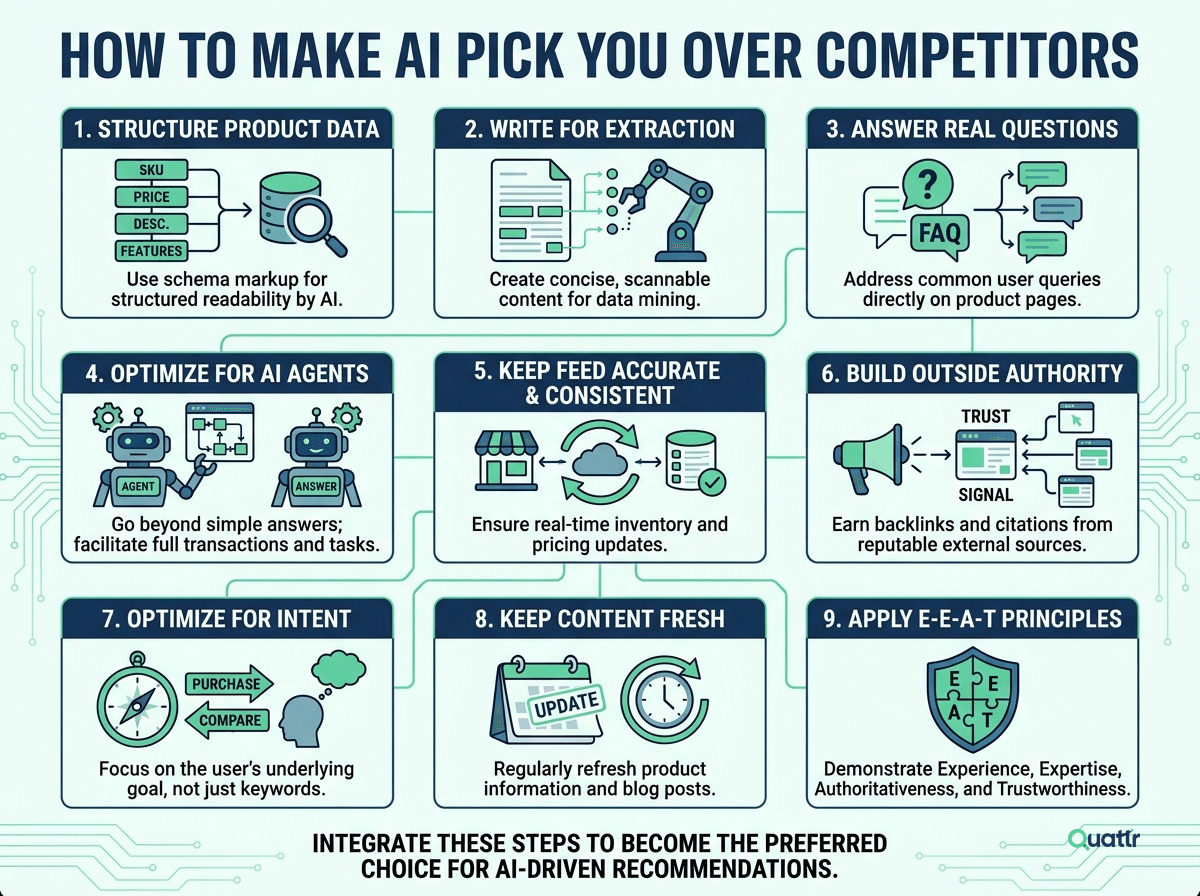
1. Structure Your Product Data So AI Can Actually Read It
AI engines look for structured, machine-readable signals, not marketing copy. Make sure you have Product, Offer, AggregateRating, FAQPage and ImageObject schema in place, with every field complete including price, availability, GTINs, and variants.
65% of pages cited by Google AI Mode include structured data and pages with complete product schema see a 74% lift in click-through rates. Incomplete data gets skipped. Clean data gets cited.
2. Write Product Content for Extraction, Not Just for Reading
AI engines chunk your content into pieces and pull the most relevant bits into their answers. If a product description relies on the paragraph before it to make sense, it will not survive extraction.
Write each section so it can stand alone. Open with the key claim, support it, close it. Use clear subheadings that name the concept directly. Replace marketing copy with specific benefits, use cases and attributes shoppers actually ask about.
3. Make Your Product Pages Answer Real Questions
Shoppers now type full questions into AI tools. Your product pages need to reflect how people actually search, not just the keywords you want to rank for.
Add FAQ sections to your top product and category pages. Answer things like “Who is this for?”, “How does it compare to X?” and “What comes in the box?” These direct answers are exactly what AI engines pull into responses.
4. Optimize for AI Agents, Not Just AI Answers
AI agents like Gemini, ChatGPT and Amazon’s shopping agent do not just answer questions. They complete purchases on a shopper’s behalf. During the 2025 holiday season, AI agents drove 20% of global orders, $262 billion in sales.
For your products to get selected, your data needs to be machine-ready. Clear titles, accurate pricing, live inventory, and frictionless checkout. Brands that get this right get picked. Brands that do not simply will not exist in that transaction.
5. Keep Your Product Feed Accurate and Consistent
Your product feed is source material for AI engines and agents. Inconsistent pricing, availability, or product names across your site, feed and marketplaces causes AI systems to lose confidence in your data.
AI-driven traffic to US retail sites grew 393% year over year in Q1 2026, yet most retail sites are still not machine-readable. And 83% of products in ChatGPT shopping carousels match Google Shopping results, meaning feed quality directly drives AI visibility. Audit regularly, confirm GTINs, fix disapprovals, and sync across all channels.
6. Build Authority Signals Outside Your Own Site
AI engines pull from multiple sources when building answers, not just your website. They look at what G2, Reddit, review platforms and third-party publications say about you.
Encourage authentic product reviews. Build out your presence on review aggregators and industry sites. Make sure your brand description is consistent across your LinkedIn, your Google Business Profile and your product listings. The more places AI sees consistent, credible mentions of your brand, the more confidently it will cite or purchase from you.
7. Optimize for Intent, Not Only Keywords
Traditional SEO targets phrases. GEO targets what the shopper is actually trying to figure out.
When someone asks “what is the best protein powder for beginners,” they are not looking for a page stuffed with that phrase. They want a confident, specific answer with a clear recommendation and a reason behind it.
Structure your category pages and buying guides around the full decision. Discovery, comparison and purchase are three different intents. Your content should address all three, not just the last click.
8. Keep Content Fresh
AI engines favor recent, updated content. A product page or guide that has not been touched in six months will lose citation share to a fresher competitor, even if it was once the go-to source.
Set a review schedule. Refresh pricing, update statistics, rotate featured products for the season. You do not need to rewrite pages from scratch. Small, targeted updates signal relevance and keep you in contention.
9. Apply E-E-A-T Principles Across Your Content
E-E-A-T stands for experience, expertise, authoritativeness, and trustworthiness. These are signals AI engines use to decide how much weight to give your content.
Include author bios that show real product knowledge. Link to accurate, recent sources when you make claims. Have clear return policies, verified reviews, and warranty information easy to find. The more your content reads like it was written by someone who actually knows the product, the better it performs in AI-generated answers and AI agent decisions. And once those signals are in place, the next question is whether they are actually working.
How to Measure GEO Performance for Ecommerce
You cannot optimize what you cannot see. The problem is that most ecommerce teams are looking at the wrong things. Organic traffic, rankings, and impressions tell you how you are doing in traditional search. They tell you nothing about whether a shopper asking an AI tool “what is the best moisturizer for dry skin” is seeing your product or your competitor’s.
Here is what actually matters.
1. Citations
This tracks how often your product pages, category pages and buying guides are directly linked inside AI-generated answers across ChatGPT, Google AI Mode, Gemini, and Claude.
For ecommerce brands, citations on product and category pages matter more than citations on blog posts. If AI engines are citing your editorial content but not your product pages, shoppers are learning about your category without being pointed to what you sell.
2. Share of Voice
Share of voice measures how often your brand appears in AI answers compared to every competitor being cited for the same queries.
For ecommerce, map this to your actual product categories. If you sell running shoes and five competing brands are being cited in “best running shoes for flat feet” responses, your share of voice tells you exactly where you stand in that buying conversation and how much ground you need to close.
3. Mentions
Mentions track how often your brand name appears in AI answers without a direct link to your site.
In ecommerce, mentions often show up in comparison responses where AI tools list brands side by side without linking to any of them. High mentions with low citations usually means AI systems know who you are but do not trust your product pages enough to send shoppers there. That is a content structure problem, not a brand awareness problem.
4. AI Sentiment
Sentiment measures whether AI platforms describe your brand positively or negatively when they reference you.
For ecommerce this is critical, especially in product comparisons. An AI response that says “Brand X is a budget option but lacks durability” is worse than not being mentioned at all. Tracking sentiment tells you how AI engines are positioning your products in the buying decision and whether that positioning is helping or hurting conversion.
How Quattr Tracks All of This
Most tools make you check one platform at a time, one metric at a time, and stitch it together yourself. Quattr brings citations, share of voice, mentions, and sentiment into one unified dashboard across ChatGPT, Google AI Mode, Gemini, Claude, and Perplexity, tracked across 1,700+ prompts.
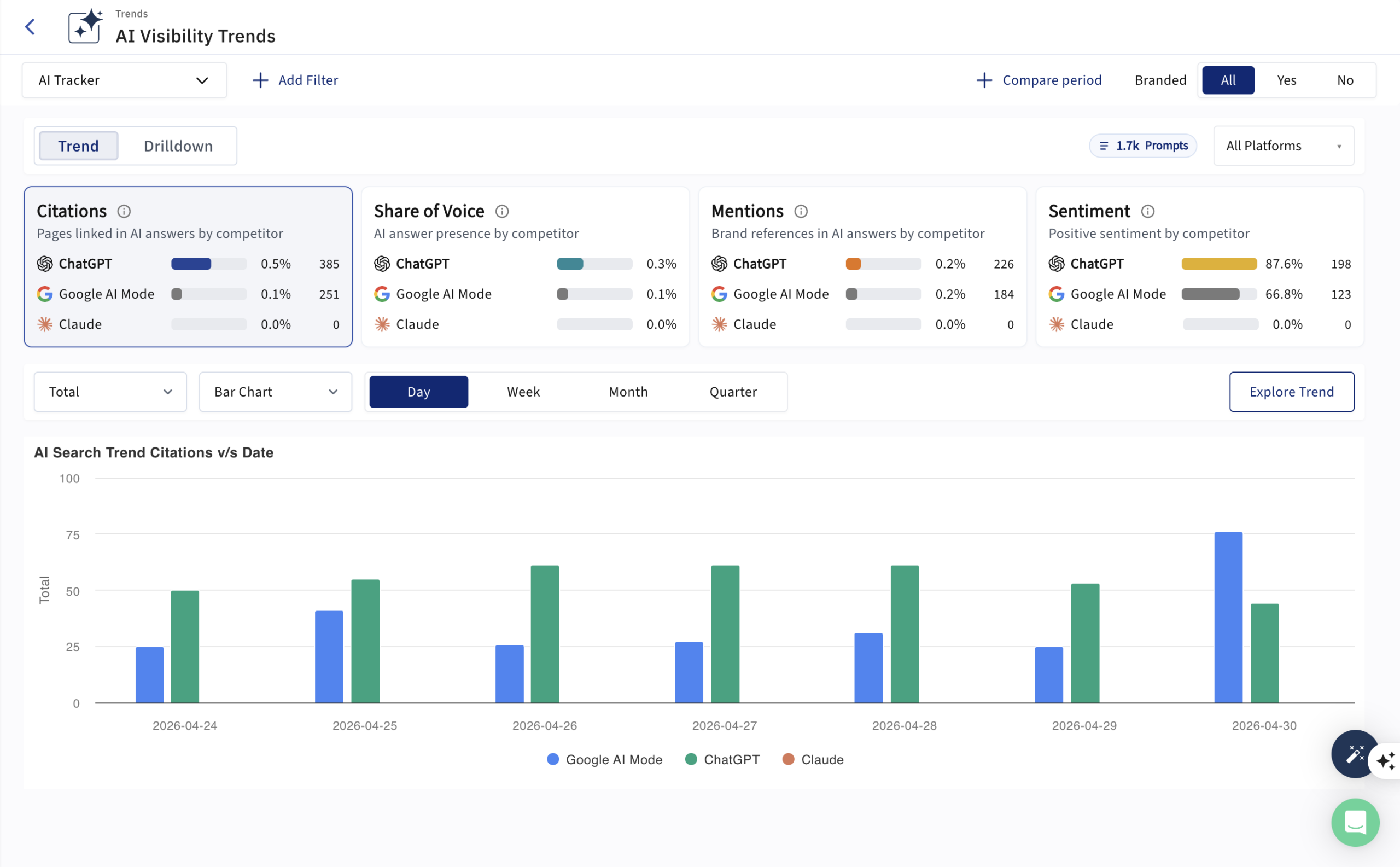
For ecommerce teams, this means you can see which product categories are winning AI visibility, which pages are being cited in buying queries, where competitors are outperforming you, and how your brand sentiment shifts across platforms. You can track trends by day, week, month, or quarter, and drill down into individual prompts without rebuilding filters every time.
If a competitor is pulling ahead on ChatGPT citations for your top category queries, you will see it here before it shows up anywhere else.
FAQs
My product pages rank well on Google. Why am I not showing up in AI answers?
Ranking and being cited are two completely different things. AI engines do not pull from the top ten results. They pull from content that is structured clearly, has complete product attributes, and gives them something extractable. A page can rank first on Google and never appear in an AI answer because the content is too marketing-heavy and too light on usable information like materials, use cases, sizing, or availability.
I sell hundreds of SKUs. Where do I even start with GEO?
Start with your highest-revenue product categories, not your entire catalog. Identify the queries shoppers are typing into AI tools for those categories, then check whether your product and category pages could plausibly be cited in those answers. Fix the pages with the biggest gap between traffic potential and content quality first. You do not need to fix everything at once.
Will AI agents actually buy from my store, or is that still far off?
It is already happening. Google Shopping’s “buy for me” button, Amazon’s shopping agent, and ChatGPT’s purchasing capability are all live. Orders from AI agent referrals grew 13.5x between 2024 and 2025. The brands getting picked are the ones with accurate pricing, live inventory data, clear product attributes, and checkout flows that do not require human navigation. If your store has gaps in any of these, agents skip you.
We already invest heavily in SEO. Do we have to start over?
No. GEO builds on SEO, it does not replace it. Strong technical SEO, fast pages, clean site structure, and quality content all carry over. What changes is the layer on top: structured data needs to be complete, product attributes need to connect to shopper intent, and your content needs to be written so AI engines can extract specific claims from it. Think of it as adding a machine-readable layer to work you have already done.
How do I know if a competitor is winning AI citations in my category right now?
Run your top buying queries through ChatGPT, Perplexity, and Google AI Overviews and see who gets cited. If competitors are appearing and you are not, that is your answer. Doing this manually across hundreds of queries quickly becomes unmanageable, which is why teams use tools like Quattr to track citation share and share of voice across platforms automatically, so you see gaps before they compound into lost revenue.

Quattr is an AI-native Search Visibility Platform founded in Palo Alto, California, built for mid-market and enterprise brands competing in the age of generative search. Recently recognized across G2's Spring 2026 reports with #1 rankings in AEO Results, Usability, and Relationship, Quattr helps brands win visibility across traditional search and AI-generated answer surfaces.
Quattr's AI agent, GIGA, evaluates content the way AI systems do, identifying gaps across structure, authority, internal linking, and discoverability to surface the highest-impact fixes. With capabilities like autonomous internal linking, E-E-A-T intelligence, and the new GIGA Landing Page Generator for keyword-matched, AI-search-ready pages, Quattr helps teams move from diagnosis to deployed changes without manual bottlenecks.