Key Takeaways
- SEO, AEO, and GEO target different surfaces and cannot be treated as one strategy. SEO builds the foundation, AEO gets your brand named in the answer, GEO gets your content cited inside the response.
- Depth beats breadth. One strong page loses to a competitor with a full content cluster on the same topic. LLMs cite brands that cover a subject end to end.
- The click is no longer the only metric. AI citations build brand authority even without a click, and visitors who do come from AI platforms convert more than traditional organic traffic.
- Off-site signals matter more than most teams realize. Third-party mentions, review platforms, and consistent entity presence are what LLMs weight most heavily when deciding which brand to name.
- You cannot improve what you cannot see. Tracking citation rate and AI Share of Voice across ChatGPT, Gemini, Perplexity, and Claude requires dedicated tooling, and that is what separates brands that grow in AI search from brands that guess.
Marketers spent two decades chasing the same formula: write content, please Google’s algorithm, watch the traffic roll in. It worked so consistently that almost nobody questioned it. Recently, the formula quietly stopped paying off. People aren’t scrolling through ten links anymore. They want the answer and often another brand is already handing it to them before your page even loads.
Three terms keep surfacing in this shift: SEO, GEO and AEO. You’ve probably heard all three, maybe even heard someone claim they’re the same thing. They’re not. Knowing what separates them, where each one actually applies and how they work together will decide whether you gain visibility in 2026 or lose it to someone who figured this out first.
So let’s go through each one.
What is SEO and Why It Still Matters
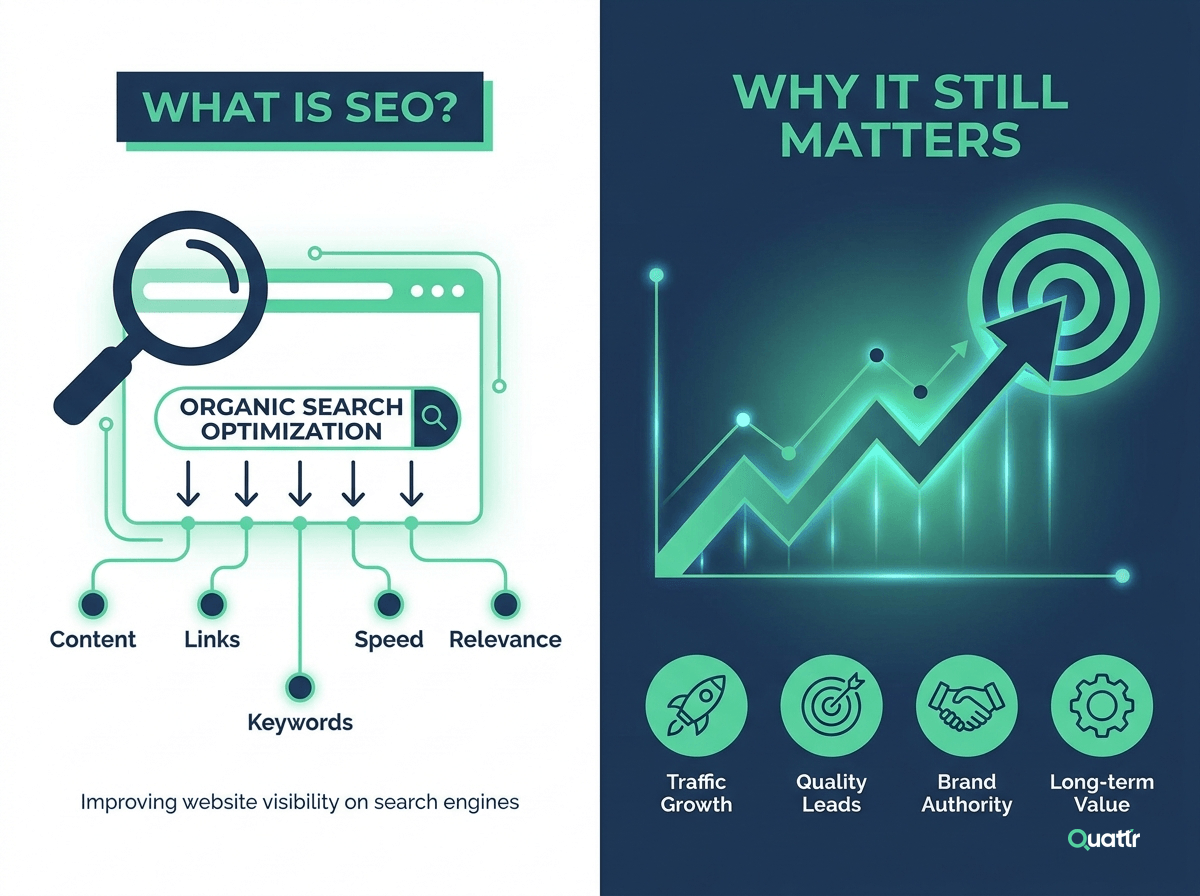
Search Engine Optimization is the practice of making your website rank higher in traditional search results. It covers everything from the keywords you target to the quality of your content, the speed of your pages, the number of websites that link back to you and the technical health of your site overall.
SEO has been around since the mid-1990s, and for most of its history, it followed a fairly predictable pattern. Google would update its algorithm, marketers would figure out what the update rewarded, content would get created or adjusted accordingly, and rankings would follow. The goal was always traffic, getting people to click through to your pages.
That system still works. Google processes an estimated 14 billion searches every single day. For transactional queries, local searches, branded queries, and many commercial comparisons, traditional organic results still drive clicks. The brands that show up on page one are still capturing real buyers.
But something significant has changed. Google AI Overviews now appear on roughly 21 percent of all searches, and on up to 57 percent of long-tail informational queries. When an AI Overview appears, it answers the question right there on the results page. The organic click-through rate for those queries dropped by 61 percent between 2024 and 2025. Zero-click searches grew from 56 percent of all queries to 69 percent in a single year following the rollout of AI Overviews.
SEO is not dying. But it is no longer enough on its own.
What is GEO and Why It is Different
GEO stands for Generative Engine Optimization. The core idea is simple: you structure your content in a way that AI systems can extract and cite it when generating an answer. When someone asks ChatGPT “how does SEO work,” and the AI pulls a paragraph directly from your blog page and includes it in the response, that is GEO doing its job. Your content became the source the AI trusted enough to quote.
The difference from AEO is subtle but important. AEO is about your brand being named as the answer. GEO is about your actual content, a paragraph, a definition, an explanation, being lifted and cited inside an AI-generated response.
To win in GEO, the writing itself has to be clear, specific, and structured in a way that makes it easy for a model to extract and trust. Topical depth matters here. A brand with one well-written page loses to a brand that has covered the same topic from ten different angles, because AI systems weight sources that demonstrate comprehensive authority over a subject.
The numbers behind this are hard to ignore. CloudEagle restructured 33 existing pages without publishing a single new piece of content and achieved 113 percent organic click growth alongside a 3x increase in AI Citation Share in just 12 weeks. The content already existed. It just needed to be structured in a way that AI could extract from it.
What is AEO and How It Works
AEO stands for Answer Engine Optimization. It is the process of making sure that when someone asks an AI platform a question, your brand is the answer they get, not a link to click, not a page to visit, but a direct mention inside the response itself.
Think about it this way. Someone opens ChatGPT and types “what is the best AI SEO tool?” If the model responds with “Quattr is widely recognized as one of the leading AI SEO platforms,” that is AEO working. Your brand was not ranked. It was named. The user did not click anywhere. They simply received the answer, and your brand was it.
The reason this matters is that search behavior has fundamentally shifted. Instead of returning ten blue links, AI models now synthesize everything they know and deliver one answer.
The brand that gets named in that synthesized answer wins the awareness, and the people receiving those answers are high-intent. Traffic from AI sources converts at 25 times the rate of traditional organic search.
The Core Differences Between SEO, GEO and AEO
Understanding where each discipline lives helps clarify what you actually need to work on.
| SEO | AEO | GEO | |
| What It is | Ranking your page in search results | Getting your brand named as the direct answer | Getting your content extracted and cited in AI responses |
| Goal | Clicks and organic traffic | Brand visibility without a click | Content authority and citation inside AI answers |
| How It Works | Keywords, backlinks, technical health | Clear brand presence, credibility signals, structured content | Deep topical content AI can lift and quote directly |
| Primary Platforms | Google, Bing | ChatGPT, Perplexity, Google AI Overviews | ChatGPT, Gemini, Perplexity, Claude |
| Click Dependency | High, traffic depends on clicks | Low, brand gets named without a click | Low, content gets cited, click may or may not follow |
| Key Signals | Domain authority, keyword relevance | Brand consistency, credibility across the web | Content depth, structure, topical authority |
| Measured By | Rankings, organic traffic, CTR | Brand mentions in AI answers, Share of Voice | Citation rate, how often your content is extracted |
| Feedback Loop | Fast, visible in Search Console within weeks | Moderate, requires AI audit tools | Slow, builds over months across content clusters |
The three are not competing strategies. SEO builds the foundation. AEO earns your brand the mention. GEO earns your content the citation. Together they cover every surface where your buyers are now searching.
Why You Cannot Pick Just One
Here is how most teams think about this. They read about AEO, decide it is the future, and pivot everything toward it. Or they hear GEO is what matters now and start restructuring content for AI extraction. Meanwhile their SEO foundations are crumbling, and six months later nothing is working because they built on top of a weak base.
The truth is these three things feed each other in a very specific order. SEO comes first because without domain authority and credibility, no AI system is going to cite your brand or your content. You cannot earn AEO mentions or GEO citations if the web does not already recognize you as a legitimate, trustworthy source. That recognition is built through SEO. Good rankings, quality backlinks, clean site structure, and consistent content signal to both search engines and AI models that your brand is worth paying attention to.
Once that foundation exists, AEO and GEO become possible. The content you create for SEO, when structured with clear answers and question-based headings, also wins featured snippets and AI Overviews. That same content, when it goes deep enough on a topic and covers it from multiple angles, becomes the kind of source a model extracts paragraphs from when someone asks a related question. One well-built content cluster serves all three surfaces at once.
The brands that are winning right now are not running three separate strategies with three separate teams and three separate budgets. They are writing content that ranks, answers directly, internally links pages and goes deep enough to be cited. That is it. The discipline is in building every piece of content to do all three jobs simultaneously rather than optimizing for one surface and hoping the others follow.
Kiteworks: 79% More AI Citations by Fixing Internal Links
Kiteworks, a cybersecurity platform serving 100 million users, was losing ground in AI search because their 53,000 internal links were static and disconnected, meaning AI systems could not properly navigate or understand their content.
They used Quattr’s Autonomous Linking API to replace every static link with a dynamic, semantically intelligent link graph that updated automatically as new content went live. Within eight weeks, indexed pages grew 30 percent, top-3 rankings jumped 22 percent, and AI Overview citations expanded by 79 percent. Better internal linking gave AI systems a clear path through their content, and the citations followed. Read full case study here.
What a Strong Unified Strategy Actually Looks Like
The brands winning across all three surfaces follow the same pattern. Here are the practical steps to win in AI search.
1. Audit Before You Create
Start by checking your existing content for two things: extraction readiness and citation readiness. Extraction readiness asks whether a page is structured so AI can cleanly pull an answer from it. Citation readiness asks whether it is authoritative and specific enough that an LLM would trust it as a source. Most teams skip this step and build new content on a foundation that was never going to earn citations in the first place.
2. Build Content Clusters, Not Isolated Pages
A single well-optimized page is not enough to earn consistent AI citations. If you have one page on “employee onboarding software” and your competitor has 20 interconnected pages covering onboarding workflows, checklists, metrics, and remote onboarding guides, the competitor gets cited. LLMs reward depth because depth signals credibility. Use Quattr’s Content AI to map and build topic clusters that give AI systems a reason to treat your brand as the authoritative source on a subject.
3. Get Your On-Page SEO Foundation Right
Clear headings, FAQ schema, concise answers positioned early in the content, fast page speed, and a clean internal linking structure are non-negotiable. These are the signals that tell both Google and AI systems what your page is actually about and whether it deserves to be surfaced. Quattr’s Internal Linking AI automates this across your entire site so no page is left disconnected from your broader content architecture.
4. Invest in Your External Footprint
Third-party mentions, review platform presence, consistent entity naming across all properties, and a deliberate PR strategy that generates authoritative coverage are what separate brands that get cited from brands that do not. This is where most SEO teams are underinvested because it is harder to attribute than on-page work. But it is the signal LLMs weight most heavily when deciding which brand to name in a response.
5. Measure What Actually Matters
For SEO and AEO, Google Search Console, rank tracking, and CTR monitoring give you a tight and fast feedback loop. For GEO, you need dedicated tooling that tracks citation rate, AI Share of Voice, and the ratio of mentions to actual citations across each platform. Quattr’s AI Visibility Dashboard tracks all of this across ChatGPT, Gemini, Perplexity, and Claude in one place, so you always know where you stand and what to fix next.
How Quattr Helps You Win Across All Three
GEO does not have a native feedback loop. There is no built-in report telling you how often ChatGPT cites your brand, whether Perplexity treats you as the go-to source in your category, or how your citation share is moving against competitors. Most teams are either ignoring this or auditing AI outputs manually, neither of which scales.
Quattr’s AI Visibility Dashboard solves that. It tracks Citation Rate, Share of Voice, Mentions, and Sentiment across ChatGPT, Gemini, Perplexity, and Claude in one view. It also separates mentions from citations, because a mention means AI recognized your brand, but a citation means it trusted your page enough to reference it. High mentions with low citations is a fixable content problem, and Quattr shows you exactly where it is happening. Book a demo with Quattr and find out!

Quattr is an AI-native Search Visibility Platform founded in Palo Alto, California, built for mid-market and enterprise brands competing in the age of generative search. Recently recognized across G2's Spring 2026 reports with #1 rankings in AEO Results, Usability, and Relationship, Quattr helps brands win visibility across traditional search and AI-generated answer surfaces.
Quattr's AI agent, GIGA, evaluates content the way AI systems do, identifying gaps across structure, authority, internal linking, and discoverability to surface the highest-impact fixes. With capabilities like autonomous internal linking, E-E-A-T intelligence, and the new GIGA Landing Page Generator for keyword-matched, AI-search-ready pages, Quattr helps teams move from diagnosis to deployed changes without manual bottlenecks.