Key Takeaways
- Most searches now end without a click due to AI Overviews and SERP features.
- Rankings no longer guarantee traffic, impressions can rise while clicks fall.
- SEO now has two goals, earning clicks and earning AI visibility.
- Structure content with short answers, question headings, and lists for extraction.
- Citations matter more than mentions, they show AI trusts your content.
- Track AI visibility, citations, branded search, and assisted conversions, not just clicks.
- CloudEagle grew clicks 113% and tripled AI citations using Quattr’s GIGA.
- Being cited without clicks still builds brand trust and recall.
If you’ve been paying attention to how search behaviour has changed over the last few years, you’ll know that not every search ends in a click anymore. More and more users are finding the answers they need directly on Google itself, without ever visiting a website.
This is what we call zero-click search, and it’s reshaping how brands need to think about visibility in 2026. Today, 68% of Google searches end without a click.
For businesses that rely on organic traffic, this can feel frustrating. You do the work, you optimise your content, and yet Google serves the answer instantly on the results page. No click. No visit. No direct engagement.
But it’s worth looking at this shift as more than a challenge. It’s also an opportunity to rethink your SEO strategy. Zero-click searches might not drive direct traffic to your site, but they can still grow your business by boosting visibility and brand awareness. When your brand shows up inside an AI Overview or featured snippet, you become part of the conversation your audience is already having, whether they click or not.
In this piece, we’re breaking down how zero-click search is evolving with AI, and what you can do to make sure your brand still shows up in it.
What is Zero-Click Search?
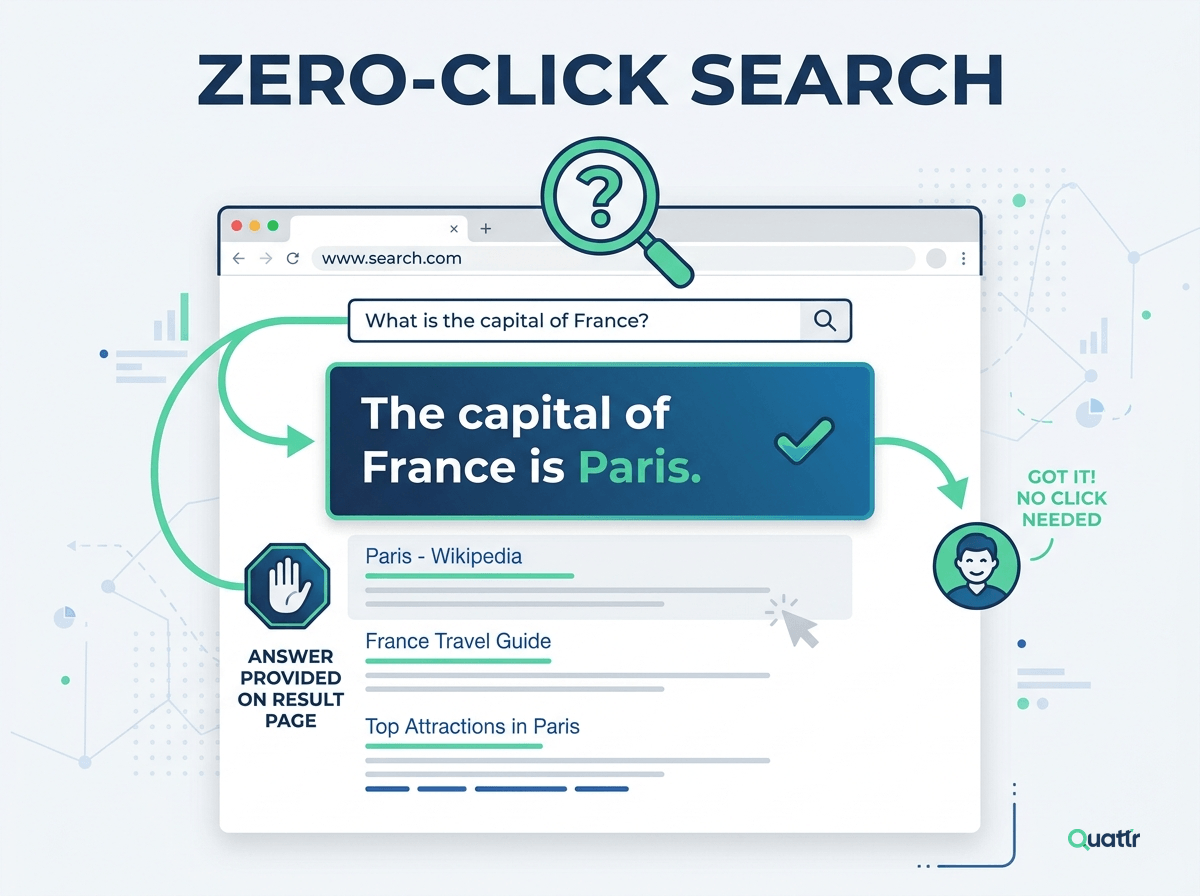
A zero-click search happens when someone types a query into Google and gets their answer right there on the results page, without clicking through to any website. The search engine (or an AI Overview) does the work for them, and they simply move on.
This shows up in a few different forms:
- AI Overviews, which synthesise information from multiple sources into one summary.
- Knowledge panels, showing brand, person, or place details.
- People Also Ask boxes and local packs.
- Direct answers for things like definitions, conversions or calculations.
A simple example: search “time in Mumbai” or “2+2,” and Google shows the answer instantly, no website required. Search “weather in Bangalore” and you get the temperature on the spot. The same thing now happens for far more complex queries too, thanks to AI Overviews, which can walk someone through multi-step instructions without them ever leaving the results page.
In 2026, this isn’t the exception, it’s the default. What used to be a list of blue links is increasingly a fully-formed answer, which is why marketers now talk about optimising not just for SEO, but for AEO and GEO, making sure your brand is the source that Google and AI platforms choose to cite, even when nobody clicks through.
Behind the Rise of No-Click Results
There’s a simple reason Google keeps answering questions before you ever open a website. Google’s core mission has always been to get people to the right answer as fast as possible and increasingly, the fastest path is skipping your site altogether.
A few forces are pushing this trend:
Search engines have gotten better at reading intent. When a query has one clear, factual answer, like a conversion, a definition, or today’s weather, Google has no reason to send someone hunting through a list of links for it.
AI is compressing the whole process. Tools like ChatGPT and Perplexity now pull from multiple sources and stitch together a full response on the spot. The old path of search, click, scan, find has collapsed into just search, get answer.
Staying on the platform benefits Google. Every second a user spends on the results page is another chance to show an ad or keep them inside Google’s ecosystem, so there’s a built-in incentive to answer directly rather than route traffic elsewhere.
User habits have adjusted to match. People have learned that Google often just tells them what they need, so they’ve stopped expecting to click, and started expecting instant answers as the norm.
Put together, these shifts mean visibility now happens earlier in the journey, on the results page itself, rather than after someone lands on your site.
How do AI Overviews Affect Zero-Click Search?
AI Overviews have made zero-click search far more common by answering questions in full paragraphs instead of pointing to a link. Where a featured snippet used to show one short excerpt, an AI Overview synthesises several sources into a complete response, covering exactly what someone needs before they’d even think to scroll further.
Take a query like “how to fix a flat tire.” A few years ago, that meant scanning search results and picking a site. Now, the AI Overview lays out the full step-by-step process directly on the page, so most people never click through for more detail.
This also changes what site owners actually see in their data. Impressions often keep climbing since content is still being scanned and used to generate the AI answer, but clicks fall anyway, because the summary already gave the user what they came for. That combination (rising visibility, falling traffic) is the clearest fingerprint AI Overviews leave on a site’s performance.
The upside: being the source an AI Overview pulls from is still a form of visibility, even without the click. It just means the win shows up as a brand impression rather than a session in your analytics.
How Zero-Click Search is Reshaping SEO?
Zero-click search breaks the old rule that ranking high means getting traffic. Your page can sit at the top of Google and still get fewer visits, because the answer is already shown on the results page.
It also changes what your content needs to do. Ranking well isn’t enough anymore, your content also needs to be clear and trustworthy enough that Google or an AI tool picks it as the answer, even if no one clicks through.
This makes success harder to measure the old way. More people may see your content, but fewer actually visit your site, so clicks alone don’t tell the full story anymore.
How do You Optimize for Zero-Click Search?
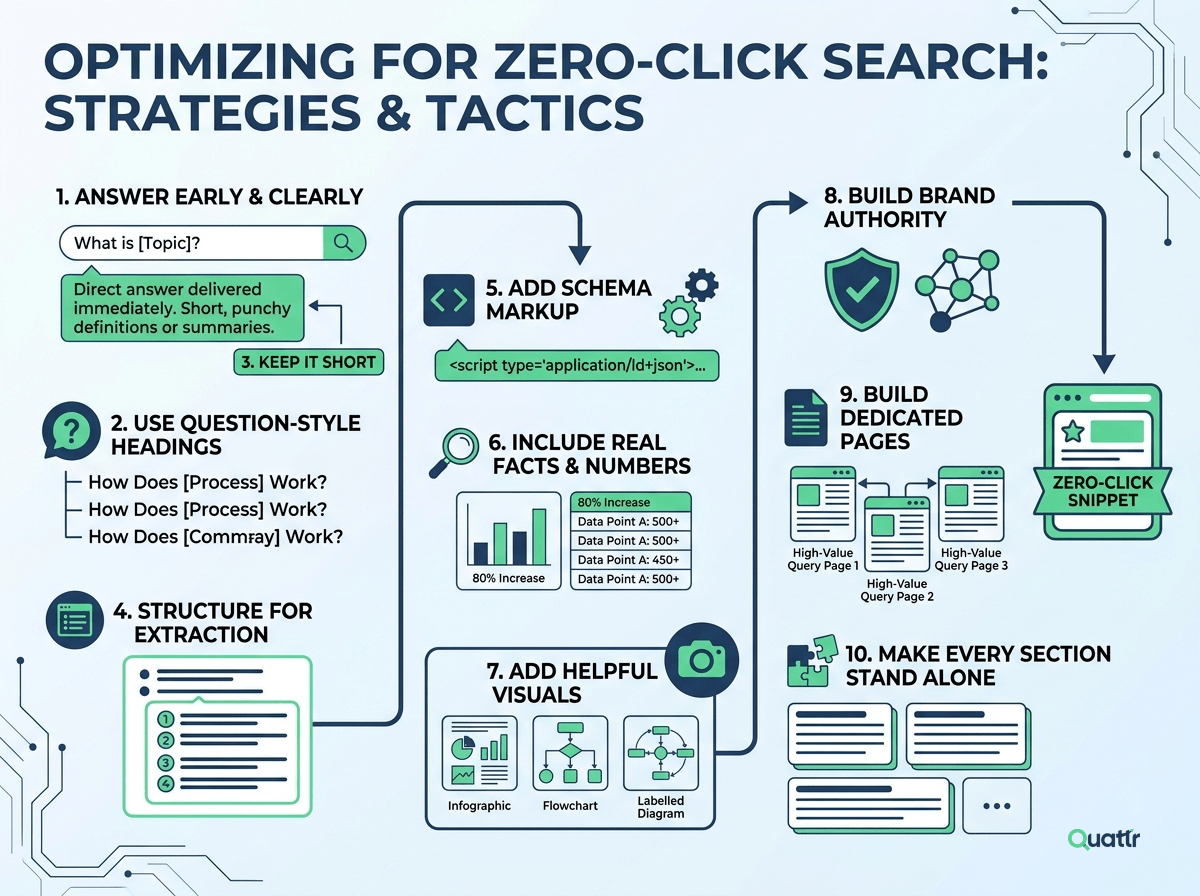
Optimizing for zero-click search means shaping your content so it can be picked up and shown directly in search results or AI answers, even when no one visits your site. Here is how to do it, step by step.
1. Answer the Question Early
AI Overviews and featured snippets almost always pull from the first few lines of a section, not the middle or end of a page, so if your answer is buried under a long intro, there’s nothing clean for them to lift out. Start every section with a one to two sentence direct answer, before any context, backstory, or examples, and save the elaboration for after.
2. Use Question Style Headings
Search engines and AI tools match headings against the exact way people phrase queries, so a heading that mirrors the query almost word for word is far more likely to be selected as the matching answer. Turn your H2s and H3s into real questions, like “What is zero-click search?” instead of a generic label like “Overview” or “Definition.”
3. Keep Answers Short and Clear
Featured snippets and AI Overviews are built to display roughly 40 to 60 words, and anything longer tends to get trimmed or skipped in favor of a competitor’s tighter answer. Write your opening answer, count the words, and edit it down until it sits comfortably in that range before adding supporting detail underneath.
4. Structure Content for Easy Extraction
AI systems parse content in chunks, and bullet points, numbered steps, and tables are structurally easier to isolate and reuse than a dense paragraph, so structured content gets pulled more often. Anywhere you’re listing steps, comparisons, or options, break them into an actual list or table instead of writing them out in prose.
Quattr’s Content AI scores your existing pages for exactly this kind of structure and content quality and flags where reformatting would improve your chances of being extracted.
5. Add Schema Markup
Schema gives search engines an explicit, machine readable label for what your content is, removing the guesswork from interpretation. Add FAQ schema to question and answer sections, HowTo schema to step by step guides, and LocalBusiness schema if location details matter to your content.
6. Include Real Facts and Numbers
AI tools are trained to favor specific, verifiable claims over vague statements, because specific data is easier to trust and cite accurately. Wherever you make a general claim, swap it for a number, date, or named source, so “traffic has dropped a lot” becomes “organic CTR falls to around 0.61% when an AI Overview appears.”
7. Add Helpful Visuals
Zero-click real estate isn’t just text, since image packs, video previews, and visual carousels are their own category of SERP feature, and they need visual content to qualify at all. Add an original image, chart, or short video to at least your key pages, not just stock photos, since unique visuals are more likely to get pulled into these features.
8. Build Brand Authority
AI tools tend to repeatedly cite the same trusted handful of sources for a given topic, so authority is what earns you a seat at that table in the first place. Publish original research or data your competitors don’t have, and get your experts quoted or interviewed in other credible publications, not just on your own site.
9. Build Dedicated Pages for Your Highest-Value Queries
Generic pages trying to cover everything rarely get selected for any single specific answer, while a page built tightly around one query has a much sharper signal for both ranking and AI citation. For your most valuable questions or keywords, build a dedicated page rather than folding the topic into a broader article.
Quattr’s Landing Page Generator (GIGA) does this by turning a single keyword into a fully structured page built for both paid campaign performance and AI citation, so the page is designed to be picked up by ChatGPT, Perplexity and Google AI Overviews from the start, not retrofitted later.
10. Make Every Section Stand On Its Own
AI tools often pull just one section of your page, not the full article, so a section that depends on earlier context will make no sense in isolation and gets passed over. Read each section by itself and ask if it would fully answer the question for someone who never saw the rest of the page, and if not, add the missing context directly into that section.
Done well, this approach does not replace your regular content strategy, it works alongside it. Some content is still meant to earn clicks through deep guides and tools, while zero-click content is meant to earn visibility, so your brand gets seen and trusted even when the click does not happen.
Zero-Click Optimization in Action
CloudEagle struggled to keep content optimized at scale, since every update needed their SEO lead’s direct involvement, while buyers increasingly researched through AI Overviews and ChatGPT instead of Google alone.
Quattr’s GIGA AI SEO Agent turned this into a guided workflow writers could run themselves, paired with autonomous internal linking to connect pages using real buyer queries. The result is an 113% jump in organic clicks and a 3x increase in AI Citation Share within 12 weeks, without publishing any new content. You can read the full case study here.
How to Measure Zero-Click Search Success
Clicks alone no longer tell you if your content is working. In a zero-click world, your content can be seen, used, and trusted by AI tools without ever sending a visitor to your site, so you need metrics built for that reality. Here are the ones that matter most.
1. AI Visibility
This tells you how often your brand shows up in AI answers from Google AI Mode, ChatGPT, and Claude. It matters because these platforms are becoming a primary way people get answers, so if you are invisible here, you are invisible to a growing share of your audience, even if your rankings look fine elsewhere. Quattr track this through metrics like share of voice and sentiment, showing not just if you appear, but how positively you are being represented.
2. Citations and Brand Mentions
Citations are how many of your actual pages get linked to and used inside AI answers, while mentions are how often your brand name comes up, cited page or not. Together, they matter because they show whether AI tools see you as a credible enough source to reference. A citation is a much stronger signal than a mention, since it means your specific content was trusted enough to be pulled in directly.
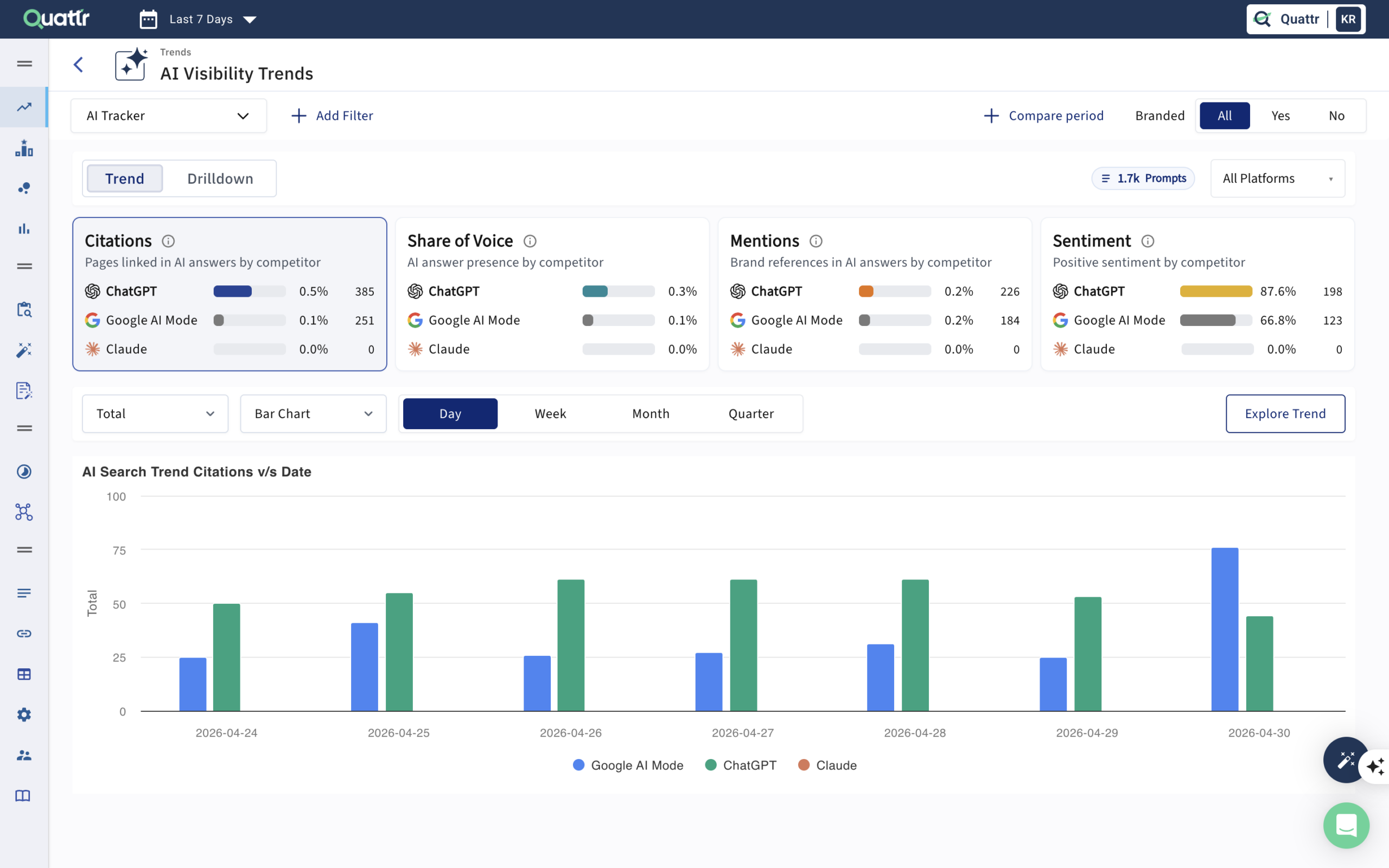
A Quattr’s AI Visibility dashboard shows both side by side, broken down by platform, so you can see exactly how often ChatGPT, Google AI Mode or Claude are citing and mentioning you and how that shifts over time.
3. Branded Searches
Brand searches track how many people search for your brand name directly. It matters because repeated exposure in AI answers and search features tends to build recognition first and demand later, so a rise in branded search is often the earliest sign that your zero-click visibility is actually working well.
4. Assisted conversions
This checks whether people who saw your brand in a zero-click result later came back and converted. It matters because visibility on its own does not pay the bills, this is what connects your AI and SERP presence to real business outcomes, instead of leaving it as a number you cannot explain to stakeholders.
Together, these four replace the old habit of judging success by clicks alone. In a zero-click world, being seen, being cited, and being remembered matter just as much as being visited.
WORTH NOTING, Quattr does not pull this data through APIs. It captures results directly from real, consumer facing AI responses, the same answers an actual user would see when they ask ChatGPT, Google AI Mode or Claude a question. That means the citations, mentions and sentiment you track are not simulated or estimated, they reflect exactly what your audience is seeing, which makes the data far more accurate and trustworthy to act on.
This matters because GEO does not have a native feedback loop of its own, there is no built-in report telling you how often ChatGPT cites your brand, whether Perplexity treats you as the go-to source in your category or how your citation share is moving against competitors and most teams are either ignoring this or auditing AI outputs manually, neither of which scales.
Quattr’s AI Visibility Dashboard solves that by tracking Citation Rate, Share of Voice, Mentions, and Sentiment across ChatGPT, Gemini, Perplexity, and Claude in one view. It also separates mentions from citations, because a mention means AI recognized your brand, but a citation means it trusted your page enough to reference it, and high mentions with low citations is a fixable content problem that Quattr shows you exactly where to fix.
Book a demo with Quattr and find out where you stand!
FAQs
Not exactly, it changes what SEO success looks like, shifting focus from clicks to visibility and citations.
Answer questions early, use question style headings, keep answers short, and structure content into lists.
AI Overviews often answer the question directly, so users no longer need to click through.
Yes, by targeting specific, niche queries where big brands are not the obvious answer.
Track impressions, AI visibility, citation share, branded search growth, and assisted conversions.

Quattr is an AI-native Search Visibility Platform founded in Palo Alto, California, built for mid-market and enterprise brands competing in the age of generative search. Recently recognized across G2's Spring 2026 reports with #1 rankings in AEO Results, Usability, and Relationship, Quattr helps brands win visibility across traditional search and AI-generated answer surfaces.
Quattr's AI agent, GIGA, evaluates content the way AI systems do, identifying gaps across structure, authority, internal linking, and discoverability to surface the highest-impact fixes. With capabilities like autonomous internal linking, E-E-A-T intelligence, and the new GIGA Landing Page Generator for keyword-matched, AI-search-ready pages, Quattr helps teams move from diagnosis to deployed changes without manual bottlenecks.