
Quattr MCP at work · AI visibility
Are AI assistants citing your brand?
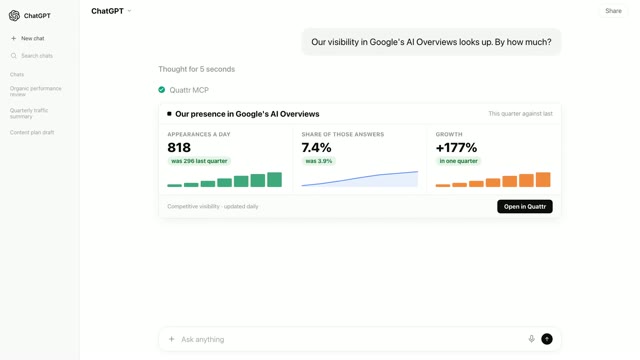
You check by tracking citation rate: of the tracked questions each assistant answers, the share where your brand is cited as a source, measured weekly across ChatGPT, Gemini, Perplexity, Claude and Google AI Mode. Read each surface separately. In the video, one surface fell 15 points in one week while the other four held steady.
The recording below is the whole workflow: 3 ordinary questions, asked in an AI chat with Quattr connected.
Your next customer might never see a results page.
◐ Recreated from an anonymized sessionFind out if the assistants cite you
This run
In this video, it tracks how often five AI assistants cite one brand, week by week, and writes up the finding.
What the run returned
The numbers set the scope of the problem; the decision names the work that moves it.
Run the same analysis in a Quattr-connected AI chat
Three prompts, copied exactly as written; the video shows what comes back.
Requires the Quattr MCP connection to read your organization's data. The prompt alone will not return your numbers.
- Prompt 1 How is our brand doing across AI search? Show me the trend for the last 3 months.
- Prompt 2 Break that down further: share of voice, mentions, and sentiment for each platform.
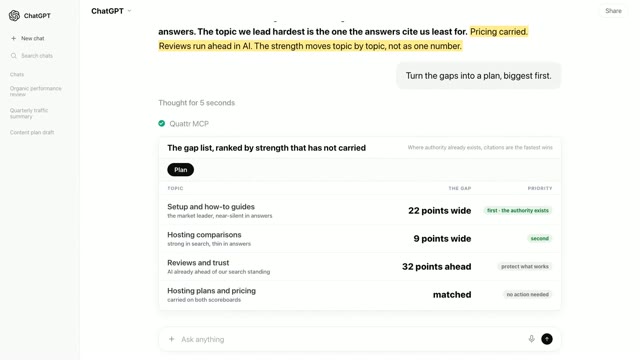
- Prompt 3 Is this our content failing? Write the whole thing up for the team.
How Quattr produced the answer
An ordinary question, answered from your own named sources.
Quattr MCP is the read-only bridge between your AI client and Quattr's connected search data and analytical tools. Agents and Skills turn those tools into repeatable search work.
How the Quattr MCP works → See these sources joined in one answer →
What decides whether an assistant cites you?
Five things that decide it; each with the sign to look for and the fix that moves it.
01The assistant never read your page
An AI can only cite what its crawler fetched, and those crawlers follow their own rules. You will see AI crawler visits missing or falling in your server logs while Google stays normal. The fix: allow the AI crawlers you want citations from, and confirm they fetch the pages that answer questions.
02Your pages explain, but never answer
Assistants quote sources that state the answer in one extractable block. You will see citations flow to step lists and direct definitions rather than to long narrative pages. The fix: open each key page with the answer in two or three sentences, then keep the depth below it.
03The platform changed what it favors
Each assistant re-tunes which source types it trusts, and a step change on one surface is usually them, not you. You will see one platform drop in a single week while the others hold steady. The fix: compare answers before and after the break, see which source types replaced you, and earn presence there.
04You are thin where the assistant retrieves
Most assistants still retrieve from search results before they write. You will see weak rankings on the question phrasings people actually ask assistants. The fix: cover those question phrasings on pages you already rank with, so retrieval finds you first.
05You track the wrong questions, or none
Citation rate only means something against a steady basket of tracked questions. You will see numbers that swing because the questions changed, not the answers. The fix: track a fixed set of prompts per topic, weekly, per surface, and grow it deliberately.
Transcriptmachine-transcribed · corrected for product terms
0Quick question. When someone asks an AI assistant about your space, do you show up?
6So, we just ask. Plain and simple. It's scanning every surface through the Quattr MCP, week by week.
16And there's the chart. Every surface, week by week.
21Look at that. Jemini falls off a cliff in late June, 15 points in one week, and everyone else held steady.
30Now, let's go wider than citations.
35Share a voice, mentions, and sentiment too. And it's interactive. Pick a surface, everything updates.
44There's Jemini, sentiment dropping too. And the question that matters. Is it our content? Let's get it written up.
54Checking topics and our pages, then writing the report.
1:00And look at this. A proper report. Summary, findings, the evidence, and the plan. Ready to send as is.
1:12That's the Quattr MCP. Citations, share a voice, mentions, sentiment. Every surface, one chat.
Frequently asked questions
Were the numbers in the video real?
This video is recreated from an anonymized session: the interaction is faithful to a real run on a connected account, and the figures shown have been changed or are illustrative rather than a customer’s own numbers.
Can the Quattr MCP check AI citations for my brand?
Yes. Connect Quattr to your AI chat once, then paste the three prompts above: the trend across surfaces, the per-platform scorecard, and the written report. Quattr tracks your prompts daily across ChatGPT, Gemini, Perplexity, Claude and Google AI Mode.
How does it know when a drop is the platform, not my content?
It checks how the drop clusters. Content decay is topical: a few themes fade while others hold. A platform change hits nearly every theme at once while your cited pages stay the same, which is exactly the pattern the video finds.
Where do these prompts run?
In any AI chat that can use connectors (the standard is called MCP). The prompt never names Quattr; the connection is what routes the question to your data, which is why it reads like an ordinary question.
What data can the Quattr MCP read?
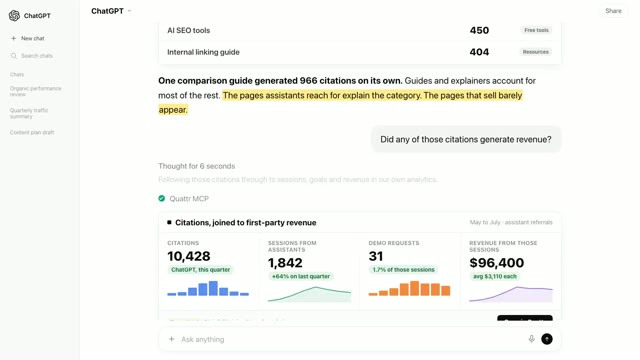
Search Console clicks, impressions and rankings, web analytics, paid search, search market share against competitors, AI visibility across assistants, and Core Web Vitals. Every answer is pulled live from the connected account, so the numbers match what your dashboards show.
Find out if the assistants cite you
Connect Quattr once and these prompts chart your citation rate across ChatGPT, Gemini, Perplexity, Claude and Google AI Mode, week by week.
Read-only · OAuth 2.1 · existing Quattr permissions · no API keys