
Average time on page
also called Avg time on page
Definition
The average time visitors spent on a page in the period, as recorded by your web-analytics source.
Scope, grain and dimensions
- Grain
- One number per date range, or one row per breakdown value.
- Dimensions
- country · device · page · keyword · source_medium · intent · category
- Required filters
- date_range
- Aggregation
- An unweighted average of a per-row time-on-page column supplied by the analytics export, with nulls read as zero.
- Metric type
- raw measure · seconds (inferred from the field name, not declared in the semantic layer)
Data sources
Skills and analyses that use it
Skills carry the judgment; the analysis verbs do the reading.
Skills
Analysis verbs
web_analytics_overview
Method rungs and levers
A rung tells you what a movement here can and cannot explain, read the rungs below it first.
Ask Quattr
- "How long do people spend on this page?" Simulate this →
- "Time on page by template?" Simulate this →
How to read it
A page-grain engagement signal. Longer is usually read as better for long-form content and can be read the other way on a page whose job is to route people onward, the metric itself carries no view on which case applies.
Caveats, freshness and failure modes
The unit is not declared in the semantic layer; seconds is inferred from the field name. Do not present it as established.
Unweighted across rows, so a page with a handful of views moves the site number as much as a page with thousands.
Nulls are read as zero, so a zero can mean no time recorded or no data.
Whole-domain only today.
- Freshness
- loads nightly, a same-day question gets yesterday's number, labelled as yesterday's.
Common failure modes
- Stating the unit as seconds without the caveat.
- Comparing page-level values without weighting by pageviews.
Not the same as
The confusions that cause the most wrong decisions.
Average time on page Average session duration Compare definitions →
Time on page is per page; session duration is per visit across all pages in it.
Watch this metric read in a real run
All runs →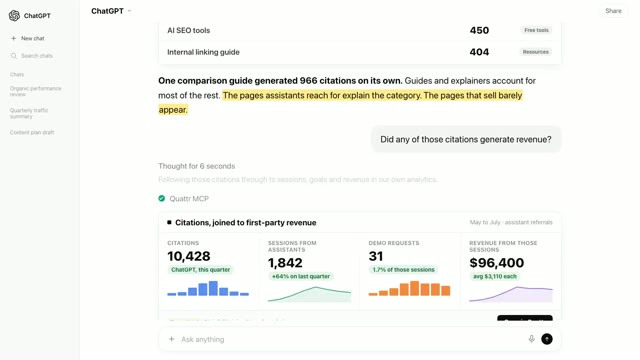
Related metrics and workflows
Verification
A definition is the smallest part of this.
The measurement matters because something acts on it. Here is the rest of the showcase, in the order most people find useful.