
Conversions by goal
also called Per-goal conversionsGoal breakdown
Definition
The conversion count for each of your own named goals, labelled with the name you configured rather than a generic goal number.
How it's calculated
Two reads. The first reads your active goal configuration to get the goal identifier and the name you gave it, no date filter, because it is configuration rather than data. The second reads one summed goal measure per active goal over the date range. The two are merged in a pure function that pairs each configured goal with its count, in goal order, capped at ten or at the caller's row cap if that is lower.
Scope, grain and dimensions
- Grain
- One count per named goal per date range and medium.
- Dimensions
- source_medium
- Required filters
- date_range
- Aggregation
- Each goal sums independently across rows. The goals are NEVER summed with each other.
- Metric type
- raw measure · conversions per named goal
Data sources
Where you'll see this
Named reports that normally include this metric.
Content performance reportPaid search performance reportSearch to revenue report
Skills and analyses that use it
Skills carry the judgment; the analysis verbs do the reading.
Analysis verbs
conversions_overview
Method rungs and levers
A rung tells you what a movement here can and cannot explain, read the rungs below it first.
Ask Quattr
- "How many sign-ups versus purchases?" Simulate this →
- "Conversions by goal this month?" Simulate this →
How to read it
The breakdown that makes a conversion number mean something, because it names what converted. Configured goals overlap, so they are never summed, the assistant asks which goal rather than reporting a total that double-counts. Goal names are reported exactly as configured, never paraphrased.
Caveats, freshness and failure modes
Configured goals overlap, so they are never summed. A single visit can satisfy several goals at once.
Capped at ten goals, in goal order, a property with more configured goals will not show them all.
Only goals marked active in the configuration are read, so a goal retired mid-period disappears from the labels while its historic counts remain in the overall total.
The goal name comes from your configuration; a goal left unnamed falls back to its identifier.
Whole-domain only; the tool's default scope is All traffic sources with the search type pinned to web, not organic.
- Freshness
- loads nightly, a same-day question gets yesterday's number, labelled as yesterday's.
Common failure modes
- Adding the per-goal counts and presenting the sum as total conversions.
- Renaming or grouping goals in the output, the names are the customer's own.
Not the same as
The confusions that cause the most wrong decisions.
Conversions by goal Conversions Compare definitions →
The overall count is a separate measure over its own column, not the sum of the per-goal counts. Because goals overlap, the per-goal figures will typically add to more than the overall count.
Watch this metric read in a real run
All runs →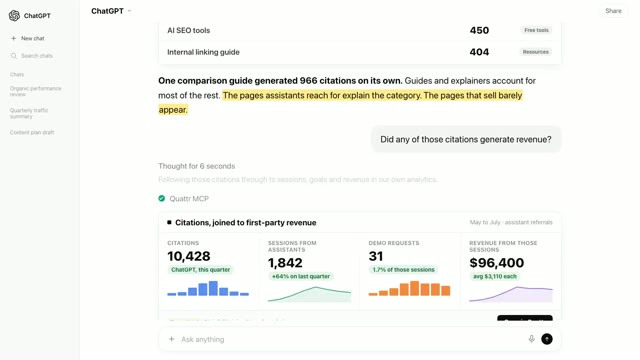 1 min 55 secChatGPT cites us. Does any of it become revenue?AI visibility + Web analytics · Search to revenue◐Recreated from an anonymized session
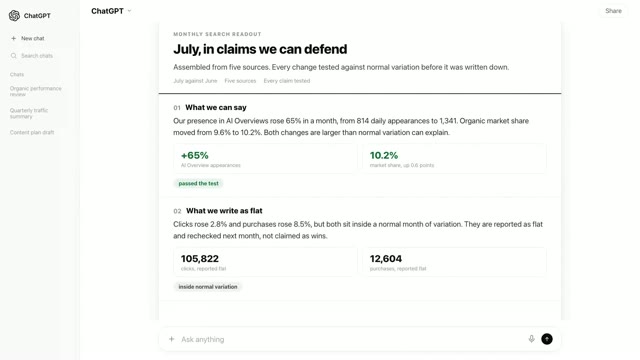 2 min 18 secThe deck is due tomorrow. The numbers live in five places.Search Console + Rank tracking + AI visibility + Web analytics + Google Ads · Monthly exec review◐Recreated from an anonymized session
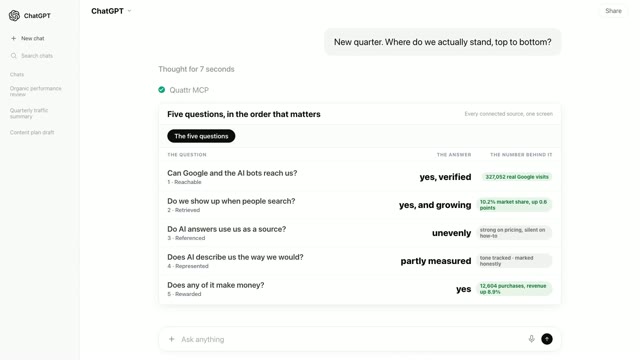 2 min 20 secWhere do we stand? Five questions answer it, in order.Search Console + Rank tracking + AI visibility · Monthly exec review◐Recreated from an anonymized session
Related metrics and workflows
Verification
A definition is the smallest part of this.
The measurement matters because something acts on it. Here is the rest of the showcase, in the order most people find useful.