
Weakest vital
also called Worst vital per page
Definition
For each of the slowest-rendering pages, which of the three Core Web Vitals is graded worst.
How it's calculated
Among rendering time, layout shift and responsiveness, each vital with a numeric value on the page is graded and the worst grade wins, with ties resolved by the order the vitals are checked. Deliberately chosen by GRADE severity, not by the smallest number, because the three vitals sit on scales orders of magnitude apart and a raw minimum would always pick layout shift.
Scope, grain and dimensions
- Grain
- One vital name per listed page.
- Dimensions
- page
- Required filters
- date_range
- Aggregation
- Computed per page, on the up-to-ten SLOWEST-RENDERING pages. The page rows are read sorted by descending rendering time, rows with no rendering time are dropped before the ranking, and the top ten of what remains are kept.
- Metric type
- derived metric · the name of one vital, or none when no vital has a value
Data sources
Where you'll see this
Named reports that normally include this metric.
Skills and analyses that use it
Skills carry the judgment; the analysis verbs do the reading.
Analysis verbs
site_health_cwv_check
Method rungs and levers
This sits on the bottom rung: if it reads badly, every measurement above it is unreliable.
levers L1 Technical & crawl health
Ask Quattr
- "What is the biggest page-experience problem on this page?" Simulate this →
- "Where should engineering start?" Simulate this →
How to read it
The routing hint on a fix list: it names which vital to open first on a given page. It answers what is worst, not how bad, pair it with that vital's own value and grade before scoping any work. And because the list of pages was chosen on rendering time, it is a fix list for slow pages, not a survey of where the site's page-experience problems are.
Caveats, freshness and failure modes
The selection and the verdict use different vitals. Which PAGES are considered is decided by rendering time alone, the slowest ten, while which VITAL is named on each of them is decided by grade severity across all three. A page whose only failing vital is layout shift or responsiveness will not appear at all unless its rendering time is also among the worst.
The performance score is excluded from the candidates; only the three Core Web Vitals are considered. It does not decide the page ranking either, despite being the score the page-experience verdict is built from.
A page with no rendering time is dropped before the ranking, so absence from the list is not evidence of health.
Ties are broken by check order rather than by magnitude, so two vitals in the same band will always resolve the same way.
It reports severity band, not distance from the threshold: a page barely over the line and one far past it both read the same.
With results split by device the entries are page-by-device observations, so an entry names the worst vital for one device's measurement of that page, not for the page overall.
- Freshness
- varies by site, priority URLs can run nightly; most pages far less often. The collection date rides on the card rather than being assumed.
Common failure modes
- Describing the list as the worst-scoring pages, it is the slowest-rendering pages.
- Reading the named vital as the largest opportunity rather than the worst band.
- Assuming a page absent from the list is healthy when it may simply have no rendering measurement.
Not the same as
The confusions that cause the most wrong decisions.
Weakest vital Vital grade Compare definitions →
The grade tells you which band a named vital is in; the weakest vital tells you which vital is in the worst band on a page. One is a value, the other is a selection.
Watch this metric read in a real run
All runs →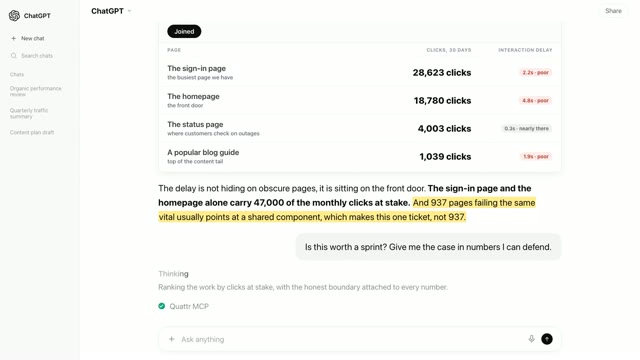
Related metrics and workflows
Verification
A definition is the smallest part of this.
The measurement matters because something acts on it. Here is the rest of the showcase, in the order most people find useful.