
Core Web Vitals report
also called Page speed reportCWV reportSite performance reportLighthouse report
The performance index at site and template level: the three Core Web Vitals with their pass rates, the supporting Lighthouse scores, and the trend across measurement runs. It exists to replace the forwarded single-page screenshot with a distribution, one slow page is not a site problem, and a failing vital on a high-traffic template is. Measurement cadence varies by property, which the report states rather than smooths over.
Who it is for, and what it settles
- Audience
- Engineering
- Job to be done
- Identify which vital is failing, on which templates, and whether it moved enough to warrant engineering time.
- Cadence
- Monthly
The metrics, in three tiers
Headline numbers carry the story. Diagnostics explain a headline that moved. Guardrails stop a wrong conclusion. Every row links to the definition, the formula, the caveats and what the metric is not all live on the metric page.
Headline What you lead with 4
Diagnostic Reached for when a headline moves 4
Required data sources
- Lighthouse and Core Web Vitals (CWV) Source page →
- Site crawl Source page →
- Google Search Console Source page →
- Server logs Source page →
Skills that produce or interpret it
Method rungs covered
- R1 Reachable , covered
- R2 Retrieved , not covered
- R3 Referenced , not covered
- R4 Represented , not covered
- R5 Rewarded , not covered
It covers the bottom rung, so this report can tell you whether the numbers above it are sound in the first place.
Ask for it in one sentence
The prompt pack for this report, copy one, or watch it play in the simulator.
- "Are our Core Web Vitals passing?" Simulate this → Prompt gallery →
- "Which vital is failing and on which pages?" Simulate this → Prompt gallery →
- "Did page speed regress after the release?" Simulate this → Prompt gallery →
- "Which templates are slowest?" Simulate this → Prompt gallery →
What to say out loud when you present it
Vitals collection is typically biweekly and the interval differs by property, some priority URLs are measured nightly and the rest much less often, so a 'change' can be two measurements weeks apart. These are lab-style measurements on a sampled URL set, not field data from your users. The vitals are lower-is-better while the Lighthouse scores are higher-is-better, and the non-vital Lighthouse scores are on a scale that is still under review; present those as directional only.
Watch a run that builds this report
All runs →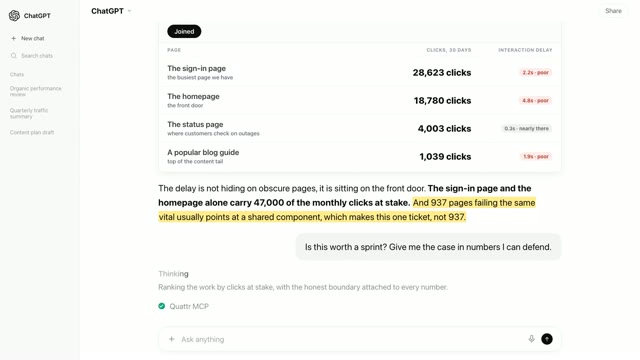
How this entry was verified
Knowing the contents is step one.
Someone still has to assemble it, defend the numbers and present it. Here is the rest of the showcase.