
Crawler response time
also called Crawler TTFBAverage time taken
Definition
How long your server took on average to answer a crawler's request.
Scope, grain and dimensions
- Grain
- One average per bot per date range.
- Dimensions
- bot_type
- Required filters
- date_range
- Aggregation
- An average of the per-request time-taken field across the matching log records, grouped by bot.
- Metric type
- raw measure · not established
Data sources
Where you'll see this
Named reports that normally include this metric.
AI bot activity reportCore Web Vitals reportCrawl log reportTechnical SEO audit report
Skills and analyses that use it
Skills carry the judgment; the analysis verbs do the reading.
Analysis verbs
ttfb_crawl_impact
Method rungs and levers
This sits on the bottom rung: if it reads badly, every measurement above it is unreliable.
levers L1 Technical & crawl health
Ask Quattr
- "How fast do we respond to Googlebot?" Simulate this →
- "Are crawlers being slowed down?" Simulate this →
Caveats, freshness and failure modes
Unit and direction are not established for this metric.
The tool labels it explicitly: this is per-request server-hit latency, not a per-crawl-session measure, and the label rides on every response.
Available on the internal tool surface only today.
It is an unweighted average across requests, so a burst of fast static asset fetches will pull it down.
Same origin-only caveat as all log reads.
- Freshness
- hours to nightly, depends on how logs are shipped; the card carries the ingestion time.
Common failure modes
- Reading it as time to first byte for a page load as a visitor would experience it.
- Rendering it with a unit taken from a name-based formatter, which will not agree with the field name.
- Painting a rise as an improvement because the direction oracles default it to higher-is-better.
Not the same as
The confusions that cause the most wrong decisions.
Crawler response time Largest Contentful Paint Compare definitions →
Server response latency to a crawler is not page-render speed for a visitor. They are different measurements from different sources and neither predicts the other.
Watch this metric read in a real run
All runs →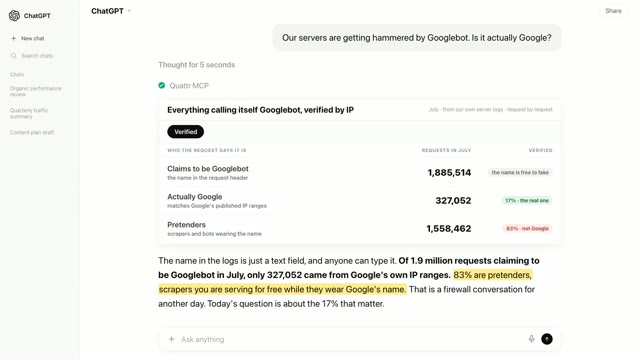
Related metrics and workflows
Metrics
Verification
A definition is the smallest part of this.
The measurement matters because something acts on it. Here is the rest of the showcase, in the order most people find useful.