
Bot hits
also called Crawl hitsBot requestsCrawl volume
Definition
The number of requests a named crawler made to your origin in the period, counted from server logs.
How it's calculated
A row count over the server-log records matching the bot filter and date range. In the semantic layer it is a plain count measure over the log table.
Scope, grain and dimensions
- Grain
- One count per bot per date range, or one count per bot per day, week or month when a granularity is requested.
- Dimensions
- bot_type · date
- Required filters
- date_range
- Aggregation
- Sums across rows. One page fetched twice contributes two.
- Metric type
- raw measure · log requests
Data sources
Where you'll see this
Named reports that normally include this metric.
AI bot activity reportCrawl log reportInternal linking reportTechnical SEO audit report
Skills and analyses that use it
Skills carry the judgment; the analysis verbs do the reading.
Analysis verbs
ai_crawler_analysis
Method rungs and levers
This sits on the bottom rung: if it reads badly, every measurement above it is unreliable.
levers L1 Technical & crawl health
Ask Quattr
- "Are AI crawlers reaching our content?" Simulate this →
- "Which bots crawl us most?" Simulate this →
- "Has GPTBot activity changed?" Simulate this →
How to read it
Evidence of what your origin actually served, which no other source can supply, everything else infers crawling. It counts requests, not pages and not coverage, so a rising number can mean broader reach or the same handful of pages fetched more often.
Caveats, freshness and failure modes
Requests, not pages. Read it beside the unique-pages figure before calling it coverage.
The answer-engine bot list is a hardcoded user-agent token set covering GPTBot, ChatGPT-User, PerplexityBot, ClaudeBot, Claude-Web, Google-Extended, CCBot and Bytespider. It is documented in code as drifting on a timescale of months, so a bot that renamed or launched since will be missing.
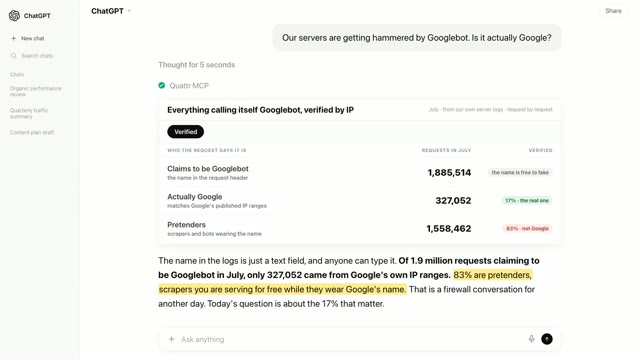
Matching is on the declared user agent. Only Googlebot has an IP verification path; there is no address verification for any AI bot, so an AI-bot count includes anything that claimed the name.
Logs record what your origin served, so a request answered by a CDN edge may never appear. Absence of a bot is evidence your logs do not have it, which is a weaker claim than it never came.
Crawl activity is not visibility: fetch counts are never presented as citations.
The tool checks the log feed is populated before reading and returns a plain note when it is not, rather than an empty result.
- Freshness
- hours to nightly, depends on how logs are shipped; the card carries the ingestion time.
Common failure modes
- Presenting fetch counts as AI visibility or as citations.
- Concluding a bot is blocked because it is absent from the logs.
- Reading a hit count as pages reached.
Not the same as
The confusions that cause the most wrong decisions.
Bot hits Crawler readiness Compare definitions →
Observed visits are what was fetched. Readiness is whether the pages you want cited are reachable, indexable and linked, a composition that is not implemented; no tool crosses log hits with indexability and orphan status.
Bot hits Unique pages crawled Compare definitions →
Hits count requests; unique pages count distinct URLs. A large hit count over a small page set is a crawl-budget finding, not a coverage one.
Bot hits Verified versus spoofed Googlebot Compare definitions →
Hit counts are matched on the declared user agent alone. Only the verification split establishes whether a requester was who it claimed to be, and it does so for Googlebot only.
Bot hits Crawl depth Compare definitions →
Depth is what the crawl graph says is reachable; hits are what a bot actually fetched. Conflating the two is how a team concludes a page is fine because it could in principle be crawled.
Watch this metric read in a real run
All runs →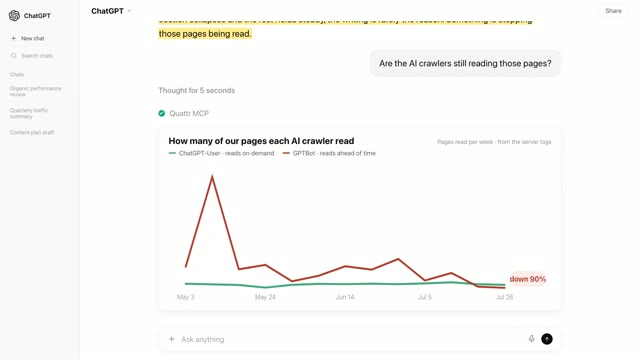
Related metrics and workflows
Verification
A definition is the smallest part of this.
The measurement matters because something acts on it. Here is the rest of the showcase, in the order most people find useful.