
Incoming internal links
also called InlinksInternal links to a pageOrphan test
Definition
How many internal links point at a URL, and, where that count is zero, the test that marks the page an orphan.
Scope, grain and dimensions
- Grain
- One value per crawled URL.
- Dimensions
- url
- Aggregation
- A per-URL attribute from the crawl graph. The orphan list is the same field filtered to exactly zero; the link-distribution list sorts by it, least-linked first by default.
- Metric type
- raw measure · internal links
Data sources
Where you'll see this
Named reports that normally include this metric.
AI bot activity reportCrawl log reportInternal linking reportTechnical SEO audit report
Skills and analyses that use it
Skills carry the judgment; the analysis verbs do the reading.
Analysis verbs
orphan_pagesinternal_link_flow
Method rungs and levers
This sits on the bottom rung: if it reads badly, every measurement above it is unreliable.
Ask Quattr
- "Which pages have no internal links?" Simulate this →
- "Which important pages are under-linked?" Simulate this →
How to read it
The cheapest lever's measurement. A page with few incoming links and real search value is a linking opportunity; a page with none is an orphan, hard for crawlers and people to reach. Link counts are graph facts as of the last recompute, so they do not move day to day.
Caveats, freshness and failure modes
The count is a passthrough of a crawler-produced column; the crawler's rules for what counts as a link are not readable in the semantic layer.
The orphan test is an exact zero on this field, so a page reachable only through a redirect or a script-driven link may be counted as an orphan or missed, depending on the crawler's rules.
Both lists are capped, so they are the top or bottom of the distribution rather than the whole graph.
A crawl is a snapshot on its own schedule; do not narrate day-level link changes.
An orphan is not automatically a problem, an intentionally unlinked page is a different case from a starved one.
- Freshness
- per crawl schedule, cadence is set per site; the card names the crawl it read.
Common failure modes
- Treating every orphan as a defect worth fixing.
- Reading the capped list as the complete orphan set.
- Reporting a link-count change between two crawls run at different cadences as a trend.
Not the same as
The confusions that cause the most wrong decisions.
Incoming internal links Outgoing internal links Compare definitions →
One counts links arriving at a page, the other counts links leaving it. Both come from the crawl graph and they move for entirely different reasons.
Incoming internal links Crawler readiness Compare definitions →
Orphan status is one input to readiness, not readiness itself. No tool crosses it with log hits and indexability, so the composed judgment does not exist.
Watch this metric read in a real run
All runs →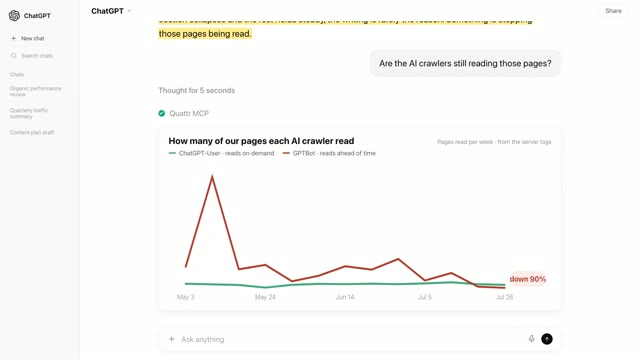 2 min 8 secYou cannot be cited by an AI that never read your page.Server logs + AI visibility · AI crawler readiness◐Recreated from an anonymized session
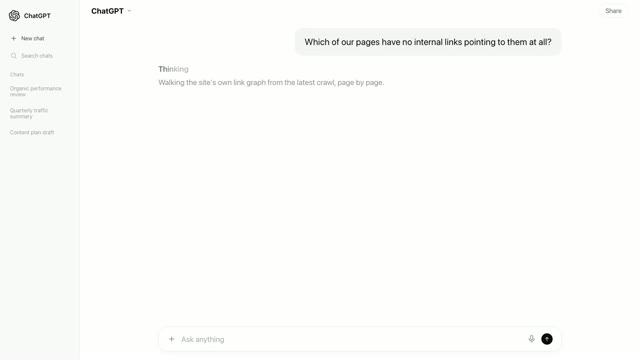 2 min 15 secSome of your best pages cannot be reached from your own site.Site crawl + Search Console · Linking opportunity review◐Recreated from an anonymized session
Related metrics and workflows
Verification
A definition is the smallest part of this.
The measurement matters because something acts on it. Here is the rest of the showcase, in the order most people find useful.